Key Takeaways:
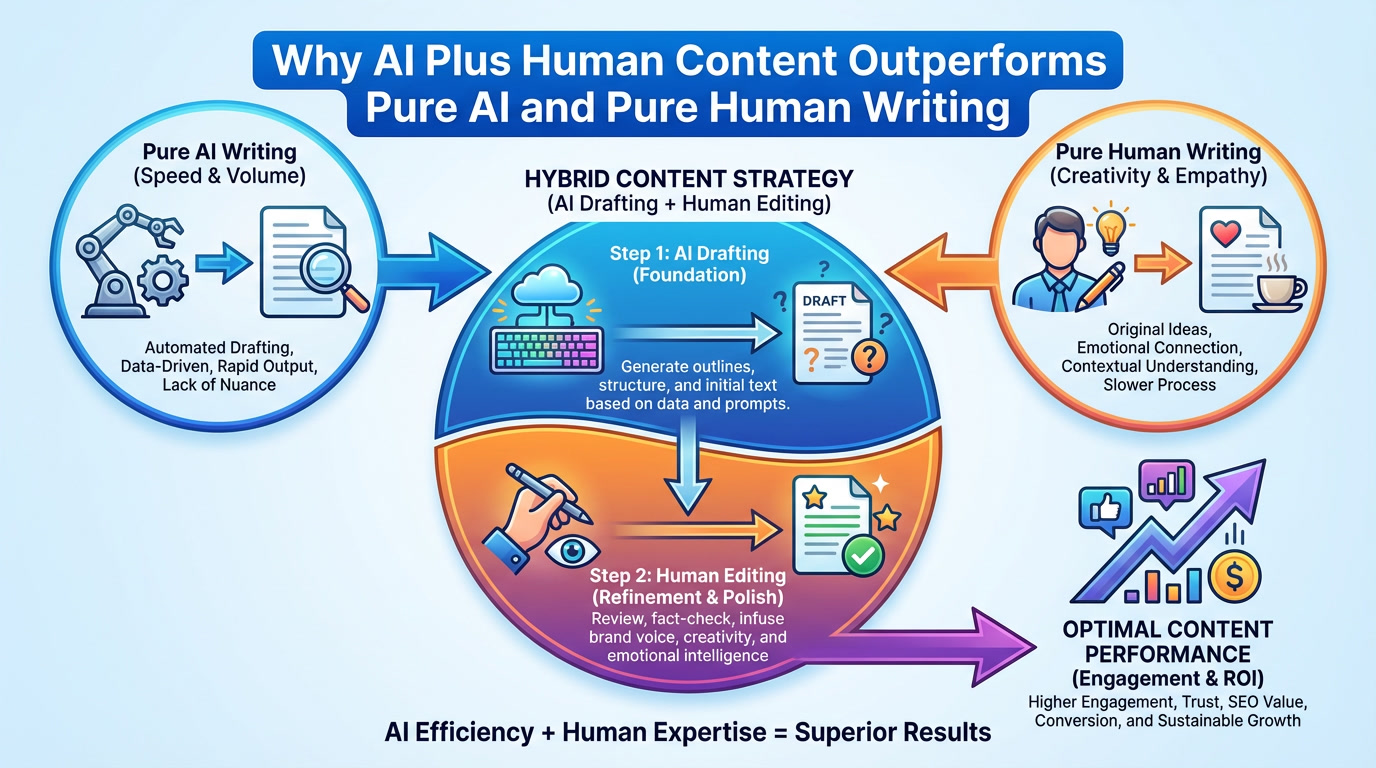
Hybrid content (AI drafting + human editing) outperforms both pure AI and pure human approaches
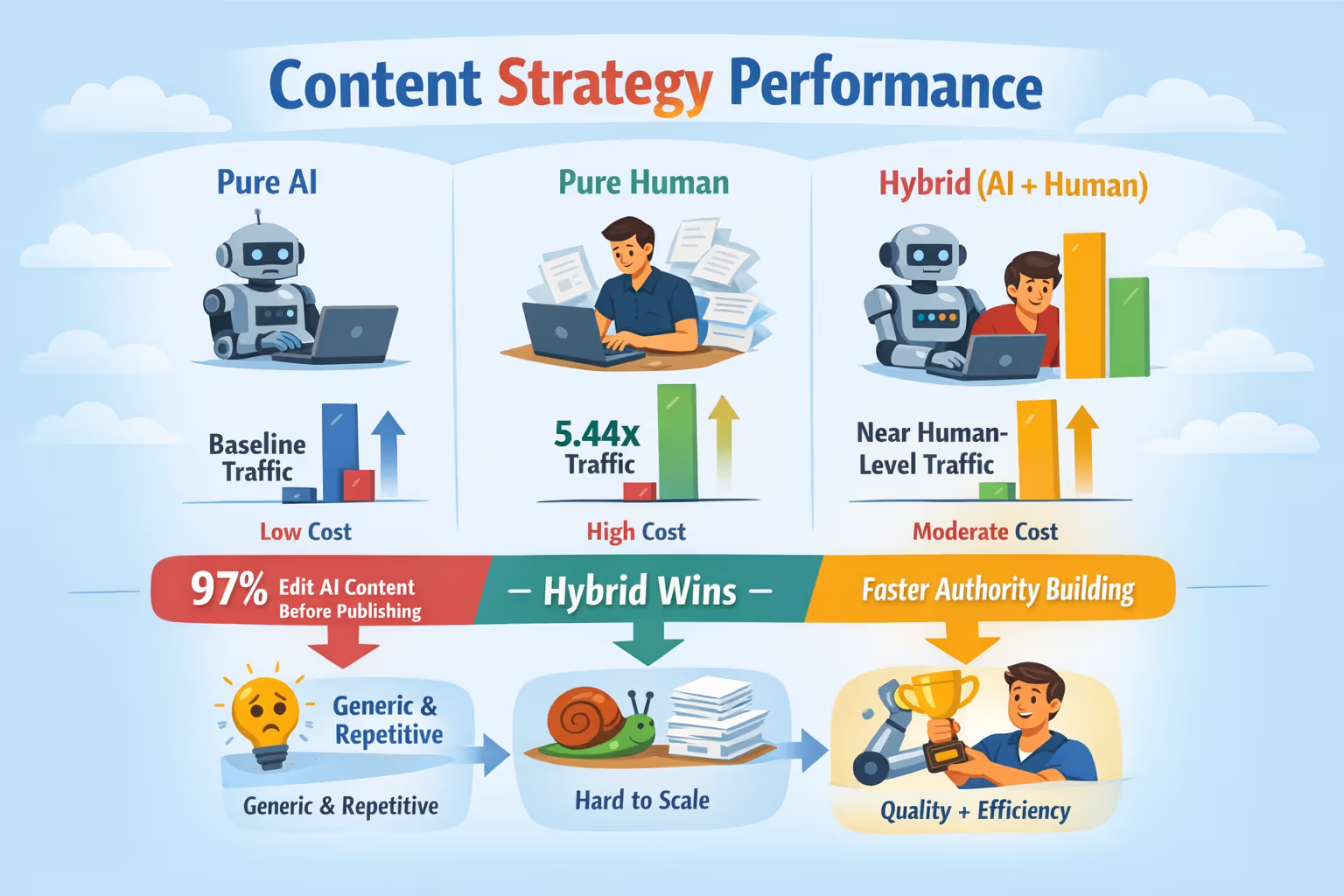
Human-written content generates roughly 5.44x more organic traffic than pure AI content—but hybrid captures most of that advantage at scale
97% of marketers edit AI output before publishing, signaling the industry has already moved toward hybrid workflows
The quality assurance layer—not the AI draft—is where competitive advantage gets built
Consistent hybrid publishing compounds authority faster than sporadic pure-human pieces
The debate is exhausting. One camp insists AI writing will replace human creators. The other swears only human-crafted content delivers real results.
Both are missing the point.
Hybrid content combines AI drafting with human editing and oversight. This approach isn't a compromise. It's a competitive advantage that delivers measurably better results than either pure AI or pure human writing alone.
The False Binary That's Costing You Traffic
Most conversations about AI plus human content get stuck in an unproductive loop. Marketers argue about authenticity versus efficiency, as if you can only choose one. Meanwhile, teams publishing hybrid content are quietly capturing traffic that purists on both sides keep losing.
The problem with pure AI content is obvious to anyone who's read enough of it. Search engines have become remarkably good at identifying thin, repetitive material that lacks genuine insight [1]. Content generated without human oversight tends to miss nuance, misread intent, and produce the kind of generic filler that readers scroll past.
Pure human content has its own challenges. It's expensive, slow, and difficult to scale. A single well-researched article might take eight to twelve hours to produce. That pace simply cannot compete in industries where topical coverage matters.
The hybrid approach solves both problems simultaneously.
What the Performance Data Actually Shows
Recent analysis of content performance reveals striking differences between approaches.
Content created by humans alone generates significantly more organic traffic than pure AI content—roughly 5.44 times more traffic on average [2]. That gap is substantial enough to explain why many SEO professionals remain skeptical of AI-generated material.
But here's where the data gets interesting.
Why the 5.44x Gap Exists
The traffic difference isn't arbitrary. It reflects how search engines evaluate content quality through E-E-A-T signals—Experience, Expertise, Authoritativeness, and Trustworthiness [5]. Pure AI content struggles to demonstrate these qualities because it cannot draw from genuine professional experience, conduct original research, or develop authentic perspectives.
Human writers naturally embed E-E-A-T signals through specific examples, nuanced opinions, and insights that only come from actually doing the work. When human editors refine AI drafts, they add these signals—transforming generic text into content that search engines recognize as genuinely valuable.
Approximately 97% of marketers who use AI writing tools edit the output before publishing [3]. They're not treating AI as a replacement for human judgment. They're using it as a starting point that human expertise then refines.
The teams seeing the strongest results aren't choosing between AI efficiency and human quality. They're combining both.
Why Pure AI Content Underperforms
AI content tools have improved dramatically. They can produce grammatically correct, reasonably coherent text on virtually any topic. But several consistent limitations explain why pure AI output struggles to compete.
Lack of Original Insight
AI models synthesize existing information. They cannot conduct interviews, run experiments, or share genuine professional experience. Content that lacks original insight tends to echo what already exists—which search engines have little reason to prioritize.
Misaligned Search Intent
AI tools often misread what searchers actually want. They might produce informational content when users want product comparisons, or vice versa. Human editors catch these misalignments because they understand audience needs beyond keyword matching.
Factual Reliability Concerns
AI systems occasionally generate plausible-sounding claims that turn out to be inaccurate. Search engines increasingly penalize sites that publish unverified information [4]. Human fact-checking remains essential for maintaining credibility.
Repetitive Patterns
Pure AI content often follows predictable structures and uses similar phrasing across articles. Readers notice this repetition even when they can't articulate what feels off. Human editing introduces variety and genuine voice.
Why Pure Human Content Falls Behind
Human-only content production isn't without merit. The quality ceiling is higher, and exceptional writers create material that AI cannot replicate. But pure human workflows face constraints that limit their effectiveness at scale.
Speed and Volume Limitations
Building topical authority requires consistent publishing across related subjects. A human writer producing two to three high-quality articles per week is working at capacity. That pace leaves gaps competitors can exploit.
Cost Structures That Don't Scale
Professional writers charge appropriately for their expertise. When content needs span dozens of topics monthly, costs escalate quickly. Many businesses abandon consistent publishing because the budget math doesn't work.
Inconsistent Output
Even talented writers have off days. Maintaining consistent quality across high volumes proves difficult without systematic processes. AI-assisted workflows help standardize baseline quality while human editors elevate the final product.
The Hybrid Model: How It Actually Works
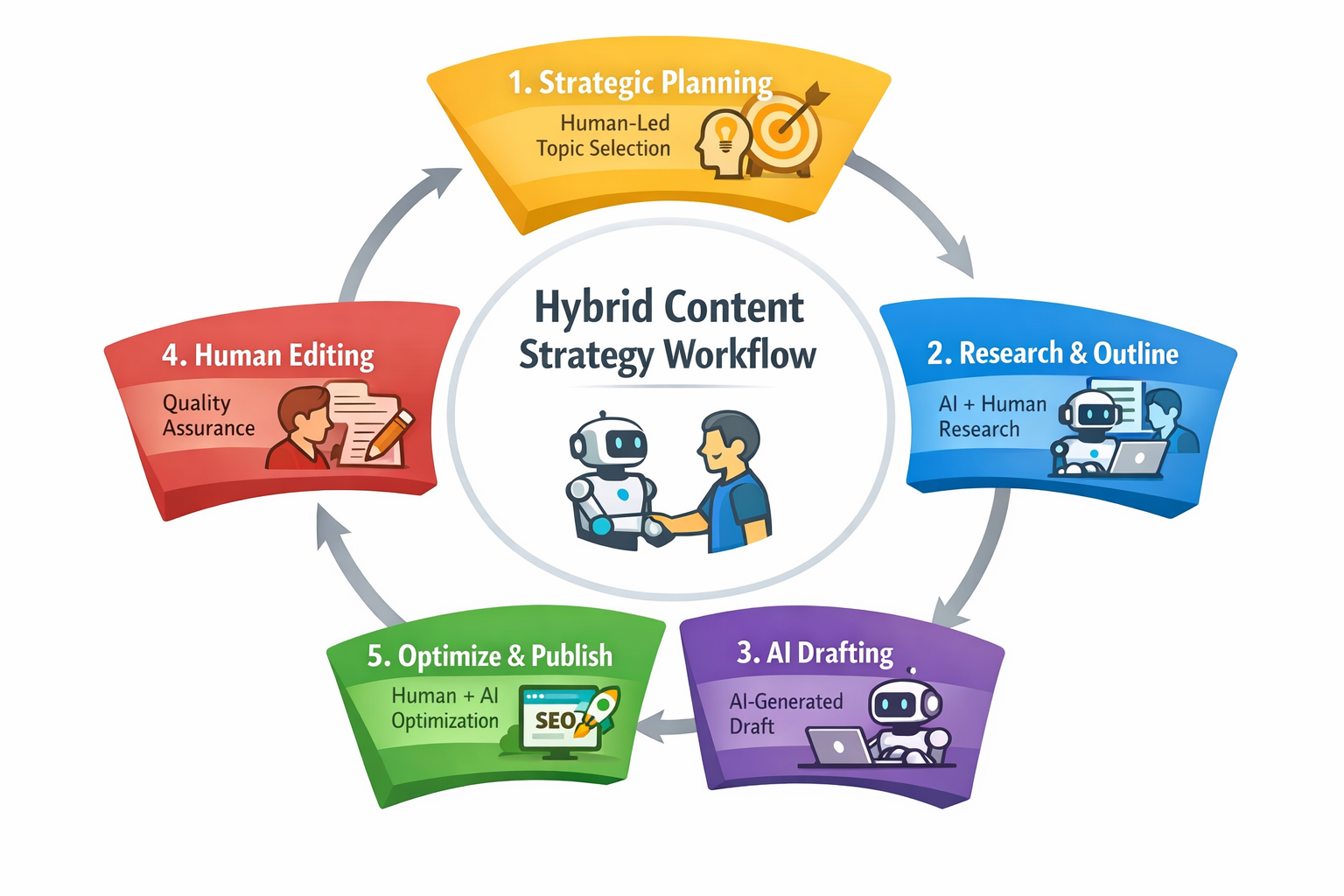
Effective hybrid content production follows a specific editorial workflow. Each stage has a clear purpose.
Stage 1: Strategic Planning (Human-Led)
Humans identify topics worth covering, analyze search intent, and determine what angle will resonate with target audiences. AI cannot reliably make these strategic decisions because they require understanding business context and audience needs.
Stage 2: Research and Outlining (Human + AI)
AI tools help gather relevant information and suggest structural approaches. Human editors evaluate sources, verify claims, and shape outlines based on what the content needs to accomplish.
This stage should include analyzing competitor gaps—identifying what existing content misses and where your piece can provide superior value. Human judgment determines which angles are worth pursuing and which have already been covered adequately.
Stage 3: Draft Generation (AI-Led)
AI produces initial drafts efficiently. This stage leverages AI's strength—generating coherent text quickly—while reserving human time for higher-value activities.
Stage 4: Content Quality Assurance (Human-Led)
This stage matters most. Human editors refine voice, verify accuracy, improve clarity, and ensure content aligns with search intent. They add original insights AI cannot generate and remove generic filler AI tends to include.
Stage 5: Optimization and Publishing (Human + AI)
Technical SEO elements get applied systematically. AI assists with consistency; humans make judgment calls about internal linking, meta descriptions, and structural formatting.
The Quality Assurance Layer: Before and After
Human oversight transforms AI output from acceptable to effective. The editing process isn't cosmetic—it's where competitive advantage gets built.
To illustrate what this actually looks like, here's a real example of the transformation:
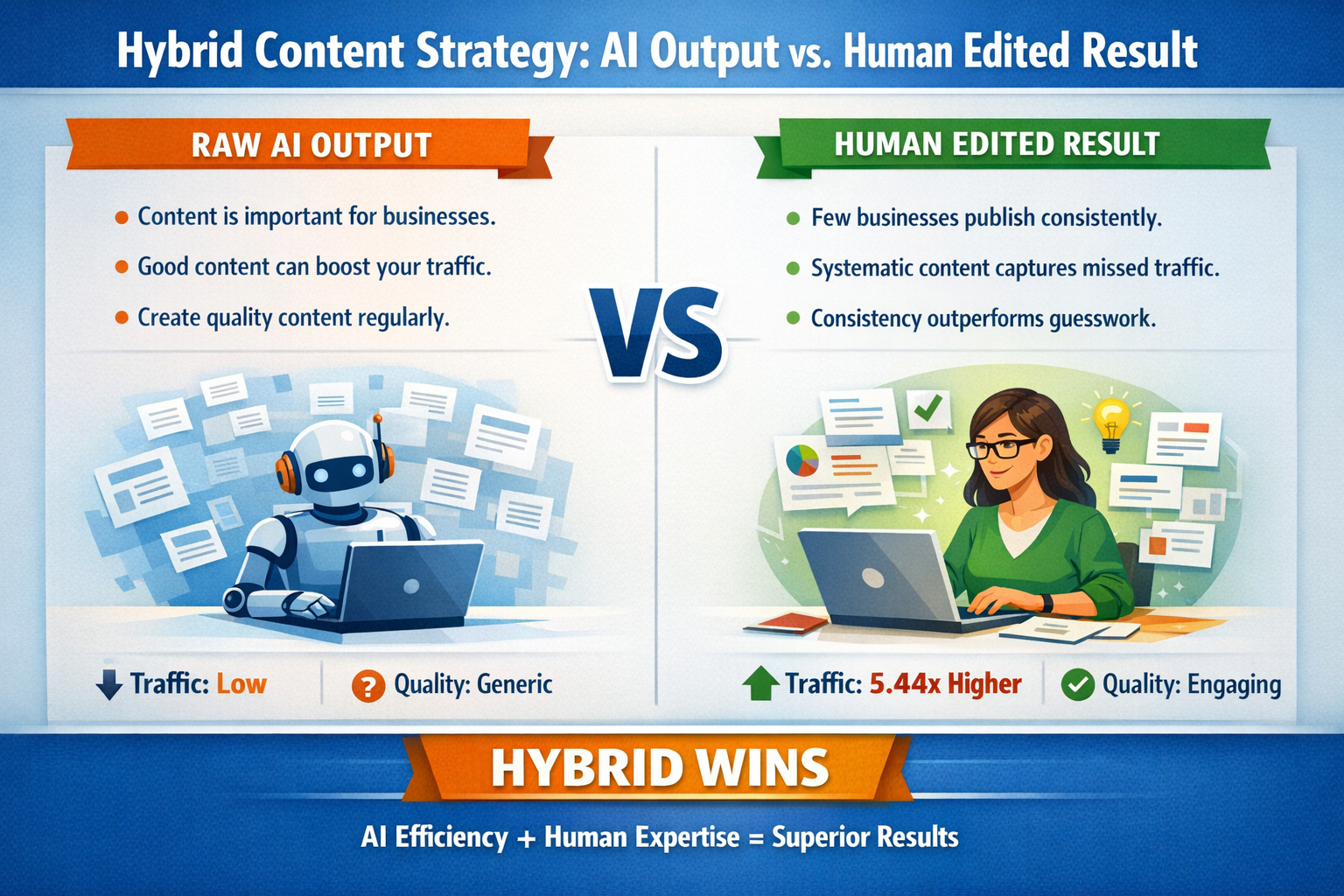
Raw AI Output:"Content marketing is important for businesses today. Many companies use content to attract customers. Good content can help you rank higher in search engines and get more traffic to your website. It's essential to create quality content regularly."
After Human Editing:"Most businesses know they need content. Few publish consistently enough to see results. The gap between knowing and doing explains why companies with systematic content operations capture traffic their competitors leave on the table—even when those competitors have better products."
The difference isn't just style. The edited version makes a specific claim, introduces tension, and positions a perspective. It demonstrates expertise through a nuanced observation rather than stating obvious facts. This transformation happens dozens of times throughout a single article during quality assurance.
What Human Editing Actually Addresses
Accuracy verification. Every factual claim gets checked against reliable sources. Questionable assertions get removed or rewritten with appropriate qualification.
Voice alignment. Generic AI phrasing gets replaced with language that matches brand voice. Sentences get restructured for natural rhythm and appropriate tone.
Intent matching. Editors evaluate whether content actually answers the question searchers are asking. Misaligned sections get revised or replaced.
Insight addition. Human editors add perspective, examples, and nuance that AI cannot generate. This original material differentiates content from everything else ranking for the same terms.
Structure refinement. Headers get clarified. Paragraphs get tightened. The reading experience improves through dozens of small decisions AI cannot reliably make.
Measuring Hybrid Content Performance
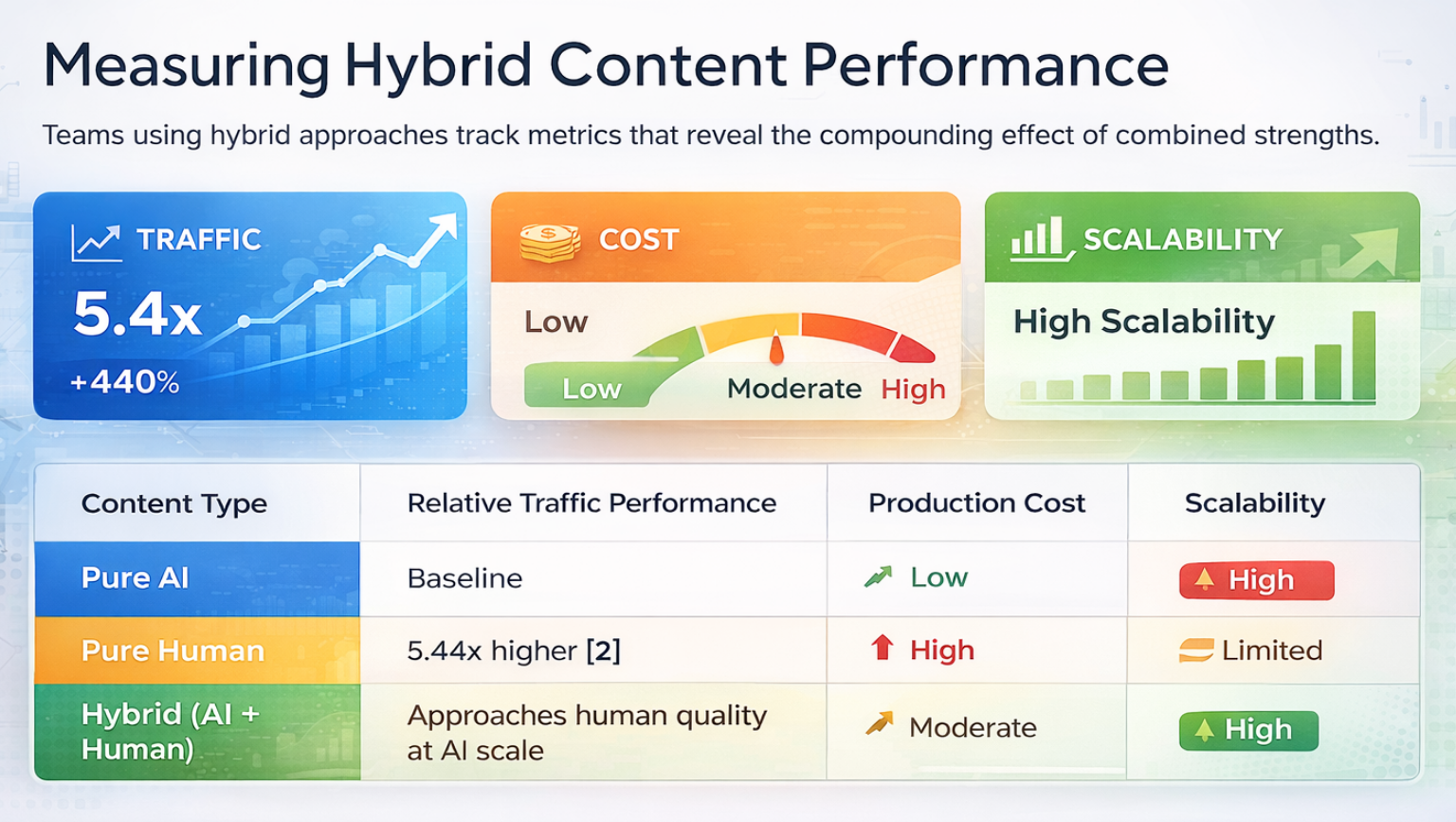
Teams using hybrid approaches track metrics that reveal the compounding effect of combined strengths.
| Content Type | Relative Traffic Performance | Production Cost | Scalability |
| Pure AI | Baseline | Low | High |
| Pure Human | 5.44x higher [2] | High | Limited |
| Hybrid (AI + Human) | Approaches human quality at AI scale | Moderate | High |
The hybrid model captures most of pure human content's quality advantages while maintaining AI's efficiency benefits. Over time, this combination produces more total traffic than either extreme because it enables consistent publishing without sacrificing quality.
Common Mistakes in Hybrid Implementation
Not all hybrid approaches succeed. Several patterns explain why some teams fail to see expected results.
Insufficient Editing
Treating human editing as a light proofreading pass misses the point. Effective AI content editing involves substantial revision—often rewriting sections entirely. Teams that minimize editing time see minimal improvement over pure AI output.
Wrong Content Types
Some content categories benefit more from hybrid approaches than others. Highly technical material, opinion pieces, and content requiring original research still need significant human involvement from the start. Hybrid workflows work best for informational and commercial content where AI can handle baseline research.
Ignoring Search Intent
AI tools don't reliably assess whether content matches what searchers want. Human editors must evaluate intent alignment for every piece. Skipping this check produces content that ranks briefly, then fades.
Inconsistent Quality Standards
Hybrid content requires clear editorial guidelines. Without documented standards, quality varies based on which editor reviews each piece. Systematic processes ensure consistent output.
Building a Sustainable Hybrid Workflow
Effective hybrid content production requires infrastructure beyond individual tools.
Documented processes ensure consistency regardless of who handles each stage. Every team member should understand what "done" looks like at each phase.
Clear accountability assigns specific responsibilities for strategic decisions, factual verification, and final approval. Ambiguity creates gaps where quality issues slip through.
Feedback loops connect content performance to production decisions. Teams should know which types of content perform well and adjust their approach accordingly.
Scalable systems handle increased volume without proportional increases in oversight time. This means templates, checklists, and workflows that standardize routine decisions.
The Compounding Effect of Consistent Quality
Hybrid content's advantage extends beyond individual article performance. Search engines reward sites that demonstrate sustained expertise across topic areas [5].
Publishing two to three high-quality articles weekly builds topical authority faster than sporadic exceptional pieces. The hybrid model makes this consistency achievable for teams that couldn't otherwise maintain that pace.
Over months, this compounding effect produces traffic results neither pure approach can match. Authority builds. Rankings improve. Each new article benefits from the credibility established by previous content.
Ready to Stop Choosing Between Quality and Efficiency?
The AI versus human debate will continue. But teams focused on results have moved past it.
Hybrid content combines what AI does well—fast, consistent draft production—with what humans do better—strategic judgment, original insight, and quality assurance. The combination outperforms both extremes.
If you're ready to implement a hybrid approach without building the infrastructure yourself, explore how The Mighty Quill's blog engine delivers AI efficiency with human editorial oversight—starting with two free articles in 48 hours.
Frequently Asked Questions
Does AI content hurt SEO rankings?
Pure AI content without human editing often underperforms because it lacks originality and may contain accuracy issues. However, AI-assisted content with substantial human oversight and quality assurance performs comparably to human-written material while enabling greater publishing consistency. The key factor isn't how content was generated—it's whether it demonstrates genuine expertise and provides real value to readers.
How much editing does AI content actually need?
Effective AI content editing goes beyond proofreading. Most high-performing hybrid workflows involve substantial revision—restructuring sections, adding original insights, verifying claims, and aligning content with search intent. Plan for editing time roughly equal to the time AI takes to generate drafts. Light proofreading produces minimal improvement over pure AI output.
Can Google detect AI-generated content?
Search engines focus on content quality rather than detecting generation methods specifically. Google's guidelines emphasize helpfulness, accuracy, and user value regardless of how content was produced [1]. Well-edited hybrid content that provides genuine value ranks effectively because it meets the quality standards search engines reward.
What content types work best with hybrid approaches?
Informational articles, how-to guides, comparison content, and industry overviews benefit most from hybrid production. Content requiring extensive original research, personal narratives, or highly technical expertise typically needs more human involvement from earlier stages. The hybrid model excels where AI can handle baseline research and structure while humans add expertise and insight.
How do I maintain consistent quality with hybrid content?
Documented editorial standards, clear quality checklists, and systematic review processes ensure consistency. Every piece should go through the same evaluation criteria regardless of which editor handles the final review. Feedback loops connecting performance data to production decisions help refine standards over time. Teams that skip documentation see quality vary unpredictably.
About Our Expertise
The Mighty Quill specializes in hybrid content production for growth-focused businesses. Our team combines AI drafting efficiency with experienced human editorial oversight, producing SEO-optimized content that earns organic traffic. With over fifteen years of digital marketing experience informing our processes, we've developed systematic approaches to content quality assurance that deliver measurable results for SaaS companies, e-commerce businesses, and marketing agencies.
Works Cited
[1] Google Search Central — "Creating helpful, reliable, people-first content." https://developers.google.com/search/docs/fundamentals/creating-helpful-content
[2] Neil Patel — "AI Content vs. Human Content: What Performs Better?" https://neilpatel.com/blog/ai-content-vs-human-content/
[3] HubSpot — "The State of AI in Marketing Report." https://www.hubspot.com/state-of-ai
[4] Search Engine Journal — "Google's Approach to AI-Generated Content." https://www.searchenginejournal.com/google-ai-generated-content/
[5] Moz — "What Is E-E-A-T? Why It Matters for SEO." https://moz.com/learn/seo/google-eat