It's 9 PM. You're still answering client emails about blog posts that were supposed to go live last week.
The freelancer ghosted. The revision you requested came back worse than the original draft. And somewhere in your inbox, there's a Slack message from your biggest account asking why their competitor just published three articles while you're still "finalizing the content calendar."
This is the content bottleneck that kills agency growth. Not a lack of strategy. Not poor client relationships. Just the relentless grind of getting words published on schedule, every single week, across every single account.
White-label SEO blog production can solve this—but only if you choose a partner who understands what actually breaks. And here's what most providers won't tell you: the writing is the easy part.
What separates scalable white-label partnerships from chaotic outsourcing nightmares is everything around the writing—approval workflows, publishing operations, quality governance, and packaging that protects your margins when a client's CEO suddenly decides to "weigh in" on draft seventeen.
This guide breaks down exactly what agencies should look for in a white-label blog production partner, including the deliverables that matter, approval workflows that actually scale, and pricing structures that keep your business healthy.
Why Traditional Outsourcing Fails Agency Content Teams
Agencies have tried the usual paths. Hire freelancers. Contract with content mills. Build an in-house writing team.
Each approach breaks in predictable ways.
The Freelancer Trap
Freelancers require constant management. You become a project manager, chasing drafts at odd hours, explaining brand voice for the hundredth time, and handling the inevitable "sorry, something came up" message the day before deadline.
Research from the Content Marketing Institute shows that 54% of B2B marketers cite "creating content consistently" as their top challenge [1]. Freelancer management doesn't solve this—it makes it worse. You've just traded one problem (no content) for another (managing people who produce content inconsistently).
The Content Mill Disappointment
Content mills deliver volume without substance. The posts technically exist, but they don't rank, don't convert, and eventually embarrass you in front of clients who start asking why their blog reads like it was written by someone who's never heard of their industry.
You get what you pay for. And at commodity rates, you're paying for words, not results.
The In-House Cost Problem
A single content writer costs $50,000–$70,000 annually before benefits, management overhead, and the inevitable turnover [2]. For agencies managing multiple client accounts with different industries, voices, and requirements, the math rarely works. You'd need several writers to cover the range—and suddenly you're running a content department instead of an agency.
The Real Bottleneck Nobody Talks About
Here's what most agencies miss: the writing itself isn't the hardest part to systematize.
The real bottleneck is operational infrastructure—topic research, editorial calendars, approval workflows, revision cycles, and publishing execution. These unglamorous systems determine whether content actually gets produced, approved, and live on schedule.
You can find decent writers. Finding writers and building the ops layer around them? That's where agencies drown.
What White-Label SEO Blog Production Actually Includes
White-label content services vary wildly in scope. Some providers hand you a Google Doc and consider their job done. Others build complete operational systems you can resell with confidence.
Here's what a comprehensive white-label blog production partnership should deliver:
Core Content Deliverables
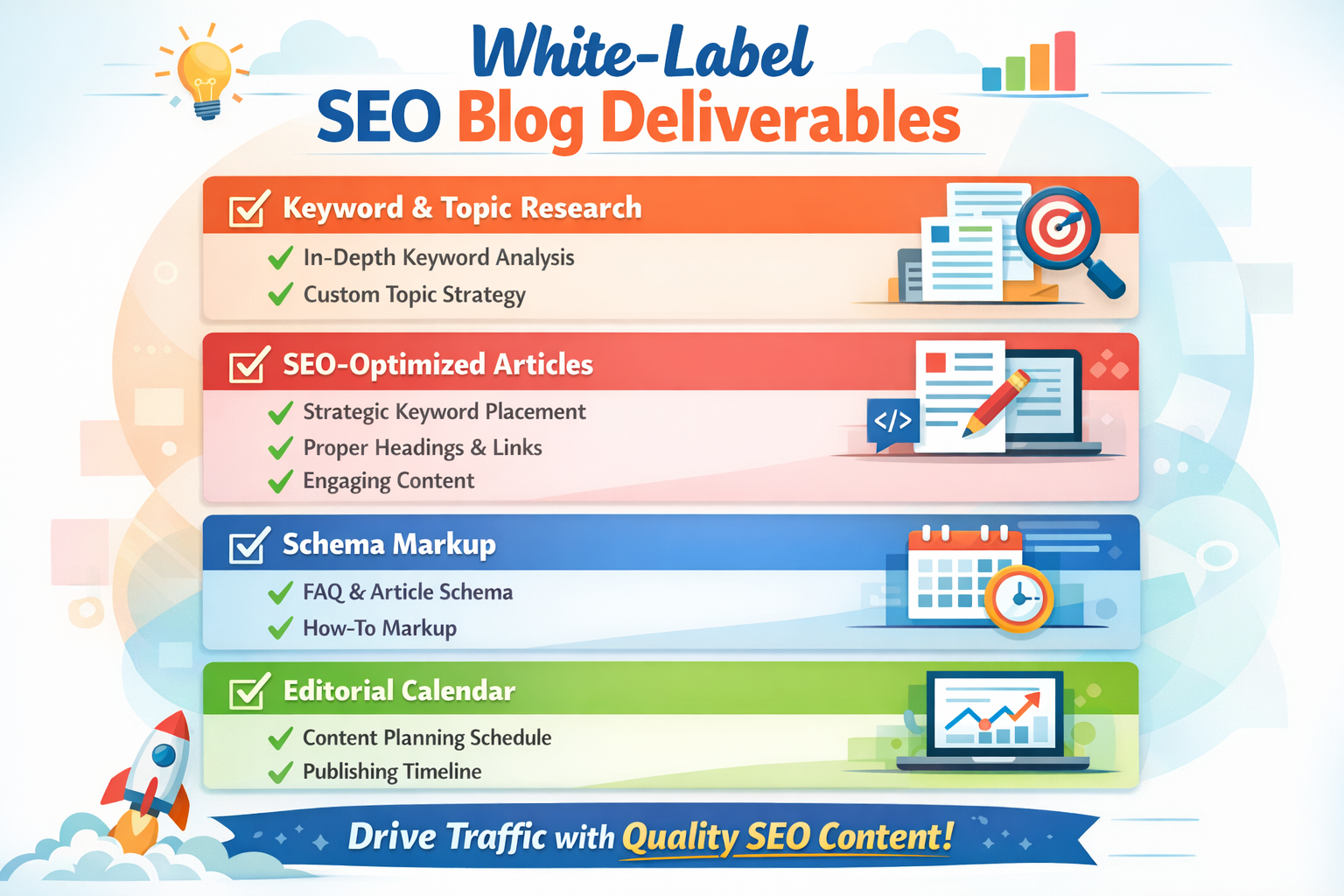
Keyword and Topic Research
Every article should start with validated topic selection. This means analyzing search volume, keyword difficulty, and topical relevance—not just picking keywords from a free tool and hoping they stick.
Your white-label partner should deliver a documented topic bank aligned to each client's business goals and search intent. This isn't a nice-to-have; it's the foundation that determines whether content drives traffic or sits unread.
SEO-Optimized Articles
The actual content matters, obviously. But "SEO-optimized" should mean more than stuffing keywords into every other sentence. Look for:
Strategic keyword placement (title, headers, first 100 words, conclusion)
Semantic variations and related terms integrated naturally
Proper heading hierarchy (H2/H3 structure that makes sense to readers and search engines)
Internal linking recommendations specific to the client's site
Meta title and description drafts ready to paste
Media Suggestions
Quality posts need supporting visuals. Your partner should recommend image types, infographic opportunities, or video embeds that enhance the content—even if your team handles the actual media sourcing.
This small addition signals professionalism to clients and saves your team from having to think through visual strategy for every post.
Schema Markup Recommendations
Structured data helps search engines understand content context. FAQ schema, article schema, and how-to markup can improve click-through rates in search results [3]. A serious white-label partner includes these specifications in deliverables, not as an upsell.
Operational Deliverables (The Part Most Providers Skip)
This is where partnerships succeed or fail. The writing might be excellent, but without operational infrastructure, you're still stuck managing chaos.
Editorial Calendars
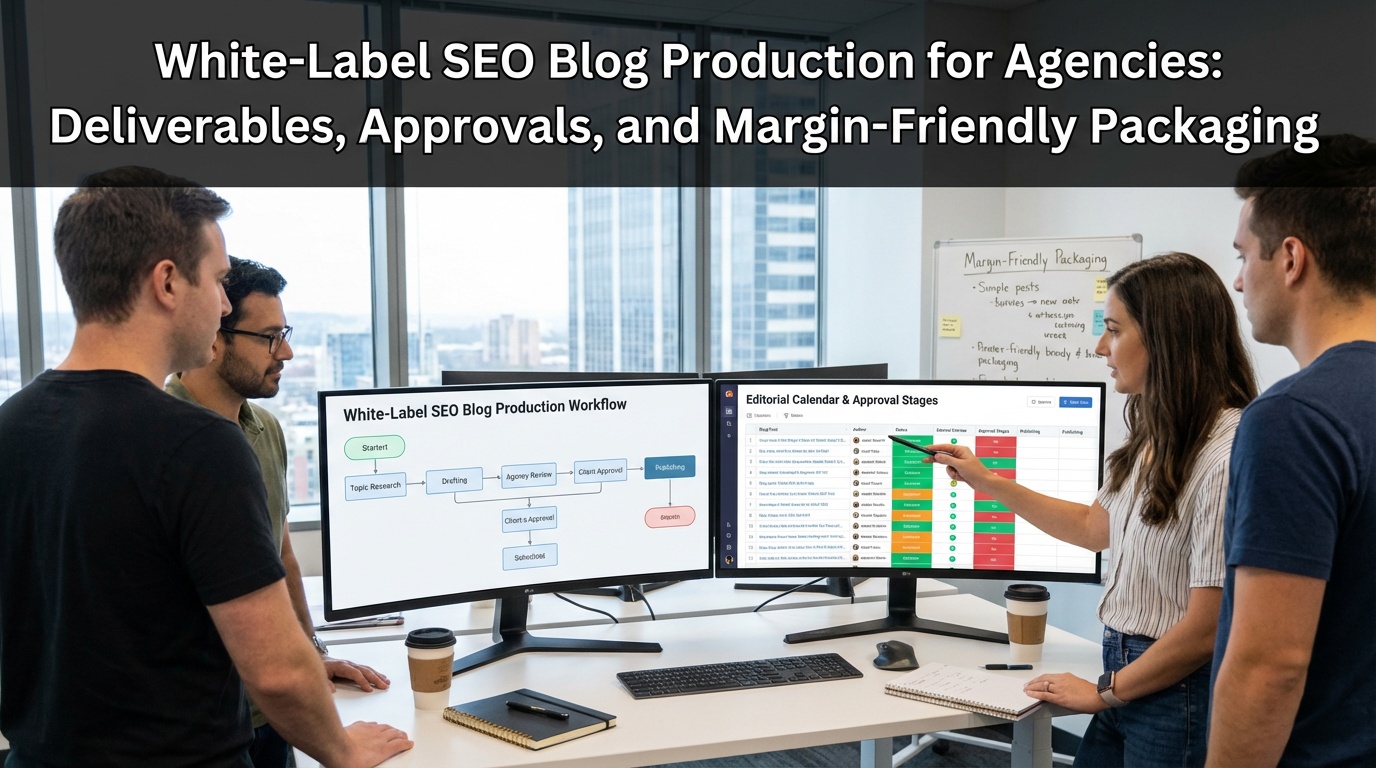
Clients expect predictability. Your white-label partner should maintain rolling editorial calendars showing upcoming topics, target keywords, assigned publish dates, and status updates.
This transforms content from ad-hoc requests into a systematic growth engine. Clients can see what's coming. Your team can plan around deliveries. Everyone stops asking "where's the next post?"
Brand Voice Documentation
Every client sounds different. A B2B SaaS company doesn't communicate like an e-commerce brand. A law firm doesn't sound like a fitness studio.
A proper onboarding process captures tone preferences, terminology to use or avoid, and stylistic guidelines. This documentation should live in a centralized system and ensure consistency across dozens of posts—not just the first few when everyone's paying close attention.
Revision Tracking
How many revision rounds are included? What's the turnaround time for each round? What happens when a client exceeds the included revisions?
Clear documentation prevents scope creep and sets appropriate expectations on both sides. Without it, you'll find yourself trapped in endless revision cycles that destroy your margins.
Publishing-Ready Formatting
If you're offering done-for-you publishing, articles should arrive formatted for WordPress, Shopify, or whatever CMS your clients use. Headers, links, images, and meta fields should be ready to paste and publish—not require thirty minutes of reformatting.
The Tech Stack That Makes Scale Possible
Abstract discussions about "systems" mean nothing without specifics. Here's what actually enables white-label content at scale:
Project Management Layer
Tools like ClickUp, Monday, or Asana track every piece of content through the production pipeline. Each article moves through defined stages (research → outline → draft → review → revision → approved → published) with clear ownership at each step.
Google Docs breaks at scale. When you're managing fifteen clients with two posts per week each, you need a system that shows status at a glance—not a folder full of documents with version numbers in the filename.
Approval Interfaces
One-click approval systems dramatically increase throughput [4]. Instead of emailing back and forth ("Did you see my comments?" "Which version is final?"), clients access a dashboard where they can approve, request minor edits, or flag concerns with a single action.
Centralized Documentation
Brand voice guides, keyword banks, editorial calendars, and client preferences should live in one accessible location—not scattered across email threads, Slack messages, and random Google Docs.
When your white-label partner can pull up any client's complete context in seconds, consistency follows. When they're searching through old messages to remember what "the client prefers," mistakes follow.
Building Approval Workflows That Actually Scale
Here's where most agency-provider relationships fall apart: approvals.
Without clear governance, the process looks something like this:
Writer submits draft
Agency reviews, requests changes
Revised draft arrives three days later
Client reviews, requests different changes
Second revision
Client's CEO reads it over the weekend, requests changes that contradict the previous round
Third revision—now everyone's frustrated
Someone forgets to publish it
Client asks why their post isn't live
Multiply this by ten clients, and your team spends more time managing content than producing it. This is the "Frankenstein Draft" scenario—where so many different stakeholders edit a document that it becomes an unreadable mess that satisfies no one.
The Three-Stage Approval Framework
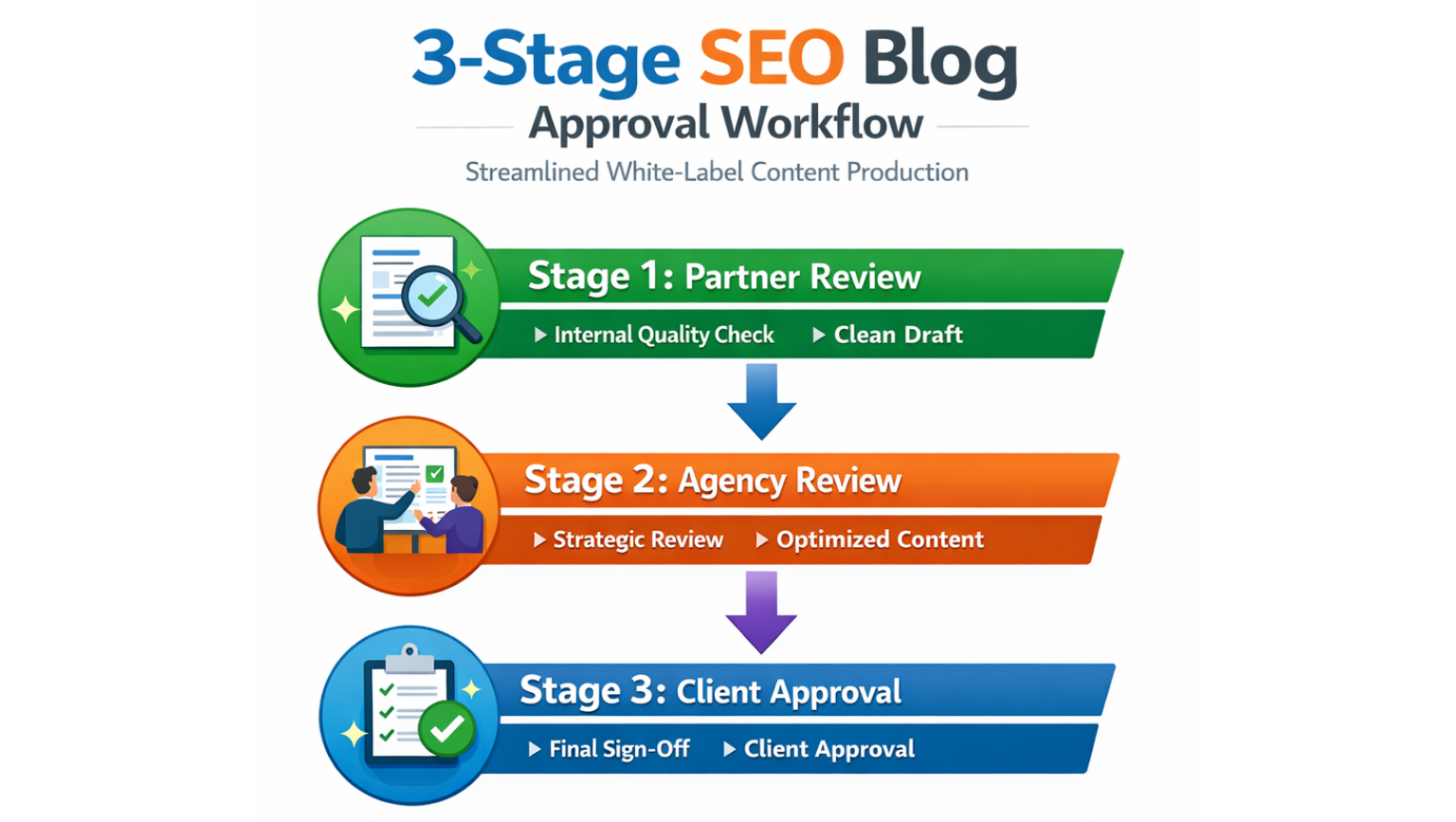
Scalable white-label partnerships establish structured approval stages with clear owners and SLAs at each step.
Stage 1: Partner Review (Internal Quality Gate)
Before anything reaches your team, the white-label provider should conduct internal quality checks:
Factual accuracy verification
SEO element compliance (keywords, headers, meta fields)
Grammar and readability review
Brand voice alignment against documented guidelines
Deliverable: Clean draft with editorial notes, ready for agency review.
This gate catches 80% of issues before they become your problem. If you're doing heavy editing on drafts from your white-label partner, something's broken upstream.
Stage 2: Agency Review (Your Quality Gate)
Your team reviews for strategic alignment and client-specific nuances. This is where you add value—not line-editing commas, but ensuring the content serves the client's actual business goals.
Does this post support the product launch next month? Does it address the objection the sales team keeps hearing? Does it position the client correctly against their main competitor?
Establish a fixed window for this stage. Twenty-four to forty-eight hours works for most agencies. If you miss the window, the draft advances automatically to the next stage. This sounds harsh, but it prevents the "sitting in review limbo for two weeks" problem that kills publishing schedules.
Stage 3: Client Approval (Final Sign-Off)
Some agencies handle all approvals internally. Others require client sign-off on every piece. Either approach works, but the process must be documented before production starts.
For client-facing approvals, create a simple interface where clients can approve, request minor edits, or flag major concerns. One-click approval options dramatically increase throughput. The more friction in the approval process, the longer content sits unpublished.
Defining SLAs That Protect Everyone
Service-level agreements prevent the endless revision spiral. They set expectations before conflicts arise—which means fewer uncomfortable conversations with clients and partners.
Typical SLA components include:
| Element | Standard Benchmark |
| Initial draft delivery | 5–7 business days from topic approval |
| Agency review window | 48 hours |
| Revision turnaround | 24–48 hours |
| Included revision rounds | 2 per article |
| Additional revision cost | Defined rate per round |
| Publishing window (if applicable) | 24 hours post-approval |
Document these upfront. When a client requests a fourth revision because their marketing director finally read the post and has opinions, the SLA clarifies what's included versus what triggers additional fees.
This isn't about being difficult. It's about sustainability. Agencies that can't enforce boundaries around revisions eventually burn out, deliver lower quality, or raise prices dramatically—none of which serve clients well.
Protecting Quality Across Multiple Accounts
Managing content for one client is straightforward. Managing content for fifteen clients simultaneously—each with different industries, audiences, brand voices, and stakeholder personalities—requires systems.
Client Onboarding That Prevents Problems
Quality issues almost always trace back to inadequate onboarding. When a post misses the mark, the root cause is usually "we didn't understand what they actually wanted" or "we didn't know they hate that word."
Before producing any content, capture:
Business goals and target audience (who reads this, and what should they do after?)
Competitor URLs to analyze and differentiate from
Existing content to match in tone and style (their best posts, not their average ones)
Terminology preferences (words to use, words to avoid—industry jargon matters)
Internal linking priorities (which pages need link equity?)
Approval chain and stakeholder preferences (who actually has veto power?)
This documentation lives in a centralized system accessible to everyone involved in production. Updating it quarterly keeps content aligned as client businesses evolve, launch new products, or shift positioning.
Centralized Quality Metrics
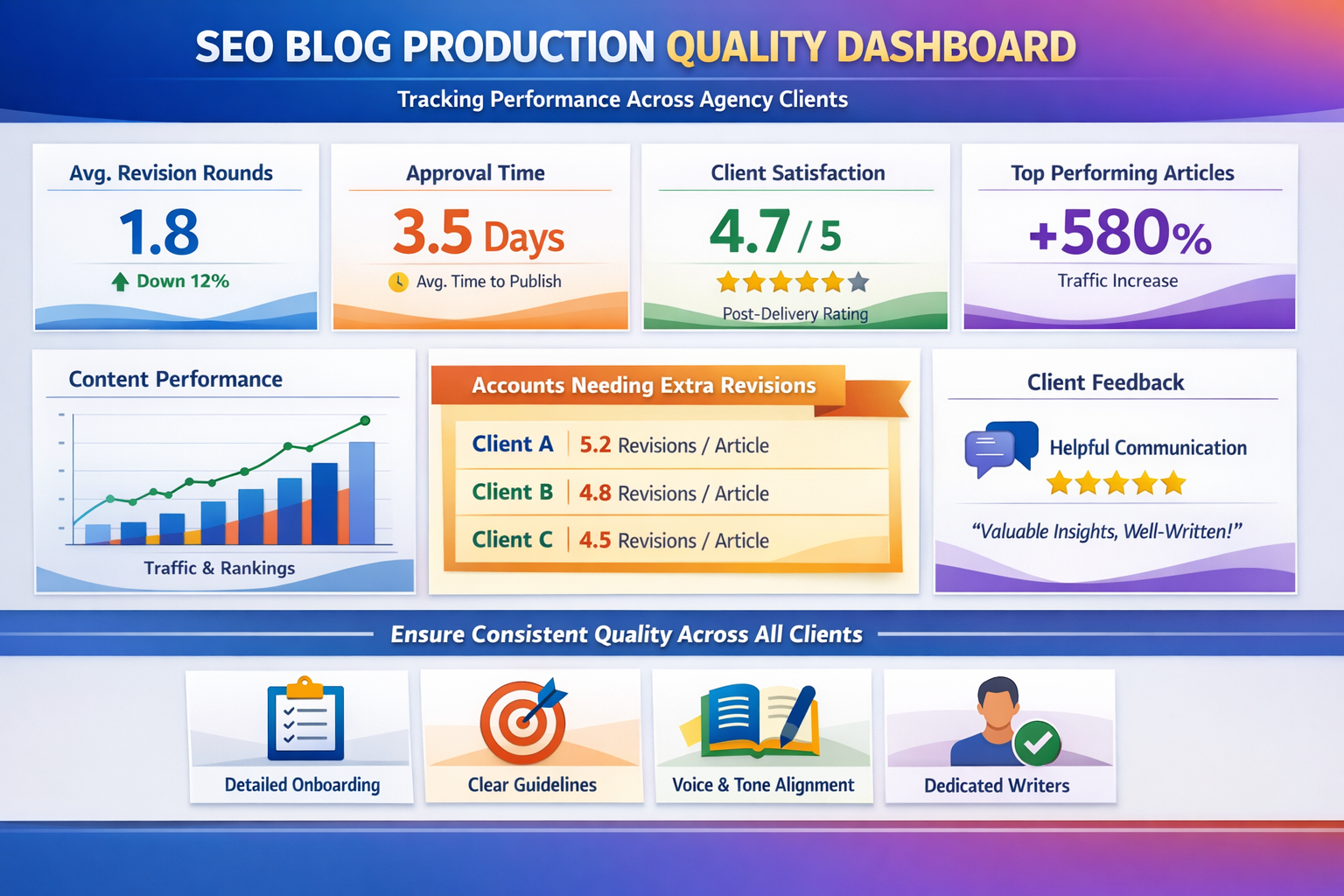
What gets measured improves. Track quality indicators across all accounts:
Average revision rounds per article (trending up = problem)
Approval-to-publish time (delays indicate process friction)
Client satisfaction scores (simple post-delivery survey)
Content performance metrics (traffic, rankings, engagement over time)
Accounts requiring consistently more revisions signal onboarding gaps, misaligned expectations, or a voice mismatch between writer and client. Address these proactively before they erode margins or damage relationships.
Writer Consistency
If possible, assign dedicated writers to specific accounts. Consistency builds familiarity with client voice, industry terminology, and content history.
A writer who's produced twenty posts for a client understands nuances that can't be captured in documentation. They know the CEO prefers short sentences. They know the product team gets sensitive about certain competitive claims. They know which topics have already been covered.
Rotating writers across accounts creates friction and quality variance. Every new writer starts from zero, requiring more detailed briefs and producing more off-target first drafts.
Handling the "Tone Mismatch" Problem
One of the most common quality failures is the tone mismatch—where technically competent content just doesn't sound like the client.
This happens when writers don't understand industry context. A post about manufacturing software written by someone who's never worked with manufacturers will use the wrong words, emphasize the wrong concerns, and miss the cultural references that signal credibility.
Prevention strategies:
During onboarding, collect examples of content the client loves (from any source)
Have writers consume the client's existing content before producing new pieces
Create a "voice cheat sheet" with specific phrases, sentence structures, and tonal examples
Build feedback loops where tone mismatches are flagged early and documented for future reference
Margin-Friendly Packaging Strategies
White-label content only works if the economics work. You can have the best content partner in the world, but if your margins evaporate with every project, you're running a charity, not an agency.
Here's how to structure offerings that protect your margins while delivering genuine value.
Tiered Packaging Based on Service Depth
Tier 1: Content-Only
You receive SEO-optimized articles with supporting documentation. Your team handles publishing, formatting, and client communication.
Best for: Agencies with existing content operations who need writing capacity.
Margin opportunity: Lower cost per article, higher volume potential. You're paying for words and research, not operations.
Tier 2: Content + Optimization
Articles arrive formatted for the client's CMS with meta fields, internal links configured, and schema markup implemented. Publishing remains your responsibility.
Best for: Agencies offering comprehensive SEO services who want publishing control.
Margin opportunity: Higher per-article fee justified by reduced internal formatting time. You're buying back hours your team would otherwise spend on production work.
Tier 3: Full-Service (Done-For-You)
Everything above plus publishing execution. Your white-label partner logs into client CMS platforms and handles end-to-end delivery.
Best for: Agencies prioritizing hands-off scalability over granular control.
Margin opportunity: Highest per-article fee, minimal internal time investment. You're essentially reselling a complete content operation.
Pricing Models That Scale
Per-Article Pricing
Simple and transparent. You pay a fixed rate per article, then mark up based on your client pricing.
Works well for: Smaller accounts, variable content needs, or clients who want flexibility month-to-month.
Watch out for: Unpredictable monthly costs, difficulty forecasting capacity needs.
Monthly Retainers
Fixed monthly fee for a defined content volume. Provides predictable costs for budgeting and often includes volume discounts.
Works well for: Established client relationships with consistent needs, accounts where you've proven content ROI.
Watch out for: Unused capacity if client needs fluctuate, commitment without flexibility.
Hybrid Models
Base retainer covering minimum volume, with per-article pricing for additional content. Balances predictability with flexibility.
Works well for: Clients with baseline needs plus seasonal spikes, accounts where you want committed minimums but room to scale.
Calculating Sustainable Markups
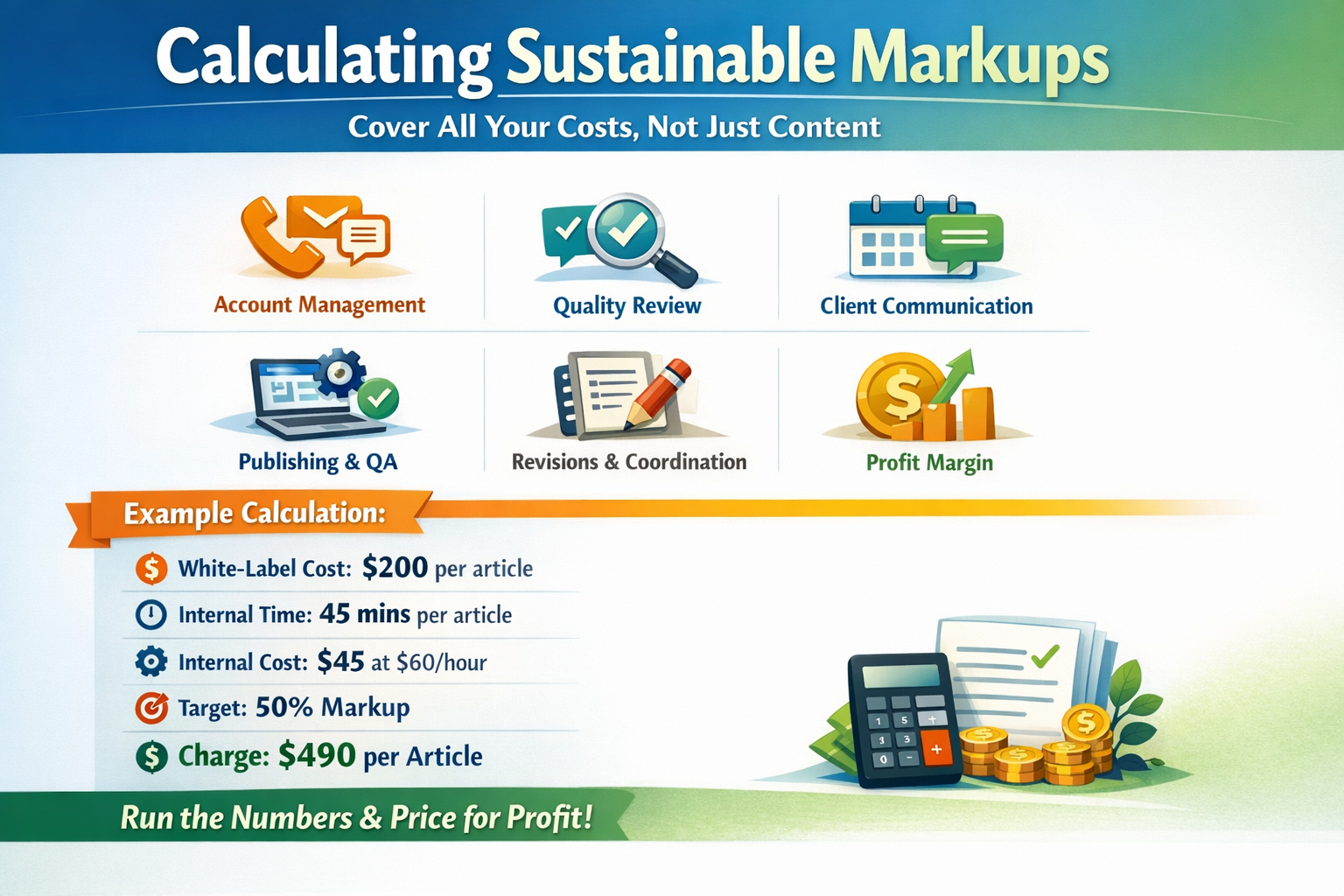
Your markup must cover more than just the content cost. Factor in:
Account management time (calls, emails, expectation management)
Quality review (even quick reviews take time across many accounts)
Client communication (status updates, calendar management)
Publishing and QA (if applicable)
Revision management (even within SLA, revisions require coordination)
Profit margin (you're running a business, not a passthrough)
Most agencies target 40–60% markups on white-label content costs [5].
Here's a concrete example:
White-label cost: $200 per article
Your internal time: 45 minutes per article (review, communication, coordination)
Internal cost at $60/hour loaded rate: $45
Total cost: $245
Target 50% gross margin: Charge $490 per article to client
Lower markups may work for high-volume accounts where efficiency gains offset percentage reduction. But if you're spending two hours per article on management and review, your pricing needs to reflect that reality.
Run the math on your actual time investment per account. If the numbers don't work, either find a partner whose processes reduce your involvement or adjust your pricing.
Common Pitfalls and How to Avoid Them
Pitfall: Treating white-label as "set and forget"
Even the best partners require some oversight. Schedule monthly reviews to assess quality trends, upcoming topics, and any client-specific adjustments.
Fix: Block thirty minutes monthly per major account to review metrics and flag concerns before they become problems.
Pitfall: Over-promising turnaround times
If your partner delivers in five business days, don't promise clients three-day turnaround. Build buffer into your commitments for reviews, revisions, and the inevitable complications.
Fix: Add two business days to whatever your partner promises before committing to clients.
Pitfall: Hiding the white-label relationship awkwardly
You don't need to advertise your production partner, but avoid creating false impressions that damage trust later. Clients hire your agency for strategic direction—the execution model matters less than results.
Fix: If asked, be straightforward: "We work with specialized content partners who execute under our direction." Most clients won't ask; those who do will respect honesty.
Pitfall: Accepting commodity pricing
The cheapest provider is rarely the most profitable choice. Low-cost content requiring heavy revision costs more in internal time than moderately-priced content delivered publication-ready.
Fix: Calculate total cost including your team's time, not just invoice amount. A $150 article requiring ninety minutes of editing costs more than a $250 article requiring fifteen minutes of review.
Pitfall: Neglecting attribution and tracking
Ensure content performance is trackable. Without data, you can't prove ROI to clients or identify what's working.
Fix: Implement UTM parameters for any linked content, set up proper analytics, and maintain clear records of what's published where and when.
Pitfall: The tone mismatch spiral
When writers don't understand client context, you end up in endless revision cycles trying to fix voice issues through feedback rather than prevention.
Fix: Invest heavily in onboarding documentation. Provide voice examples. Request writer consistency. It's cheaper to prevent tone problems than to edit them away.
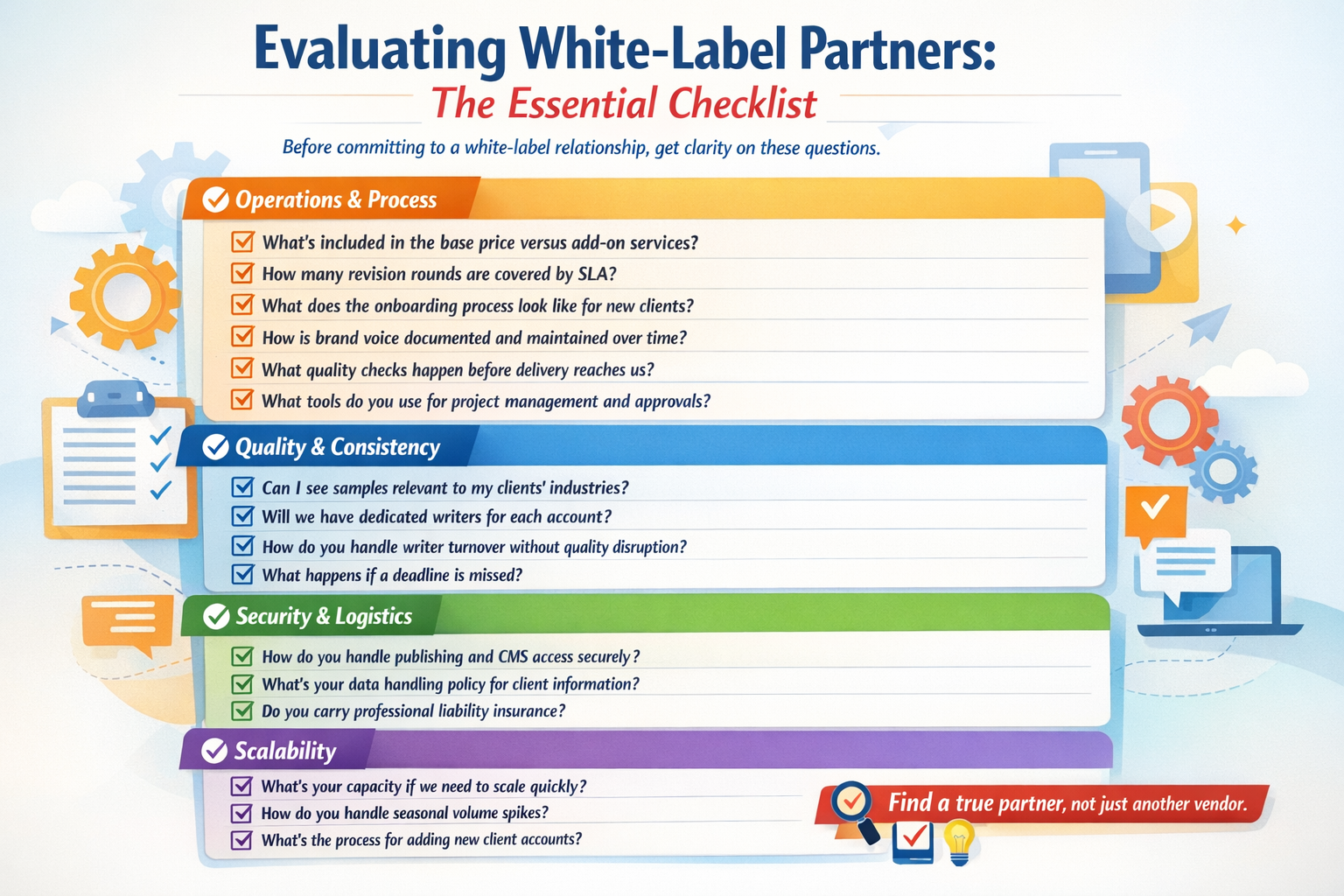
Evaluating White-Label Partners: The Essential Checklist
Before committing to a white-label relationship, get clarity on these questions. Print this list and bring it to your next vendor evaluation call:
Operations & Process
☐ What's included in the base price versus add-on services?
☐ How many revision rounds are covered by SLA?
☐ What does the onboarding process look like for new clients?
☐ How is brand voice documented and maintained over time?
☐ What quality checks happen before delivery reaches us?
☐ What tools do you use for project management and approvals?
Quality & Consistency
☐ Can I see samples relevant to my clients' industries?
☐ Will we have dedicated writers for each account, or rotating assignments?
☐ How do you handle writer turnover without quality disruption?
☐ What happens if a deadline is missed?
Security & Logistics
☐ How do you handle publishing and CMS access securely?
☐ What's your data handling policy for client information?
☐ Do you carry professional liability insurance?
Scalability
☐ What's your capacity if we need to scale quickly?
☐ How do you handle seasonal volume spikes?
☐ What's the process for adding new client accounts?
The answers reveal whether you're evaluating a true operational partner or just another vendor who happens to write blog posts.
Making White-Label Content Work for Your Agency
White-label SEO blog production isn't about abdicating responsibility. It's about focusing your agency's energy where it creates the most value—strategy, client relationships, and business development—while building reliable systems for execution.
The agencies that scale successfully don't just find good writers. They build content operations that run predictably across dozens of accounts without requiring constant intervention. No more answering emails at 9 PM about late drafts. No more apologizing for missed publishing dates.
That means clear deliverables defined upfront. Documented approval workflows with real SLAs. Quality governance that catches issues before they reach clients. And pricing structures that leave room for sustainable margins after accounting for your actual time investment.
The content itself is important—but it's the operational layer around the content that determines whether your agency can scale.
Ready to test a white-label workflow for your agency? Start with a trial—two sample posts delivered under your brand, with full approval documentation—and see how it fits your operations.
Frequently Asked Questions
How do I maintain brand consistency across multiple client accounts?
Brand consistency starts with thorough onboarding documentation capturing each client's voice, terminology preferences, and stylistic guidelines. Assign dedicated writers to specific accounts whenever possible—a writer who's produced twenty posts for a client understands nuances that documentation can't fully capture. Conduct quarterly reviews to update voice guides as client businesses evolve, and track revision patterns to identify accounts where voice alignment needs attention.
What should be included in a white-label content SLA?
A comprehensive SLA covers initial draft delivery timelines (typically five to seven business days), review windows for each approval stage, revision turnaround times, the number of included revision rounds (usually two), additional revision costs, and publishing windows if applicable. Clear SLAs prevent scope creep and protect both parties when clients request extensive changes. Document these before production begins, not after conflicts arise.
How do I price white-label content to protect agency margins?
Calculate your actual time investment per article—including account management, quality review, client communication, coordination, and publishing. Most agencies target 40–60% gross margins on white-label costs. For example, a $200 article plus forty-five minutes of your time at $60/hour means $245 total cost; achieving 50% margin requires charging around $490. Consider tiered service packages with higher markups for full-service offerings that minimize your internal involvement.
Can white-label content partners handle publishing directly?
Yes, many providers offer done-for-you publishing where they access client CMS platforms and handle end-to-end delivery. This requires secure credential management and clear publishing protocols. For agencies prioritizing hands-off scalability, full-service packages eliminate internal publishing bottlenecks while commanding higher client fees. Ensure your partner has documented security practices before sharing any access credentials.
How many clients can one white-label partnership realistically support?
Capacity depends on content volume per client and your operational systems. With proper workflows—documented onboarding, structured approvals, centralized quality tracking, and dedicated writers per account—a single white-label partnership can support fifteen to twenty active accounts producing two to four posts per week each. Beyond that threshold, evaluate whether your partner has capacity or whether you need additional production resources to maintain quality.
About This Content
This guide draws on established content marketing practices and agency operations research. The Mighty Quill specializes in white-label SEO blog production designed specifically for agencies—combining AI-powered efficiency with human editorial oversight to deliver publication-ready content that scales across multiple accounts while protecting your margins and client relationships.
Cited Works
[1] Content Marketing Institute — "B2B Content Marketing Research." https://contentmarketinginstitute.com/research/
[2] Bureau of Labor Statistics — "Occupational Employment and Wages: Writers and Authors." https://www.bls.gov/ooh/media-and-communication/writers-and-authors.htm
[3] Google Search Central — "Introduction to Structured Data." https://developers.google.com/search/docs/appearance/structured-data/intro-to-structured-data
[4] HubSpot — "Content Workflow Best Practices." https://www.hubspot.com/marketing-statistics
[5] Agency Management Institute — "Agency Pricing and Profitability Benchmarks." https://agencymanagementinstitute.com/