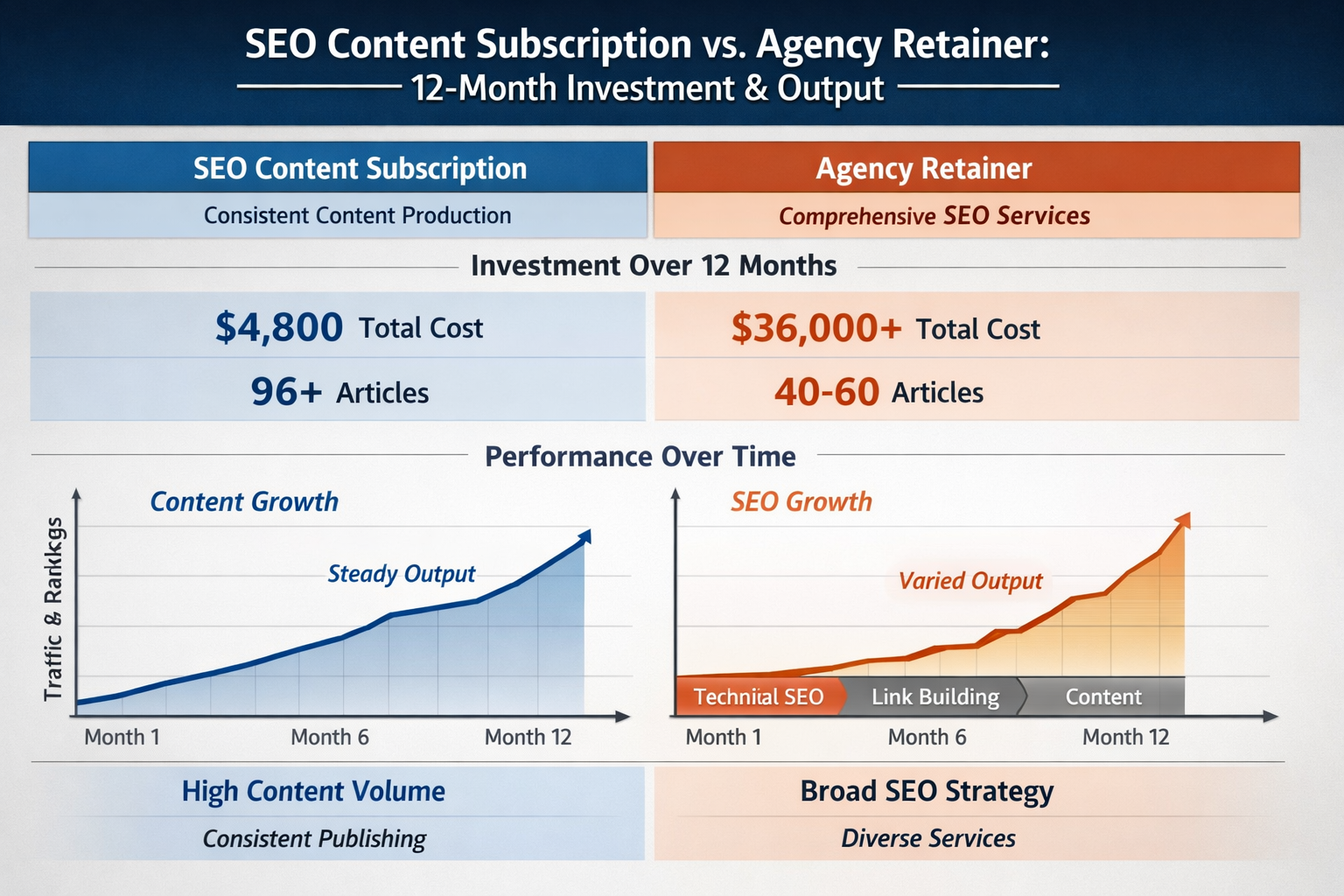
You've decided to invest in content marketing. Good call. But now comes the harder question: do you sign a monthly retainer with an agency, or subscribe to an SEO content subscription service?
Both promise organic growth. Both cost real money. And both will happily take your budget for the next year while you wait for results.
The difference? How they compound—and whether you'll actually see it happening.
This isn't about which option is "better" in the abstract. It's about which model fits your bandwidth, your goals, and your tolerance for waiting in the dark. By the end of this guide, you'll know exactly what to demand from either model—and how to measure whether your investment is actually working.
Understanding the Two Models
Before comparing outcomes, let's clarify what we're actually comparing.
What Is an SEO Content Subscription?
An SEO content subscription is a fixed-price, fixed-output service. You pay a monthly fee, and you receive a set number of SEO-optimized articles—typically two to four per week.
The scope is narrow by design. These services focus on one thing: producing consistent, search-optimized content at a predictable cadence. Topic research, keyword targeting, and publishing schedules are usually included. Strategic consulting, link building, and technical SEO typically are not.
The value proposition is straightforward: consistent publishing without hiring writers or managing freelancers. The trade-off is equally clear—you need someone internally who can own strategy and direction.
What Is an Agency Retainer?
An agency retainer is a monthly fee for access to a broader team and service mix. Retainers often include content creation, but also technical audits, link building, strategy calls, and ongoing consulting.
The scope varies wildly between agencies. Some deliver highly structured programs with clear deliverables. Others operate more reactively, responding to client requests as they come in.
Retainers tend to cost more—often significantly more—but they also promise more comprehensive support. Good agencies absolutely can drive compounding growth. The question is whether you need (and can afford) everything they offer, or whether a more focused approach gets you further faster.
The Compounding Model: Why 6–12 Months Matters
Here's the thing most vendors won't tell you: SEO compounds. But it compounds slowly, unevenly, and only if you're consistent.
A single blog post might rank in three months. Or six. Or never. But a body of fifty interlinked posts on related topics? That builds topical authority [1]. Google starts to see your site as a legitimate source on those subjects. Your older posts get lifted by your newer ones. Internal links distribute equity. Rankings improve across the board.
This is why the 6–12 month timeframe matters so much. You're not buying individual posts—you're building a content asset that appreciates over time.
The question is: which model sets you up better for that compounding effect?
Content Subscriptions and the Consistency Advantage
Content subscriptions win on one metric above all others: publishing consistency.
When you subscribe to a content service, you know exactly what you're getting each month. Two articles per week means eight to ten posts per month. Every month. No gaps when your account manager goes on vacation. No slowdowns when the agency gets a bigger client.
This consistency is the engine of compounding. Search engines reward sites that publish regularly with fresh, relevant content [2]. A predictable publishing cadence also means predictable internal linking opportunities, which strengthen your site's topical clusters over time.
The trade-off is scope—and strategy ownership. Content subscriptions don't fix your site speed. They don't build backlinks. They don't redesign your landing pages. And critically, most don't provide strategic direction. You (or someone on your team) need to own the editorial calendar, approve topics, and ensure content aligns with business goals.
If you have that internal capacity, subscriptions offer remarkable leverage. If you don't, you may end up with consistent content that doesn't move the needle because it's targeting the wrong topics.
Agency Retainers and the Breadth Trade-Off
Agency retainers offer breadth. You get a team that can theoretically handle everything: content, technical fixes, link outreach, and strategy.
For companies without internal marketing capacity, this is genuinely valuable. A good agency brings strategic thinking you might not have in-house. They can identify which technical issues are blocking growth, which content gaps matter most, and how to prioritize across channels.
The question is whether breadth comes at the cost of depth—especially in content production.
Here's a common scenario: your retainer includes "content creation," but the agency produces two to four posts per month instead of per week. The rest of your budget goes to calls, audits, and link prospecting. Six months in, you have twenty posts instead of fifty. Your topical authority is thinner. Your compounding is slower.
This isn't always the case. Premium agencies (typically $5,000–$10,000+ per month) often maintain high content velocity alongside other services. But at lower price points, something usually gets squeezed—and content volume is often the casualty.
When Each Model Makes Sense
Choose a content subscription if:
Your technical SEO foundation is solid
You don't need link building (or you're handling it separately)
You want maximum content output per dollar
You have someone internally who can own strategy and approve topics
Your budget is under $3,000/month for content marketing
Choose an agency retainer if:
Your site has significant technical debt that's blocking growth
You need link building as part of the package
You don't have internal marketing capacity to provide strategic direction
You prefer a single vendor for all SEO needs
Your budget supports $5,000+/month for comprehensive service
Neither model is inherently superior. The right choice depends on what's actually holding your organic growth back—and whether you have internal resources to fill the gaps.
What to Demand in Monthly Reporting
Here's where most vendors fail their clients: reporting.
You're paying for organic growth. You should be able to see whether it's happening. Yet many agencies and content services send vague monthly summaries—or worse, dashboards full of vanity metrics that obscure whether anything meaningful changed.
Don't accept that. Whether you choose a subscription or a retainer, demand reporting that actually tracks compounding.
Weekly Reporting: What to Watch
Weekly check-ins should focus on output and indexing:
Content published this week: Titles, URLs, target keywords
Indexing status: Are new posts being indexed within 48–72 hours?
Internal links added: Which existing posts were linked to?
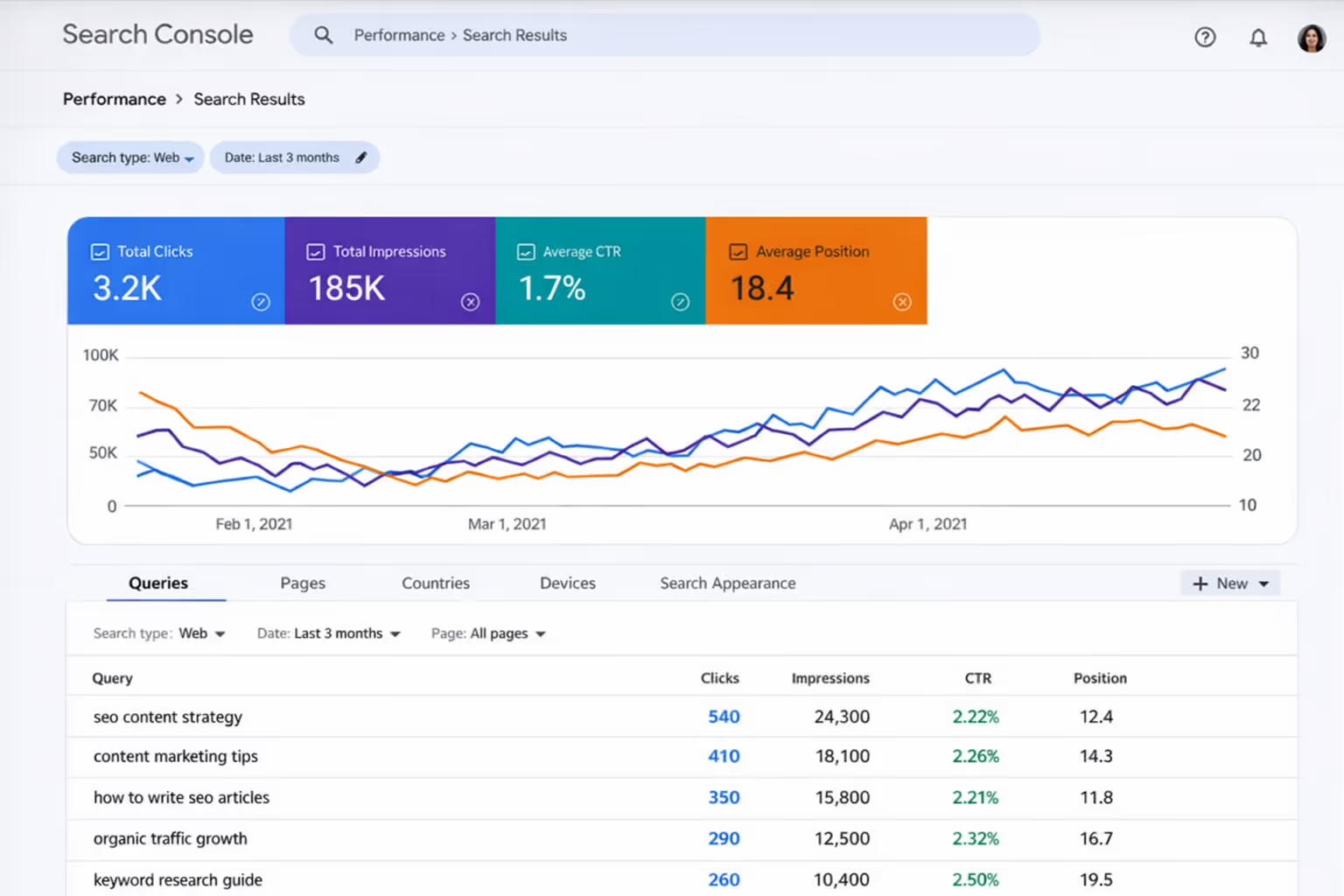
You can verify indexing yourself using Google Search Console. Navigate to the URL Inspection tool, paste your new post's URL, and confirm it's in Google's index. If posts aren't getting indexed within a week, something's wrong.
Monthly Reporting: The Metrics That Matter
Monthly reporting should show whether your investment is compounding. Demand these specific metrics, pulled directly from Google Search Console:
Impressions by page and query
Impressions measure how often your pages appear in search results—even before users click. Rising impressions indicate that Google is showing your content for more queries. This is the earliest signal of compounding.
In Google Search Console, go to Performance > Search Results. Filter by page to see which posts are gaining visibility. Filter by query to see which keywords you're starting to rank for.
Clicks and click-through rate (CTR)
Clicks measure actual traffic. CTR measures how compelling your titles and meta descriptions are. If impressions rise but clicks don't, your on-page elements may need work.
Average position by target keyword
Track your target keywords over time. Are they moving from position 50 to position 20? From page two to page one? This progression shows whether your topical authority is building.
Indexed pages over time
Your total indexed pages should grow steadily. Flat or declining indexed page counts suggest technical problems or content quality issues.
Red Flags in Reporting
Watch for these warning signs:
No Google Search Console data: If your vendor isn't using GSC, they're guessing
Only showing "top performers": Cherry-picked wins hide broader stagnation
Traffic without source breakdown: Organic traffic should be isolated from paid, direct, and referral
No trend lines: Single-month snapshots don't show compounding
Avoiding volume discussions: If they can't tell you exactly how many posts were published, ask why
Good reporting tells a story over time. If you can't see the trajectory, you can't evaluate whether the model is working.
Calculating Real ROI Over 6–12 Months
Let's get concrete. How do you actually compare the ROI of these two models?
Content Subscription Economics
Content subscriptions vary in price and quality. At the lower end, you'll find services charging $50–$100 per article—but quality at that price point is typically inconsistent or AI-generated without meaningful human oversight.
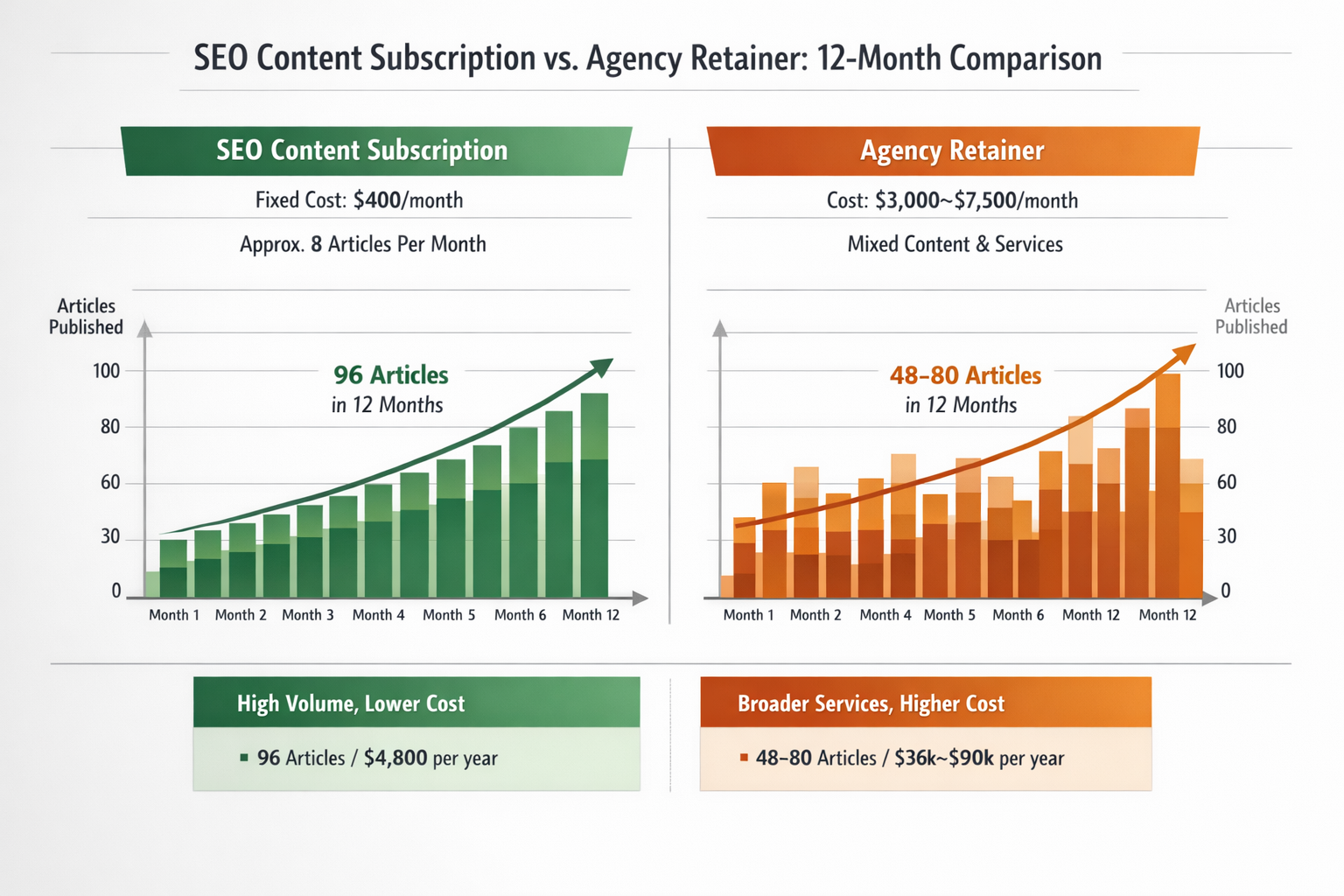
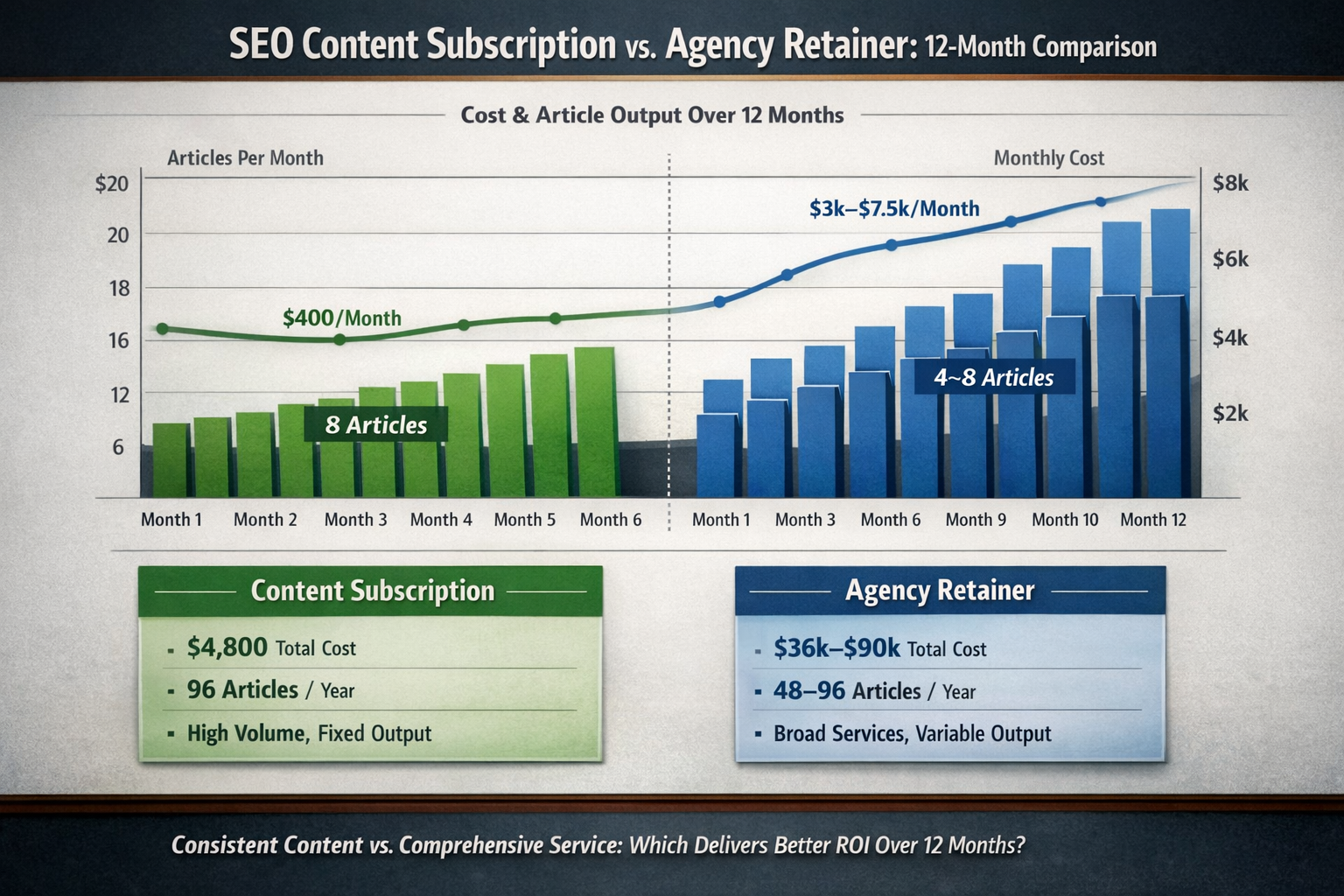
Mid-tier subscriptions (like Mighty Quill's $400/month done-for-you plan) deliver around eight posts per month with keyword research, optimization, and publishing included. The economics work because these services use streamlined workflows—no account management bloat, no endless strategy calls, no scope creep.
Over 12 months at $400/month:
Total investment: $4,800
Total posts: ~96 (assuming 8/month)
Fully optimized and published
The key question isn't just cost-per-post—it's whether the content is good enough to rank and whether the volume is sufficient to build topical authority.
Agency Retainer Economics
Agency retainers typically start around $2,000–$3,000/month for smaller agencies and scale to $10,000+ for premium firms. What you get varies enormously.
At a $3,000/month retainer that includes content:
Total investment over 12 months: $36,000
Content output: Often 4–8 posts per month (the rest goes to audits, calls, link building)
Total posts: 48–96
At a $7,500/month premium retainer:
Total investment over 12 months: $90,000
Content output: Potentially 12–20 posts per month plus technical work and link building
Total posts: 144–240
The agency might also secure backlinks, fix technical issues, and provide strategic direction. These are valuable—but harder to attribute directly to traffic growth.
The Compounding Difference
Here's what the math obscures: content compounds, but only if you have enough of it—and if it's targeting the right topics.
Ninety-six well-researched, properly optimized posts build a content library. Forty-eight scattered posts build a content blog. The difference in topical authority—and in how Google perceives your site—is significant.
But volume alone doesn't guarantee results. Fifty posts on random topics won't compound the way fifty posts in a tight topical cluster will. This is where strategy matters—and where you need to honestly assess whether you have internal capacity to provide direction, or whether you need to pay an agency for it.
Building a Hybrid Approach
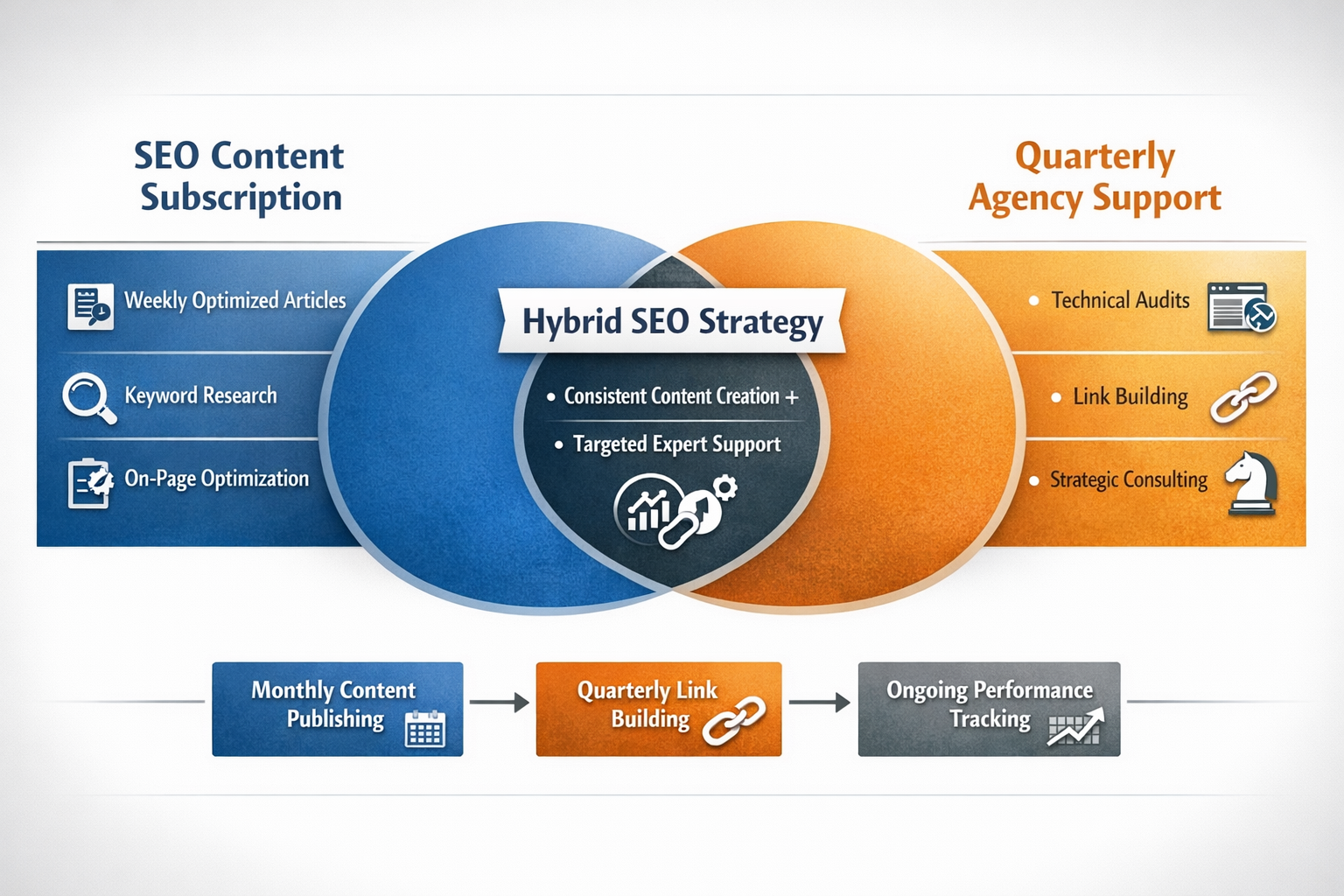
Many growth-focused companies land on a hybrid model: a content subscription for volume, supplemented by targeted agency work or in-house efforts for technical SEO and link building.
This approach maximizes content output (the engine of compounding) while addressing gaps that content alone can't fix.
How to Structure a Hybrid
Here's what a practical hybrid workflow looks like:
Month 1: Foundation
Bring in an agency or consultant for a one-time technical audit and keyword strategy
Investment: $2,000–$5,000 (one-time)
Outcome: Prioritized technical fixes and a validated topic list
Months 2–12: Execution
Content subscription handles weekly publishing, keyword research, and on-page optimization
Investment: $250–$400/month
Outcome: 88–96 optimized posts over 11 months
Quarterly: Link Building Sprints
Agency or contractor runs focused link outreach campaigns
Investment: $1,500–$3,000 per sprint
Outcome: 10–20 quality backlinks per quarter
Total 12-month investment: $8,000–$15,000Total content output: 88–96 posts plus technical improvements and backlinks
Compare that to a full-service retainer at $36,000–$90,000 over the same period. For many businesses, the hybrid approach delivers more content—the primary compounding asset—at a fraction of the cost.
Who Owns What
The hybrid model requires clear ownership:
Content subscription: Handles weekly publishing, keyword research, on-page optimization
Internal team: Approves topics, provides brand direction, monitors performance
Agency/contractor (as needed): Technical fixes, link building, strategic audits
If you don't have someone internally who can own the strategy layer, a hybrid approach may create more complexity than value. Be honest about your capacity before committing.
Making the Decision
If you've read this far, you're serious about organic growth. Here's how to decide:
Start with your constraints. Do you have someone internally who can own SEO strategy? If yes, a content subscription gives you maximum output for minimum management. If no, an agency retainer might make sense—but scrutinize their content volume before signing.
Audit your foundation. If your site has major technical issues, fix those first. No amount of content will compensate for a site that doesn't load or can't be crawled. Consider a one-time audit before committing to ongoing content investment.
Commit to the timeframe. SEO compounding requires patience. Six months is the minimum. Twelve months is where the real gains appear. Choose the model you can sustain for the full period.
Demand real reporting. Whatever you choose, insist on Google Search Console data showing impressions, clicks, and average position trends over time. If a vendor resists transparency, find a different vendor.
Match model to budget. If your total content marketing budget is under $3,000/month, a content subscription (possibly with occasional consultant support) likely gets you further than a constrained agency retainer. If you're investing $7,500+/month, a premium agency can deliver both volume and strategy.
Start Building Your Content Engine
Ready to see what consistent, SEO-optimized publishing can do for your organic traffic?
If you have internal bandwidth to handle strategy and topic approval, the $250/month plan delivers two articles per week with full keyword research and topic calendars—you handle publishing.
If you want end-to-end management—including publishing, schema optimization, and internal linking—the $400/month plan handles everything so you can focus on running your business.
[Try two free articles in 48 hours] and see the quality for yourself. No commitment required.
Frequently Asked Questions
How long does it take to see results from an SEO content subscription?
Most businesses start seeing measurable improvements in Google Search Console impressions within 60–90 days of consistent publishing. Significant traffic gains typically emerge around the 6-month mark as topical authority builds. The key variable is publishing consistency—gaps in your content calendar delay compounding and extend your timeline to results.
Can I use a content subscription and an agency at the same time?
Yes, and many companies do. A common approach: use an agency for a one-time technical audit and quarterly link building sprints, while a content subscription handles ongoing publishing. This hybrid model maximizes content volume (the primary compounding asset) while addressing gaps that content alone can't fix. Just ensure there's clear ownership so efforts don't overlap.
What should I look for in monthly SEO reports?
Demand Google Search Console data showing impressions, clicks, and average position trends for your target keywords. Look for month-over-month trajectory rather than single snapshots. Good reports also show indexed page growth and highlight which content is gaining traction. Avoid vendors who only share vanity metrics or cherry-pick top performers without showing the full picture.
How many blog posts per month do I need for SEO compounding?
There's no universal number, but consistency matters more than occasional bursts. Publishing two to three optimized posts per week (eight to twelve per month) builds topical authority faster than sporadic publishing. The goal is creating enough interlinked content that Google recognizes your site as an authority on your target subjects.
What's the difference between impressions and clicks in Google Search Console?
Impressions count how often your pages appear in search results, regardless of whether anyone clicks. Clicks measure actual visits from search. Rising impressions indicate that Google is showing your content for more queries—an early signal of compounding. If impressions grow but clicks don't, your titles and meta descriptions may need optimization to improve click-through rate.
About The Mighty Quill
The Mighty Quill was founded by Mario, a digital marketing veteran with over 15 years of experience in SEO, Amazon PPC, and e-commerce growth. The Mighty Quill blog engine was built specifically to solve the consistency problem that stalls most content marketing programs—delivering research-backed, SEO-optimized articles on a fixed weekly schedule so organic traffic compounds instead of stagnates. Every article is built from keyword research, optimized for both Google and AI search, and reviewed for quality before delivery.
Cited Works
[1] Moz — "What Is Topical Authority in SEO?"
https://moz.com/learn/seo/topical-authority
[2] Google Search Central — "Google Search Essentials." https://developers.google.com/search/docs/essentials