Most comparison guides for blog content services miss the point entirely.
They'll show you feature tables, word count tiers, and price-per-article breakdowns—then leave you to figure out whether any of it will actually help you rank. That's like comparing cars by paint color and ignoring the engine.
The real question isn't "which service is cheapest?" It's "which service produces content that compounds into organic traffic month after month?"
This guide gives you a framework for evaluating SEO blog subscription services based on what actually predicts performance: production quality, SEO infrastructure, and strategic alignment with your growth goals. You'll walk away with a practical scorecard, clear red flags to watch for, and specific questions that separate serious providers from content mills wearing better marketing.
Why Blog Subscription Services Have Replaced the Old Model
The economics of content marketing have fundamentally shifted.
Paid acquisition costs keep climbing. Average cost-per-click in competitive B2B categories rises year over year [1]. Meanwhile, organic search still drives the largest share of website traffic for most businesses [2].
But organic visibility doesn't happen by accident. It requires consistent publishing, strategic keyword targeting, and content quality that satisfies both algorithms and humans.
Here's the problem: most companies can't execute on that consistently.
Hiring full-time writers is expensive and slow. Managing freelancers becomes a second job. And the blog quietly dies—updated once a quarter when someone "has time."
SEO blog subscription services solve this by delivering a set number of optimized articles per week or month, removing the operational friction that kills most content programs.
The catch? Not all subscriptions deliver equal value. Some prioritize volume over substance. Others lack the SEO infrastructure to make content actually rank. And a surprising number still operate like content mills with nicer websites.
The Quality-First Evaluation Framework
Surface-level criteria—word count, turnaround time, price—tell you almost nothing about whether content will perform.
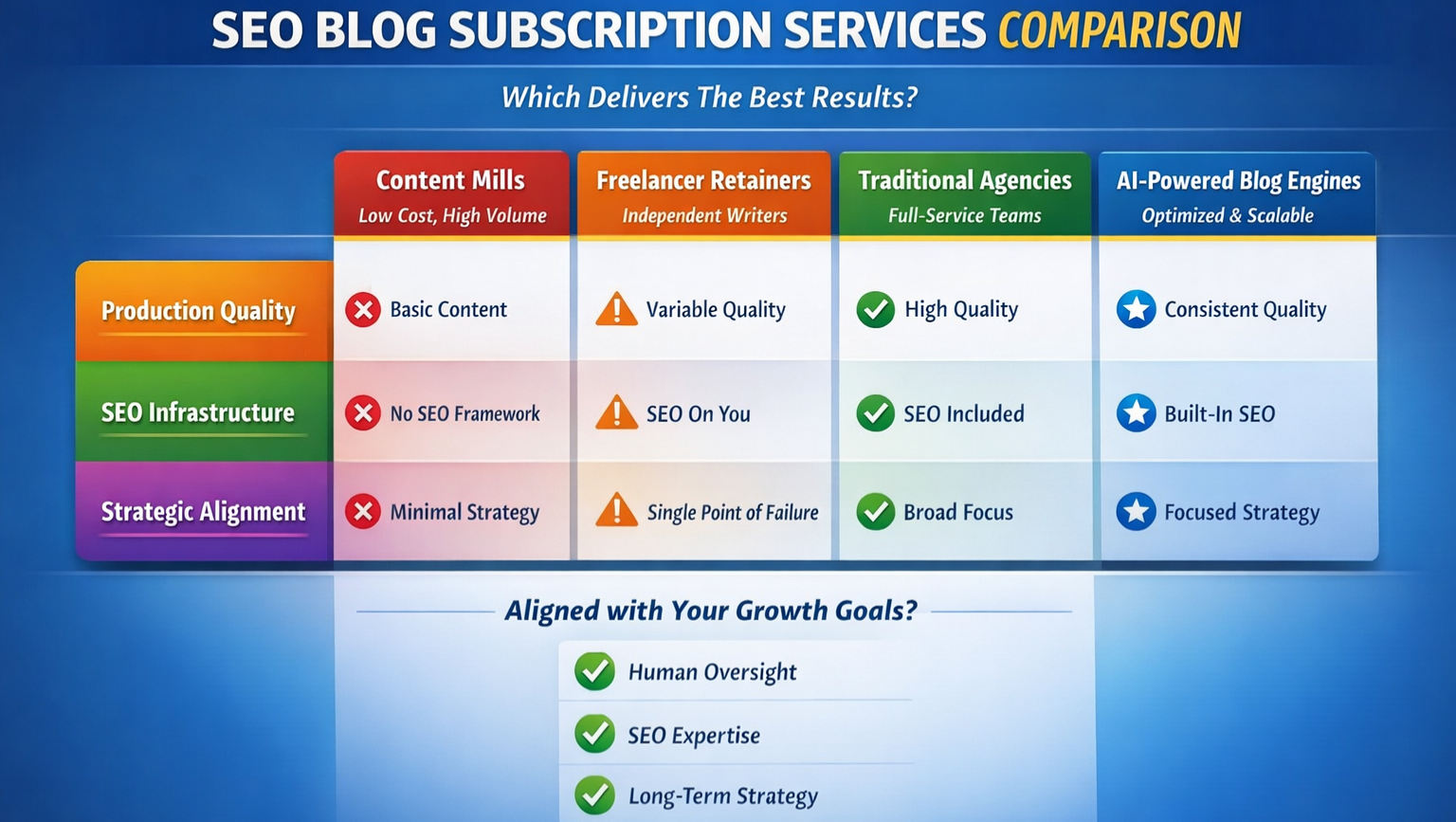
A smarter approach evaluates providers across three dimensions:
Production Quality – How is content actually created, reviewed, and refined? Who touches it before delivery?
SEO Infrastructure – What systems ensure content targets the right keywords, follows on-page best practices, and has a realistic chance of ranking?
Strategic Alignment – Does the service understand your audience, business model, and competitive landscape—or are you just another ticket in the queue?
The evaluation matrix below turns these dimensions into specific, verifiable criteria you can use during sales conversations.
The 10-Point Provider Evaluation Matrix
Use this framework when comparing SEO writing subscriptions. Score each provider on a 1–5 scale for every criterion, then weight results toward the categories that matter most for your situation.
Production Quality Criteria
| Criterion | What to Look For | Red Flags |
| 1. Human Editorial Review | Every piece reviewed and edited by a human before delivery. Ask: "What percentage of content receives human review?" | Pure AI output with no human oversight. If they can't answer the question, assume zero. |
| 2. Writer Expertise Matching | Writers assigned based on industry knowledge or specifically trained on your niche during onboarding. | Generic content mill rotation where you get whoever's available. |
| 3. Revision Process | Clear revision policy with reasonable turnaround. Ask how many rounds are included and what happens if you're still unsatisfied. | "Unlimited revisions" with no process detail (often means endless back-and-forth with no accountability). No revisions included, or excessive fees per round. |
Pro Tip: Request a sample article on a topic in your industry before signing. Quality claims are easy to make—actual content reveals the truth.
SEO Infrastructure Criteria
| Criterion | What to Look For | Red Flags |
| 4. Keyword Research Integration | Service includes keyword and topic research as part of their workflow. They should explain how topics are selected. | Expects you to provide all keywords. This means you're paying for writing, not strategy. |
| 5. On-Page Optimization | Meta titles, descriptions, header structure, and internal linking included with every article. | Content delivered as raw text with no formatting or SEO elements. |
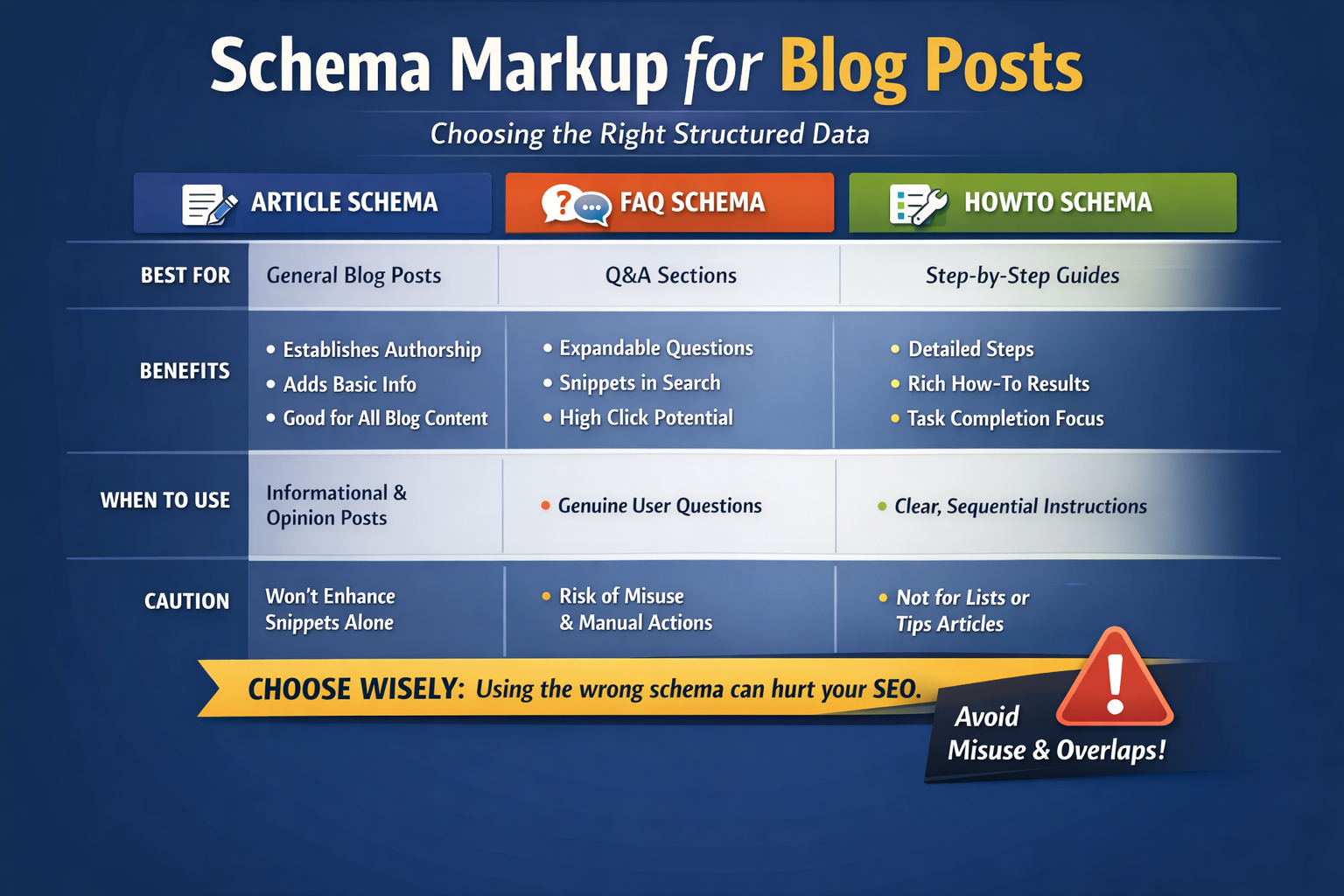
| 6. Schema and Technical SEO | FAQ schema, article schema, and formatting optimized for featured snippets where relevant. | No mention of technical SEO. Content exists but isn't structured for visibility. |
Pro Tip: Ask to see a content calendar or topic research document they've created for another client (anonymized). If they can't produce one, their "SEO strategy" may be an afterthought.
Strategic Alignment Criteria
| Criterion | What to Look For | Red Flags |
| 7. Onboarding Depth | Comprehensive kickoff covering brand voice, audience segments, competitors, and business goals. Takes 30–60 minutes minimum. | Generic intake form with a few fields. They're guessing your keywords and audience. |
| 8. Topic Strategy | Editorial calendar built around your specific goals and funnel stages, not random "trending topics." | Topic suggestions that could apply to any company in your industry. |
| 9. Performance Feedback Loop | Regular reporting on content performance, or optimization of underperforming posts based on data. | No visibility into what happens after content publishes. No iteration. |
| 10. Content Ownership | You own all content outright, immediately upon delivery. No licensing restrictions. | Ownership delays, licensing terms, or restrictions on republishing. |
Scoring Your Shortlist
Rate each criterion 1–5:
5 = Exceeds expectations with clear evidence
4 = Fully meets expectations
3 = Partially meets expectations
2 = Significant gaps or vague answers
1 = Does not address or actively concerning
Interpreting Results:
Below 30: Likely lacks infrastructure for sustainable organic growth. Proceed with caution.
30–40: Serviceable, but may require significant client-side management.
Above 40: Strong alignment with quality-focused content strategy.
Comparing Service Model Types
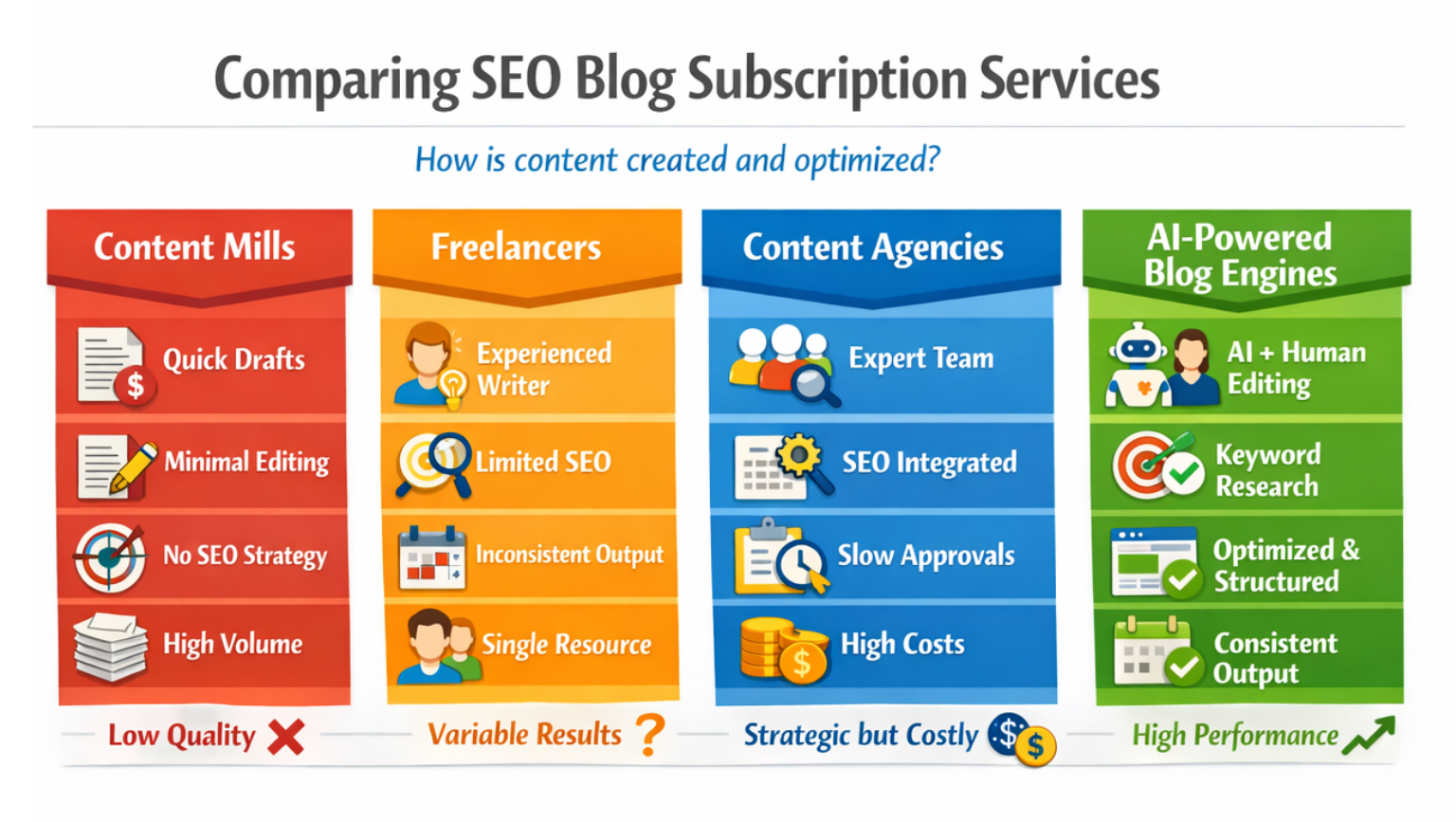
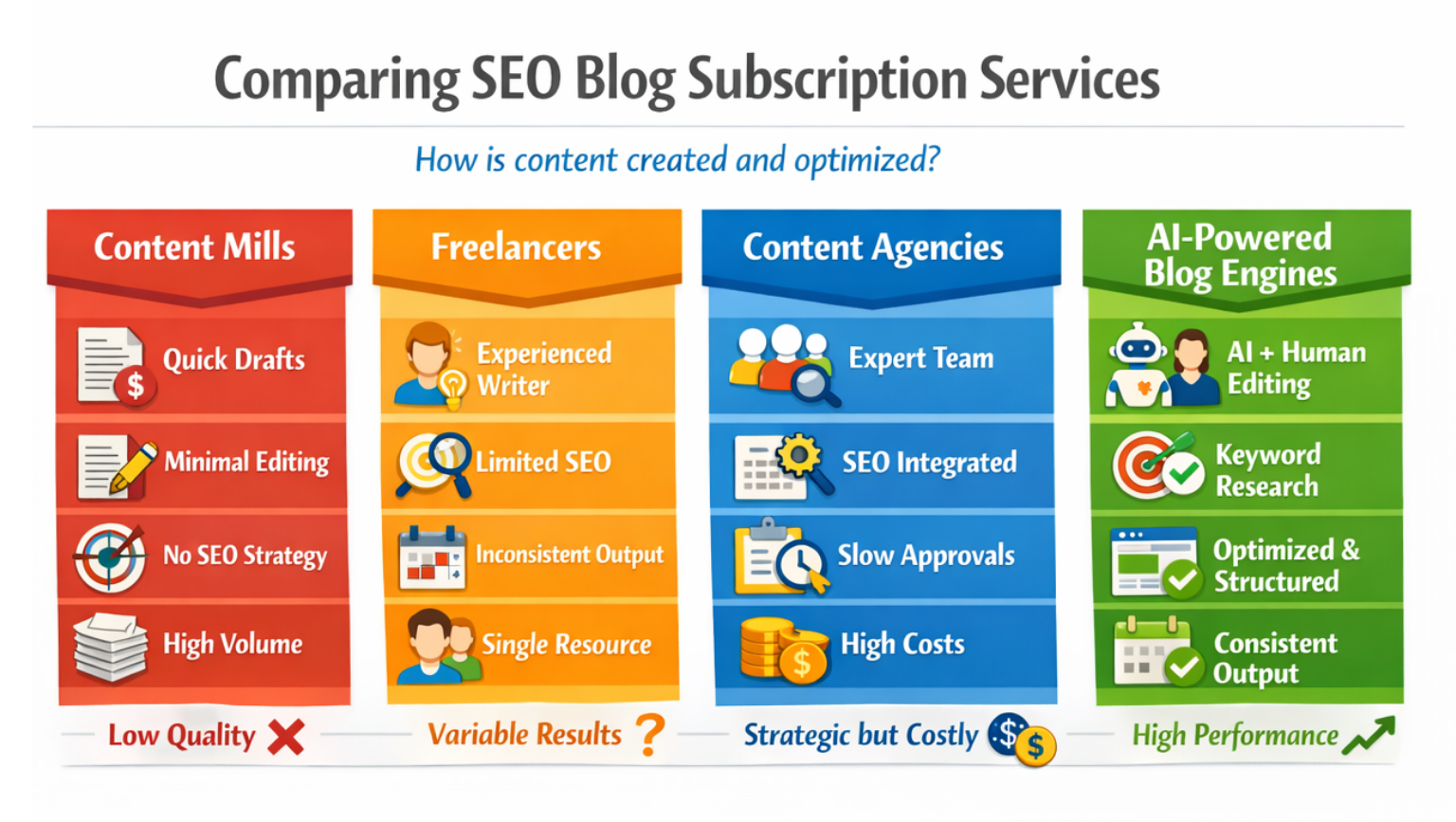
SEO blog subscription services fall into four general categories. Each has distinct strengths and limitations depending on your team's capacity and growth stage.
Content Mills and Marketplaces
How they work: Large platforms connecting buyers with freelance writers at scale. Orders placed through dashboards with minimal customization.
Typical pricing: $0.03–$0.10 per word ($50–$150 per article)
What you typically get:
Fast turnaround
Basic keyword insertion
Little to no strategic input
Content that often requires heavy editing before publishing
Strengths: Low cost, easy to scale volume quickly.
Limitations: Inconsistent quality, no SEO strategy, no ongoing optimization. You're buying words, not results.
Best for: Companies with strong internal editing resources who only need raw drafts, or those prioritizing volume over performance.
Freelancer Retainers
How they work: Direct relationships with individual freelance writers on monthly contracts.
Typical pricing: $200–$800 per article depending on expertise
What you typically get:
Consistent writer
Relationship-based communication
Quality dependent on the individual
SEO strategy typically falls on you
Strengths: Consistent voice, potential for deep niche expertise, direct communication.
Limitations: Single point of failure (what happens when they're sick, or quit?). Scaling requires finding additional writers. You manage the workflow.
Best for: Companies with in-house content strategists who can direct the entire operation.
Traditional Content Agencies
How they work: Full-service agencies offering content as part of broader marketing retainers.
Typical pricing: $2,000–$10,000+ monthly retainers
What you typically get:
Strategic guidance
Dedicated account management
Content integrated with other marketing services
Longer timelines and approval processes
Strengths: Comprehensive marketing support, strategic perspective, professional project management.
Limitations: Higher cost, content often one component of larger scope, may lack specialized SEO depth. Overkill if you just need consistent blog content.
Best for: Enterprise organizations needing comprehensive marketing support beyond content.
AI-Powered Blog Engines
How they work: Subscription services combining AI content generation with human editorial oversight and built-in SEO infrastructure. Deliver consistent article volume with integrated optimization.
Typical pricing: $250–$500 monthly for 8–12 articles
What you typically get:
Consistent publishing cadence (typically 2–3 articles per week)
Keyword research and topic strategy included
Human editing and quality control
On-page optimization, schema, internal linking
One workflow, one provider
Strengths: Scalable without proportional cost increase, consistent output, integrated SEO strategy.
Limitations: Less suitable for highly technical or regulated industries requiring deep subject matter expertise (medical, legal, financial).
Best for: Growth-focused companies needing consistent, optimized content without building internal teams or managing multiple vendors.
What Current Comparison Content Gets Wrong
Search "SEO blog subscription services" and you'll find plenty of listicles. Most share the same blind spots:
No transparent pricing. Providers hide costs behind "contact us" forms, making comparison nearly impossible.
Features over outcomes. Lists emphasize what's included without explaining what actually matters for ranking.
No quality benchmarks. A service charging $100 per article with no SEO infrastructure isn't comparable to one charging $250 with keyword research, schema markup, and human editing—even though both deliver "blog content."
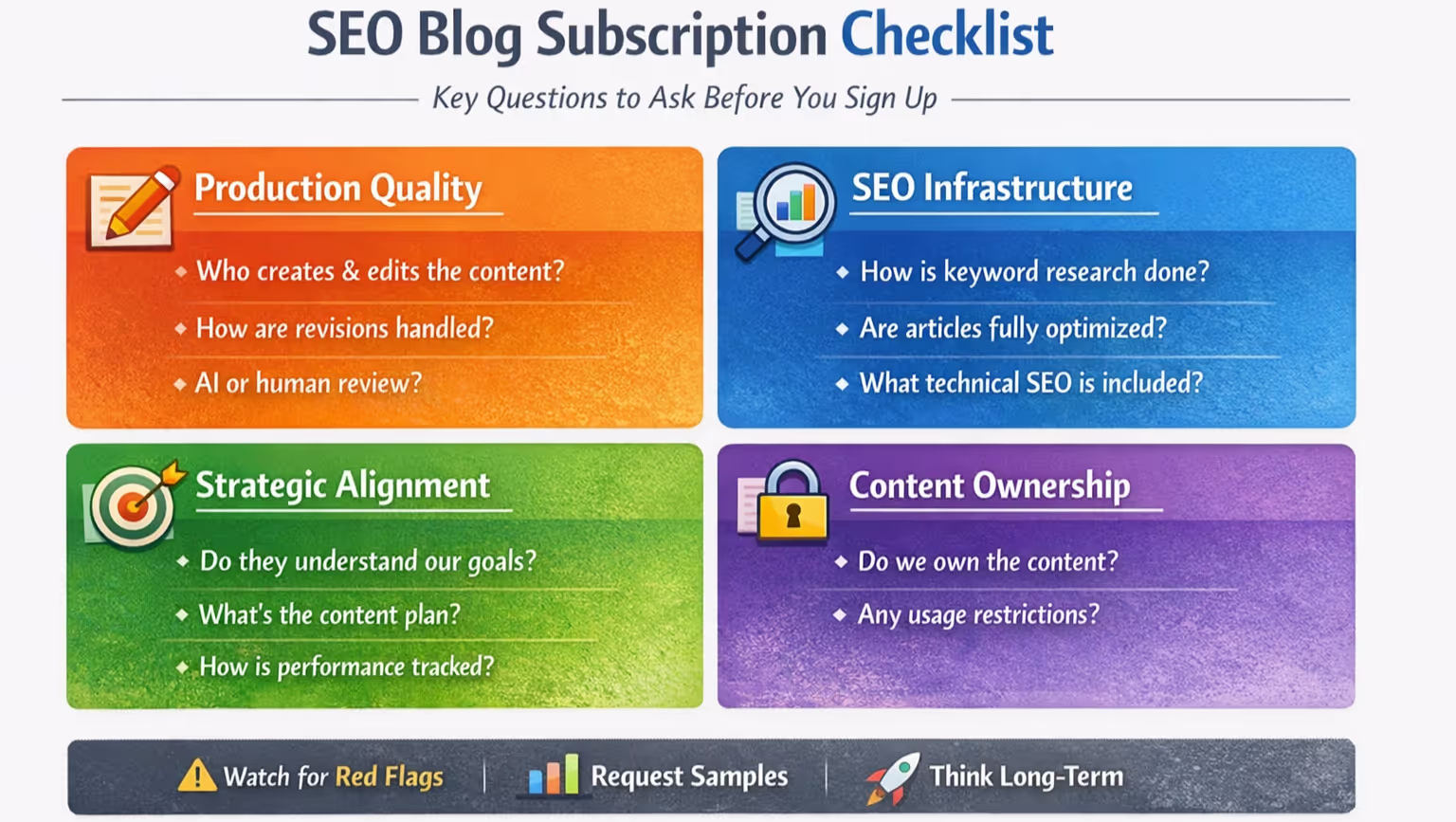
When evaluating providers, push for specifics:
"What percentage of content receives human review before delivery?"
"Who conducts keyword research, and how is it integrated into topic selection?"
"What happens after content publishes—is there any optimization or performance tracking?"
Clear, confident answers to these questions typically indicate providers who've built real systems. Vague assurances suggest you'll be the one filling in the gaps.
The Hidden Cost of Volume-First Thinking
Some subscription services lead with impressive output numbers. Fifty articles per month. One hundred blog posts quarterly.
The implied logic: more content equals more traffic.
The reality is more nuanced. Search engines increasingly reward topical authority and content quality over raw volume [3]. Publishing dozens of thin, undifferentiated articles can actually harm your organic visibility by:
Diluting your site's perceived expertise
Creating "content debt" (pages consuming crawl budget without contributing traffic)
Triggering quality filters that depress rankings site-wide
Quality-weighted subscription models—those emphasizing human review, strategic topic selection, and SEO optimization—typically outperform pure volume plays. The compounding effect of well-optimized content means fewer articles generating more traffic over time.
This doesn't mean volume is irrelevant. Consistent publishing signals activity to search engines and accumulates ranking opportunities. But volume without quality creates problems that are expensive to fix later.
The practical sweet spot for most businesses: Two to three well-optimized articles per week. Enough for consistency without sacrificing depth.
Questions to Ask Before Signing Any Contract
Before committing to a blog content retainer, get clear answers to these questions. Hesitant or evasive responses warrant caution.
About Production
Who writes the content, and what's their background?
What AI tools are used, and how is human oversight incorporated?
Can I see your revision process documented somewhere?
What happens if I'm still unsatisfied after revisions?
About SEO
How do you approach keyword research for my topics?
What on-page optimization is included with each article?
Do you handle internal linking and schema markup?
How do you decide which keywords to target first?
About Strategy
Walk me through your onboarding process.
Who decides what topics to cover each month—and based on what criteria?
How do you measure content performance?
What happens if content isn't ranking after three months?
About Logistics
What's the typical turnaround time from approval to published draft?
Do I own the content immediately and permanently?
What's the cancellation process if the service isn't working?
Are there minimum commitment periods?
Building Your Shortlist
With the evaluation matrix in hand, building a provider shortlist becomes methodical rather than overwhelming:
1. Identify your primary constraint. Is budget tight? Time limited? Internal expertise lacking? This determines which service model fits best.
2. Score three to five providers using the 10-point matrix. Focus on providers whose model aligns with your constraint.
3. Request samples or trials. Don't rely on case studies alone. See actual content they'd produce for you.
4. Verify SEO infrastructure. Ask for examples of keyword research documents, content calendars, or optimization checklists they've produced for other clients.
5. Evaluate cultural fit. The best content partnerships feel collaborative. Early interactions reveal whether a provider understands and respects your brand—or treats you like another order number.
Making the Final Decision
The right SEO blog subscription service isn't necessarily the cheapest, or the one with the most impressive feature list.
It's the one that aligns with how you actually work, what you actually need, and what results you're actually trying to produce.
For most growing businesses, that means prioritizing:
Consistency over sporadic bursts of content
Human quality control over pure AI generation
Integrated SEO strategy over generic article delivery
Transparent processes over black-box production
When those criteria are met, blog content stops being a cost center and becomes a compounding asset—generating organic traffic month after month without proportional ongoing investment.
The evaluation matrix in this guide exists because we built The Mighty Quill around these same principles: human-edited content, keyword research built into every engagement, and SEO infrastructure that gives articles a real chance to rank.
Ready to see what quality-first content looks like for your business? Try The Mighty Quill's Blog Engine free—receive two custom, SEO-optimized articles within 48 hours, no commitment required. See how your content scores against the framework above.
Frequently Asked Questions
How much should an SEO blog subscription service cost?
Pricing varies significantly by service model. Content mills may charge $50–$150 per article, while AI-powered blog engines typically run $250–$500 monthly for consistent weekly output with SEO included. Traditional agencies often require $2,000+ monthly retainers. Evaluate cost against what's actually included—keyword research, optimization, and human editing add value that raw word counts don't capture.
What's the difference between a content retainer and a blog subscription?
These terms often overlap. A content retainer typically implies broader scope—potentially including case studies, whitepapers, and web copy alongside blog posts. A blog subscription specifically focuses on regular blog article delivery. Both can include SEO optimization, though blog subscriptions more commonly emphasize consistent publishing cadence as the core deliverable.
How long before I see results from an SEO blog subscription?
Content marketing compounds over time. Most businesses see measurable organic traffic increases within three to six months of consistent publishing. Initial indexing and ranking signals appear earlier, but meaningful traffic growth requires search engines to recognize your site's growing topical authority. Plan for at least a 90-day runway before evaluating performance.
Should I choose a service using AI-generated content?
AI-assisted content creation has become standard across the industry. The critical distinction is whether AI output receives human editorial review and strategic oversight. Pure AI generation often produces generic, undifferentiated content that doesn't rank. AI combined with human editing and SEO strategy can deliver quality at scale. Ask specifically about the human review process before deciding.
What if the content doesn't match my brand voice?
Reputable providers include comprehensive onboarding to capture your voice, audience, and preferences before any content is created. Look for services offering revision rounds and maintaining consistent writer or editor assignments. If voice alignment issues persist after initial calibration, the provider may lack the infrastructure for brand-specific content at scale—and you should consider alternatives.
About This Guide
This evaluation framework reflects insights from years of experience in content marketing, SEO strategy, and digital growth. The Mighty Quill team works with SaaS companies, e-commerce brands, and agencies navigating the increasingly complex landscape of AI-powered search. Our recommendations prioritize sustainable organic growth through consistent, quality-first content systems.
Cited Works
Statista — "Average cost per click in Google Ads worldwide." https://www.statista.com/statistics/873639/google-ads-average-cost-per-click-worldwide/
BrightEdge Research — "Organic Search Improves Ability to Map to Consumer Intent." https://www.brightedge.com/resources/research-reports/organic-search
Google Search Central — "Creating helpful, reliable, people-first content." https://developers.google.com/search/docs/fundamentals/creating-helpful-content