

You've seen the pitch before: invest in consistent content, watch organic traffic grow, reap the rewards. But when the CFO asks for numbers—real numbers—vague promises about "compounding visibility" won't cut it.
The truth is most SEO ROI calculators are built on fantasy. They assume every visitor converts. They ignore the months where nothing seems to happen. They skip the part where you need to justify a recurring expense before results materialize.
This article takes a different approach. We're building a practical SEO blog engine ROI model you can actually use—one that accounts for different conversion scenarios, honest timelines, and the leading indicators that prove the system is working before revenue shows up.
Whether you're evaluating a content subscription or trying to get budget approval for a larger investment, you'll walk away with a framework that survives scrutiny from finance teams who've seen too many marketing projections fall apart.
Why Traditional SEO ROI Calculations Fall Apart
Most ROI content you'll find online commits the same errors. They project traffic growth in straight lines. They assume a single conversion rate applies universally. They treat "traffic" as synonymous with "revenue."
Here's what actually happens:
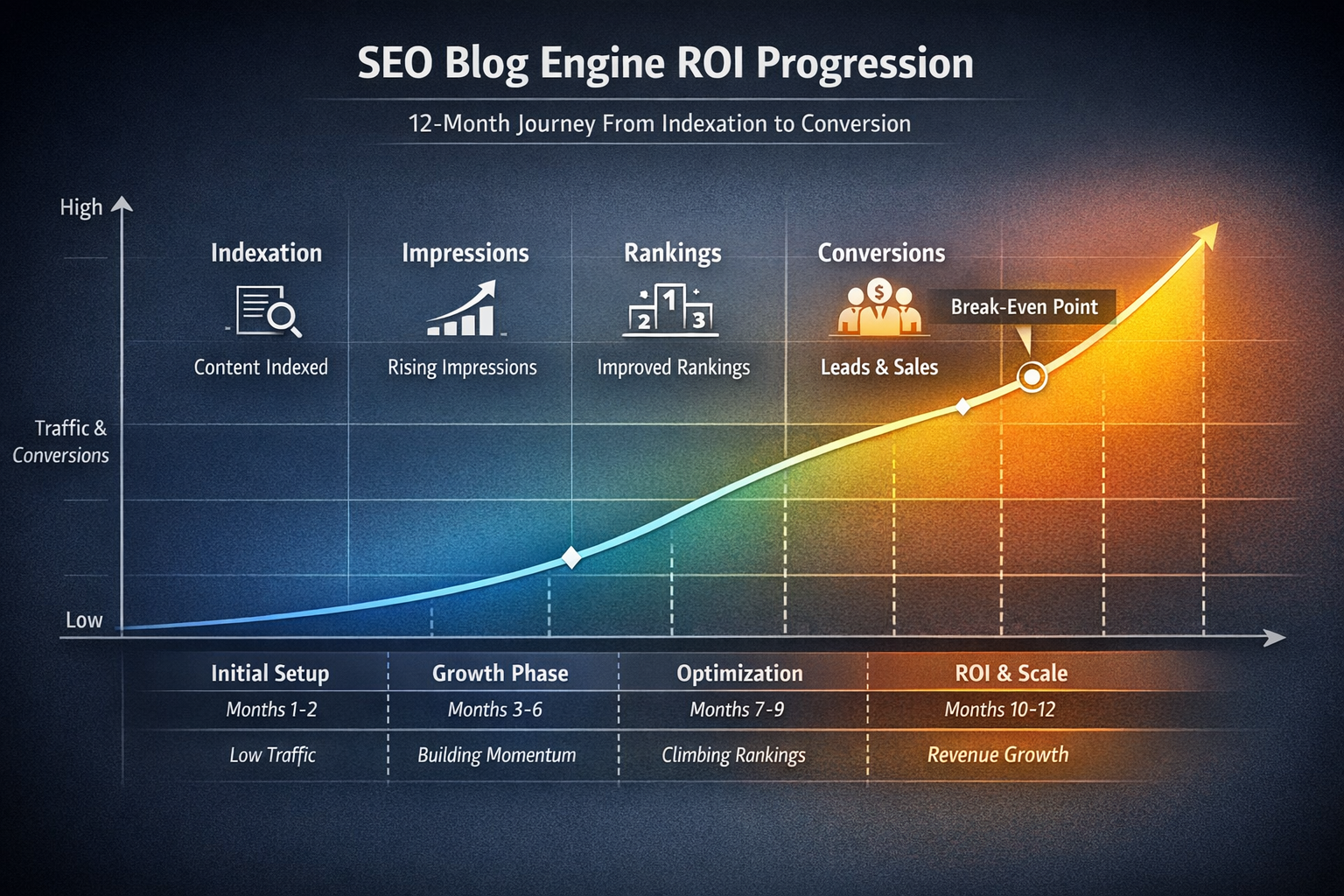
Content marketing follows an accumulation curve, not a linear path [1]. Early months often show minimal traffic gains while search engines index, evaluate, and eventually rank your content. Then—if the content is structured well and targets the right queries—growth compounds.
The disconnect between effort and visible results creates a credibility gap. Finance teams see three months of invoices and flat traffic charts. They start asking hard questions.
A useful ROI model needs to account for:
Lag time between publishing and ranking
Variable conversion rates across different traffic sources and content types
Leading indicators that signal progress before revenue appears
Realistic customer value tied to your specific business model
Attribution complexity in multi-touch B2B sales cycles
Let's build that model.
The Three Variables That Actually Matter
Before running any calculations, you need honest inputs. Garbage in, garbage out.
Variable 1: Customer Lifetime Value (LTV)
This is the average revenue a customer generates over their relationship with your business.
For SaaS companies, this typically means monthly recurring revenue multiplied by average customer lifespan. For e-commerce, it's average order value times purchase frequency. For service businesses, it's average project value times repeat engagement rate.
Important distinction for financial rigor: If you're presenting this model to a CFO, consider using margin-adjusted LTV rather than revenue LTV. A customer paying $1,500 who costs $900 to service contributes $600 in gross margin. For strict ROI calculations, the margin figure gives you a more accurate picture of what marketing spend actually returns.
For this article, we'll use revenue-based LTV for simplicity—but note that applying your gross margin percentage to the final calculations produces more conservative (and often more credible) projections.
Don't inflate this number. If your average customer pays $100/month and stays 14 months, your LTV is $1,400. If you're unsure, use a conservative estimate.
Variable 2: Organic Conversion Rate
This is where most models lie to themselves.
Industry benchmarks suggest organic traffic converts between 2-5% for most B2B websites, though this varies dramatically by industry and intent match [2]. But averages hide important distinctions:
Informational content (how-to guides, explainers) typically converts at 0.5-2%
Commercial investigation content (comparisons, reviews) converts at 2-4%
Transactional content (pricing pages, solution-specific landing pages) converts at 3-8%
A healthy content mix will include all three types. Your blended rate probably lands between 1-3% for qualified organic traffic.
A note on attribution: In B2B environments especially, SEO often plays an "assist" role rather than capturing full credit for conversions. A prospect might discover you through a blog post, leave, return via email, and finally convert after a sales call. Multi-touch attribution models account for this complexity—but for a baseline ROI model, using last-touch organic conversions provides a conservative floor. Your actual SEO contribution is likely higher than what last-touch data shows.
Variable 3: Monthly Content Investment
For this model, we'll use $400/month as an example—representative of done-for-you blog engine subscriptions that handle research, writing, optimization, and publishing.
You could substitute your own numbers: freelancer costs, agency retainers, or internal team allocation. The math works the same way regardless of the specific investment level.

Building the Break-Even Model
Here's a straightforward framework for calculating when content investment pays for itself.
Monthly Investment: $400 (example)
Break-Even Formula:
Monthly visitors needed = (Monthly cost) ÷ (Conversion rate × LTV)
Let's run three scenarios using different conversion assumptions and a $1,500 LTV (reasonable for many B2B SaaS or service businesses).
Scenario A: Conservative (1% Conversion Rate)
Monthly visitors needed = $400 ÷ (0.01 × $1,500) = 27 visitors/month
At a 1% conversion rate, you need just 27 incremental organic visitors monthly to break even. That's less than one visitor per day from your content efforts.
Scenario B: Moderate (2% Conversion Rate)
Monthly visitors needed = $400 ÷ (0.02 × $1,500) = 13 visitors/month
With a 2% conversion rate, break-even requires only 13 additional monthly visitors from organic search.
Scenario C: Optimistic (3.5% Conversion Rate)
Monthly visitors needed = $400 ÷ (0.035 × $1,500) = 8 visitors/month
At 3.5% conversion (achievable with well-targeted commercial content), you need fewer than 10 new visitors monthly.
The insight here: The bar for SEO content profitability is lower than most people assume—if you're creating content that attracts the right visitors and your conversion infrastructure works.
Adjusting for Your Business
These scenarios assume a $1,500 LTV. Your numbers will differ.
| Your LTV | 1% CVR Break-Even | 2% CVR Break-Even | 3.5% CVR Break-Even |
| $500 | 80 visitors | 40 visitors | 23 visitors |
| $1,000 | 40 visitors | 20 visitors | 11 visitors |
| $2,000 | 20 visitors | 10 visitors | 6 visitors |
| $5,000 | 8 visitors | 4 visitors | 2 visitors |
For high-LTV businesses (enterprise software, professional services, specialized e-commerce), the math becomes almost trivially easy. A single converted customer can justify months of content investment.
For lower-LTV businesses, you need higher traffic volumes—which means content strategy becomes more critical. You can't afford to rank for low-intent queries that don't convert.
For margin-conscious calculations: If your gross margin is 60%, multiply the visitor targets by roughly 1.7x to account for delivery costs. This gives you break-even on profit contribution rather than revenue.

The Timeline Problem: Leading Indicators That Matter
Here's where finance teams get nervous. SEO content doesn't produce instant results. Research indicates that the average top-10 ranking page takes considerable time to achieve that position, though pages targeting lower-competition keywords can rank within months [3].
You need metrics that demonstrate progress during the accumulation phase—before revenue materializes.
Leading Indicator 1: Indexation Rate
What it measures: Whether Google is discovering and storing your content.
Why it matters: Content can't rank if it isn't indexed. A healthy site should see new posts indexed within days of publication.
What to track: Google Search Console's "Pages" report shows indexed vs. non-indexed URLs. You want to see new content moving into the indexed bucket quickly.
Target: 95%+ of published content indexed within 2 weeks.
Leading Indicator 2: Impressions Growth
What it measures: How often your pages appear in search results (regardless of clicks).
Why it matters: Impressions precede clicks. Rising impressions indicate Google is testing your content for relevant queries—even if rankings aren't yet high enough to generate traffic.
What to track: Google Search Console's Performance report. Filter by page or query to see impression trends.
Target: Month-over-month impression growth, particularly for target keywords.
Leading Indicator 3: Ranking Velocity
What it measures: How quickly new content enters ranking positions and climbs.
Why it matters: A page ranking #47 today might reach #7 in three months. Tracking position changes reveals whether content is gaining authority.
What to track: Rank tracking tools (Ahrefs, SEMrush, or GSC average position). Look for consistent upward movement.
How to interpret movement:
Position 100 to 50: Noise—Google is still evaluating
Position 50 to 20: Signal—content is gaining traction
Position 20 to 10: Strong signal—optimize and support with internal links
Position 10 to 3: High value—consider updating to maintain position
Target: New content appearing in top 50 within 30-60 days for target keywords; progressive improvement over 90-180 days.
Leading Indicator 4: Click-Through Rate by Position
What it measures: Whether your titles and meta descriptions compel clicks relative to ranking position.
Why it matters: High CTR signals relevance and can reinforce rankings. Low CTR indicates optimization opportunities.
What to track: GSC Performance report, segmented by query and position. Compare your CTR to position benchmarks [4].
Target: CTR at or above position averages (roughly 30%+ for position 1, 15% for position 2, declining from there).
Creating Your Monthly Progress Report
Combine these indicators into a simple dashboard that tells a coherent story:
| Metric | Month 1 | Month 2 | Month 3 | Trend |
| Posts Published | 8 | 8 | 8 | Stable |
| Indexed Pages | 8 | 15 | 22 | ↑ |
| Total Impressions | 1,200 | 3,400 | 8,100 | ↑ |
| Avg. Position (target KWs) | 42 | 31 | 19 | ↑ |
| Organic Clicks | 45 | 127 | 298 | ↑ |
| Conversions | 0 | 1 | 3 | ↑ |
This progression—indexation → impressions → rankings → clicks → conversions—is the natural sequence. When you can show consistent movement through each stage, the revenue case makes itself.
Where to pull this data:
Posts Published: Your CMS or content calendar
Indexed Pages: Google Search Console → Pages
Impressions & Clicks: Google Search Console → Performance
Average Position: Google Search Console or rank tracking tools
Conversions: Google Analytics (set up goal tracking for organic traffic segment)
The Compounding Effect: Why Patience Pays
Content marketing isn't a linear game. Research shows that older blog posts often generate the majority of traffic and leads over time as they accumulate authority and backlinks [5].
Here's what that means practically:
Month 3: You have 24 posts. Some start ranking. Traffic: modest.
Month 6: You have 48 posts. Earlier posts gain authority. New posts benefit from internal linking. Traffic multiplies.
Month 12: You have 96 posts. Multiple pieces rank on page one. Domain authority lifts newer content faster. Traffic compounds significantly.
The first three months of a content subscription might generate modest direct returns. But you're building an asset that continues producing traffic—and revenue—long after each piece is written.
This compounding effect is why subscription-based content models make financial sense. Sporadic publishing never builds enough momentum. Consistent publishing creates the conditions for exponential growth.
Connecting Content Investment to Customer Acquisition Cost
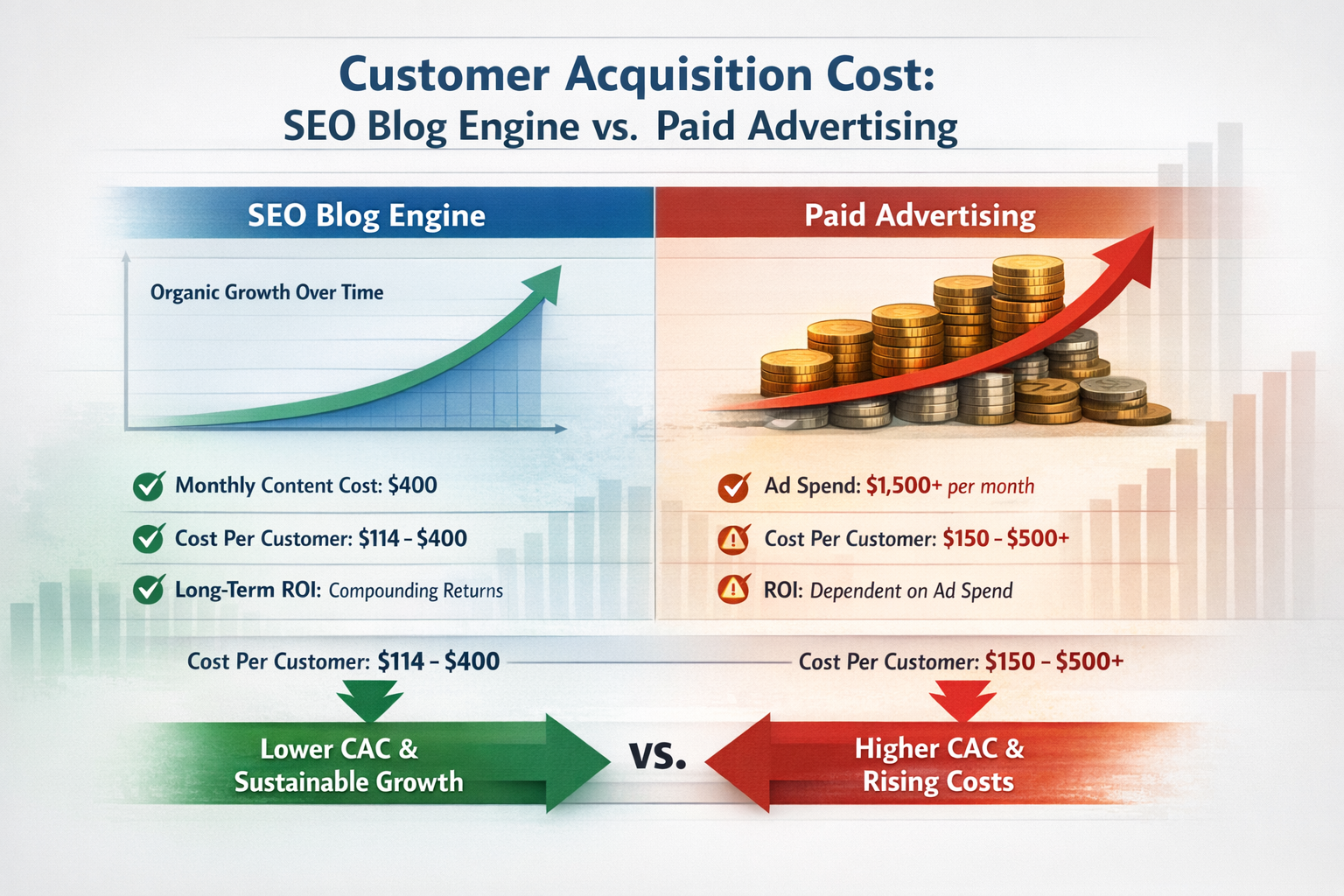
For finance teams accustomed to evaluating marketing spend, framing content ROI in terms of Customer Acquisition Cost (CAC) can strengthen your case.
Simple CAC calculation for content:
CAC = Monthly content investment ÷ Monthly customers acquired from organic
Using our earlier scenarios with $400/month investment:
At 1% conversion with 100 organic visitors: 1 customer → $400 CAC
At 2% conversion with 100 organic visitors: 2 customers → $200 CAC
At 3.5% conversion with 100 organic visitors: 3.5 customers → $114 CAC
Compare this to your paid acquisition CAC. If you're spending $150+ per customer on ads, content that delivers equivalent or better CAC becomes strategically valuable—especially since the content asset continues producing after the initial investment.
Marketing Efficiency Ratio (MER) offers another lens: total revenue divided by total marketing spend. As organic traffic grows while content investment stays flat, your MER improves over time—unlike paid channels where costs scale linearly with results.
When SEO Content Investment Doesn't Make Sense
Intellectual honesty requires acknowledging when this model breaks down.
Content investment may not fit if:
Your LTV is very low (<$100) AND conversion rates are structurally limited
Your market is so competitive that ranking requires massive authority you don't have time to build
Your customers don't use search to find solutions (some B2B enterprise sales rely entirely on referrals and outbound)
You need revenue in 30 days or less (paid acquisition is faster, though often more expensive long-term)
Content investment makes strong sense when:
Your LTV supports the math (even conservative scenarios)
Your target customers research solutions via search
You can commit to 6+ months of consistent execution
You have conversion infrastructure in place (landing pages, CTAs, nurture sequences)
Validating Your Assumptions Cheaply
The smartest approach to content investment isn't committing blindly to a long-term engagement. It's testing your assumptions with minimal risk.
A free trial—like receiving two optimized articles delivered within 48 hours—lets you evaluate:
Content quality and brand alignment
Whether the topics match your strategic priorities
How the content performs in initial indexation and engagement metrics
From there, you can run a 90-day pilot at the subscription level and measure against the leading indicators we discussed. If indexation, impressions, and rankings move in the right direction, the revenue math will follow.
This phased approach gives you real data to bring to budget conversations—not projections based on industry averages someone pulled from a blog post.
Making the Case to Stakeholders
When presenting SEO content ROI to leadership, structure the conversation around three elements:
1. The Investment Frame
Position content as asset creation, not expense. Each article is a permanent (or semi-permanent) asset that can generate traffic for years. Compare this to paid ads, where traffic stops the moment spending stops.
2. The Conservative Math
Use your break-even calculations with the conservative conversion rate. If the model works at 1% conversion, it almost certainly works in reality. Consider presenting margin-adjusted figures for financial credibility.
3. The Validation Path
Propose a pilot with clear leading indicator milestones. Define what success looks like at 30, 60, and 90 days—using metrics that precede revenue but predict it.
This approach respects skepticism while providing a path to proof.
Try the Math With Your Own Numbers
Ready to run your specific scenario?
Grab these inputs:
Your average customer LTV (revenue-based or margin-adjusted)
Your current organic conversion rate (check Google Analytics)
Your target monthly content investment
Run the break-even formula:
Visitors needed = Investment ÷ (Conversion rate × LTV)
Compare to realistic traffic projections:
Based on your keyword targets and competition levels, can consistent content reach that visitor threshold within 6-12 months?
For most businesses with reasonable LTV and functional conversion paths, the answer is yes—often by a comfortable margin.
If you want to test whether a content subscription model works for your specific situation, starting with a low-risk trial makes sense. Two articles in 48 hours costs nothing but gives you real data on quality, fit, and potential.
Start your free trial and see what the math looks like with actual content in hand.
Frequently Asked Questions
How long does it take for SEO content to generate measurable ROI?
Most businesses see meaningful organic traffic improvements within 3-6 months of consistent publishing, though individual articles may start ranking earlier for lower-competition keywords. Leading indicators like indexation and impression growth typically appear within weeks, providing early signals that the strategy is working before revenue materializes. The key is tracking the right metrics at each stage rather than expecting immediate conversions.
What conversion rate should I use for SEO ROI calculations?
Start with your actual data—check Google Analytics for organic traffic conversion rates specific to your site. If you lack historical data, use 1-2% as a baseline for B2B and 2-3% for e-commerce. Using conservative assumptions makes your ROI case more credible with finance teams and leaves room for upside. Remember that SEO often assists conversions in multi-touch journeys, so last-touch data may undercount its true contribution.
Is it better to invest in SEO content or paid advertising?
Both serve different purposes in a marketing mix. Paid advertising generates immediate traffic but stops when spending stops—and costs scale linearly with results. SEO content takes longer to produce results but creates lasting assets that compound over time with fixed ongoing investment. For sustainable, long-term customer acquisition, content typically delivers better ROI, though many businesses benefit from using both channels strategically during different growth phases.
How many blog posts per month do I need to see results?
Research suggests that publishing frequency correlates with traffic growth, with consistent weekly publishing generally outperforming sporadic efforts. However, quality and strategic targeting matter more than raw volume. A consistent cadence of 2-3 well-optimized posts weekly provides enough momentum for meaningful compounding while maintaining quality standards. The key is sustainability—eight mediocre posts won't outperform four excellent ones.
What's the biggest mistake companies make with content ROI calculations?
The most common error is measuring too early and expecting immediate revenue. SEO content follows an accumulation curve—early months build the foundation for later growth. Companies that abandon content strategies at month 3 never see the compounding returns that typically emerge around months 6-12. The second biggest mistake is using revenue LTV instead of margin-adjusted LTV, which can make ROI projections look better than financial reality.
About This Content
This analysis draws on direct experience building content systems for B2B and e-commerce companies, combined with industry research on SEO performance benchmarks. The ROI framework presented here reflects real-world subscription pricing models and conversion data rather than theoretical projections. We believe in transparent, practical guidance that helps businesses make informed decisions about content investment—whether that means working with us or building internal capabilities.
Cited Works
[1] Ahrefs — "How Long Does It Take to Rank in Google?"
https://ahrefs.com/blog/how-long-does-it-take-to-rank/
[2] First Page Sage — "B2B SaaS Marketing Conversion Rate Benchmarks" https://firstpagesage.com/seo-blog/conversion-rate-benchmarks/
[3] Ahrefs — "How Long Does It Take to Rank in Google?"
https://ahrefs.com/blog/how-long-does-it-take-to-rank/
[4] Backlinko — "Google CTR Stats" https://backlinko.com/google-ctr-stats[5] HubSpot — "Compounding Blog Posts: What They Are and Why They Matter" https://blog.hubspot.com/marketing/compounding-blog-posts-what-why-matter


