Your product pages and category pages work hard. They carry technical specs, pricing, and purchase buttons—everything a ready-to-buy customer needs. But they're not equipped to answer the questions shoppers ask before they're ready to buy.
That gap is costing you traffic. More importantly, it's costing you trust.
Search engines have evolved beyond matching keywords to serving answers. Google's helpful content system and AI-powered features like Search Generative Experience now prioritize content that demonstrates genuine experience and expertise [1]. For e-commerce brands, this shift demands more than optimized product listings. It requires a content strategy built around buying intent—the questions, comparisons, and concerns that shape purchasing decisions.
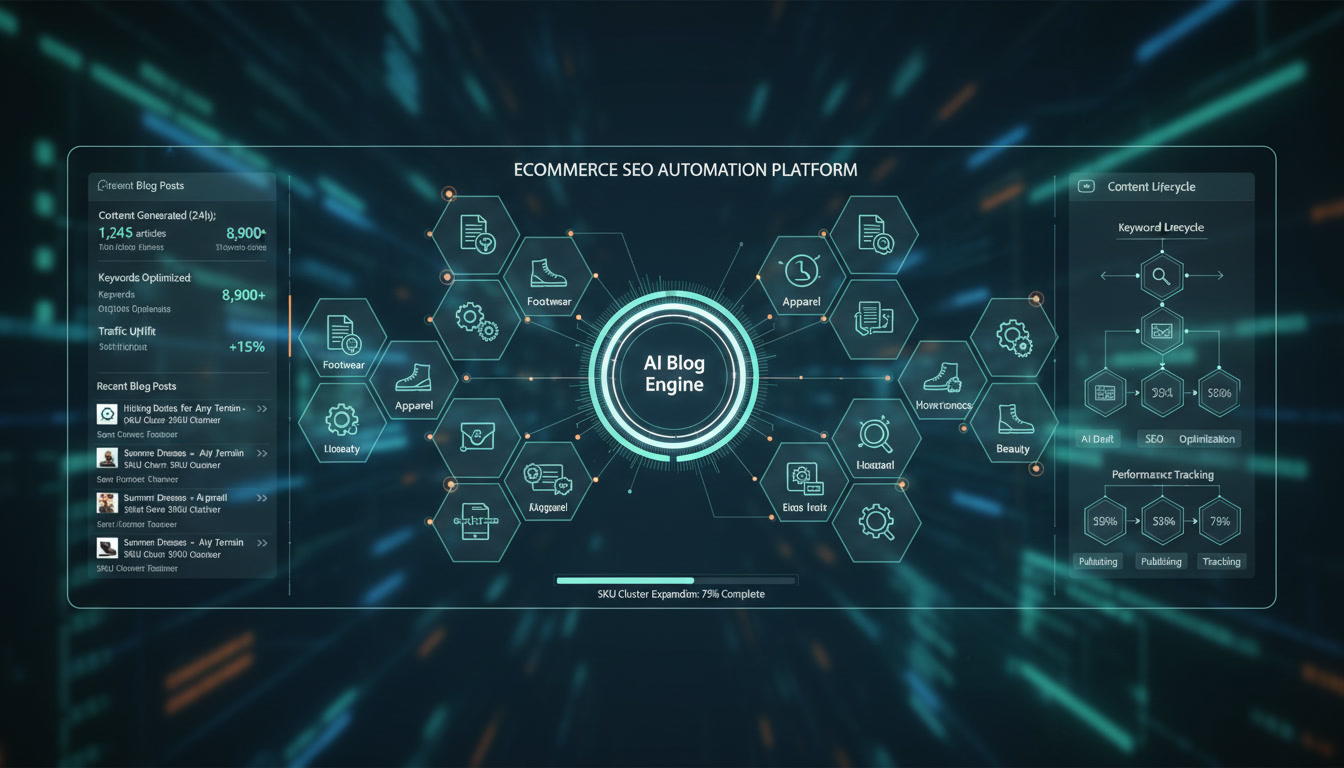
Automated blog engines offer a practical path forward. They help e-commerce businesses scale content production without sacrificing quality, turning product knowledge into searchable, answer-ready content that builds authority across entire SKU clusters.
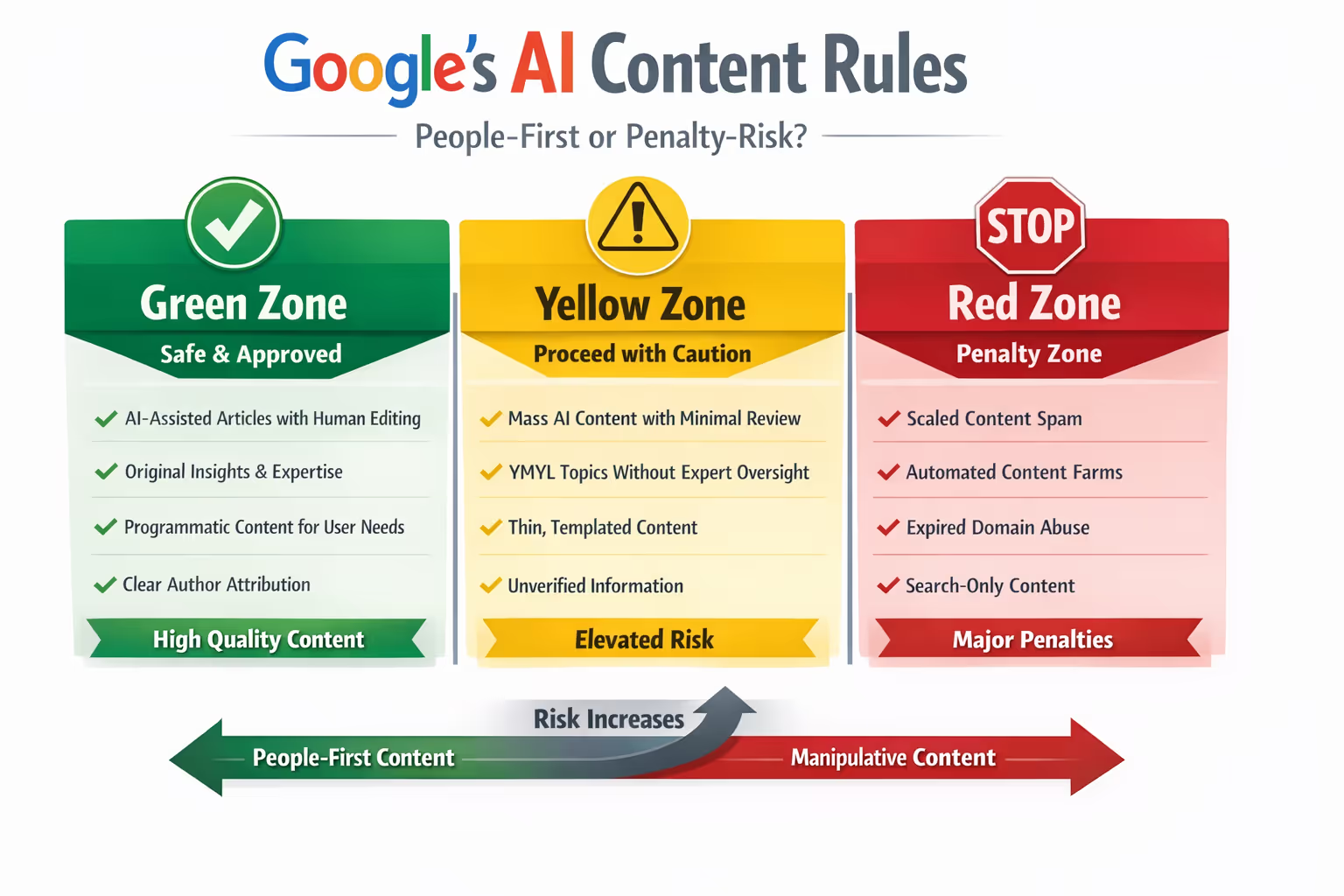
But here's the uncomfortable truth: most AI-generated content fails to index at all. Raw, unedited AI output often reads like a summary of summaries—exactly what search engines have learned to deprioritize. The automation that works combines systematic AI drafting with strategic human oversight. That distinction matters more than ever.
Why Product Pages Alone Can't Win AI-Driven Search
Product pages serve a specific function: converting visitors who already know what they want. They're transactional by design.
But most customer journeys don't start with a product name. They start with questions:
"What's the difference between memory foam and hybrid mattresses?"
"Best running shoes for flat feet"
"How do I choose the right size generator for my RV?"
These queries represent buying intent at different stages. Customers researching these topics aren't ready to purchase yet, but they're moving toward a decision. The brands that show up with helpful, specific answers earn consideration—and often, the sale.
AI search tools amplify this dynamic. When someone asks ChatGPT or Perplexity for a recommendation, those systems pull from content that demonstrates topical depth and firsthand knowledge [2]. Thin product descriptions don't make the cut. Neither do category pages optimized only for navigation.
The brands winning in AI-driven search treat their content library as a competitive asset—not an afterthought updated when someone remembers the blog exists.
The E-E-A-T Problem in Generic E-commerce Content
Google's quality guidelines emphasize Experience, Expertise, Authoritativeness, and Trustworthiness [3]. For e-commerce sites, the "Experience" component presents a particular challenge.
Generic blog posts scraped together from competitor sites or generated without product knowledge lack the specific, grounded perspective that signals real expertise. They read like summaries rather than guidance.
Consider the difference:
Generic content: "When choosing a laptop, consider factors like processor speed, RAM, and storage capacity."
Experience-driven content: "We've tested dozens of laptops in this price range. The [Product X] handles video editing smoothly with its dedicated GPU, while the [Product Y] struggles with anything beyond basic photo work—despite similar specs on paper."
The second example demonstrates actual product knowledge. It answers the question a shopper is really asking: "Which one should I buy, and why?"
Building this kind of content across hundreds or thousands of SKUs requires a systematic approach. Manual content creation at that scale typically proves unsustainable—teams burn out, consistency suffers, and the blog becomes another neglected asset.
How Automated Blog Engines Address Scale and Quality
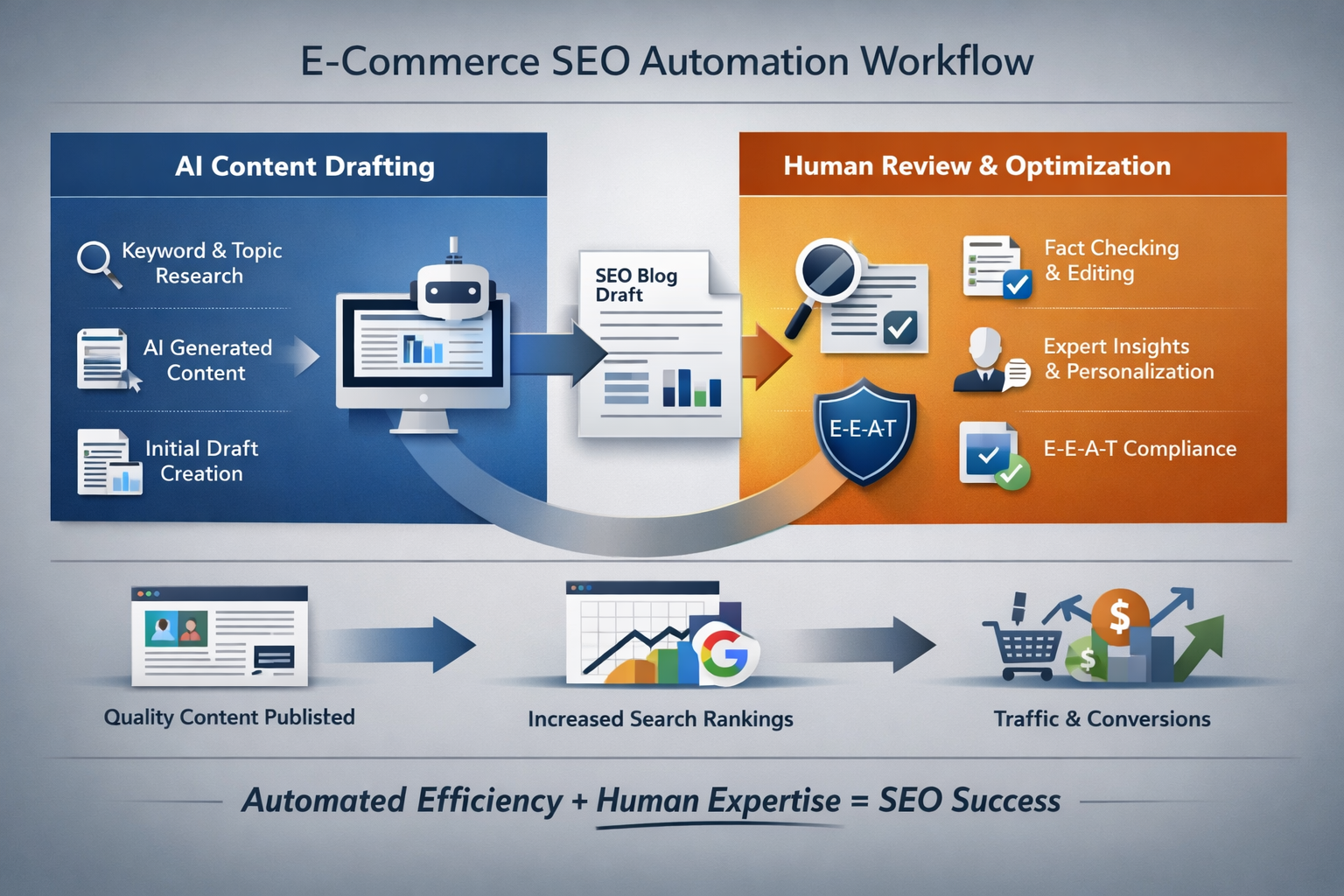
An automated blog engine combines AI-powered content generation with strategic oversight and human editing. The goal isn't to replace expertise—it's to operationalize it.
Here's how the process typically works:
1. Keyword and topic research identifies high-intent queries across your product categories
2. Topic clustering groups related queries around SKU families or buyer personas
3. AI-assisted drafting produces structured content following SEO best practices
4. Human review and editing ensures the content passes quality checks:
Hallucination checks (verifying AI didn't invent product features or specifications)
Formatting for skim-readers (breaking walls of text, adding subheadings)
Brand voice alignment (matching your company's tone and terminology)
Accuracy verification (confirming claims match actual product capabilities)
5. Consistent publishing maintains a predictable cadence—often two to three posts per week
This approach lets e-commerce brands cover the full buying journey: awareness-stage educational content, consideration-stage comparisons, and decision-stage guides that link naturally to product pages.
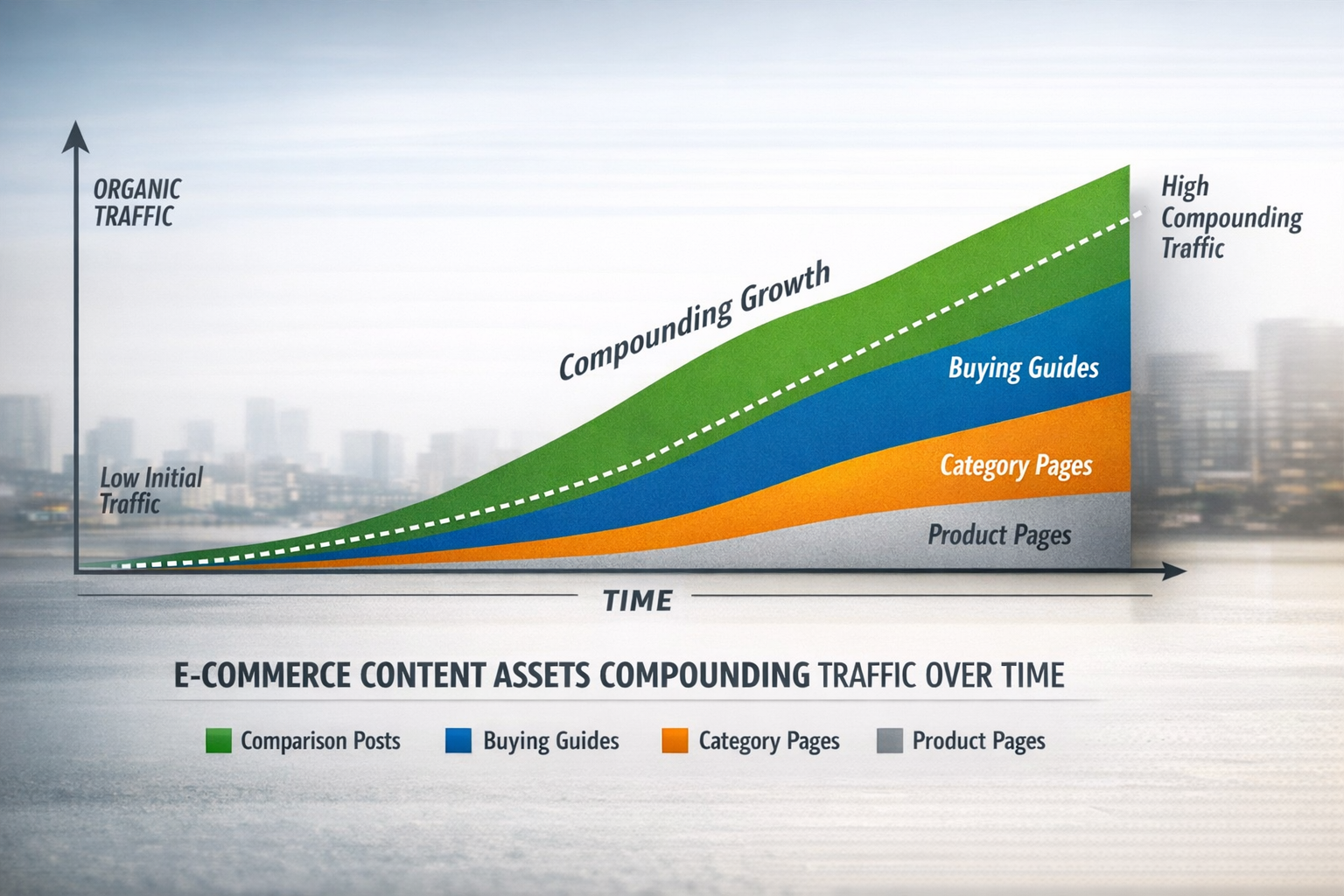
The compounding effect matters. One well-researched comparison post might rank for dozens of related long-tail queries. Multiply that across your catalog, and organic traffic becomes a growth engine rather than a static metric.
Building Answer-Ready Content for SKU Clusters
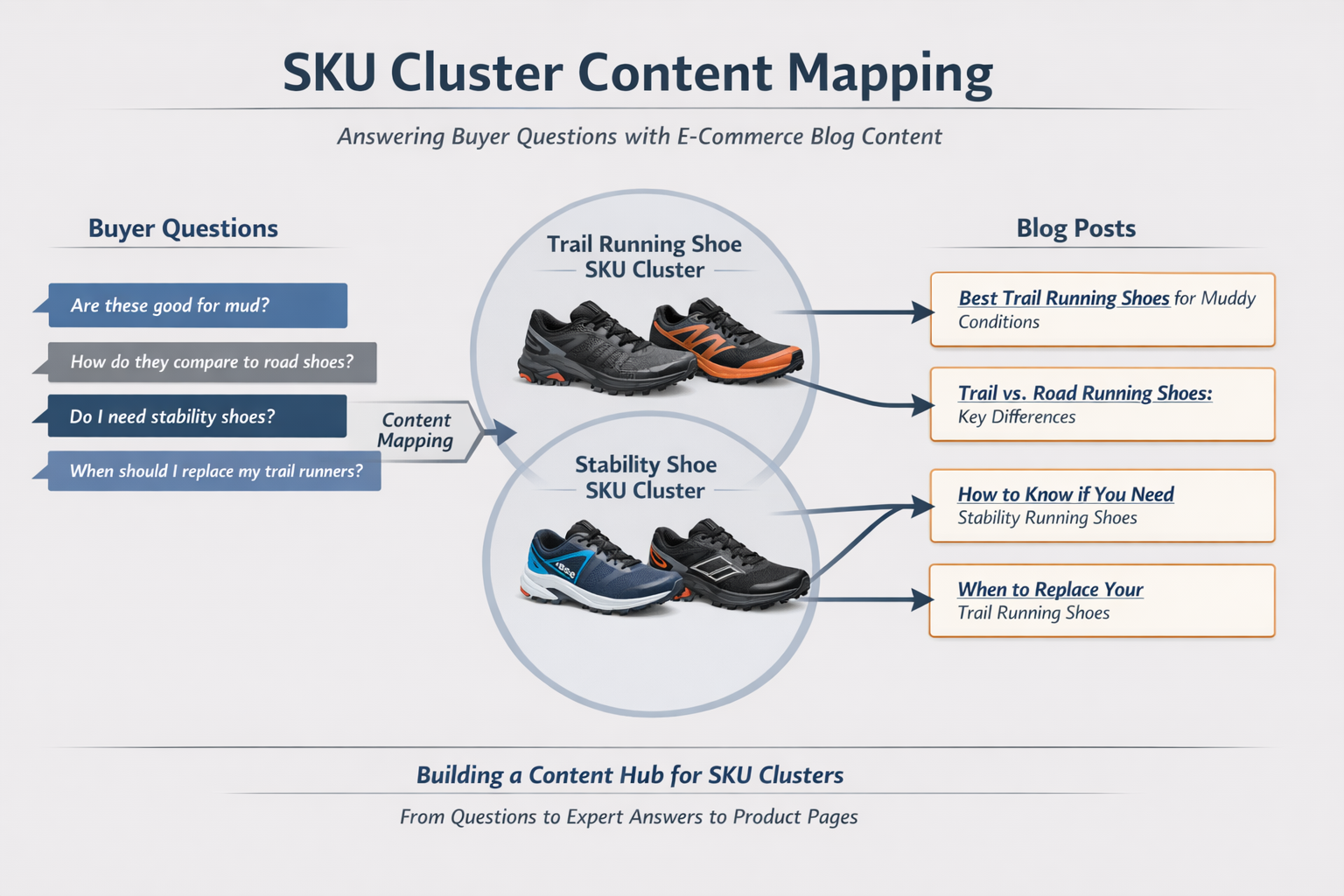
SKU clusters represent groups of related products that serve similar customer needs. A running shoe retailer might have clusters around trail running, road running, stability shoes, and racing flats.
Each cluster generates its own ecosystem of buyer questions. Mapping content to these questions creates topical depth that search engines recognize and reward.
Here's what a SKU cluster content map looks like in practice:
| SKU Cluster | Example Product | Buyer Question | Blog Post Title |
| Trail Running | Salomon Speedcross 5 | Are these good for mud? | Best Trail Running Shoes for Muddy Conditions |
| Trail Running | Hoka Speedgoat 5 | How do these compare to road shoes? | Trail Running Shoes vs. Road Running Shoes: Key Differences |
| Trail Running | Brooks Cascadia 16 | How often should I replace them? | When to Replace Your Trail Running Shoes (Signs to Watch) |
| Stability Shoes | ASICS Gel-Kayano | Do I need stability shoes? | How to Know If You Need Stability Running Shoes |
| Stability Shoes | Brooks Adrenaline GTS | What's the difference from neutral shoes? | Stability vs. Neutral Running Shoes: Which Do You Need? |
Rather than publishing isolated posts on random topics, you're building interconnected content hubs that signal comprehensive expertise in specific areas.
Internal linking reinforces this structure. Educational posts link to comparison guides, which link to product pages. This creates clear pathways for both search crawlers and human visitors navigating their buying journey.
Practical Steps for E-commerce Content Automation
Getting started doesn't require overhauling your entire operation. Focus on these foundational elements:
Identify your highest-value SKU clusters. Start with product categories that drive meaningful revenue and face search competition. These warrant the content investment first.
Map the buyer journey for each cluster. What questions do customers ask at awareness, consideration, and decision stages? Use search data, customer service logs, and reviews to build this picture. Your support team's most common questions often reveal your highest-value content opportunities.
Establish content guidelines that capture your expertise. Document what makes your products different, common customer misconceptions, and the specific advice your team gives shoppers. This knowledge should inform every piece of content—it's what separates useful guides from generic filler.
Choose a publishing cadence you can sustain. Consistency beats intensity. Two quality posts per week for a year outperforms a content sprint followed by silence.
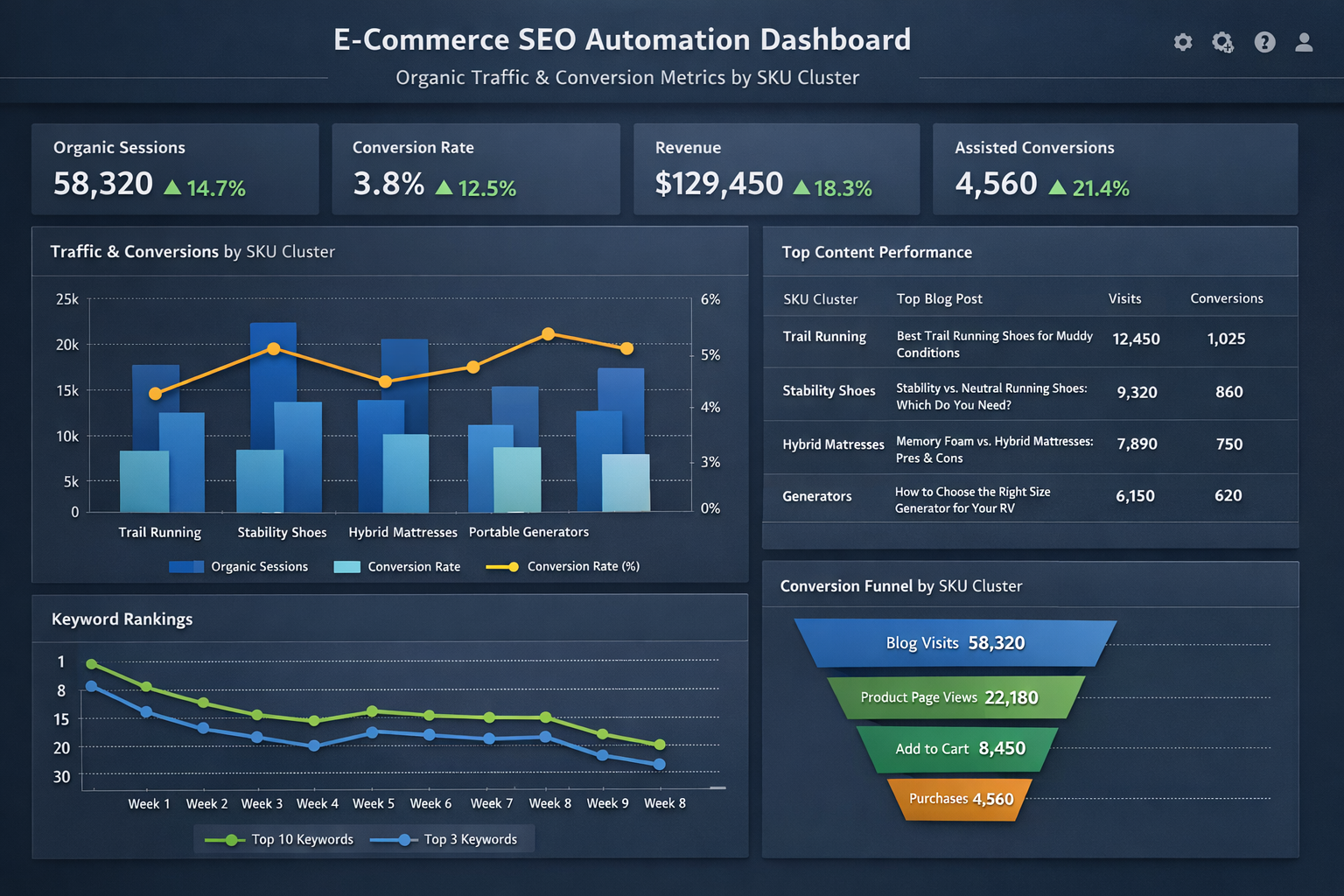
Build measurement systems early. Track organic traffic by SKU cluster, monitor which content drives product page visits, and measure conversion paths. This data shapes ongoing strategy.
Measuring What Matters for E-commerce SEO
Vanity metrics mislead. Total blog traffic matters less than traffic that demonstrates buying intent.
Focus on:
Organic sessions to product pages from blog content
Keyword rankings for commercial and transactional queries in your categories
Time on page and scroll depth (signals of genuine engagement)
Assisted conversions where blog content appeared in the customer journey
Domain authority growth over time, particularly for category-relevant topics
These metrics reveal whether your content strategy actually supports sales—not just traffic numbers that look impressive in reports.
The Long Game: Why Content Assets Beat Campaigns
Search visibility isn't built overnight. Content marketing for e-commerce operates on a timeline measured in months, not weeks.
The difference between campaigns and content assets explains why:
| Campaigns | Content Assets |
| Traffic stops when spending stops | Traffic compounds over time |
| Each campaign starts from zero | Each post builds on previous authority |
| Costs scale linearly with reach | Costs stay flat as reach grows |
| Dependent on platform algorithms | Earns direct search visibility |
| Renting attention | Owning attention |
The brands that win commit to consistent, quality-focused publishing over extended periods. They treat their blog as a strategic asset rather than an afterthought.
Automated blog engines make this commitment practical. They remove the operational friction that causes content programs to stall—the missed deadlines, the scramble to find writers, the inconsistent quality when workloads spike.
When your content system runs reliably, you can focus on strategy: which topics to pursue, how to differentiate your perspective, and where to double down based on performance data.
Ready to build your e-commerce content engine? View our e-commerce specific pricing tiers to find a plan that matches your catalog size and growth goals.
Frequently Asked Questions
How is automated blog content different from AI-generated product descriptions?
Automated blog engines produce strategic, long-form content designed to rank for informational and commercial queries—the questions shoppers ask before they're ready to buy. Product descriptions serve transactional pages. Blog content builds the topical authority that makes your entire site more competitive in search, capturing customers earlier in their buying journey.
How long before automated content impacts e-commerce SEO?
Most e-commerce sites see measurable organic traffic increases within three to six months of consistent publishing. Results depend on your current domain authority, competition level, and content quality. The compounding effect accelerates over time as your content library grows and earns backlinks from other sites.
Can automated content match our brand voice and product expertise?
Quality blog engines include human review and customization based on your brand guidelines, product knowledge, and customer insights. The automation handles scale and consistency; human oversight ensures accuracy, catches AI hallucinations, and maintains voice alignment. The combination matters—neither pure AI nor pure manual processes deliver both quality and volume.
How many blog posts does an e-commerce site need per week?
Two to three well-researched posts per week provides enough volume to build topical authority without sacrificing quality. The right cadence depends on your catalog size, competitive landscape, and internal capacity to review content before publication. Consistency matters more than volume—regular publishing signals to search engines that your site is actively maintained.
Does blog content cannibalize traffic from product pages?
Strategic content actually drives traffic to product pages through internal linking and buyer journey mapping. Educational and comparison content captures visitors earlier in their research process, then guides them toward relevant products when they're ready to buy. The blog becomes a pathway to conversion, not competition for it.
About Our E-commerce Content Expertise
The Mighty Quill specializes in AI-powered content systems for growth-focused e-commerce brands. Our team combines over fifteen years of digital marketing experience—including deep expertise in Amazon PPC and e-commerce SEO—with systematic content production designed for scale. We understand the specific challenges of building search visibility across large product catalogs and have helped clients achieve measurable improvements in organic traffic and domain authority.
Cited Works
Google Search Central — "Creating helpful, reliable, people-first content." https://developers.google.com/search/docs/fundamentals/creating-helpful-content [1]
Search Engine Journal — "How AI Search Is Changing SEO." https://www.searchenginejournal.com/ai-search-seo/ [2]
Google Search Central — "E-E-A-T and quality rater guidelines." https://developers.google.com/search/docs/fundamentals/creating-helpful-content [3]