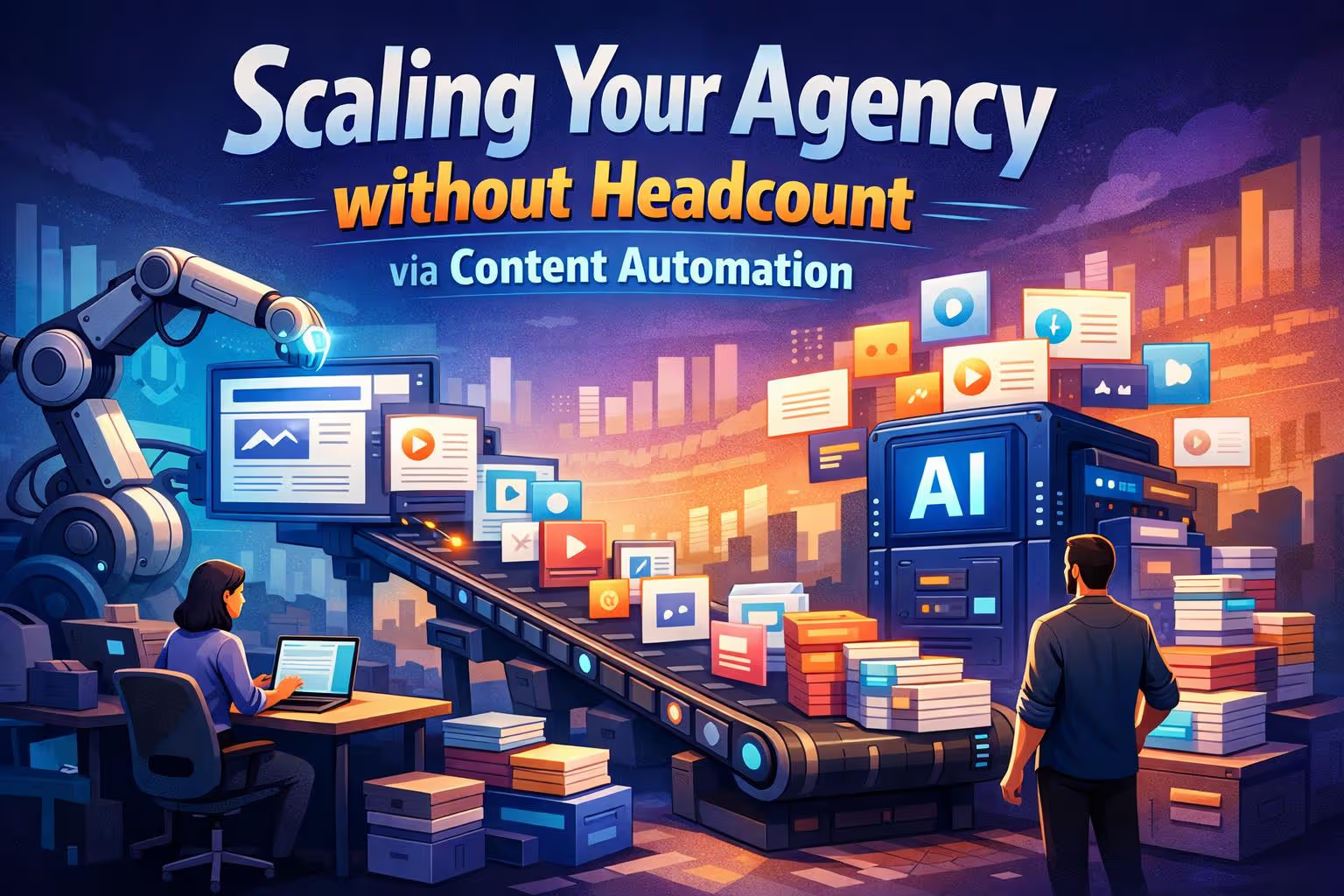
Most agency owners hit the same wall. Revenue grows, but so does payroll. Every new client means another writer, another project manager, another round of hiring headaches. The math never quite works out the way you hoped.
The traditional agency model turns content into a service burden. You're selling hours, managing people, and watching profit margins shrink with every new retainer.
But what if content wasn't a cost center at all? What if you could transform it into a high-margin product—one that scales without scaling headcount?
That's exactly what content automation makes possible. Agencies that figure this out aren't just surviving. They're building fundamentally different businesses.
Why the Freelancer Model Breaks at Scale
The default playbook looks familiar. Land a client, hire a freelancer, manage the workflow, pray the quality stays consistent. Rinse and repeat.
This model has three structural problems:
Margin compression is inevitable. As you add clients, you add labor costs at nearly the same rate. Your gross margins hover somewhere between 30-50%, and that's before accounting for the management overhead nobody tracks properly [1].
Quality variance creates churn. Freelancers come and go. Their availability shifts. One month you have a stellar writer; the next month they're ghosting you for a better gig. Clients notice the inconsistency, even when they can't articulate it.
Your time becomes the bottleneck. Managing freelancers takes hours you don't have. You end up spending more time coordinating than actually growing the business.
The agencies that break through this ceiling aren't finding better freelancers. They're removing the freelancer dependency entirely.
The Product Shift: Content as a Scalable Asset
When you automate content production using AI-powered systems, you stop selling hours and start selling outcomes. The delivery mechanism becomes a product—consistent, repeatable, and largely decoupled from human labor.
Consider the economics:
A traditional agency might deliver 8 blog posts per month per client with a team of writers, editors, and project managers
An automated content engine can produce the same volume with a fraction of the oversight
The variable cost per piece drops significantly while the client price stays the same
This isn't about replacing humans with robots. It's about replacing chaos with systems.
The best automated content workflows still involve human oversight—strategic direction, quality checks, brand alignment. But the heavy lifting of research, drafting, and optimization happens systematically rather than manually [2].
Building Profit Margins That Actually Compound
Traditional content agencies operate on a linear revenue model. One more client requires roughly one more unit of labor. Growth requires proportional hiring.
Automated content operations work differently. Once the system is built, adding clients requires incremental management time—not proportional labor. This creates operating leverage: your costs grow slower than your revenue.
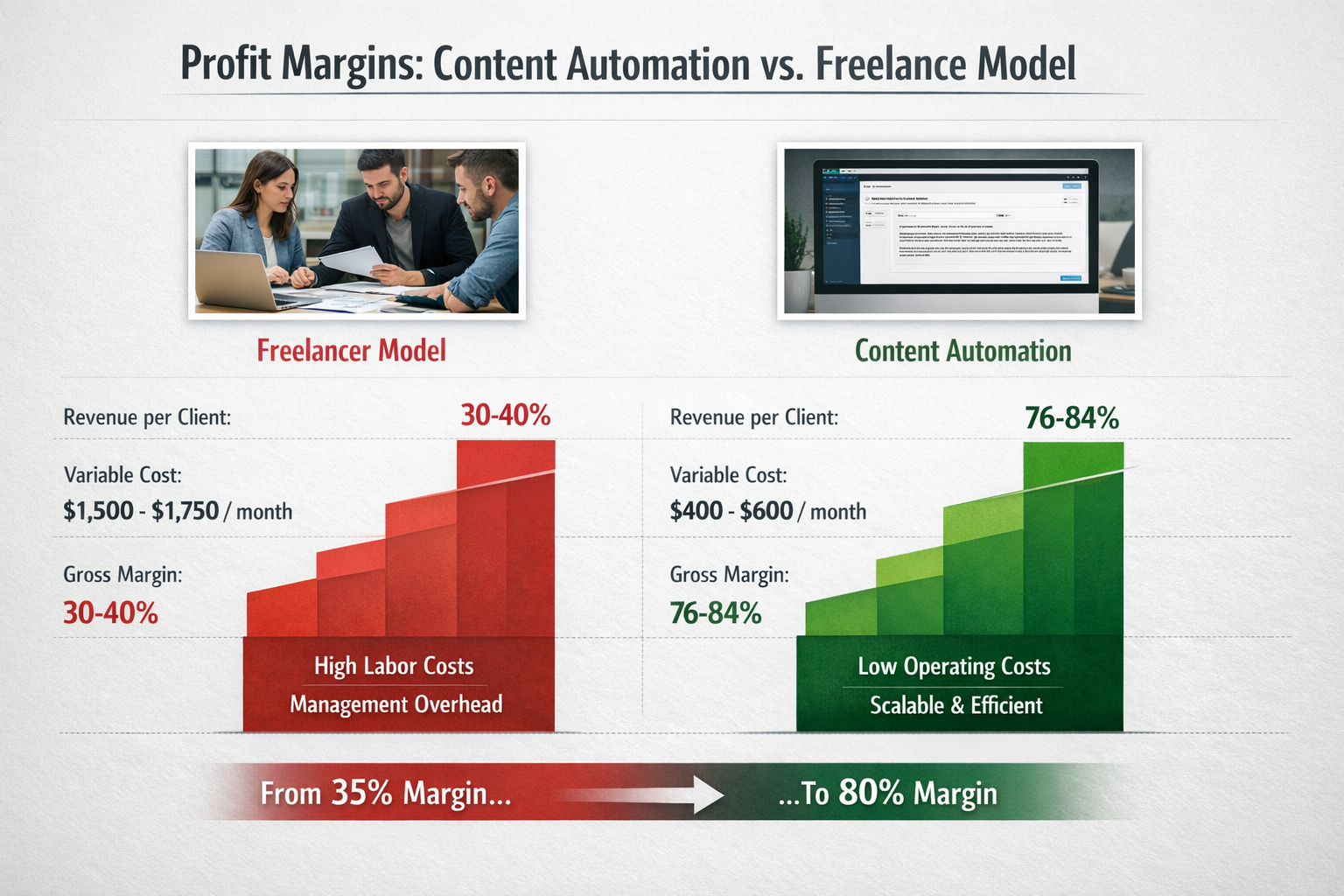
Here's what that looks like in practice:
| Model | Revenue per Client | Variable Cost | Gross Margin |
| Freelancer-Based | $2,500/mo | $1,500-1,750/mo | 30-40% |
| Automated System | $2,500/mo | $400-600/mo | 76-84% |
A note on these numbers: The automated system's variable costs assume you're paying for AI API usage (typically $50-150/month per client depending on volume), a fractional human editor reviewing and refining output (roughly $200-300/month per client at scale), and basic software subscriptions. Your actual margins will depend on your specific tech stack, editorial standards, and client volume. The point isn't the precise percentage—it's the structural difference in how costs scale.
At 20 clients, the automated model might generate the same revenue with one-third the team size. That's not a marginal improvement—it's a structural advantage.
And unlike hiring, software doesn't call in sick, miss deadlines, or quit for a competitor.
What Content Automation Actually Looks Like
The term "automation" gets thrown around loosely. Here's what a functional system actually includes.
The Core Tech Stack
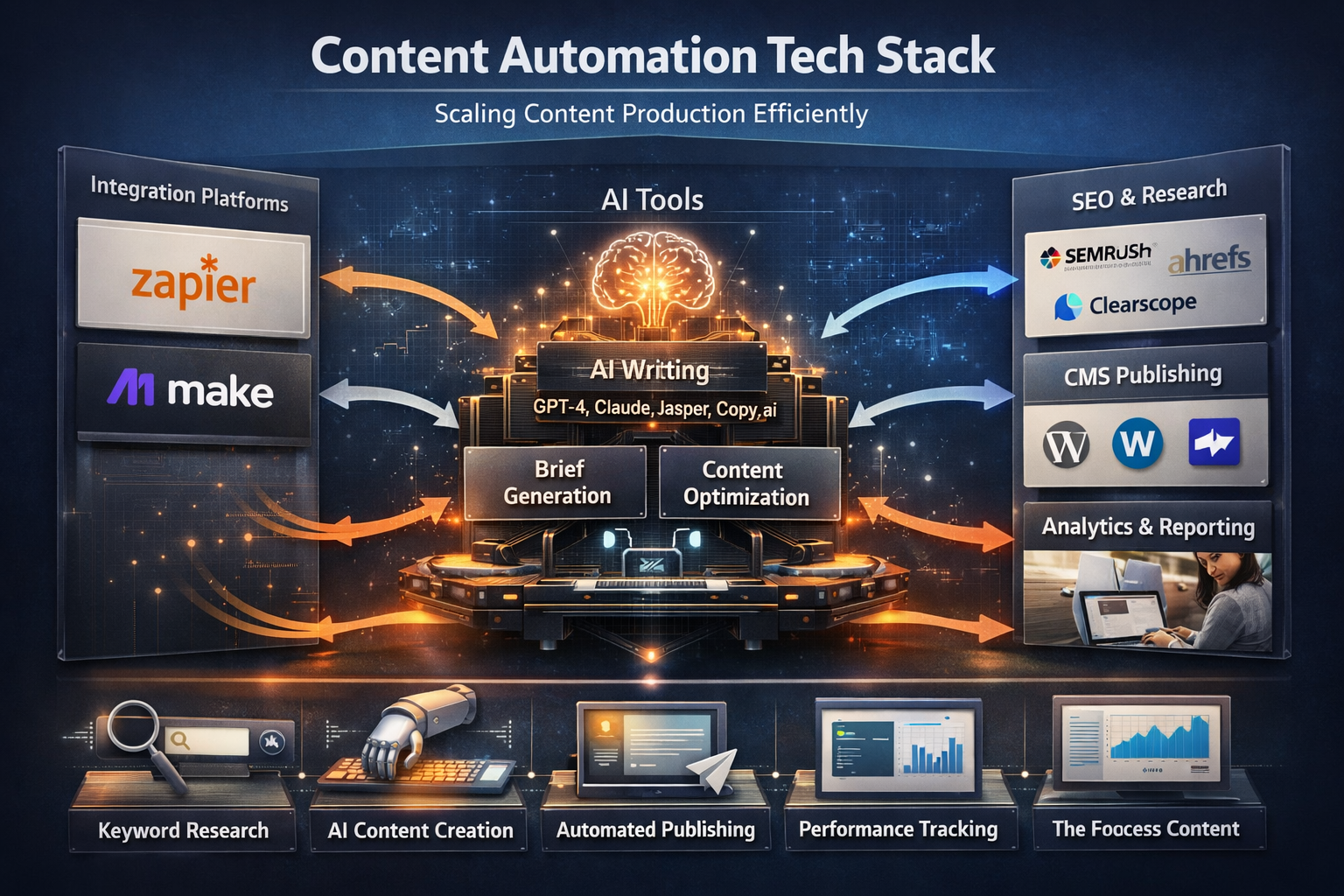
Integration platforms connect your tools and move data between them. Options like Make (formerly Integromat) or Zapier let you build workflows that trigger automatically—when a topic is approved, when a draft is ready for review, when a post needs publishing.
AI writing tools handle the initial draft generation. You might use direct API access to large language models (like OpenAI's GPT-4 or Anthropic's Claude) for maximum control, or opt for specialized content platforms that wrap these models with SEO-specific features.
Content management and publishing happens through your client's CMS (WordPress, Webflow, Shopify's blog, etc.) or through tools that can push content directly via API.
SEO and research tools feed the system with keyword data, competitor analysis, and topic opportunities. Platforms like Semrush, Ahrefs, or Clearscope integrate with many automation workflows.
A Sample Workflow
Here's one way the pieces fit together:
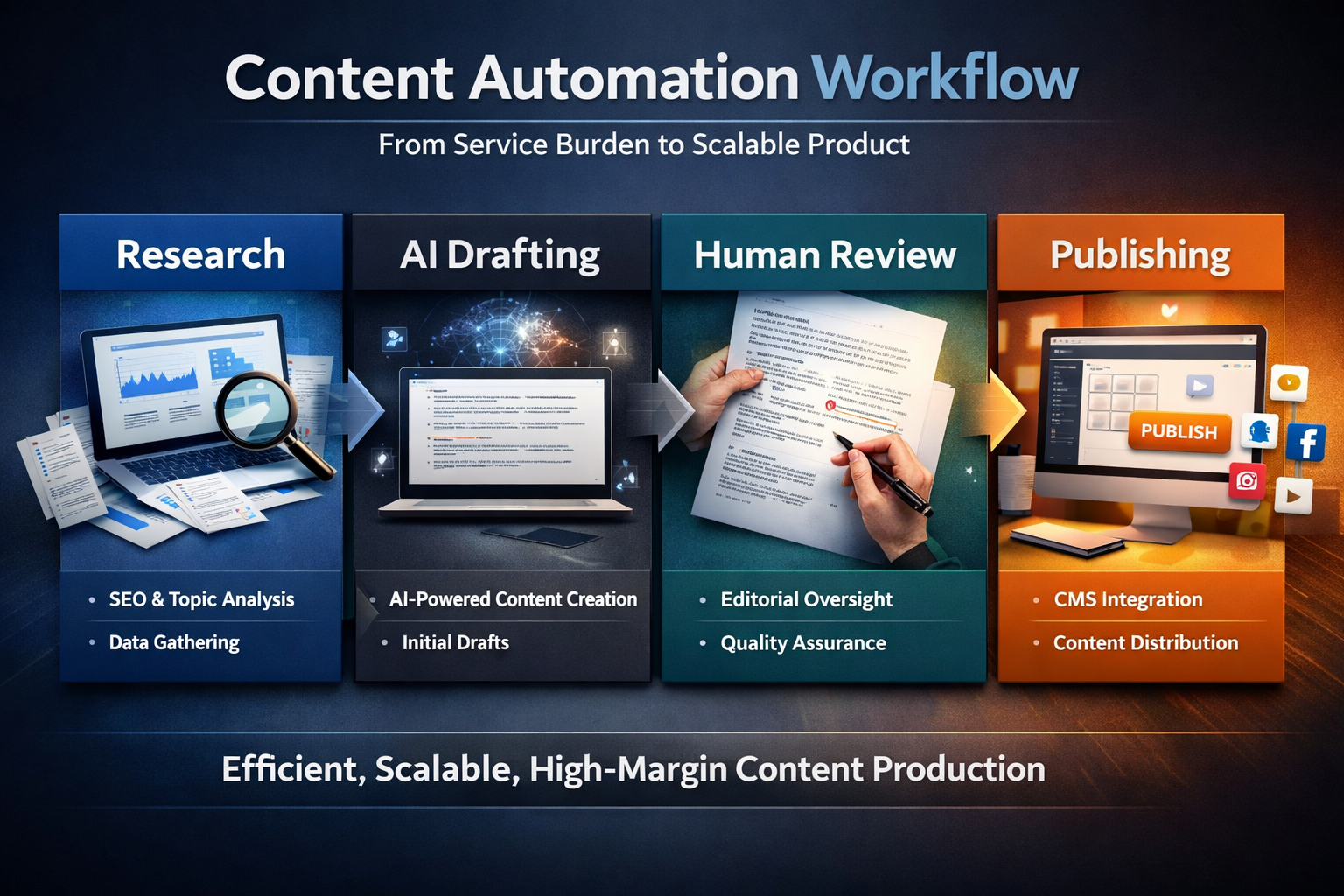
Research phase: Your SEO tool identifies high-opportunity keywords. These populate a shared topic database (Airtable, Notion, or a custom dashboard).
Brief creation: When you approve a topic, an automation triggers. It pulls search intent data, competitor headlines, and relevant talking points into a structured brief.
Draft generation: The brief feeds into your AI writing system. The output is a first draft calibrated for brand voice, target audience, and SEO requirements.
Human review gate: A human editor reviews every piece. They catch tone issues, verify factual claims, add nuance, and ensure brand alignment. This step is non-negotiable for quality.
Publishing automation: Approved content routes to the client's CMS with proper formatting, meta descriptions, schema markup, and internal links pre-configured.
Performance tracking: Analytics data flows back to your dashboard, showing which content performs and informing future topic selection.
The key insight: automation doesn't mean "set it and forget it." It means removing repetitive, time-intensive tasks so humans can focus on strategy, quality control, and client relationships.
Think of it like accounting software. QuickBooks didn't eliminate accountants—it eliminated manual ledger entries. Content automation works the same way. You're not replacing expertise; you're multiplying it.
Risks, Guardrails, and How to Avoid Common Failures
Automation introduces new risks. Acknowledging them upfront helps you build systems that actually work.
AI Hallucinations and Factual Errors
Large language models sometimes generate plausible-sounding information that's simply wrong. They might invent statistics, misattribute quotes, or confidently state outdated information.
The guardrail: Human verification on every piece before publication. Build a checklist: Are statistics sourced? Are claims verifiable? Does anything feel suspiciously convenient? Train your editors to be skeptical, and create a culture where flagging potential errors is rewarded.
Voice Drift and Generic Output
Without proper calibration, AI-generated content can feel bland or off-brand. One agency's posts start sounding like another's.
The guardrail: Invest heavily in the setup phase. Document each client's voice, preferred terminology, topics to avoid, and stylistic quirks. Feed this context into your prompts. Review early outputs with clients and iterate until the voice clicks. Periodically audit published content against the original voice guidelines.
Copyright and Originality Concerns
The legal landscape around AI-generated content continues to evolve. Some clients worry about originality; others have specific policies about AI disclosure.
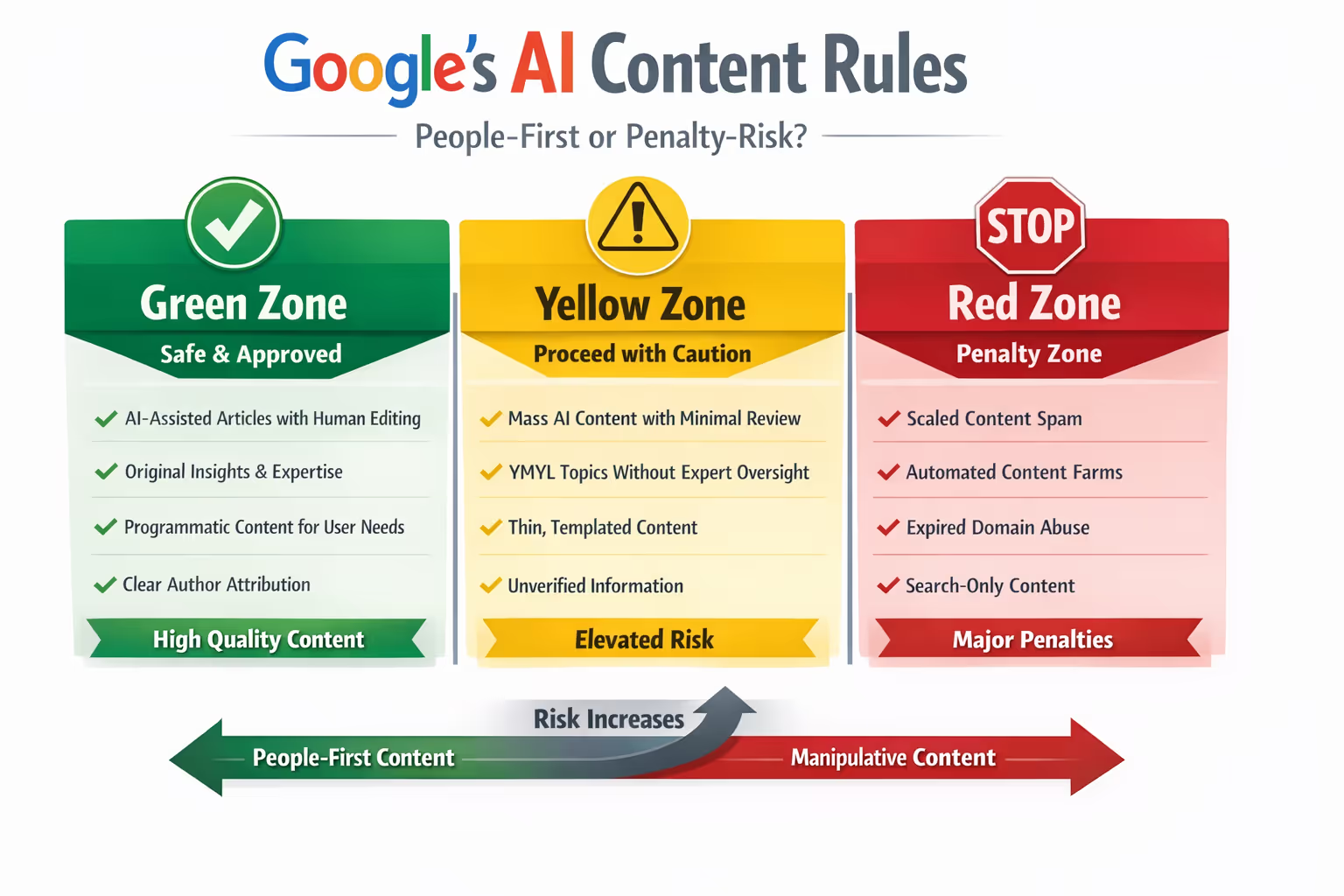
The guardrail: Understand your clients' requirements upfront. Use AI as a drafting tool, not a copy-paste solution—human editing naturally introduces originality. Some agencies run plagiarism checks as a standard QA step. Stay informed about legal developments in your jurisdiction [3].
Over-Automation and Quality Erosion
The temptation to reduce human involvement grows as margins improve. Resist it. The agencies that cut corners eventually lose clients to quality issues.
The guardrail: Define your minimum viable human touchpoints and treat them as sacred. For most agencies, that means: strategic topic selection, editorial review of every piece, and periodic brand alignment audits with clients.
The Agency Services That Pair Best with Automated Content
Smart agencies don't offer automated content alone. They bundle it with services that require genuine expertise.
High-margin complementary services include:
Content strategy and editorial planning — Clients still need someone to think through what they should write about and why. This strategic layer commands premium pricing.
Conversion optimization — Automated content drives traffic; strategy turns that traffic into leads. Offer landing page optimization, CTA testing, and funnel analysis.
Analytics and reporting — Showing clients the ROI of consistent publishing creates stickiness. Build dashboards that connect content to business outcomes.
Paid amplification — Combining organic content with targeted promotion multiplies reach. Manage social distribution, email nurture sequences, or paid social campaigns.
The automation handles the production grind. Your team handles the thinking. That's where the real value lives—and where clients pay premium rates without resistance.
The Retention Advantage Nobody Talks About
Agencies lose clients for two primary reasons: poor results and inconsistent delivery.
Automated systems address both.
On results: Consistent publishing creates compounding SEO benefits. Clients who stick around for six months start seeing meaningful traffic growth because frequency and quality work together over time [4].
On delivery: Automated workflows eliminate the "we missed the deadline because the writer flaked" problem. Posts go out on schedule. Every week. Without drama.
This reliability becomes a retention moat. Clients stay not because switching is hard, but because the service actually works. They stop thinking about their content—it just happens.
That's the difference between a vendor relationship and a partnership.
Pricing Strategies for Automated Content Services
How you price matters as much as what you deliver.
Three models that work:
Flat monthly retainer — Simple, predictable, easy to sell. Works best when you're bundling content with other services.
Volume-based tiers — Different prices for different output levels (4 posts/month, 8 posts/month, etc.). Gives clients flexibility and creates natural upsell paths.
Performance-based hybrid — Base retainer plus bonuses tied to traffic or lead metrics. Higher risk, but creates strong alignment and premium positioning.
Avoid hourly billing entirely. It undermines the entire value proposition. You're not selling time anymore—you're selling outcomes.
Implementation: A Practical 90-Day Roadmap
If you're running a traditional content agency, you don't need to rebuild everything overnight. Start with a single client or your own agency's content.
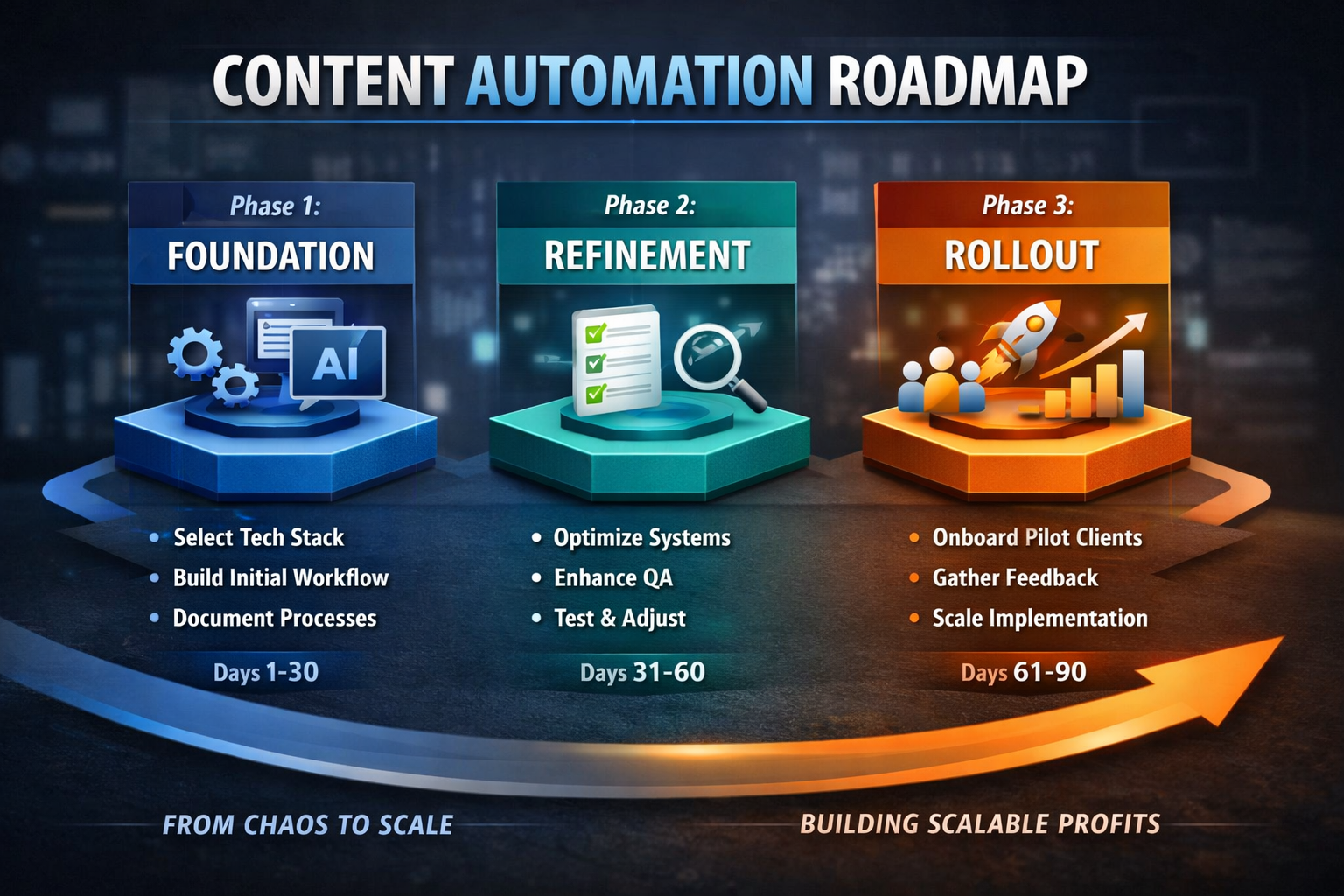
Days 1-30: Foundation
Select your tech stack. Choose an integration platform (Make or Zapier are solid starting points), an AI writing approach (direct API or specialized tool), and decide how you'll handle publishing.
Configure for one test case. Pick your own agency blog or one forgiving client. Build the workflow end-to-end, from topic approval through published post.
Document everything. Create process documentation so the system isn't dependent on one person's knowledge. Note what works, what breaks, and what needs refinement.
Measure baseline metrics. Track time spent per post under your current model. You'll need this to quantify improvements.
Days 31-60: Refinement
Iterate based on learnings. Your first workflow will have friction points. Identify bottlenecks—slow approval gates, prompt inconsistencies, formatting issues—and solve them systematically.
Develop your QA process. Create editorial checklists. Define what "ready to publish" actually means. Train anyone who will review content on your quality standards.
Test at slightly higher volume. Push 8-12 pieces through the system. See how it handles scale. Identify failure points before they affect clients.
Days 61-90: Controlled Rollout
Extend to a small client cohort. Pick 2-3 clients who are good fits—ideally those who value consistency and have reasonable expectations during a transition period.
Price it appropriately. Position automated content as a premium offering (faster turnaround, guaranteed consistency), not a discount service.
Gather feedback obsessively. Talk to clients about quality, voice accuracy, and results. Use their input to refine before broader rollout.
Establish ongoing optimization habits. Set a monthly review cadence: What's working? What content performs best? How can prompts improve?
The goal isn't perfection. It's proof of concept—evidence that the model works before you scale it.
The Competitive Reality
This isn't a "someday" opportunity. It's happening now.
Agencies that master content automation are already winning clients from traditional competitors. They can offer more output at similar prices, faster turnaround, and better consistency.
If your agency doesn't build this capability, you'll eventually compete against agencies that have. And they'll have better margins, more capacity, and lower client acquisition costs.
The question isn't whether to explore automation. It's how quickly you can implement it without compromising the quality your clients expect.
Ready to transform content from a service burden into a scalable product? Our agency partner program shows you exactly how to build automated content systems that grow profit margins while reducing headcount pressure. Join the agencies already making this shift.
Frequently Asked Questions
Will clients know the content is AI-assisted?
Quality automated content doesn't announce itself. When properly calibrated with human oversight, readers experience well-researched, clearly written articles. The goal is consistent excellence, not disclaimers about process. Most clients care about results—traffic, rankings, leads—not production methods. That said, discuss disclosure preferences with clients upfront, as some industries or brands have specific policies.
How long before automated content shows SEO results?
Content marketing compounds over time regardless of production method. Most businesses see measurable traffic improvements within three to six months of consistent publishing. Automated systems often accelerate this timeline by ensuring you never miss a publishing window—a consistency advantage that search engines reward with improved crawl frequency and topical authority [4].
Can automation handle technical or specialized industries?
Yes, with proper setup. The calibration phase requires deeper input for complex verticals—more detailed briefs, specialized terminology lists, and careful human review by someone with domain knowledge. But automated systems can learn industry nuances, and the human editorial layer catches technical errors that might slip through. Start with less technical content and expand as your processes mature.
What happens if the AI produces inaccurate information?
Human editorial oversight catches factual errors before publication. Quality automation workflows include verification steps specifically designed to prevent hallucinated statistics or incorrect claims. The system generates; humans verify. This is non-negotiable—agencies that skip editorial review eventually face embarrassing corrections or client churn.
Is this approach suitable for small agencies?
Absolutely. Smaller agencies often benefit most because automation removes the scaling barrier that typically requires hiring. A three-person agency can deliver content volume that would normally require seven or eight people. The investment in setting up systems pays off faster when you don't have the overhead of a large team to begin with.
About The Mighty Quill
The Mighty Quill was built specifically to solve the content scaling problem. Our founder brings over fifteen years of hands-on experience in digital marketing, including deep work in SEO and e-commerce growth. We've seen firsthand how traditional content models break under pressure—and we've engineered systems that don't. Our approach combines AI-powered efficiency with human editorial judgment, delivering consistent quality without the overhead that erodes profit margins.
Works Cited
[1] Forbes — "How To Improve Agency Profit Margins." https://www.forbes.com/councils/forbesagencycouncil/2023/01/17/how-to-improve-agency-profit-margins/
[2] Content Marketing Institute — "How AI Is Transforming Content Marketing." https://contentmarketinginstitute.com/articles/ai-transforming-content-marketing/
[3] Search Engine Journal — "AI Content Quality Guidelines." https://www.searchenginejournal.com/google-ai-content-guidelines/
[4] Semrush — "How Long Does SEO Take to Work."
https://www.semrush.com/blog/how-long-does-seo-take/