Most SaaS blog topic lists fail for the same reason: they ignore where your reader actually is in their buying journey.
You've seen these lists. Fifty generic headlines like "Top 10 Productivity Tips" or "Why [Industry] Is Changing." They generate impressions, maybe. But demos? Pipeline? Rarely.
The problem isn't creativity. It's strategy.
A SaaS blog engine that drives demos needs topics mapped to buyer awareness stages—with intentional conversion paths built into every post. This playbook gives you exactly that: 30 topic frameworks organized by awareness level, each tied to a specific CTA type that moves readers toward your product.
These aren't copy-paste headlines. They're adaptable templates designed for you to customize to your vertical, your audience, and your product. Each framework includes a concrete example so you can see how it works in practice.
No fluff. No filler. Just a system you can deploy this week.
Why Funnel-Mapped Content Outperforms Generic Blog Posts
Content marketing works when it meets readers where they are. HubSpot's research consistently shows that companies publishing consistent, intent-aligned content generate significantly more leads than those publishing sporadically or off-topic. Specifically, their data indicates that businesses publishing 16+ blog posts per month get roughly 3.5 times more traffic than those publishing four or fewer [1].
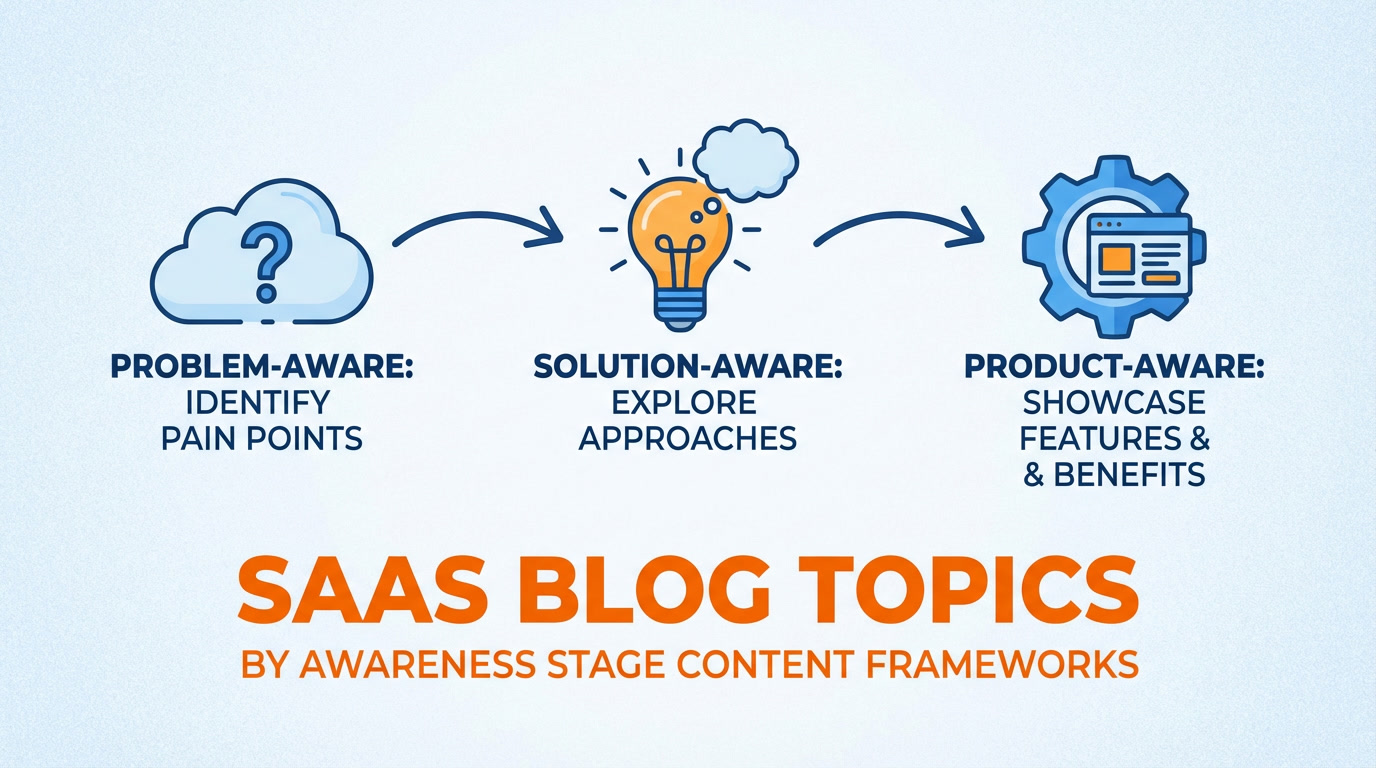
The awareness spectrum—popularized by Eugene Schwartz and adapted for modern SaaS—breaks buyers into distinct stages:
Problem-aware: They know something's wrong but haven't named it
Solution-aware: They're researching approaches, not specific tools
Product-aware: They're comparing vendors and evaluating features
Each stage requires different content, different hooks, and different calls to action. When you map topics to stages, you stop hoping for conversions and start engineering them. The disconnect between what readers need at each stage and what most blogs deliver explains why so much content generates traffic but never touches pipeline.
Understanding the Three Awareness Stages for SaaS
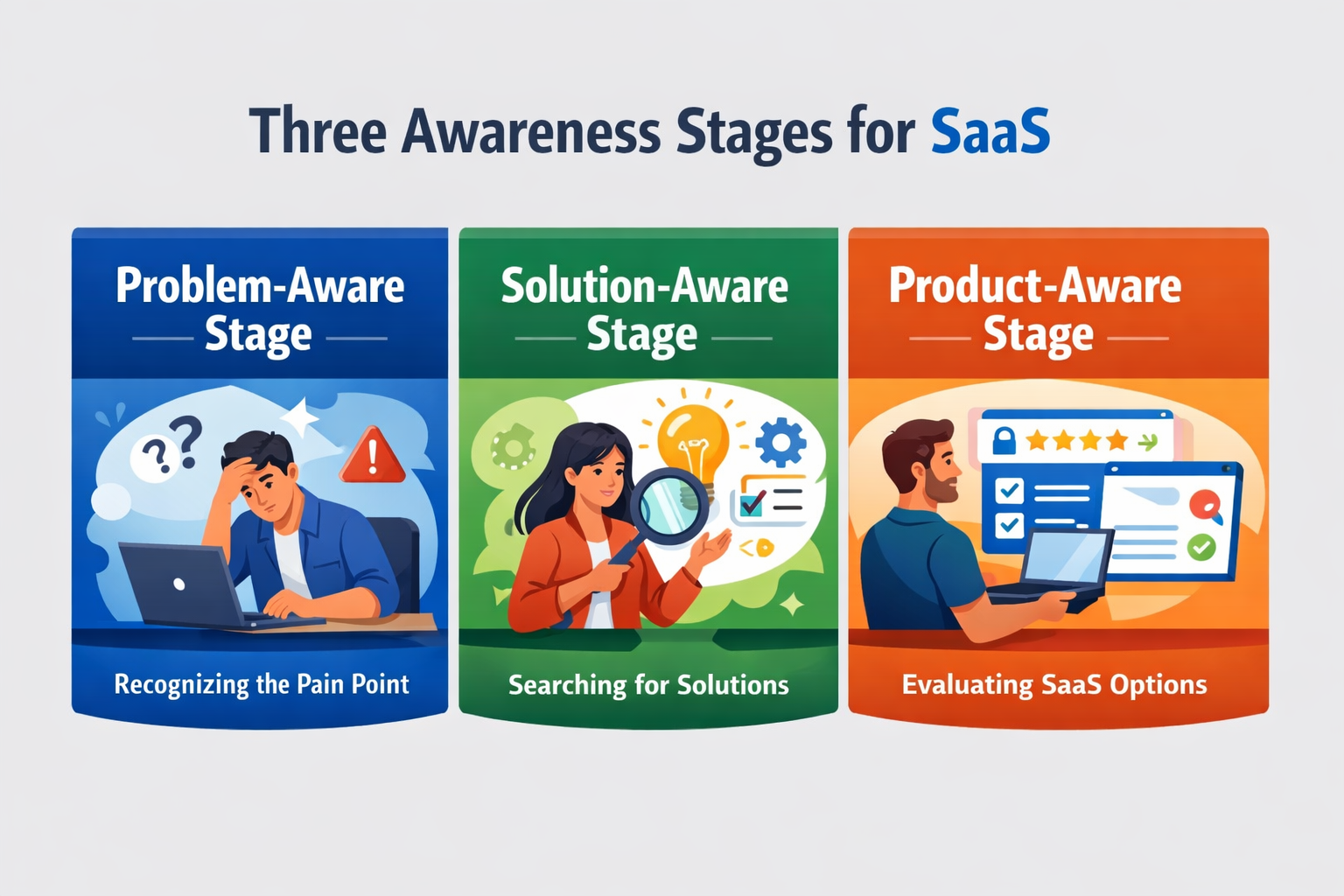
Problem-Aware Stage
Your reader feels pain. Churn is climbing. The team is drowning in manual work. Revenue growth has flatlined. But they haven't crystallized the problem—or started looking for solutions.
Content goal: Name their pain. Build trust. Establish your brand as someone who gets it.
CTA type: Newsletter signup, resource download, or related article
Solution-Aware Stage
Now they're actively researching. They've Googled "how to reduce SaaS churn" or "best practices for customer onboarding." They want frameworks, comparisons, and strategies—but they're not ready to evaluate specific products.
Content goal: Educate on approaches. Position your methodology as the smart path forward.
CTA type: Webinar registration, free tool, or in-depth guide download
Product-Aware Stage
They know solutions exist. They might already have a shortlist. They're reading comparison posts, scanning feature pages, and looking for proof that your product delivers.
Content goal: Differentiate. Prove value. Make the demo the obvious next step.
CTA type: Demo request, free trial, or sales conversation
10 Problem-Aware Topic Frameworks (Top of Funnel)
These frameworks target readers experiencing pain but not yet searching for solutions. The goal is visibility and trust.
1. Why Your [Core Metric] Stalled—And What Most [Role] Miss
Example in the wild: "Why Your MRR Growth Stalled—And What Most SaaS Founders Miss"
Pain addressed: Plateauing performance without clear diagnosis
CTA: Newsletter signup for growth diagnostics
Internal link path: Link to solution-aware content on growth levers
2. The Hidden Cost of [Manual Process] in Scaling [Company Type]
Example in the wild: "The Hidden Cost of Manual Reporting in Scaling E-Commerce Companies"
Pain addressed: Operational drag that leaders feel but can't quantify
CTA: Download: "[Process] Audit Checklist"
Internal link path: Connect to automation solution content
3. Why Customers Leave: [Number] [Problem] Signals You're Probably Ignoring
Example in the wild: "Why Customers Leave: 7 Churn Signals B2B SaaS Companies Ignore"
Pain addressed: Retention anxiety without actionable visibility
CTA: Newsletter signup for retention insights
Internal link path: Bridge to churn-reduction methodology content
4. The Real Reason Your [Team] Can't Hit [Goal]
Example in the wild: "The Real Reason Your Sales Team Can't Hit Quota"
Pain addressed: Underperformance blamed on wrong factors
CTA: Related article on pipeline optimization
Internal link path: Lead to sales enablement content
5. What "[Industry Term]" Actually Means [Timeframe]
Example in the wild: "What 'Product-Market Fit' Actually Means Post-Series A"
Pain addressed: Confusion about growth plateau causes
CTA: Framework download: "[Concept] Diagnostic Questions"
Internal link path: Connect to positioning and messaging content
6. How Much Is Bad [Asset] Costing Your [Team]?
Example in the wild: "How Much Is Bad Documentation Costing Your Support Team?"
Pain addressed: Team overload without root cause clarity
CTA: Newsletter for operational efficiency content
Internal link path: Link to knowledge base strategy articles
7. The [Process] Mistake That's Killing Your [Conversion Point]
Example in the wild: "The Onboarding Mistake That's Killing Your Trial Conversions"
Pain addressed: Low conversion rates at key stages
CTA: Checklist download: "First 7 Days [Process] Audit"
Internal link path: Bridge to onboarding optimization content
8. Why Your Competitors Rank Higher (Even With Worse [Offering])
Example in the wild: "Why Your Competitors Rank Higher (Even With a Worse Product)"
Pain addressed: SEO frustration and visibility anxiety
CTA: Newsletter signup for content strategy insights
Internal link path: Connect to content marketing methodology
9. The [Metric] Your [Stakeholder] Cares About (That You're Probably Ignoring)
Example in the wild: "The Finance Metric Your Board Cares About (That You're Probably Ignoring)"
Pain addressed: Stakeholder pressure without clear KPI alignment
CTA: Guide download: "[Industry] Metrics That Actually Matter"
Internal link path: Lead to financial modeling content
10. Signs Your [System] Is Holding Your Team Back
Example in the wild: "Signs Your Tech Stack Is Holding Your Marketing Team Back"
Pain addressed: Tool sprawl and integration friction
CTA: Related article on system optimization
Internal link path: Connect to integration and workflow content
10 Solution-Aware Topic Frameworks (Middle of Funnel)
These readers are actively researching approaches. They want frameworks and strategies—educational content that positions your methodology as credible.
11. Pain-Point SEO: How to Rank for Problems Your Product Solves
Example in the wild: This very article demonstrates the approach
Pain addressed: Content that generates traffic but not leads
CTA: Webinar: "Building a Pain-Point Content Calendar"
Internal link path: Bridge to product comparison templates
Why this works: Pain-Point SEO targets searches where prospects describe symptoms rather than solutions. According to Ahrefs, long-tail keywords (which often describe specific problems) typically have lower competition and higher conversion intent because the searcher knows exactly what they're looking for [2]. Instead of competing for "CRM software," you target "why is my sales team missing quota"—catching prospects at the moment of frustration.
12. The [Framework Name]: Mapping [Content Type] to [Business Outcome]
Example in the wild: "The Content Funnel Framework: Mapping Blog Posts to Pipeline Stages"
Pain addressed: Disconnected content strategy
CTA: Template download: "[Framework] Mapping Worksheet"
Internal link path: Link to demo-driving content examples
13. How to Build a [Sequence/System] That Actually Converts [Prospect Type]
Example in the wild: "How to Build an Onboarding Sequence That Actually Converts Trial Users"
Pain addressed: Leaky conversion funnels
CTA: Free tool: "[Sequence] Builder Template"
Internal link path: Connect to product-aware case studies
14. Reducing [Problem]: A Framework for Proactive [Solution]
Example in the wild: "Reducing SaaS Churn: A Framework for Proactive Retention"
Pain addressed: Reactive problem management
CTA: Guide download: "[Solution] Playbook for B2B SaaS"
Internal link path: Bridge to customer success tool comparisons
15. How High-Growth [Company Type] Structure Their [Team/Function]
Example in the wild: "How High-Growth SaaS Companies Structure Their Content Teams"
Pain addressed: Unclear operational models
CTA: Newsletter signup for operational insights
Internal link path: Link to content automation content
16. The [Methodology] Approach to [Challenge]
Example in the wild: "The Jobs-to-Be-Done Approach to Feature Prioritization"
Pain addressed: Decision-making chaos
CTA: Workshop registration: "[Methodology] for [Role] Teams"
Internal link path: Connect to product positioning content
17. Building a Scalable [Function] Playbook
Example in the wild: "Building a Scalable Customer Success Playbook"
Pain addressed: Inconsistent post-sale experience
CTA: Template download: "[Function] Playbook Starter Kit"
Internal link path: Bridge to software comparisons
18. [Discipline] for [Company Type]: A Technical Checklist for [Growth Stage] Companies
Example in the wild: "SEO for SaaS: A Technical Checklist for Product-Led Companies"
Pain addressed: Technical blind spots
CTA: Audit tool: "[Discipline] Scorecard"
Internal link path: Link to strategy comparison content
19. How to Prioritize [Work Type] When Everything Feels Urgent
Example in the wild: "How to Prioritize Content Topics When Everything Feels Urgent"
Pain addressed: Planning paralysis
CTA: Framework download: "[Work Type] Prioritization Matrix"
Internal link path: Connect to calendar templates
20. The Compound Effect: Why Consistent [Action] Beats [Alternative]
Example in the wild: "The Compound Effect: Why Consistent Publishing Beats Campaign Spikes"
Pain addressed: Boom-bust operational cycles
CTA: Newsletter signup for publishing strategy content
Internal link path: Bridge to automation solutions
10 Product-Aware Topic Frameworks (Bottom of Funnel)
These readers are evaluating options. They want proof, specifics, and reasons to choose you over alternatives.
21. [Your Product] vs. [Competitor]: An Honest Feature Comparison
Example in the wild: "Asana vs. Monday.com: An Honest Feature Comparison for Remote Teams"
Pain addressed: Evaluation overwhelm
CTA: Demo request with personalized walkthrough
Internal link path: Link to customer case studies
22. How [Customer Name/Type] [Achieved Result] in [Timeframe]
Example in the wild: "How a B2B SaaS Reduced Churn by 34% in 90 Days" (Note: Use real customer data when available, or clearly frame as a hypothetical template)
Pain addressed: Need for proof of results
CTA: Schedule a strategy call to discuss your situation
Internal link path: Connect to methodology content
23. What to Expect in Your First [Timeframe] Using [Your Product]
Example in the wild: "What to Expect in Your First 30 Days Using HubSpot CRM"
Pain addressed: Implementation anxiety
CTA: Free trial with guided onboarding
Internal link path: Link to integration documentation
24. The ROI of [Solution Type]: A Calculator
Example in the wild: "The ROI of Automated Content Publishing: A Calculator"
Pain addressed: Budget justification needs
CTA: Interactive ROI calculator leading to demo
Internal link path: Bridge to pricing page
25. [Number] Warning Signs You've Outgrown Your Current [Solution Category]
Example in the wild: "5 Warning Signs You've Outgrown Your Current Email Marketing Platform"
Pain addressed: Status quo inertia
CTA: Assessment: "Is it time to switch?"
Internal link path: Connect to migration support content
26. How We Built [Specific Feature]—And Why It Matters for [Use Case]
Example in the wild: "How We Built Our AI Writing Assistant—And Why It Matters for Content Teams"
Pain addressed: Feature uncertainty
CTA: Demo request to see feature in action
Internal link path: Link to product documentation
27. The True Cost of DIY vs. [Your Solution Type]
Example in the wild: "The True Cost of DIY vs. Done-For-You Content Operations"
Pain addressed: Build vs. buy decision paralysis
CTA: Comparison download + demo offer
Internal link path: Bridge to pricing and services overview
28. Questions to Ask Before Choosing a [Solution Category] Vendor
Example in the wild: "Questions to Ask Before Choosing a Customer Data Platform Vendor"
Pain addressed: Fear of making wrong choice
CTA: Consultation call to answer your specific questions
Internal link path: Connect to trust-building content (team, methodology)
29. How [Your Product] Integrates With Your Existing [System Type]
Example in the wild: "How Segment Integrates With Your Existing Marketing Stack"
Pain addressed: Technical fit concerns
CTA: Technical demo with your tools
Internal link path: Link to integration marketplace
30. Why [Specific Customer Segment] Companies Choose [Your Product]
Example in the wild: "Why Series B SaaS Companies Choose Our Analytics Platform"
Pain addressed: Fit uncertainty for their specific situation
CTA: Demo tailored to their segment
Internal link path: Connect to segment-specific case studies

Building Internal Link Paths From ToFu to BoFu
Strategic internal linking transforms disconnected blog posts into a conversion system. Here's how to structure paths that guide readers toward demos.
The Three-Link Rule
Every top-of-funnel post should include:
Lateral link: To related problem-aware content (keeps readers engaged)
Downward link: To solution-aware content (advances the journey)
Resource link: To your newsletter or lead magnet (captures contact)
Example Link Path: Churn Topic Cluster
ToFu: "Why Customers Leave: 7 Churn Signals You're Probably Ignoring"↓ Links toMoFu: "Reducing SaaS Churn: A Framework for Proactive Retention"↓ Links toBoFu: "How [Customer Name] Reduced Churn by 34% in 90 Days"↓ Links toConversion page: Demo request with retention focus
Pain-Point SEO in Practice
Pain-Point SEO means targeting keywords that describe symptoms rather than solutions. Instead of "customer success software," target "why are my customers churning" or "how to improve trial conversion."
These searches indicate high purchase intent because the reader is actively experiencing the problem your product solves. Content Marketing Institute's B2B research confirms that the most successful content marketers prioritize audience needs over promotional messaging—and addressing specific pain points is the clearest expression of that priority [3].
Examples for SaaS categories:
| Generic Keyword | Pain-Point Alternative | Why It Converts Better |
| Project management software | Why do projects always run over budget | Searcher has active pain |
| Email marketing platform | Why aren't my emails getting opened | Frustration drives action |
| Customer success tool | How to predict which customers will churn | Specific problem, clear intent |
| Content marketing service | Why isn't my blog generating leads | Ready for a solution |
Matching CTAs to Awareness Stages
The right CTA depends entirely on where your reader sits in their journey. Mismatched CTAs kill conversions.
Problem-Aware CTAs
Newsletter signup
Related article recommendation
Diagnostic checklist download
Free assessment or quiz
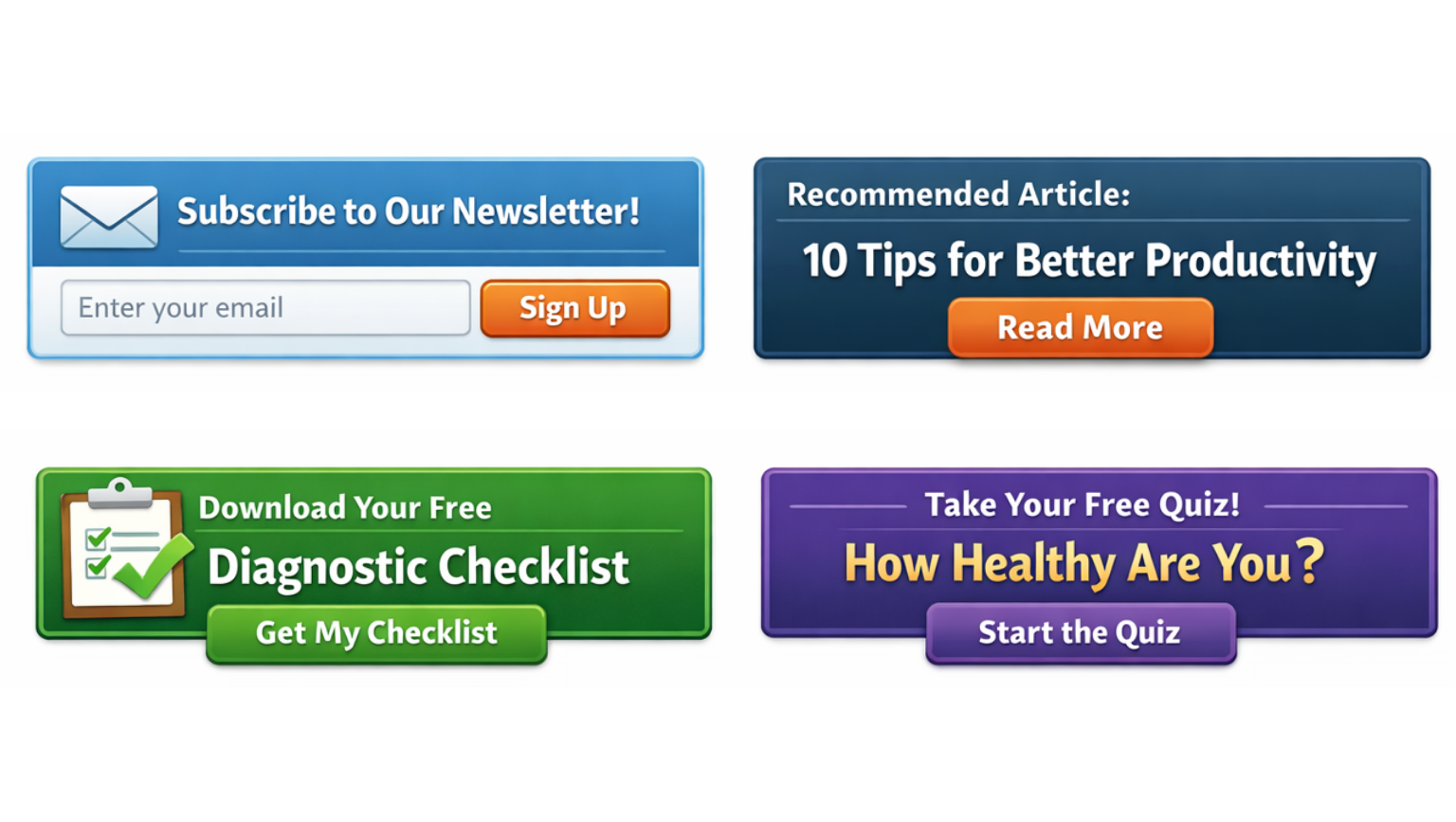
Why these work: Low commitment. You're building trust, not asking for a meeting. A reader who just realized they have a churn problem isn't ready to see a demo—they're ready to learn more.
Solution-Aware CTAs
Webinar registration
In-depth guide or playbook download
Free tool or template
Workshop signup
Why these work: They offer deeper value in exchange for engagement—positioning you as the expert while the reader evaluates approaches.
Product-Aware CTAs
Demo request
Free trial
Sales conversation
ROI calculator
Why these work: The reader is ready to evaluate. Make it easy to take the next step. Anything less aggressive at this stage leaves money on the table.
Operationalizing Your Content Calendar
Having 30 topic frameworks means nothing if they sit in a spreadsheet. Execution is where most SaaS companies fail.
The Publishing Cadence That Works
Orbit Media's annual blogging survey found that bloggers who publish weekly are 2.5 times more likely to report "strong results" compared to those who publish monthly [4]. The compounding effect of consistent publishing—better SEO authority, more indexed pages, greater topical coverage—creates a structural advantage that's difficult for competitors to overcome.
From Frameworks to Live Posts
A functional SaaS blog engine requires:
Topic prioritization: Map frameworks to business goals and search opportunity
Production workflow: Research, outline, draft, edit, optimize
Publishing schedule: Consistent cadence (ideally 2+ posts per week)
Optimization layer: Internal links, schema markup, meta data
Measurement: Track which content drives pipeline, not just traffic
Most teams stall at step two. The frameworks exist. The execution doesn't.
If you're building in-house, tools like Trello, Asana, or Notion can structure the editorial workflow. Assign clear ownership for each stage—research, writing, editing, publishing—and set non-negotiable deadlines. The key is treating content like product development: shipping consistently matters more than waiting for perfection.
For teams without bandwidth to build the engine internally, done-for-you services can handle the operational lift while you focus on strategy and sales.
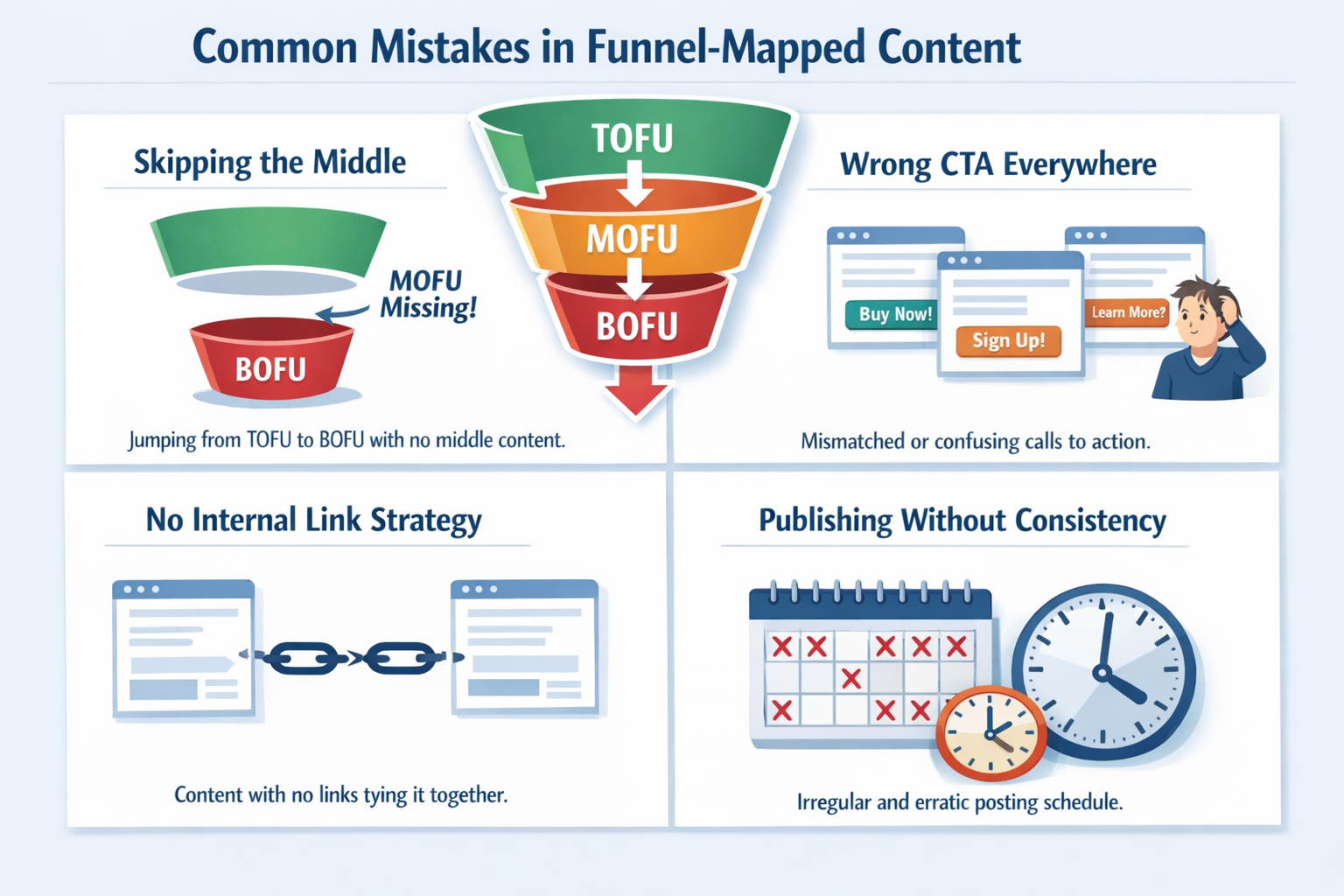
Common Mistakes in Funnel-Mapped Content
Mistake 1: Skipping the Middle
Many SaaS companies publish awareness content and product pages—with nothing in between. Solution-aware content is where trust is built and methodology is established. Skip it, and you lose readers before they're ready to evaluate. They'll find someone else who educated them first.
Mistake 2: Wrong CTA Everywhere
Asking for a demo in a top-of-funnel post feels aggressive. Offering a newsletter signup in a comparison post feels weak. Match the ask to the awareness level. When in doubt, ask: "What would a reasonable person at this stage actually want next?"
Mistake 3: No Internal Link Strategy
Orphaned blog posts don't compound. Every piece of content should connect to the broader content ecosystem—guiding readers deeper into your funnel. If your posts don't link to each other strategically, you're building islands instead of a continent.
Mistake 4: Publishing Without Consistency
Sporadic content creates sporadic results. The compounding effect only works with sustained publishing velocity. One great post per month will always lose to two good posts per week.
Turning This Playbook Into Pipeline
You now have 30 saas blog topics frameworks mapped to buyer stages, CTAs aligned to intent, and internal linking strategies to connect everything. The system is sound.
The question is execution.
Building a SaaS blog topics engine that actually drives demos requires more than good frameworks. It requires consistent production—week after week, month after month—with proper optimization at every step.
Some teams build this capability in-house. It takes time, hires, and operational rigor, but it's entirely possible with the right systems. Others partner with services designed specifically for this purpose: keyword-researched topics, SEO-optimized posts, and a publishing cadence that compounds over time.
Whatever path you choose, the principle remains the same: funnel-mapped content, published consistently, with intentional conversion paths beats generic content every time.
Ready to operationalize your content calendar? The Mighty Quill builds and ships 2+ SEO-optimized posts per week—fully researched, edited, and optimized for your funnel. Try the Blog Engine free and get two custom articles in 48 hours.
Frequently Asked Questions on Saas Blog Topics
How many blog posts should a SaaS company publish per week?
Research from Orbit Media suggests that publishing weekly yields significantly better results than monthly publishing—with weekly publishers being 2.5 times more likely to report strong outcomes. The compounding effect of more indexed pages, stronger topical coverage, and consistent freshness signals creates measurable advantages over time. Starting with two posts per week provides enough velocity to build momentum while remaining operationally manageable for most teams.
What is Pain-Point SEO and why does it work for SaaS?
Pain-Point SEO targets keywords that describe problems rather than solutions. Instead of optimizing for "CRM software," you'd target "why is my sales team missing quota." These searches indicate high purchase intent because readers are actively experiencing pain your product addresses. This approach often yields higher conversion rates than generic category keywords because the searcher already knows they have a problem worth solving.
How do I decide which awareness stage to prioritize first?
Start with bottom-of-funnel content if you need pipeline quickly—comparison pages and case studies convert existing demand. Build middle-funnel content to establish methodology and credibility. Expand to top-of-funnel once you have conversion content to link toward. Most SaaS companies benefit from building the funnel backwards, ensuring every visitor has somewhere meaningful to go.
What's the difference between a blog post CTA and a page CTA?
Blog post CTAs should match reader awareness level—newsletter signups for problem-aware readers, demos for product-aware readers. Page CTAs (like homepage or pricing page) can assume higher intent since visitors navigated there deliberately. Mismatching blog CTAs to awareness stage is one of the most common conversion killers in SaaS content marketing.
How long does content marketing take to generate SaaS demos?
Most B2B SaaS content programs take three to six months to show meaningful pipeline impact. SEO authority compounds over time—early months build foundation, later months capture returns. Companies expecting results in 30 days typically abandon content before it has time to work. Consistent publishing accelerates the timeline, but patience remains essential.
About The Mighty Quill
The Mighty Quill is a done-for-you blog engine built for SaaS and growth-focused B2B companies. Founded by Mario Gorito—a digital marketing veteran with over 15 years of experience in SEO and e-commerce—the service combines AI-powered content production with human editorial oversight. Every article is keyword-researched, optimized for both traditional search and AI answer engines, and designed to drive measurable organic growth. Clients retain full ownership of all content, and the entire process—from topic research to publishing—is managed by the Mighty Quill team.
Cited Works
[1] HubSpot — "The State of Marketing Report." https://www.hubspot.com/state-of-marketing
[2] Ahrefs — "Long-Tail Keywords: What They Are and How to Use Them." https://ahrefs.com/blog/long-tail-keywords/
[3] Content Marketing Institute — "B2B Content Marketing Research." https://contentmarketinginstitute.com/research/
[4] Orbit Media — "Blogging Statistics and Trends." https://www.orbitmedia.com/blog/blogging-statistics/