Most SaaS content teams publish consistently and still wonder why pipeline stays flat.
The problem isn't output. It's targeting.
Marketing teams gravitate toward top-of-funnel content because it's easier to produce, easier to rank, and generates satisfying traffic charts. But those "What is [industry term]?" posts attract readers who are learning—not buying. They click, skim, and leave.
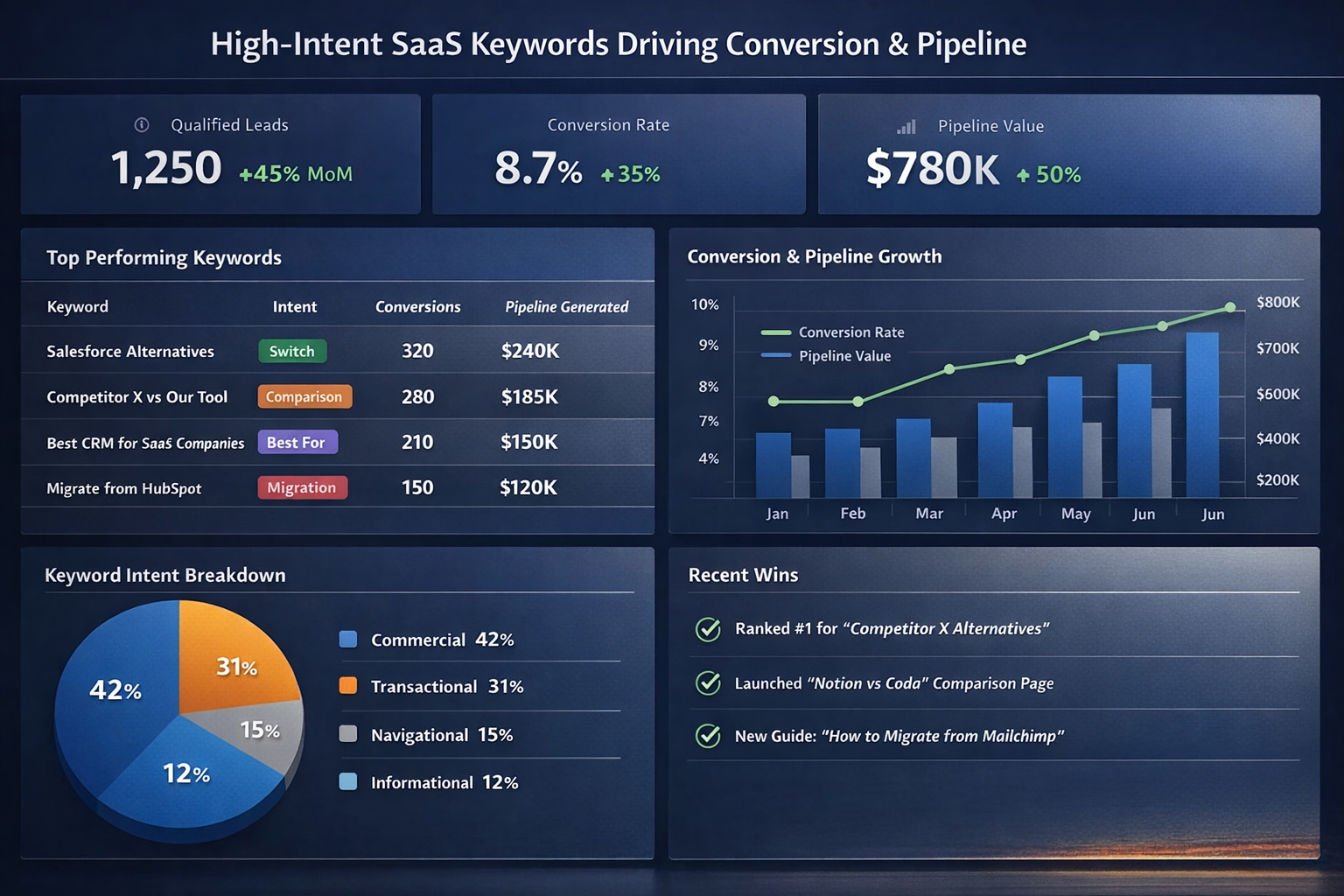
Pain-point SEO takes a different approach. Instead of chasing volume at the top of the funnel, it targets high-intent SaaS keywords that signal a buyer is actively searching for solutions. These are the "moments of switch"—searches that happen when someone is frustrated with their current tool, comparing alternatives, or one search away from a purchase decision.
This isn't about abandoning awareness content entirely. It's about fixing a lopsided strategy. If your content calendar is packed with educational posts but empty on "[Competitor] alternatives" or "How to fix [specific pain]," you're missing the searches that actually drive revenue.
Let's build a practical framework for capturing bottom-of-funnel traffic—where keyword intent translates directly to pipeline.
Why Most SaaS SEO Strategies Miss the Mark
The standard playbook looks familiar: identify high-volume keywords, create pillar pages, build topic clusters, wait for organic traffic to compound.
It's not wrong. But it's incomplete.
High-volume keywords cluster around awareness-stage queries. Think "What is project management software" or "CRM best practices." These searches attract people in research mode, not buying mode. They're useful for brand visibility, but they convert at significantly lower rates than decision-stage content [1].
SaaS companies default to top-of-funnel content for understandable reasons:
It's easier to rank for (less competition, more search volume)
It feels productive (more content = progress)
It's what competitors are publishing
Here's the uncomfortable reality: when everyone fights for the same awareness keywords, no one wins decisively. While you're accumulating pageviews, competitors targeting decision-stage queries are capturing the buyers.
The opportunity cost is substantial. A single well-ranked comparison page can generate more qualified pipeline than dozens of awareness posts combined.
Understanding Keyword Intent in the SaaS Buyer Journey
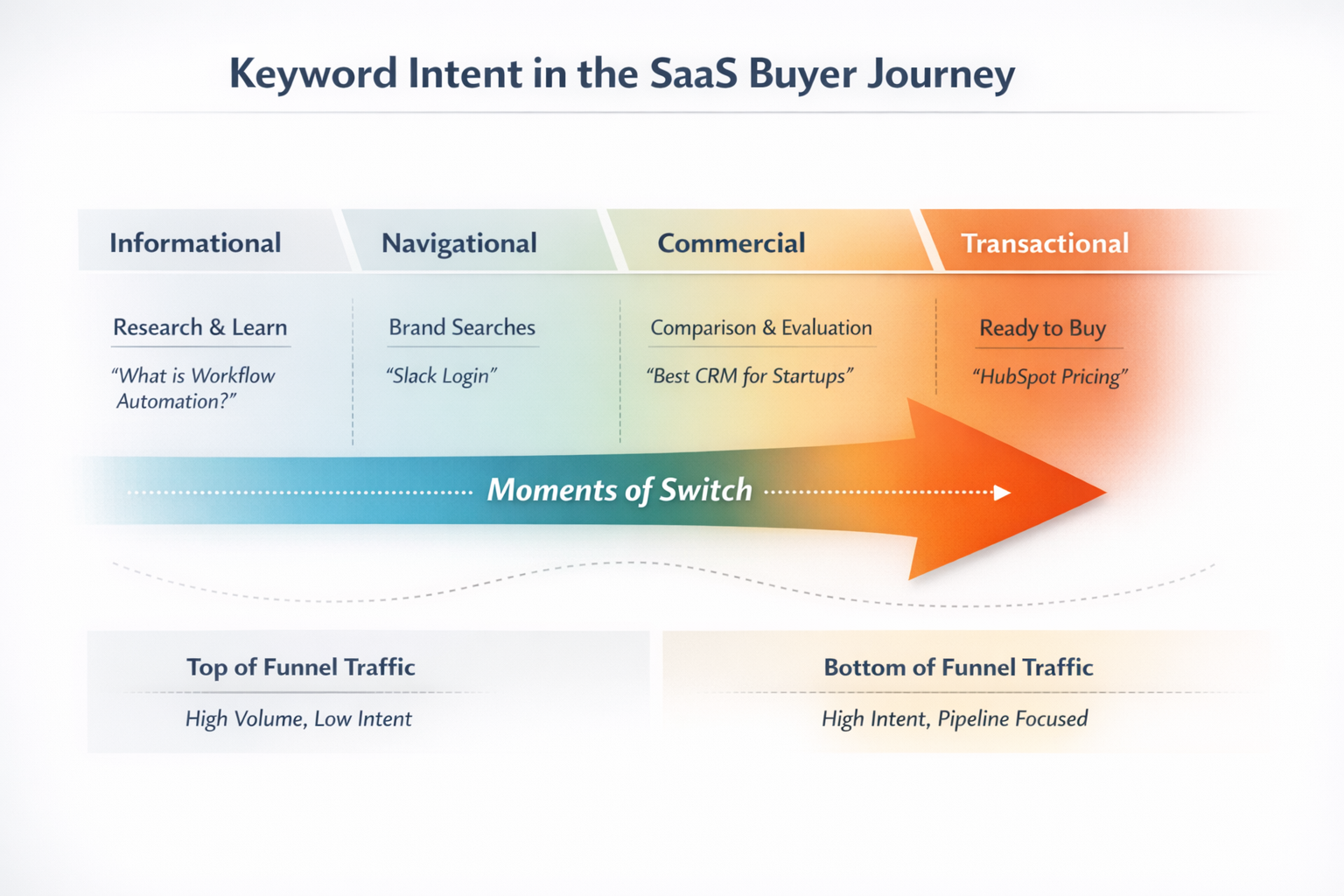
Keyword intent reveals the "why" behind a search. It tells you where someone is in their decision-making process—and whether they're ready to act.
Most frameworks break intent into four categories:
Informational: Learning and research ("What is workflow automation")
Navigational: Looking for a specific brand or page ("Slack login")
Commercial: Comparing options ("Best CRM for startups")
Transactional: Ready to take action ("HubSpot pricing")
For SaaS companies, commercial and transactional intent are where pipeline lives. These searches indicate a buyer who has moved past education into evaluation or purchase mode [2].
Recognizing "Moments of Switch"
Within commercial and transactional intent, a subset of searches carries exceptional value: moments of switch.
These occur when a prospect is:
Frustrated with their current solution and actively seeking alternatives
Comparing two or more tools head-to-head
Searching for specific capabilities their current tool lacks
Looking for pricing, integrations, or implementation details
Queries like "[Competitor] vs [Your Product]," "[Tool] alternative for [use case]," or "How to migrate from [Platform]" signal someone who isn't browsing. They're ready to move.
Example: Consider a project management tool competing with Asana. A search for "project management software" (informational) might convert at under 1%. But "Asana alternatives for small teams" signals someone who has already decided Asana isn't right and is actively evaluating options. That search might convert at 5-10x the rate.
Targeting these moments means showing up exactly when intent peaks—not earlier, not later.
How to Build a High-Intent Keyword Framework
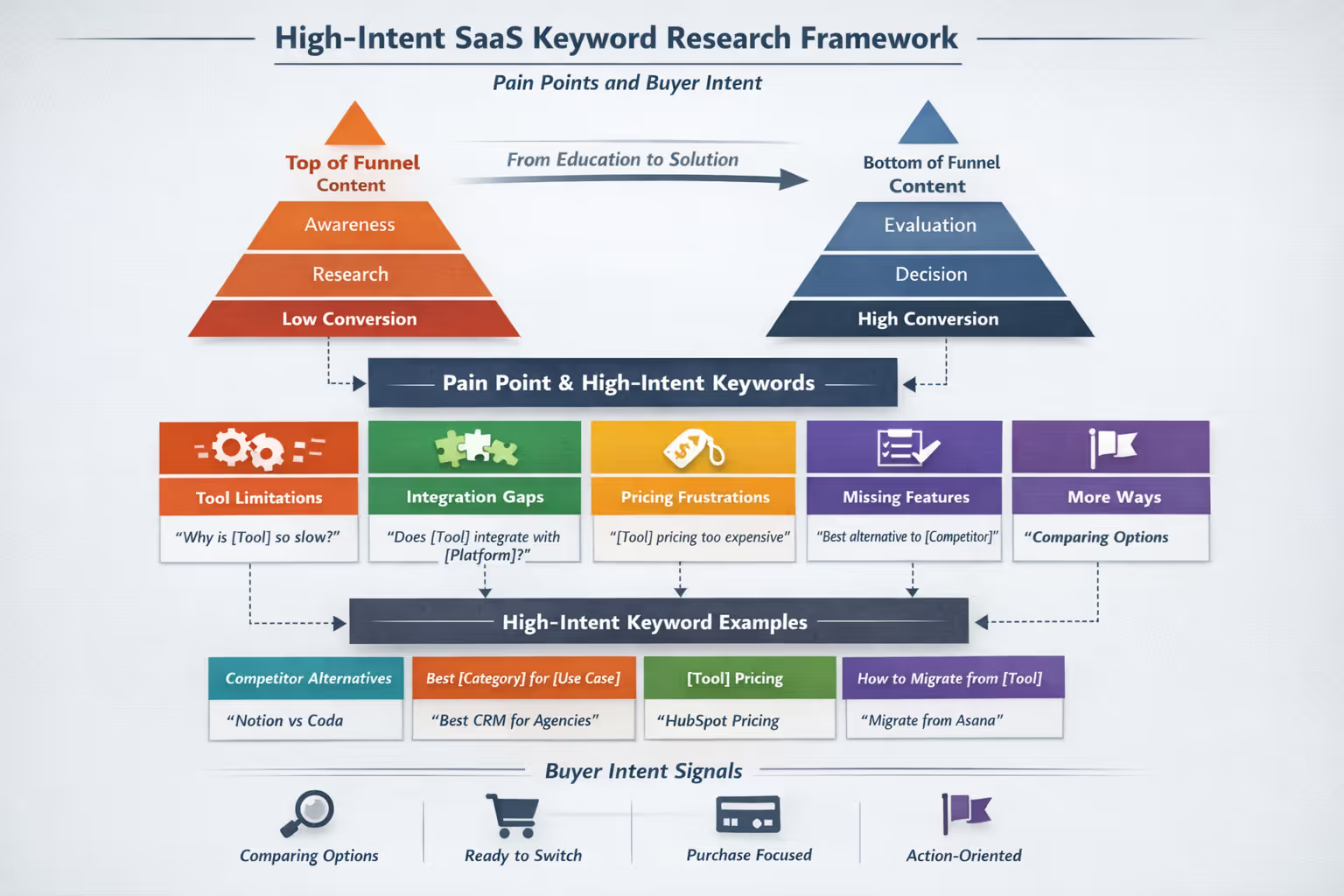
Pain-point SEO starts with a different kind of keyword research. Instead of leading with volume, you lead with intent.
Step 1: Map Your Buyer's Actual Pain Points
Start with the problems your product solves. Not features—problems.
Here's a specific process:
Mine your sales conversations. Ask your sales team: "What frustrations do prospects mention about their current tools?" Document the exact language they use. Phrases like "we're constantly switching between apps" or "reporting takes forever" become keyword seeds.
Analyze competitor reviews systematically. Go to G2 or Capterra, find your top 3 competitors, and filter reviews to 1-3 stars. Look for patterns in complaints. Note the specific adjectives and phrases reviewers use—"clunky," "too expensive for what you get," "terrible customer support." These are the words prospects type into Google.
Review support tickets. Your own support queue reveals what users struggle with. These struggles often mirror what prospects experience with competitors.
Common pain-point categories for SaaS include:
| Pain Category | Example Searches | What It Signals |
| Tool limitations | "Why is [tool] so slow" | Active frustration |
| Integration gaps | "Does [tool] integrate with [platform]" | Workflow evaluation |
| Pricing frustrations | "[Tool] pricing too expensive" | Budget-driven switching |
| Workflow inefficiencies | "How to automate [task] without [tool]" | Seeking alternatives |
| Missing features | "[Tool] doesn't have [feature]" | Feature-driven evaluation |
Step 2: Identify High-Intent Keyword Patterns
Certain keyword structures consistently signal commercial or transactional intent:
| Keyword Pattern | Intent Signal | Example |
| [Competitor] alternatives | Actively seeking to switch | "Monday.com alternatives" |
| [Competitor] vs [Brand] | Direct comparison shopping | "Notion vs Coda" |
| Best [category] for [use case] | Evaluating options | "Best CRM for agencies" |
| [Tool] pricing / [Tool] cost | Purchase consideration | "Salesforce pricing" |
| How to migrate from [Tool] | Ready to switch | "Migrate from Mailchimp" |
| [Category] software for [industry] | Niche buying research | "Accounting software for contractors" |
Pro tip: Use these patterns as templates. Plug in your competitors, your category, and your target use cases to generate a starter list of 20-30 high-intent keywords.
Step 3: Prioritize by Conversion Potential
Not all high-intent keywords deserve equal attention. Score each keyword against four criteria:
Relevance (Weight: High)Does this query map directly to a problem you solve? A keyword like "Salesforce alternatives for small teams" only matters if your product genuinely fits that use case.
Competition (Weight: Medium)Can you realistically rank in the top 5? Check the current SERP. If it's dominated by review sites with high domain authority, you may need a different angle or longer-tail variation.
Volume (Weight: Low-Medium)Is there enough search demand to matter? Here's the key insight: even 50 searches/month can be valuable if intent is high. Don't dismiss low-volume keywords automatically.
Conversion path (Weight: High)Do you have a clear next step for visitors? The best keyword in the world won't help if your landing experience drops the ball.
A practical scoring approach: Rate each keyword 1-5 on Relevance and Conversion Path (high weight), then 1-3 on Competition and Volume (lower weight). Focus first on keywords scoring 12+ out of 16.
Content Formats That Capture Bottom-of-Funnel Traffic
High-intent keywords require high-intent content. The format matters as much as the topic.
Comparison Pages
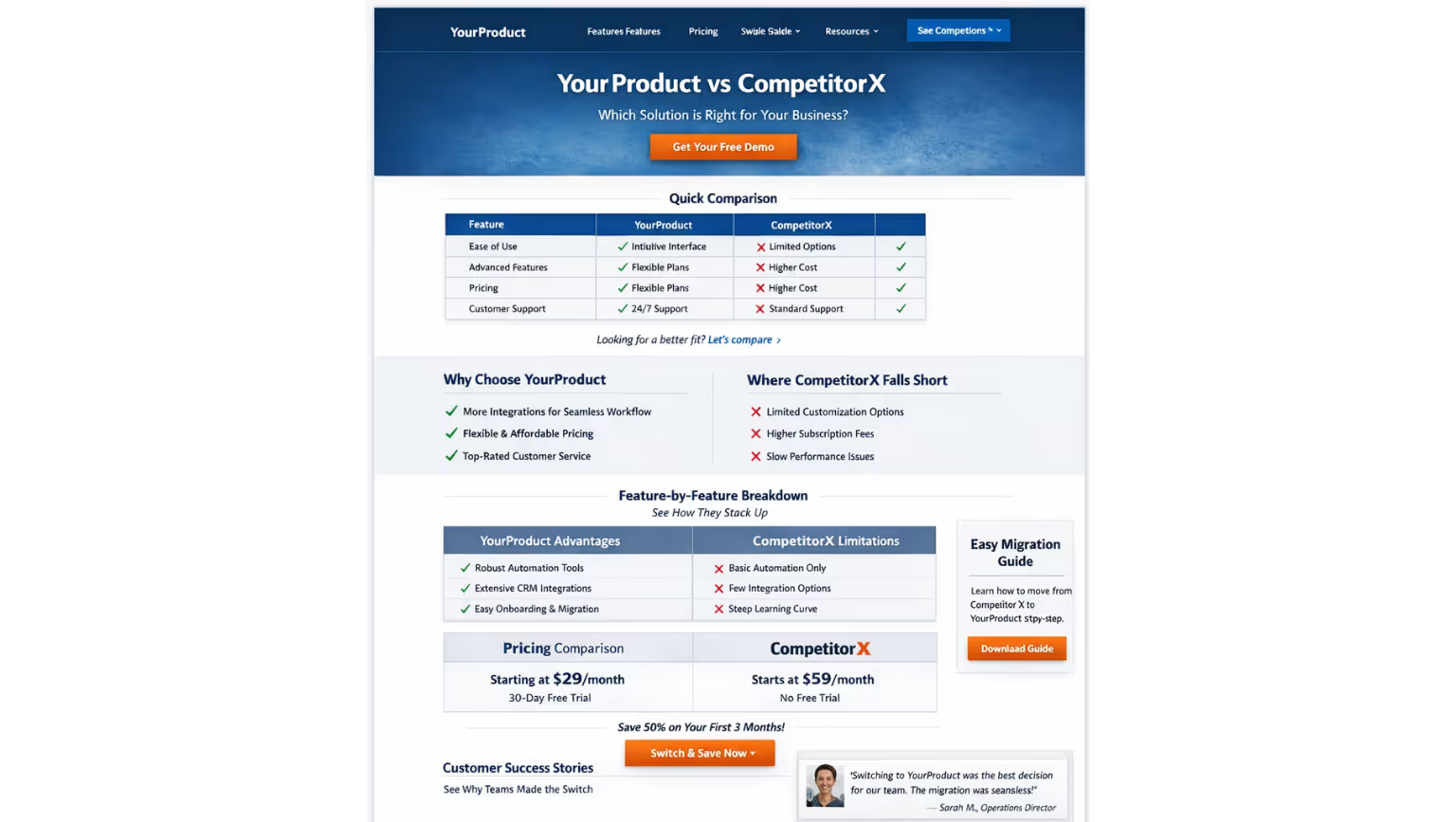
"[Your Product] vs [Competitor]" pages rank among the highest-converting content types in SaaS marketing. They intercept prospects who are actively weighing options.
What a strong comparison page includes:
Above the fold: Clear headline stating the comparison, a summary table of key differences, and your primary CTA
Feature-by-feature breakdown: Honest assessment of where each tool excels
Use-case recommendations: "Choose [Competitor] if... Choose [Your Product] if..."
Pricing comparison: Transparent side-by-side costs
Migration section: How to switch (reduces friction)
Social proof: Customer quotes specifically from users who switched
The credibility principle: Acknowledge where competitors genuinely excel. Buyers can detect bias instantly. A comparison page that admits "Competitor X has better mobile apps, but our desktop experience and integrations are stronger" builds more trust than one that claims superiority across the board [3].
Alternative Roundups
"[Competitor] alternatives" posts capture active switchers. The format matters here.
Structure them as genuine evaluations:
Brief intro acknowledging why someone might be looking for alternatives
Your selection criteria (transparent methodology)
5-7 alternatives including your product (positioned where it genuinely fits best, not necessarily first)
Pros and cons for each option
Clear recommendation based on use case
Include competitors in these posts. It sounds counterintuitive, but ranking for "[Competitor] alternatives" and providing genuinely useful information—even about other competitors—builds the trust that ultimately benefits you.
Problem-Solution Content
"How to [solve specific problem]" content works when the pain is acute and your product offers a path forward.
The structure that converts:
Validate the pain: Show you understand the problem deeply
Explain why it exists: Build credibility through insight
Present solution approaches: Multiple methods, not just "use our tool"
Introduce your product: As one solution path, with specific workflow examples
Clear CTA: Trial, demo, or next resource
Lead with the pain, not the product. The goal is helping first; the conversion follows naturally.
Pricing and Feature Breakdowns
Transparency wins at the bottom of the funnel. If prospects are searching for your pricing, give it to them directly.
Detailed pricing pages should include:
Clear tier breakdown with features at each level
Comparison to competitor pricing (where favorable)
Calculator tools for estimating costs
FAQ addressing common pricing objections
Feature comparison pages work similarly—they serve buyers actively evaluating capabilities.
Migration and Implementation Guides
"How to switch from [Competitor]" content serves buyers who've already decided to leave but need confidence that the transition won't be painful.
This is pure bottom-of-funnel gold. Someone searching this query has made their decision—they just need reassurance about execution.
Include:
Step-by-step migration process
Data export/import procedures
Timeline expectations
Common pitfalls and how to avoid them
Support resources available during transition
Three Quick Wins You Can Execute Today
Before building a full strategy, start here:
1. Check your "[Competitor] alternative" rankings. Search for your top competitor's name + "alternatives." Are you ranking? If not, that's your first content priority.
2. Audit your existing content for BOFU gaps. List your last 20 blog posts. How many target decision-stage intent? If the answer is "fewer than 5," you've identified your opportunity.
3. Create one comparison page this week. Pick your most common competitor. Draft a thorough, honest comparison. This single page may outperform months of awareness content.
Measuring What Matters: Beyond Traffic Metrics
Pain-point SEO requires different success metrics. Traffic alone won't tell you if it's working.
Track these metrics by content type:
Conversion rate by landing pageAre high-intent pages converting better than awareness content? Segment your analytics to compare. You should see measurably higher conversion rates on BOFU content—if you don't, the content or CTA needs work.
Assisted conversionsIs this content appearing in the journey of buyers who eventually convert? Use Google Analytics attribution reports to see which pages appear in converting paths, even if they weren't the last touch.
Engagement depthAre visitors reading thoroughly or bouncing? Time on page and scroll depth indicate whether your content matches their intent.
Pipeline attributionWhich content is actually driving demo requests or trial signups? This is the metric that matters most. A blog post with 500 monthly visitors generating 10 demo requests delivers more value than one with 10,000 visitors and zero conversions [4].
Optimize for outcomes, not vanity metrics.
Common Mistakes to Avoid
Ignoring Long-Tail Variations
High-intent keywords are often long-tail. "Best project management software for remote marketing teams" has lower volume than "project management software"—but dramatically higher intent and lower competition.
Don't skip these because the numbers look small. Stack enough high-converting long-tail pages and they compound into significant pipeline.
Creating Thin Comparison Content
A 300-word comparison page that's obviously biased won't rank or convert. Invest in thorough, genuinely useful comparisons. Your credibility—and your rankings—depend on depth.
Forgetting the CTA
Bottom-of-funnel content needs a clear, relevant next step. If someone reads your "[Competitor] alternative" post and agrees your product fits, what should they do? Make it obvious and make it easy.
Match CTAs to intent level:
Comparison pages → Free trial or demo
Migration guides → Talk to sales or implementation support
Pricing pages → Start trial or contact for custom quote
Chasing Volume Over Relevance
Resist the temptation to target higher-volume keywords when they're off-intent. A focused strategy built around conversion-ready searches will outperform a scattered approach every time.
Building Your High-Intent Topic Bank
Pain-point SEO isn't a one-time project. It's an ongoing discipline that compounds over time.
Start by auditing your current content. What percentage targets bottom-of-funnel intent? For most SaaS companies, the answer reveals significant opportunity.
Then build a topic bank focused on:
Competitor weaknesses: Your top 3-5 competitors and the specific pain points their users experience
Switching triggers: The frustrations your best customers had before they found you
Sales enablement: The questions your sales team answers most often in late-stage conversations
Document this in a simple spreadsheet:
| Keyword | Intent Level | Competitor Target | Content Format | Priority Score |
| [Example] alternatives | High | [Competitor] | Alternative roundup | 14/16 |
| [Your product] vs [Competitor] | High | [Competitor] | Comparison page | 15/16 |
| How to migrate from [Tool] | High | [Competitor] | Migration guide | 13/16 |
This becomes your BOFU content roadmap—a systematic approach to capturing buyers at their moment of highest intent.
The traffic will be smaller than your awareness content. The pipeline impact will be larger.
Ready to stop chasing volume and start capturing buyers? Build your high-intent topic bank this week. Start with your top competitor, identify three pain-point keywords, and create your first comparison page. Your future pipeline will thank you.
Frequently Asked Questions
What is pain-point SEO and how does it differ from traditional SEO?
Pain-point SEO focuses on keywords that reflect specific problems your target audience is actively trying to solve—particularly at the decision stage of their journey. Traditional SEO often prioritizes search volume and awareness-stage content. Pain-point SEO prioritizes intent, targeting queries that indicate a prospect is evaluating solutions or ready to make a switch. The content formats differ too: comparison pages, alternative roundups, and migration guides instead of definitional posts.
How do I find high-intent keywords for my SaaS product?
Start with your buyers' problems, not your product's features. Interview your sales team about prospect frustrations. Analyze 1-3 star reviews of competitors on G2 and Capterra, noting the exact language reviewers use. Then apply high-intent keyword patterns like "[competitor] alternatives," "best [category] for [use case]," and "[tool] vs [tool]." These structures consistently signal commercial or transactional intent.
Is bottom-of-funnel content worth creating if search volume is low?
Yes—often more so than high-volume alternatives. Lower search volume with high intent typically outperforms high volume with low intent when measuring pipeline impact. A keyword with 100 monthly searches converting at 5% delivers more qualified leads than one with 5,000 searches converting at 0.1%. Focus on conversion potential, not traffic potential, when evaluating BOFU keywords.
How long does it take to see results from pain-point SEO?
SEO compounds over time, so expect 3-6 months before meaningful organic rankings appear for new content. However, high-intent content often converts well immediately when promoted through other channels (email, social, paid). The long-term payoff is a steady stream of qualified prospects finding you at exactly the right moment—without ongoing ad spend.
Can I use pain-point SEO if my product is new with few direct competitors?
Absolutely. Focus on the problems you solve rather than competitor comparisons. Target queries like "how to [solve problem]" or "best tool for [specific use case]." You can also compare against the status quo—spreadsheets, manual processes, or cobbled-together tool stacks. As your market matures and direct competitors emerge, expand into comparison and alternative content.
About Our Expertise
This article was produced by The Mighty Quill, an AI-powered content engine built by marketers with over 15 years of experience in SEO, e-commerce, and B2B growth strategy. We specialize in creating search-optimized content that drives measurable results—not just traffic, but pipeline. Our approach combines strategic keyword research, conversion-focused content planning, and rigorous editorial standards to help businesses build sustainable organic visibility.
Cited Works
[1] Conductor — "The Role of Content in the Buyer's Journey." https://www.conductor.com/academy/buyer-journey-content/
[2] Ahrefs — "Keyword Intent: How to Identify and Optimize for Search Intent." https://ahrefs.com/blog/search-intent/
[3] G2 — "How B2B Buyers Use Review Sites in Their Purchase Decisions." https://www.g2.com/articles/b2b-buyer-behavior
[4] HubSpot — "What Is Search Intent? A Complete Guide."
https://blog.hubspot.com/marketing/search-intent