
You've been doing everything right. Or at least, everything that felt right.
You carved out time for blog posts. You researched keywords. You even managed to publish consistently—for a while. But somewhere between the third rewrite and the twelfth article that went nowhere, a quiet question started forming: Is this actually working?
For most marketing teams, the answer is no. And that's not a failure of effort. It's a failure of fit.
I've spent over 15 years in digital marketing, and I've watched dozens of smart, capable teams burn months on content strategies that never had a chance. Not because they lacked talent—but because DIY content requires a constellation of skills, time, and systems that most internal teams simply can't sustain.
Outsourcing SEO content isn't about giving up. It's about recognizing when the DIY approach has reached its ceiling—and making a strategic decision to break through it. This article will help you see the signs, understand why they happen, and explore what high-performing teams do when they finally make the shift.
The Sunk Cost Trap: Why Teams Keep Pushing a Broken System
Here's something most marketing leaders won't admit publicly: they knew their content wasn't working long before they changed course.
The problem is sunk cost. You've already invested time, energy, and budget into building a content workflow. Walking away from that feels like waste. So you keep going—tweaking headlines, adjusting publishing schedules, hoping the next post will be the one that finally ranks.
This is understandable. It's also expensive.
According to the Content Marketing Institute's most recent B2B research, only 29% of marketers rate their content marketing as very or extremely successful [1]. That means more than two-thirds of teams are running content programs that underperform. Many of those teams are stuck in a cycle of incremental fixes rather than structural change.
The sunk cost fallacy convinces you that past investment justifies future investment. But in content marketing, time spent on the wrong approach doesn't compound—it evaporates. Every month you spend on a broken system is a month your competitors are building topical authority you'll have to work harder to catch.
Warning Signs Your DIY Content Strategy Has Failed
Not every struggle means your content program is broken. But patterns matter. If several of these warning signs sound familiar, it's time to reassess.
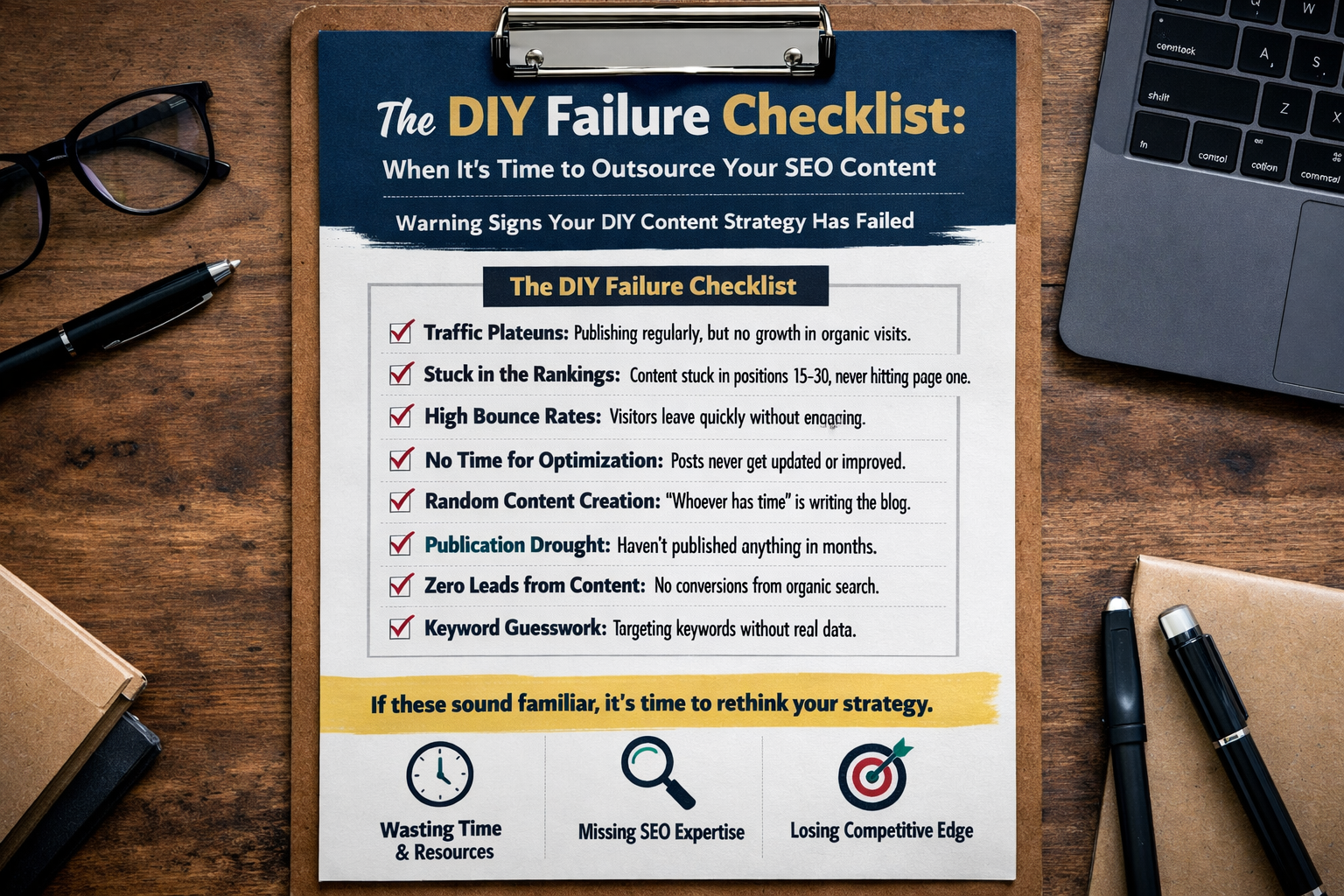
The DIY Failure Checklist
Traffic plateaus despite consistent publishing. You're posting regularly, but organic sessions stay flat month over month.
Rankings stall in positions 15–30. Your content shows up in search, but never climbs to page one where clicks actually happen.
High bounce rates on blog posts. Visitors arrive and leave immediately, signaling a mismatch between search intent and content.
No internal capacity for optimization. Posts go live and are never touched again—no updates, no refreshes, no internal linking strategy.
Content creation falls to whoever has time. There's no dedicated owner, so quality and consistency vary wildly.
You've stopped publishing altogether. The blog exists, but the last post was months ago.
Zero lead attribution to content. Your analytics show traffic, but no conversions tied to organic search.
Keyword research feels like guesswork. You're targeting terms based on intuition rather than competitive data.
If you checked three or more boxes, your DIY content program isn't just struggling—it's stalled. And stalled content doesn't just fail to help. It actively costs you opportunity while competitors capture the search visibility you're missing.
Why DIY Content Fails (It's Structural, Not Personal)
Most teams assume DIY content fails because of quality. They think they need better writers or sharper headlines. Sometimes that's true. But more often, the failure is structural—baked into how internal teams operate.
The Capacity Problem
Content marketing requires sustained output. Not one great article—dozens of good ones, published consistently over months and years.
Most internal teams can't sustain that pace. Marketing managers wear multiple hats. Writers get pulled into campaigns, product launches, and urgent requests. The blog becomes a "when we have time" project—which means it becomes a "never" project.
The math is unforgiving. A senior marketer earning $80,000 annually costs roughly $40 per hour when you include benefits and overhead. If that person spends 6 hours per article (research, writing, editing, publishing), you're paying $240 per post in labor alone—before accounting for the opportunity cost of campaigns they're not running.
The Expertise Gap
SEO content isn't just writing. It requires:
Keyword research and competitive analysis
Search intent mapping
On-page optimization (titles, meta descriptions, headers)
Schema markup implementation
Internal linking strategy
Content structure for featured snippets
Each of these is a skill. Expecting a generalist marketer to master all of them while also managing campaigns, coordinating with sales, and reporting to leadership is unrealistic.
When expertise is missing, content gets published but doesn't perform. It might be well-written. It might even be helpful. But without proper optimization, search engines struggle to surface it—and qualified readers never find it.
The Feedback Loop Problem
Effective content programs iterate. They analyze what's working, double down on successful formats, and prune underperformers. DIY teams rarely have time for this. Posts go live and disappear into the archive. There's no system for measuring, learning, or improving.
Without a feedback loop, content production becomes a treadmill—constant effort, no forward motion.
Comparing Your Options: In-House vs. Freelancer vs. Content Service
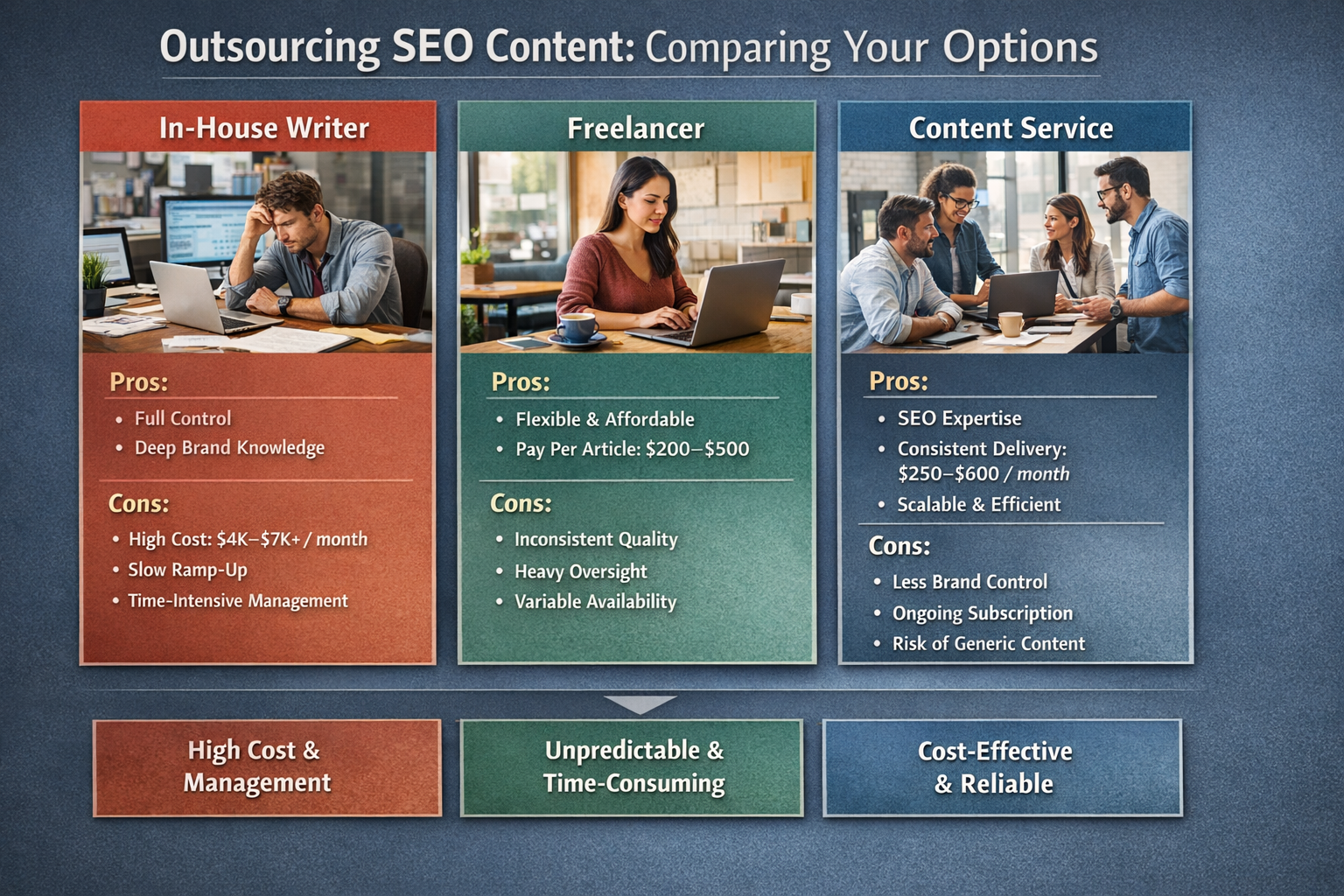
Once you recognize DIY isn't working, you face a choice. Here's how the main options compare:
| Factor | In-House Writer | Freelancer | SEO Content Service |
| Monthly Cost | $4,000–$7,000+ (salary + benefits) | $200–$500 per article | $250–$600/month for consistent output |
| Management Time | High (hiring, training, oversight) | Medium (briefing, feedback, chasing) | Low (approve and publish) |
| SEO Expertise | Varies widely | Usually limited | Built into the service |
| Publishing Consistency | Depends on bandwidth | Unreliable | Guaranteed cadence |
| Scalability | Requires new hires | Requires more freelancers | Scales within subscription |
| Ramp-Up Time | 2–3 months to hire and train | 2–4 weeks per freelancer | Days to first delivery |
The right choice depends on your constraints. But for most growth-stage companies, a dedicated content service offers the best combination of cost efficiency, consistency, and expertise.
The Hidden Cost of Freelancer Management
Freelancers seem affordable on paper. But the overhead adds up quickly:
Writing detailed briefs for every article
Managing multiple contractors with different schedules
Reviewing and revising inconsistent quality
Handling the SEO optimization yourself anyway
Replacing freelancers when they disappear or get busy
A 2023 analysis by Superpath found that content leaders spend an average of 10+ hours per week managing freelance writers [2]. That's a quarter of your workweek spent on coordination, not strategy.
The Strategic Case for Outsourcing SEO Content
Outsourcing isn't a concession. It's a multiplier.
When you shift content production to specialists, you're not just buying time. You're buying expertise, systems, and consistency that most internal teams can't replicate.
What a Dedicated Content Service Actually Provides
Keyword research and topic strategy. Content partners build topic banks based on search data and competitive gaps, not guesses.
Consistent publishing cadence. Two to three posts per week, every week—without internal scrambling or dropped deadlines.
Built-in optimization. On-page SEO, internal linking, and schema handled as standard practice.
Scalable capacity. Output increases without adding headcount or management burden.
Performance focus. Content is designed to rank and convert, not just exist.
The goal isn't to replace your marketing team. It's to free them. When content production is handled, your team can focus on strategy, campaigns, and customer engagement—the work that actually requires internal context.
What Smart Teams Do Instead of DIY Content
High-performing marketing teams treat content like infrastructure, not a side project. They build systems that run without constant intervention. Here's what that looks like in practice.
They Invest in Content Engines, Not Content Projects
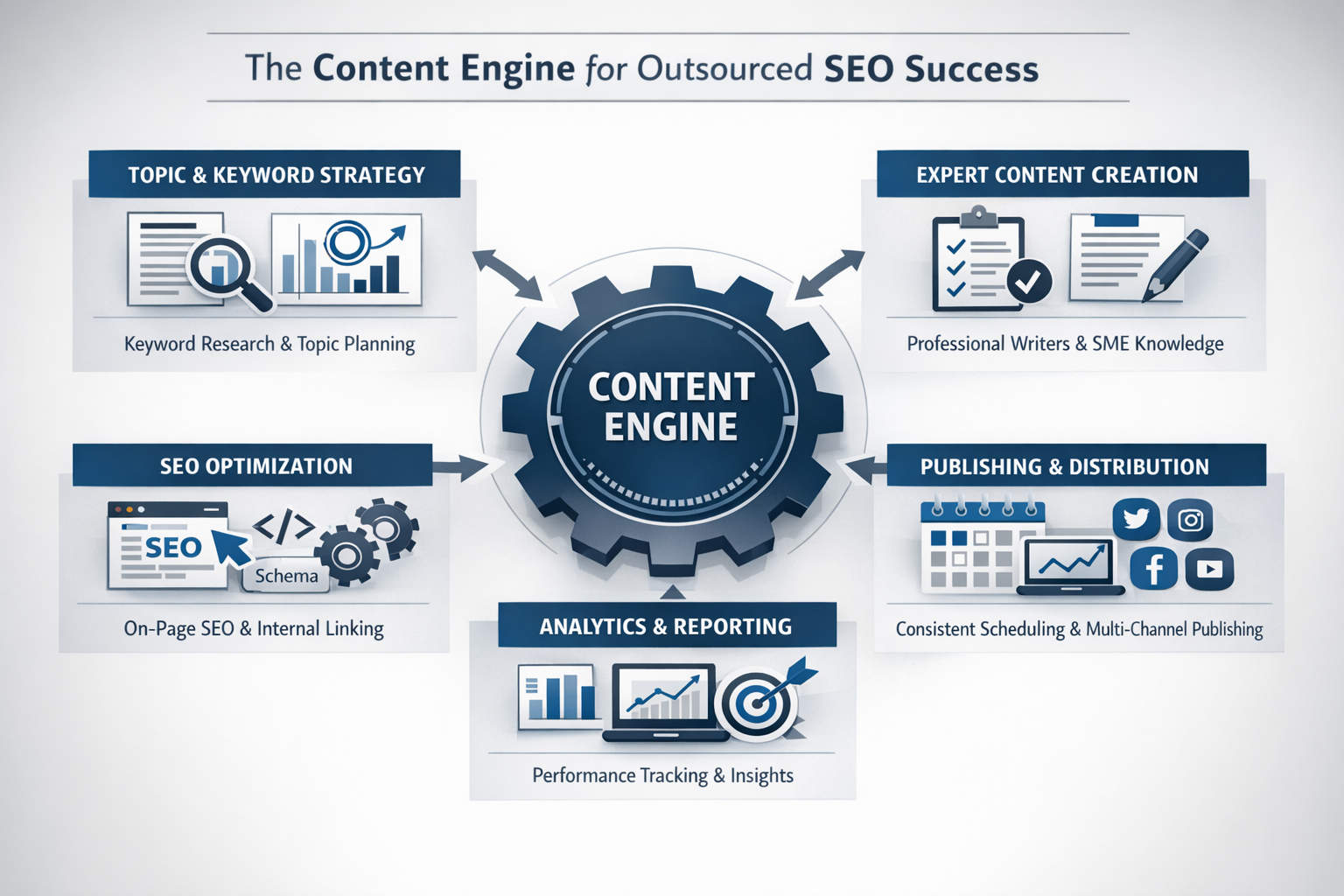
A content engine is a system that produces, optimizes, and publishes content on a predictable schedule. The components include:
A topic calendar based on keyword research and content gaps
A production workflow with clear ownership and deadlines
Standard operating procedures (SOPs) for briefs, approvals, and publishing
An optimization layer ensuring every post is search-ready
A publishing cadence that compounds over time
Teams that build (or outsource) content engines see compounding returns. Traffic grows month over month because the system keeps feeding the machine regardless of who's on vacation or which campaign is launching.
They Measure What Matters
Smart teams don't just track pageviews. They measure:
Organic sessions by source — separating branded from non-branded traffic
Keyword rankings over time — tracking movement for target terms
Conversion rate from organic traffic — connecting content to pipeline
Content velocity — posts published per week or month
Content decay — identifying older posts that need refreshing
This data informs decisions. It tells you which topics resonate, which formats convert, and when to refresh older content instead of creating something new.
They Recognize the True Cost of DIY
The cheapest option on paper is rarely the cheapest option in practice. DIY content seems free—until you account for:
Hours spent by senior team members on writing and editing
Opportunity cost of campaigns not launched
Lost revenue from organic traffic that never arrived
Morale drain from a blog that never gains traction
Marketing budgets are tight. Spending months on content that doesn't perform isn't frugal—it's wasteful in the worst way, because you're burning time you can't recover.
They Choose Partners, Not Vendors
The best content outsourcing relationships aren't transactional. They're collaborative. The right partner understands your audience, learns your voice, and builds content that reflects your brand—not generic filler.
Look for partners who:
Conduct a deep kickoff to understand your business, audience, and goals
Provide topic research and strategy, not just execution
Include optimization as a standard, not an upsell
Offer transparent processes and clear ownership
Give you final approval before anything publishes
The Risks of Outsourcing (And How to Avoid Them)
Let's be honest: outsourcing can go wrong. I've seen it happen. Here are the common pitfalls and how to sidestep them.
Risk 1: Generic, Low-Quality Content
The problem: Some services churn out thin, keyword-stuffed articles that read like they were written by someone who Googled the topic five minutes ago.
The solution: Request samples before committing. Look for depth, specific examples, and clear structure. Ask about their editorial process—do humans review AI-generated drafts? If a service can't explain their quality control, walk away.
Risk 2: Brand Voice Mismatch
The problem: The content sounds nothing like your company. It's technically correct but feels off-brand.
The solution: Choose partners who start with a thorough kickoff process. They should ask about your audience, tone preferences, and positioning. Provide examples of content you like. Good partners will refine their approach based on your feedback over the first few articles.
Risk 3: Missing Subject Matter Expertise
The problem: For technical industries (SaaS, healthcare, finance), generic writers produce surface-level content that doesn't resonate with expert readers.
The solution: Ask how the service handles technical topics. Do they have writers with relevant backgrounds? Can they work from internal documentation or SME interviews? The best partners will build processes to capture your expertise, not fake it.
Risk 4: No SEO Integration
The problem: You're outsourcing writing, but you still have to handle all the SEO work yourself—keyword research, optimization, schema, internal linking.
The solution: Choose a service that includes SEO as part of the package, not an add-on. Content should arrive ready to publish, not requiring hours of additional work.
When Is the Right Time to Outsource?
There's no universal trigger, but common patterns emerge. Teams typically outsource successfully when:
They've tried DIY for 6–12 months without meaningful organic growth
Internal bandwidth can't support the publishing pace required for results
They recognize that content is a growth lever, not a checkbox exercise
They're ready to treat content as a system, not a series of one-off projects
Leadership understands that SEO compounds—and delays cost more than investments
If you're reading this article, you're probably already past the tipping point. The question isn't whether DIY has failed. It's how much longer you're willing to wait before trying something different.
What to Expect After Making the Shift
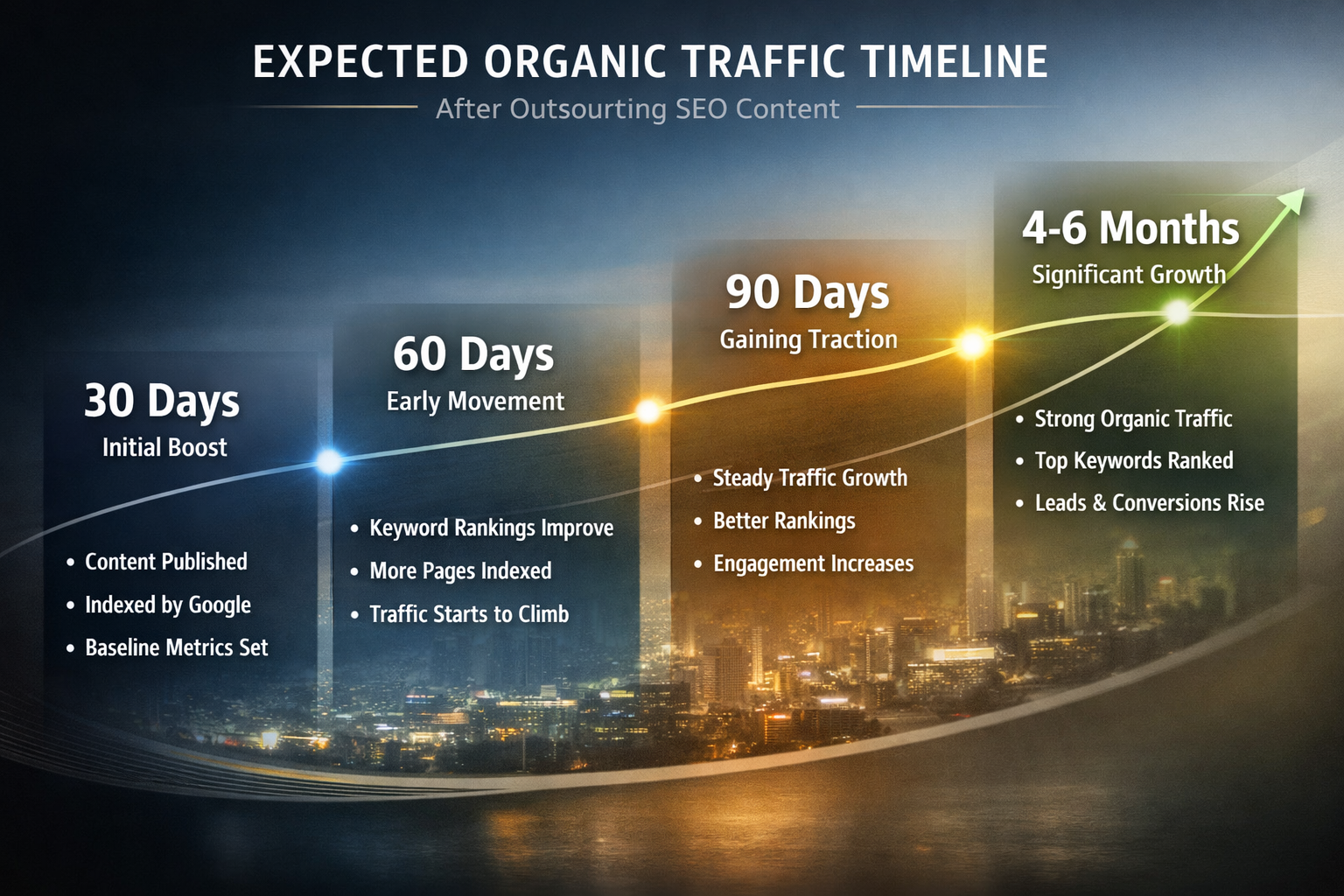
Outsourcing doesn't produce instant results. Content marketing is a compounding game—the work you do in month one often doesn't show returns until month four or five. But the timeline becomes predictable once you have a system.
30–60 Days
Content calendar established and first articles delivered
Initial posts published and indexed
Baseline metrics captured for comparison
60–90 Days
More pages indexed in search
Initial keyword movement for target terms
A clearer picture of what topics and formats resonate
4–6 Months
Compounding effects become visible
Traffic curves upward as content library grows
Rankings consolidate for key terms
Leads start appearing from posts published months earlier
The teams that win are the ones that commit to consistency. Outsourcing makes that commitment possible—and sustainable.
Ready to Build a Content System That Works?
If your DIY content strategy has stalled, you're not alone—and you're not stuck.
The Mighty Quill helps growth-focused teams build organic traffic engines through consistent, SEO-optimized content. No more chasing freelancers. No more posts that go nowhere. Just a system that compounds.
Try the Blog Engine free and get two custom articles in 48 hours—no commitment required.
Frequently Asked Questions
How do I know if my DIY content strategy has truly failed?
Look for patterns, not isolated struggles. If traffic has plateaued for three or more months despite publishing, if rankings stall below page one, or if your team has stopped publishing altogether, these are structural failures—not temporary setbacks. A consistent inability to generate results signals a systemic problem that incremental fixes won't solve.
How much does outsourcing SEO content typically cost?
Costs vary widely. Individual freelancers charge $200–$500 per article but require significant management. Full-service content subscriptions typically range from $250–$600 per month for consistent output including research and optimization. Compare this to in-house writers at $4,000–$7,000 monthly when you factor in salary, benefits, and management overhead.
How quickly will I see results after outsourcing SEO content?
Content marketing compounds over time. Most teams see initial movement—more indexed pages, early keyword rankings—within 60–90 days of consistent publishing. Meaningful traffic growth typically becomes visible around the four-to-six month mark as your content library expands and Google recognizes your topical authority.
Will outsourced content match my brand voice?
It should, if you choose the right partner. Quality content services begin with a deep kickoff process to understand your audience, tone, and positioning. They learn your voice rather than applying a generic template. Look for partners who offer revision cycles and maintain ongoing communication to ensure alignment as your content evolves.
What's the difference between outsourcing to a freelancer versus a content service?
Freelancers provide writing. A content service provides a system. The difference includes keyword research, topic strategy, SEO optimization, and consistent publishing—not just words on a page. Freelancer management also creates overhead; a content service handles the entire pipeline so your team stays focused on strategy.
About The Mighty Quill
The Mighty Quill was founded by Mario, a digital marketing veteran with over 15 years of experience in SEO, e-commerce, and content strategy. After watching brands struggle with inconsistent publishing and underperforming content, he built a system that delivers expert-level, SEO-optimized articles on a predictable schedule. The Mighty Quill combines AI-powered efficiency with human editorial oversight to create content that ranks, reads well, and converts—helping growth-focused teams build organic traffic engines without hiring writers or managing freelancers.
Works Cited
[1] Content Marketing Institute — "B2B Content Marketing: Benchmarks, Budgets, and Trends." https://contentmarketinginstitute.com/research/
[2] Superpath — "The State of the Content Marketing Industry." https://superpath.co/content-marketing-salary-report/