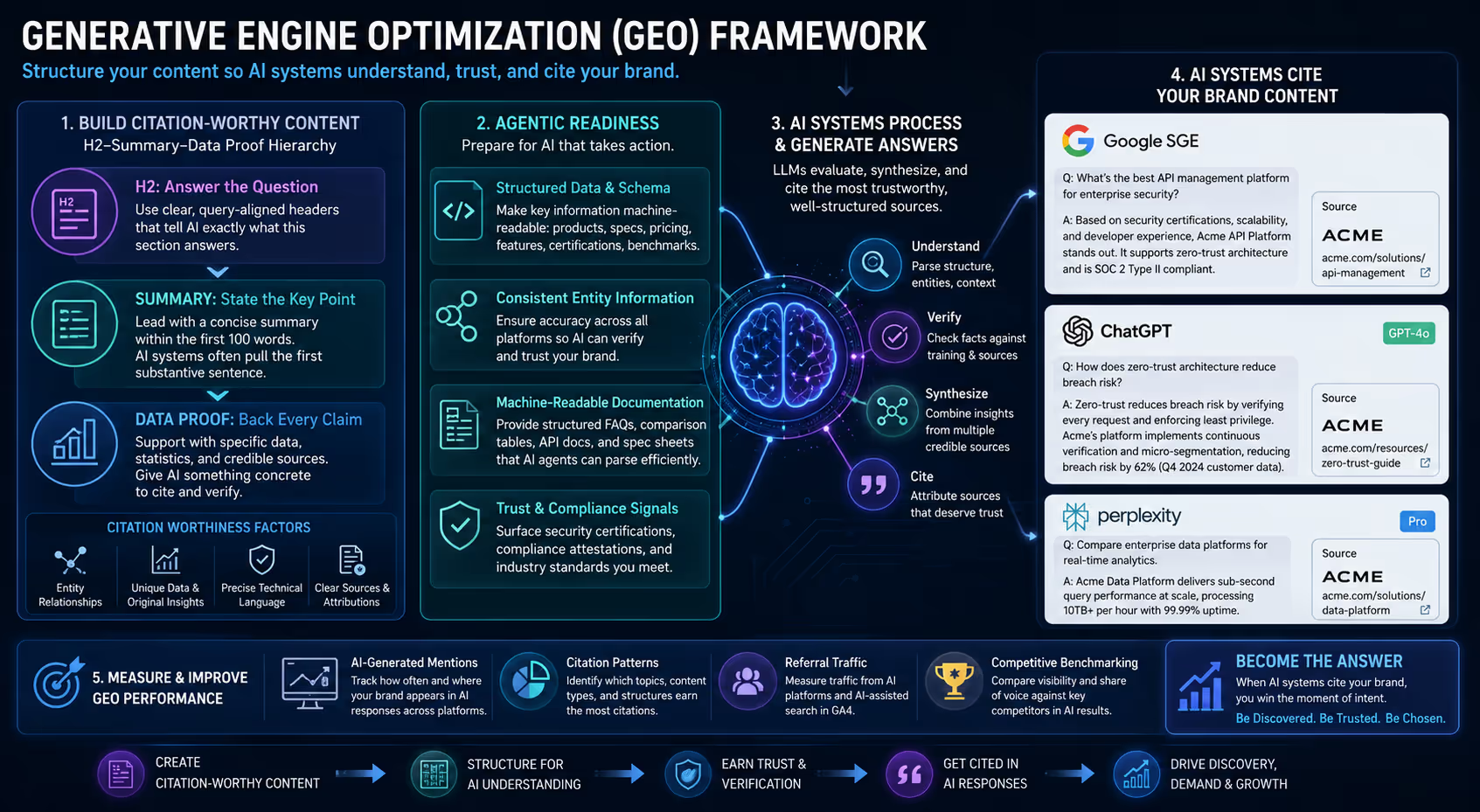

Search visibility used to be straightforward. Rank on page one, get clicks, generate leads. The model worked for years, and entire industries grew around optimizing for those ten blue links.
That model is evolving—quickly and in ways that matter for how businesses think about content strategy.
AI-powered search engines no longer just retrieve and rank links. They synthesize answers from multiple sources and deliver responses directly to users, often without generating a single click to any website [1]. This shift means the question isn't only where you rank. It's whether AI systems cite your content at all when they generate those answers.
This creates the need for a new way of measuring visibility: what some practitioners are calling Model Influence Rate, or AI Citation Share. It measures how often large language models reference, quote, or draw from your content when generating answers.
The concept is still emerging—there's no industry-standard dashboard for it yet—but the underlying shift it represents is real and accelerating. Businesses that understand this early will have a meaningful head start.
Why Traditional Rankings No Longer Tell the Full Story
Page-one rankings still matter. They're not obsolete. But they're increasingly incomplete as a measure of true visibility.
The reason is mechanical: AI search assistants—Google's AI Overviews, ChatGPT with browsing, Perplexity, and others—aggregate information from across the web and present synthesized answers. According to research from Moz, a growing percentage of searches now end without any click at all because users get what they need directly from the AI-generated response [2].
This creates a specific problem for businesses tracking SEO performance. Your site can technically rank well while experiencing declining traffic. The click never happens because the AI answered the question using information synthesized from various sources.
And if the AI drew primarily from your competitor's content instead of yours? Your competitor built credibility with that user. You didn't—even if your page appeared in the traditional search results.
Traditional SERP tracking tools weren't designed for this dynamic. They measure link positions well, but they can't tell you whether your content influenced the AI's response.
What Is Model Influence Rate?
Model Influence Rate measures the frequency with which AI systems cite, reference, or incorporate your content into their generated responses. Think of it as your AI share of voice for a given topic.
Here's a practical example: if a user asks an AI assistant, "What's the best way to structure a content calendar?" and the AI's answer draws heavily from your published guide—or directly cites your brand name—that's model influence in action.
This metric captures something traditional rankings alone cannot: whether you're part of the AI's working knowledge base for your topic area.
It's worth noting that Model Influence Rate isn't yet a standardized metric you can pull from a dashboard. It's an emerging conceptual framework—what some in the SEO industry are calling Generative Share of Voice. But the underlying reality it describes is observable and increasingly important.
Several factors appear to affect how often AI systems draw from a given source:
Content depth and structure. AI models rely on a process called Retrieval-Augmented Generation (RAG), which pulls relevant information from indexed content to inform responses. Well-organized, comprehensive content that clearly answers specific questions is more likely to be retrieved and cited [3].
Topical authority. Sites with extensive, interlinked coverage of a subject tend to get cited more frequently. A single post on "content marketing" won't establish authority. Twenty interlinked posts covering strategy, distribution, measurement, and real-world examples signal genuine expertise.
Freshness and accuracy. Models appear to prioritize content that seems current and factually reliable. Outdated statistics or thin reasoning can reduce citation likelihood.
Source reputation. Content from sites with established authority—through quality backlinks, brand mentions, and consistent publishing—tends to surface more often in AI responses [3].
The exact algorithms remain proprietary, but the pattern is consistent: content built for depth, clarity, and trustworthiness outperforms content optimized primarily for keyword density.

The Attribution Problem: Why Current Analytics Fall Short
Most analytics platforms weren't built to track AI-driven attribution, and this creates a significant gap in understanding.
Google Analytics tells you where clicks came from. It shows organic traffic and referral sources. But when an AI provides a complete answer and the user never clicks through to any source? That interaction is invisible to your analytics.
Even when users do click through from AI interfaces, the referral data is often inconsistent. Traffic from ChatGPT browsing or Perplexity may appear as direct traffic or get categorized unpredictably, making it difficult to track systematically [4].
This leaves important questions unanswered:
Which AI platforms are referencing your content?
How often is your brand mentioned in AI-generated responses?
What topics or questions trigger citations to your site versus competitors?
Traditional SERP tracking tools can't answer these questions because they were designed for a different paradigm—one where links and click-through rates were the primary success signals.
The industry is beginning to develop new measurement approaches. Some emerging tools attempt to monitor AI outputs for brand mentions and citations. Practitioners are experimenting with methods like setting up regex filters in Google Search Console to identify AI bot traffic, or using brand monitoring tools to spot when their content gets cited in AI responses.
But standardized attribution models for AI-driven visibility don't yet exist at scale. This is the practical gap: you can't improve what you can't measure, and most businesses can't yet measure their AI citation share with precision.
That said, waiting for perfect measurement tools isn't a viable strategy. The businesses building model influence now will have compounding advantages later.
How to Start Building Your AI Share of Voice
While the measurement infrastructure catches up, the strategies for building model influence are becoming clearer. Here's what the evidence suggests works.
Create Answer-Ready Content
AI systems extract and synthesize information to construct responses. Content that provides clear, direct answers to specific questions is more likely to be retrieved and cited.
Practically, this means:
Structure content with clear headings and subheadings that signal what each section covers
Answer the core question early in each section rather than building to a conclusion
Use lists, tables, and definitions where they add clarity
Avoid filler content that dilutes the core answer
Think about the exact questions your audience asks, then answer them precisely and completely. Content that requires the AI to do interpretive work is less likely to be selected.

Build Topical Depth Through Consistent Publishing
AI models assess topical authority partly by evaluating how comprehensively a site covers its subject area. One blog post establishes nothing. A coordinated library of interlinked content covering a topic from multiple angles signals expertise.
This is where consistent publishing creates compounding returns. According to Semrush's research on topical authority, sites that systematically cover related subtopics tend to rank better across their entire topic cluster—and the same principle applies to AI citation likelihood [5].
At The Mighty Quill, we've observed this pattern directly. Clients who maintain a steady publishing cadence—two to three posts per week over several months—tend to see broader organic visibility than those publishing sporadically, even when total content volume is similar.
Prioritize Accuracy and Trustworthiness
AI models have mechanisms to assess source reliability. Content with factual errors, outdated information, or unsupported claims is less likely to be cited.
Every claim should be supportable. Every statistic should be traceable to a credible source. This isn't just good editorial practice—it's becoming a factor in AI visibility. The stakes of accuracy are rising.
Earn External Validation
Backlinks remain important, but brand mentions also contribute to how AI systems evaluate authority. When other credible sites reference your work—through links, citations, or mentions—it signals trustworthiness to both traditional search engines and AI systems [5].
Guest contributions, cited research, media coverage, and industry mentions all contribute to this signal. The goal is building genuine recognition within your space.
Monitor What's Trackable Now
While comprehensive AI attribution tools are still emerging, you can start building baseline visibility into your AI citation presence:
Manual spot-checks: Periodically ask AI assistants questions related to your core topics and note whether your content or brand appears in responses
Referral pattern analysis: Watch for unusual traffic patterns in analytics that don't correlate with ranking changes
Brand monitoring tools: Services like Brand24 or similar can sometimes detect when your content gets cited in AI-generated responses
AI platform traffic: Look for referral traffic from platforms like Perplexity or ChatGPT, even if attribution is imperfect
Imperfect data is better than no data. The goal is developing intuition for how your content performs in AI contexts.
The Compounding Advantage of Early Action
Search visibility has always rewarded early movers. The sites that built backlink profiles and content libraries years ago still benefit from that foundation today. Authority compounds.
The same dynamic is playing out with AI citation share. Models are trained on existing web content. The content that exists now—and the content published consistently over the coming months—shapes which sources AI systems learn to trust and cite.
Waiting means ceding that ground to competitors who are already publishing. This isn't about gaming a system. It's about building genuine authority in your space through consistent, high-quality content. AI models, like human readers, ultimately reward content that's helpful, accurate, and well-organized.
The window for establishing AI citation authority is open now. It won't stay open indefinitely.

What This Means for Your SEO Strategy
Model Influence Rate isn't replacing traditional SEO metrics. It's supplementing them.
You still need solid technical SEO. You still need keyword research. You still need to rank for important terms. Those fundamentals haven't disappeared.
But if you're only tracking rankings and click-through rates, you're missing a growing portion of the visibility picture. The shift requires:
New measurement frameworks that account for AI citations, even imperfect ones
Content strategies built for answer-extraction, not just ranking signals
Consistent publishing that compounds topical authority over time
Quality standards that prioritize accuracy and depth over volume alone
The businesses that adapt early will own the AI citation share for their categories. The ones that wait will spend years trying to catch up.
Start Building Your AI Share of Voice
Model Influence Rate isn't a vanity metric. It's becoming a core measure of whether your content actually reaches your audience in an AI-mediated search landscape.
The infrastructure for measuring it precisely is still developing. But the strategies for building it are clear: publish consistently, prioritize depth and accuracy, and create content that AI systems want to cite.
If your blog is sitting idle—or you're publishing sporadically—you're losing ground in a compounding game.
Ready to build consistent, authority-driven content? Try the Mighty Quill Blog Engine free and see how automated publishing can help you capture AI citation share while you focus on running your business.

Frequently Asked Questions
What is Model Influence Rate in SEO?
Model Influence Rate is an emerging framework that measures how frequently AI systems—like ChatGPT, Google's AI Overviews, or Perplexity—cite or draw from your content when generating answers. It represents your share of voice within AI-generated responses, distinct from traditional search rankings that measure link positions. While not yet a standardized metric with universal tracking tools, the concept captures an increasingly important dimension of search visibility.
How is AI Citation Share different from traditional rankings?
Traditional rankings show where your page appears in search results lists. AI Citation Share measures whether your content gets used by AI systems when they synthesize answers. You can rank well but still lose visibility if AI assistants pull information from competitors instead. It's the difference between being on the shelf and being the ingredient the chef actually uses to prepare the dish.
Can I track my Model Influence Rate today?
Comprehensive tracking tools are still emerging—there's no industry-standard dashboard yet. However, you can begin monitoring through manual spot-checks (asking AI assistants questions in your topic area), watching referral patterns from AI platforms, and using brand monitoring tools to detect citations. Some practitioners are also experimenting with Google Search Console filters to identify AI bot traffic. Imperfect measurement now beats waiting for perfect tools.
What content strategies improve AI citation share?
Focus on creating answer-ready content with clear structure and direct answers to specific questions. Build topical depth through consistent publishing on related subtopics, creating an interlinked content library rather than isolated posts. Prioritize factual accuracy—AI systems appear to favor trustworthy, well-sourced content. External validation through quality backlinks and brand mentions also signals authority to AI models.
Why does consistent publishing matter for Model Influence?
AI models assess topical authority partly based on how comprehensively a site covers its subject area. A single post won't establish expertise, but a library of interlinked, well-structured content signals depth and reliability. Consistent publishing compounds this authority over time, making your site more likely to be cited across a range of related queries. The effect is cumulative—early, steady investment creates lasting advantages.
Works Cited
[1] Search Engine Journal — "How AI Overviews Are Changing Search Behavior." https://www.searchenginejournal.com/ai-overviews-search-behavior/
[2] Moz — "Zero-Click Searches and the Future of SEO."
https://moz.com/blog/zero-click-searches
[3] Ahrefs — "What Makes Content Rank in AI-Powered Search."
https://ahrefs.com/blog/ai-search-ranking-factors
[4] Search Engine Land — "Tracking Traffic from AI Assistants: The Attribution Challenge." https://searchengineland.com/ai-assistant-traffic-attribution/
[5] Semrush — "Building Topical Authority for Modern SEO." https://www.semrush.com/blog/topical-authority/