Your blog hasn't been updated in three weeks. Maybe six. The last post sits there like an accusation—a half-finished project that was supposed to drive traffic but instead collected dust while your competitors climbed search rankings.
You know how this story goes. You've tried the DIY approach: bought a Jasper subscription, generated some drafts, then watched them sit in Google Docs because nobody had time to edit, optimize, and publish them. You've considered agencies, but $5,000 monthly retainers for four articles doesn't pencil out when you need consistent volume to build authority.
There's a third option that most businesses overlook—one that sits between expensive agencies and time-consuming DIY tools. Managed blog services combine AI efficiency with human oversight to deliver publish-ready content at predictable costs.
This guide breaks down how managed blog services actually work, what they cost across different models, and how to evaluate whether this approach fits your growth strategy.
What Are Managed Blog Services?
Managed blog services handle your entire content production pipeline—from keyword research through publishing. Unlike hiring freelance writers or using standalone AI tools, these services own the complete process so you're not coordinating between multiple vendors or handling the operational work yourself.
The core promise: you approve content while someone else handles everything else.
A typical managed blog service includes:
Keyword and topic research to identify what your audience actually searches for
Content calendar management so publishing stays consistent week after week
Article drafting using AI-assisted workflows refined by human editors
Quality control and editing before anything goes live
On-page SEO optimization including meta descriptions, headers, and internal links
Publishing directly to your CMS (in full-service tiers)
The category emerged because businesses recognized a gap between two imperfect options. DIY tools require too much internal bandwidth—someone still needs to prompt the AI, edit output, optimize for search, and actually publish. Traditional agencies charge premium rates that make consistent, high-volume publishing financially impractical for most growing companies [1].
Managed services sit in the middle. They combine modern AI tools with human oversight and strategic direction at price points that make weekly publishing sustainable.
How Managed Blog Services Actually Work
Understanding the workflow helps clarify what you're paying for—and what separates a well-run service from one that cuts corners.
The Production Workflow
Most managed services follow a similar operational structure:
Step 1: Strategic Kickoff
The service conducts a deep-dive into your business—your audience, competitors, brand voice, and content goals. This isn't a checkbox exercise. The quality of this kickoff determines whether content sounds like your company or generic filler.
Step 2: Topic Bank Creation
Using keyword research tools (typically platforms like Ahrefs, Semrush, or similar), the service builds a prioritized list of topics based on search volume, competition, and relevance to your business. You'll review and approve this bank before production begins.
Step 3: Content Calendar Scheduling
Topics get scheduled across weeks or months. A good service maintains a content queue so you're never scrambling for what to publish next.
Step 4: AI-Assisted Drafting
Here's where the "managed" part matters most. AI generates initial drafts based on research and briefs. But raw AI output rarely meets quality standards—it often lacks nuance, occasionally includes inaccuracies, and tends toward generic phrasing.
Step 5: Human Editing and Optimization
Skilled editors refine AI drafts for accuracy, brand voice, and readability. They add internal links, optimize headers, write meta descriptions, and ensure the piece actually answers the search intent behind the target keyword.
Step 6: Client Approval
You review the finished piece. Most services offer revision rounds if something needs adjustment.
Step 7: Publishing (Full-Service Tiers)
Done-for-you services handle the final mile: uploading to your CMS (WordPress, Webflow, HubSpot, and others), formatting, adding images, and scheduling publication.
What Separates Good Services from Bad Ones
The workflow above sounds straightforward. The execution varies wildly.
Red flag: Services that skip the strategic kickoff and jump straight to churning out content. Without understanding your business, they'll produce generic articles that drive traffic but not conversions.
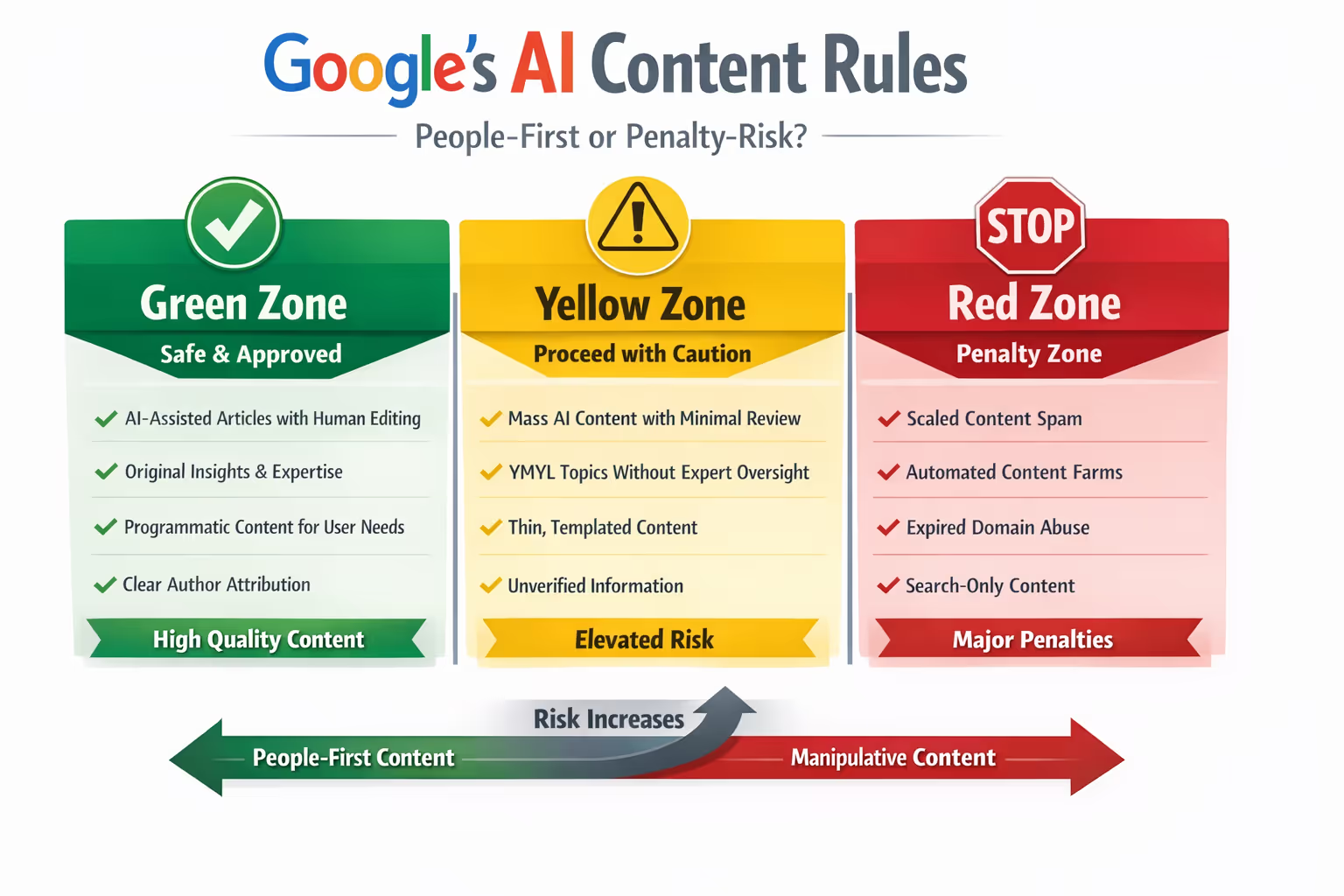
Red flag: Services with no human editing layer. Pure AI output—even from sophisticated models—contains errors, awkward phrasing, and occasionally fabricated information. Search engines have grown increasingly sophisticated at identifying thin, AI-generated content [2].
Green flag: Services that show you their editing process and can explain how they maintain quality at volume.
The Three Content Production Models Compared
Most businesses choose between three distinct approaches. Each has tradeoffs worth examining honestly.
DIY AI Writing Tools
Tools like Jasper, Copy.ai, and ChatGPT let anyone generate content quickly. Monthly costs typically range from $20–$100 for unlimited generation [3]. The appeal is obvious: instant output at minimal cost.
The problems surface over time. Someone on your team still needs to:
Research keywords and plan topics strategically
Prompt the AI effectively (this is harder than it sounds)
Edit output for accuracy, flow, and brand voice
Optimize for SEO with proper headers, links, and metadata
Format and publish consistently every week
These tasks add up to several hours weekly. For marketing teams already stretched thin, "affordable" AI tools become expensive when you factor in opportunity cost.
Content quality also suffers without editorial oversight. Most companies using DIY tools publish inconsistently—a burst of articles followed by weeks of silence when other priorities take over.
Best for: Solo operators with writing experience who genuinely enjoy content creation and have time to do it well.
Traditional Content Agencies
Agencies offer strategic guidance, experienced writers, and account management. They handle the creative load while providing reporting and optimization recommendations.
Monthly retainers typically range from $2,000–$10,000 depending on volume, specialization, and agency prestige [4]. The model works well for enterprises with substantial content budgets.
For growing companies, the economics often don't pencil out. High retainers mean fewer articles per dollar spent. A company paying $5,000 monthly might receive four to six articles—far below the publishing frequency that builds topical authority in competitive spaces.
Agency timelines also tend toward the slow. Onboarding takes weeks. Revision cycles drag. The high-touch service model that justifies premium pricing creates bottlenecks that undermine consistency.
Best for: Enterprises with large marketing budgets and complex content needs requiring significant strategic consultation.
Managed Blog Services (The Middle Path)
Managed services combine AI efficiency with human quality control at price points between DIY tools and agencies. Monthly costs typically run $250–$800 depending on volume and service level.
The model works because AI handles computationally intensive tasks—research synthesis, initial drafting, outline generation—while humans provide strategy, editing, fact-checking, and optimization. This hybrid approach produces more content than agencies at lower cost while avoiding the quality problems of unedited AI output.
For businesses targeting two to four articles weekly, managed services often represent the sweet spot between quality and scalability.
Best for: Growth-focused companies that need consistent, quality content without dedicating internal resources to production.
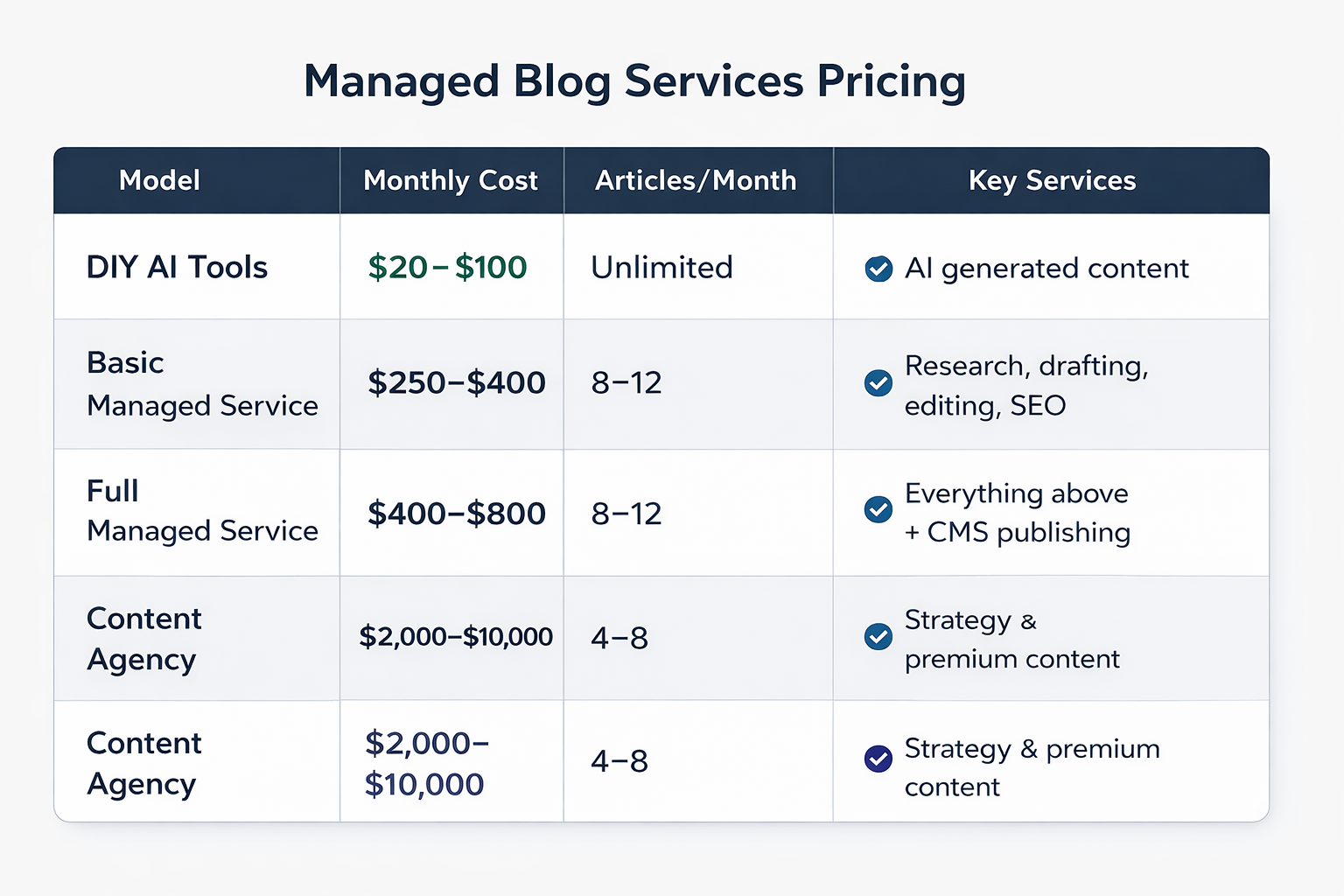
Managed Blog Service Pricing Breakdown
Pricing varies significantly based on what's included. This comparison clarifies what different investment levels actually deliver:
| Model | Monthly Cost | Articles/Month | What's Included | Best For |
| DIY AI Tools | $20–$100 | Unlimited (you write/edit) | AI generation only | Solo operators with writing skills |
| Managed Service (Basic) | $250–$400 | 8–12 articles | Research, drafting, editing, SEO | Companies that publish internally |
| Managed Service (Full) | $400–$800 | 8–12 articles | Everything above + CMS publishing | Hands-off content production |
| Content Agency | $2,000–$10,000 | 4–8 articles | Strategy, premium writing, reporting | Enterprises with large budgets |
The ROI Calculation
At $400 monthly for eight optimized articles, you're paying roughly $50 per publish-ready piece. Agencies charging $500–$1,000 per article deliver similar quality at significantly higher cost per unit.
The more important calculation involves what you're not paying for.
True cost of in-house content:
Salary: $50,000–$80,000 annually for qualified content marketers in most markets [5]
Benefits: Add 20–30% for health insurance, PTO, and payroll taxes
Management overhead: Someone needs to direct strategy and review output
Tools: SEO software, editing tools, stock images, CMS costs
Ramp time: New hires take months to learn your industry and voice
Total cost often exceeds $70,000 annually for a single writer producing eight to twelve articles monthly. Managed services delivering equivalent output cost $3,000–$5,000 yearly at the basic tier—a fraction of in-house expense without the management overhead.
The Compounding Factor
Content marketing operates on compound interest principles. Each article targeting valuable keywords adds to your total organic visibility. Unlike paid advertising—which stops generating traffic the moment you stop paying—blog content continues attracting visitors for months or years after publication [6].
This compounding effect makes consistency the primary driver of results. Publishing two articles weekly for twelve months typically outperforms publishing eight articles monthly for six months—even though total article volume is similar. Search engines reward sites that demonstrate ongoing topical investment.
Managed services excel specifically because they maintain the consistency that enables compounding. No sick days. No vacation coverage gaps. No turnover disruption.

What to Look for in a Managed Blog Service
Not all managed services deliver equal value. These factors separate effective partners from those that waste your budget.
Content Quality Standards
Quality remains non-negotiable. Search engines have grown sophisticated at identifying thin, generic content. Google's helpful content updates specifically target material that exists only to rank rather than genuinely serve readers [2].
Ask potential providers:
How do they ensure factual accuracy in technical topics?
What does their editing process look like step-by-step?
Can they share sample articles from your industry?
How do they handle content that requires subject matter expertise?
The best services combine AI efficiency with human judgment. Pure AI output often lacks nuance and occasionally hallucinates facts. Pure human writing at scale gets expensive. The hybrid approach—AI drafts refined by skilled editors—typically produces the best balance.
SEO Expertise Built Into the Process
Blog management pricing means nothing if content doesn't drive traffic. Effective managed services bake SEO into every step of production—not as an afterthought.
Look for providers that include:
Keyword research tied to your business goals and competitive landscape
Topic clustering to build topical authority in your core areas
On-page optimization including headers, meta descriptions, and internal links
Schema markup for enhanced search visibility where appropriate
Performance reporting so you can track what's working
Some services focus purely on writing and leave SEO to you. That approach works if your team has technical search expertise—but defeats the purpose for most companies seeking done-for-you content marketing.
Publishing Consistency You Can Count On
The entire point of managed services is removing the bottleneck of inconsistent publishing. Your blog needs fresh content every week, not whenever someone remembers it exists.
Confirm the service can deliver:
A predictable publishing schedule (typically two to three articles weekly)
Clear turnaround times for drafts and revisions
Systems that don't depend on any single writer's availability
Backup processes when primary editors are unavailable
Consistency compounds. Publishing two quality articles weekly for six months builds more authority than publishing ten articles sporadically over the same period [7].
Strategic Alignment From Day One
Volume means nothing without direction. The best managed services start with understanding your audience, competitive landscape, and business objectives—before a single article gets written.
Expect a proper onboarding process covering:
Your ideal customer profile and their search behavior
Products or services to prioritize in content strategy
Competitors to monitor and differentiate from
Brand voice and messaging guidelines
Existing content to reference, update, or avoid duplicating
Services that skip this step produce generic content that might drive traffic but won't drive conversions. The strategic foundation determines whether content becomes a business asset or just noise.
When Managed Services Aren't the Right Fit
Managed services aren't right for every situation. The model makes less sense when:
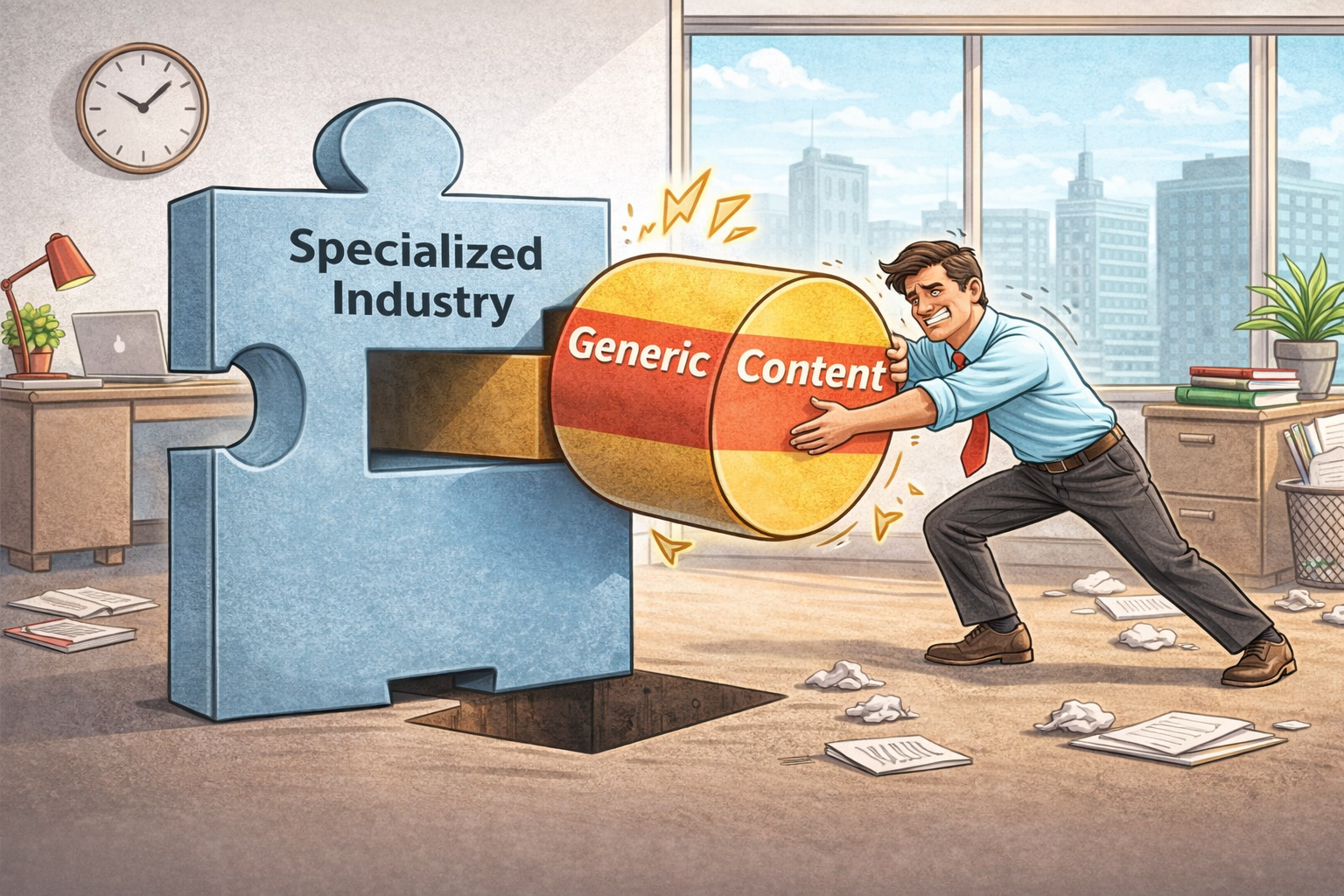
Your industry requires deep technical expertise no outside writer can match. If you're writing about proprietary technology, specialized medical procedures, or highly regulated financial products, external writers—even good ones—may struggle to add value.
Your content needs change unpredictably week to week. Managed services work best with consistent volume and predictable topics. If you need rapid-response content tied to news cycles or product launches, the model may feel too rigid.
You're producing fewer than four articles monthly. The operational overhead of onboarding and managing a service relationship may not justify the investment at very low volumes.
Budget constraints genuinely limit you to under $200 monthly. At that price point, DIY tools with careful internal editing may be more practical—though you should be realistic about whether you'll actually maintain consistency.
For most growth-focused companies publishing regularly, however, the ROI favors managed services over alternatives.

How to Evaluate Providers Before Signing
The managed services category has grown crowded. These questions help separate strong providers from those that overpromise.
Questions to Ask
What's your content production process end-to-end? Look for clear steps from research through publishing with defined handoffs.
How do you handle revisions? Unlimited revisions sounds generous but sometimes signals quality problems requiring multiple rounds of fixes.
What happens if I'm unhappy with content quality? Reasonable policies protect both parties.
Can I see samples from my industry or similar businesses? Generic portfolios don't prove capability in your specific context.
What's your turnaround time? First drafts should arrive within days, not weeks.
Do I own the content? This should be an unambiguous yes with no strings attached.
How do you measure success? Providers focused on vanity metrics (word count, articles produced) rather than outcomes (traffic, rankings, engagement) often disappoint.
Which CMS platforms do you support for publishing? Confirm compatibility with your specific setup.
Red Flags to Avoid
Watch for warning signs that predict poor experiences:
No trial or sample option: Legitimate providers let you evaluate quality before committing significant budget
Vague pricing structures: Hidden fees often appear after you've started
Guaranteed rankings: No ethical provider promises specific search positions—too many variables exist outside their control
Extremely low prices: Quality content has floor costs; services charging $20 per article cut corners somewhere
No human review claims: Pure AI output without editing rarely meets quality standards for competitive search terms
Use the Trial Period Strategically
Most managed services offer trial periods or sample articles. Use this time intentionally:
Assign topics relevant to your actual content needs, not generic tests
Evaluate how well content matches your brand voice and industry knowledge
Check for factual accuracy and proper sourcing
Test the revision process with specific, constructive feedback
Assess responsiveness and communication quality
A strong trial experience usually predicts a strong ongoing relationship. Problems during trials typically get worse, not better.
Getting Started: What to Prepare
Transitioning to managed content production works best with proper preparation on your end.
Materials to Gather Before Onboarding
Existing content audit: What's currently on your blog? What's performing? What needs updating or removing?
Target keyword list: Even a rough list of terms you want to rank for helps providers understand your goals faster.
Competitor examples: Who produces content you admire in your space? What do they do well?
Brand guidelines: Voice, tone, and messaging documentation. If you don't have this formalized, write down key phrases you use and words you avoid.
Product/service information: What should content ultimately promote? What are your key differentiators?
Setting Realistic Expectations
Managed services produce results—but not overnight. Search engines take time to crawl, index, and rank new content. Realistic timelines look like:
Month 1: Onboarding complete, first articles published, baseline metrics established
Months 2–3: Publishing rhythm established, early indexing signals visible in Search Console
Months 4–6: Traffic growth becomes measurable, some target keywords showing ranking movement
Months 6–12: Compounding effects visible, consistent traffic increases, content driving measurable leads
Companies expecting dramatic results in thirty days haven't understood how content marketing works. Those who commit to twelve months of consistent publishing rarely regret the investment.
Metrics That Actually Matter
Track these to evaluate your managed service investment:
Organic traffic growth: The primary outcome metric—are more people finding you through search?
Keyword rankings: Particularly for terms with commercial intent relevant to your business
Publishing consistency: Are promised volumes actually delivered on schedule?
Content quality: Subjective but important—does content meet your standards and represent your brand well?
Lead generation: For commercial content, do articles drive conversions and inquiries?
Monthly check-ins reviewing these metrics help optimize the partnership over time.

The Direction Managed Services Are Heading
The category continues evolving as AI capabilities improve and search engines adapt.
AI as enhancer, not replacement. The most effective services use AI to accelerate research and drafting while retaining human judgment for strategy, accuracy, and voice. Pure AI content faces growing headwinds as search algorithms improve at detecting and deprioritizing it [8].
Specialization by industry. Generalist services struggle to match the expertise of providers focused on specific verticals like SaaS, e-commerce, or professional services. Expect continued fragmentation as providers narrow their focus.
Integration with broader marketing stacks. Managed services increasingly connect with CRM systems, email platforms, and analytics tools—providing more seamless reporting and optimization capabilities.
Quality over quantity pressure. Search engines continue rewarding depth and expertise while penalizing thin content. Services prioritizing volume without quality face diminishing returns.
The businesses that benefit most from these shifts are those publishing consistently now. Authority compounds—and starting earlier beats waiting.
Ready to see what consistent content looks like for your business? The Mighty Quill offers a free trial: two custom articles delivered within 48 hours, no commitment required. See the quality before you decide.
Frequently Asked Questions
How much should I budget for managed blog services?
Most growth-stage companies invest between $300 and $800 monthly for managed blog services. This range typically covers eight to twelve articles with full editorial support and SEO optimization. Budgets below $200 monthly usually force compromises on either quality or volume that undermine long-term results.
How long before managed blog services show results?
Expect measurable traffic growth between three and six months after consistent publishing begins. SEO compounds over time—early months build foundation while later months show accelerating returns. Companies typically see significant momentum by month six when publishing two or more articles weekly.
Can managed services match my brand voice?
Quality providers invest in understanding your voice during onboarding. They review existing content, document your preferences, and refine output based on your feedback. Most clients find voice matching improves over the first month as providers learn their style and industry nuances.
What's the difference between managed services and content agencies?
Agencies typically offer broader strategic consulting at higher price points—usually $2,000–$10,000 monthly for fewer articles. Managed services focus specifically on content production efficiency, delivering higher volume at lower cost through AI-assisted workflows with human editorial oversight.
Should I choose DIY tools or managed services?
DIY tools work well if your team has content expertise and realistic bandwidth to research, edit, and publish consistently every week. Managed services make more sense when you need hands-off production at scale. The deciding factor is usually whether you can genuinely maintain publishing consistency internally—most teams overestimate their capacity.
About The Mighty Quill
The Mighty Quill is a managed blog service built for growth-focused companies. Founded by Mario Gorito—a digital marketing veteran with over fifteen years of experience in SEO and content strategy—the service combines AI-powered drafting with human editorial oversight to deliver consistent, high-quality content. Every article is researched, written, optimized, and ready to publish, helping businesses build organic visibility without the overhead of managing writers or coordinating freelancers.
Cited Works
[1] Content Marketing Institute — "B2B Content Marketing Report." https://contentmarketinginstitute.com/research
[2] Google Search Central — "Creating Helpful, Reliable, People-First Content." https://developers.google.com/search/docs/fundamentals/creating-helpful-content
[3] Jasper — "Pricing." https://www.jasper.ai/pricing
[4] Clutch — "Content Marketing Agency Pricing Guide." https://clutch.co/agencies/content-marketing/pricing
[5] Bureau of Labor Statistics — "Occupational Outlook Handbook: Writers and Authors." https://www.bls.gov/ooh/media-and-communication/writers-and-authors.htm
[6] HubSpot — "Compounding Blog Posts." https://blog.hubspot.com/marketing/compounding-blog-posts-research
[7] Orbit Media — "Blogging Statistics and Trends." https://www.orbitmedia.com/blog/blogging-statistics
[8] Search Engine Journal — "Google's Approach to AI Content." https://www.searchenginejournal.com/google-ai-content