Publishing two blog posts every week sounds straightforward until you're six months in and realize three articles are fighting for the same keyword. Your traffic plateaus. Rankings cannibalize each other. And somewhere in your content management system, a dozen drafts sit orphaned because nobody remembers why they were assigned.
This is the silent failure mode of ambitious content programs.
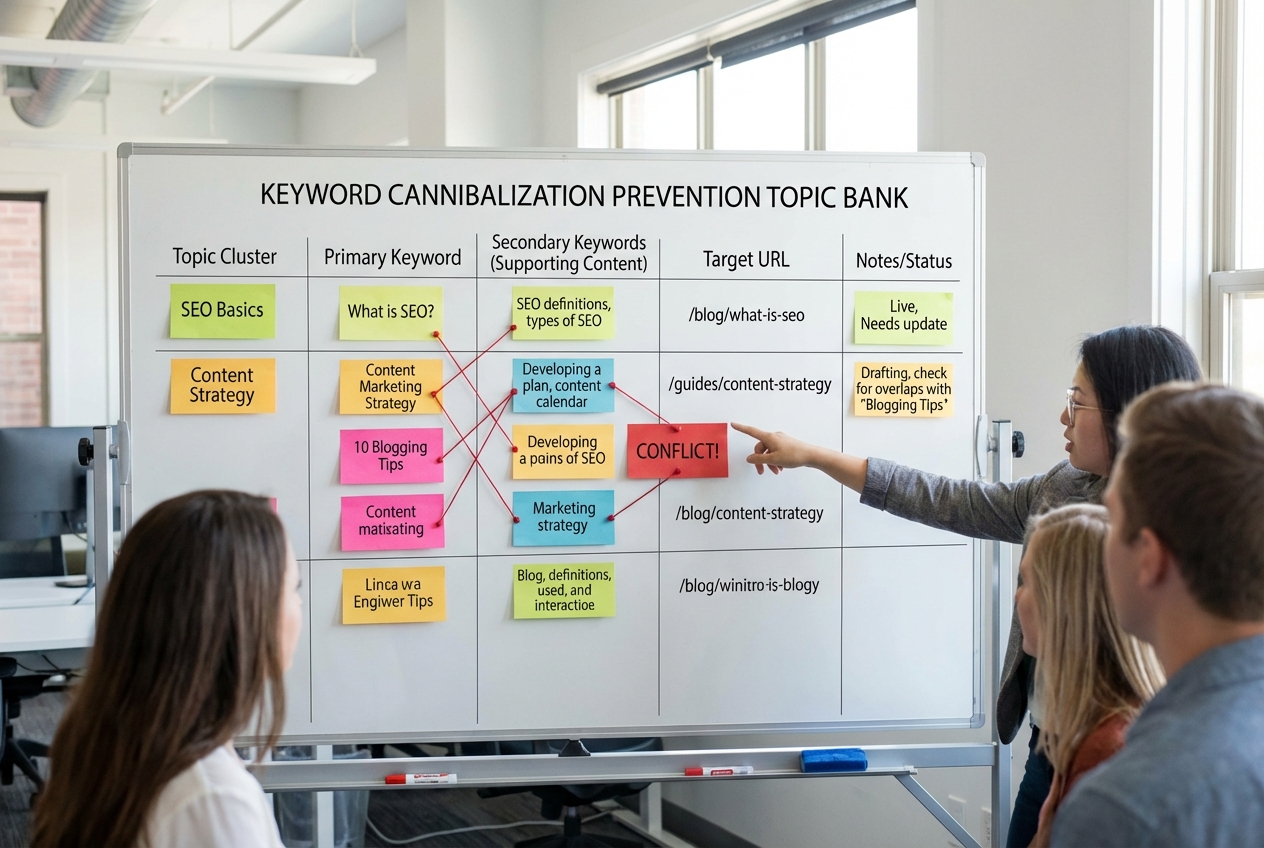
The solution isn't publishing less. It's building a keyword/topic bank SOP that governs what you publish, when you publish it, and how each piece connects to the others. A system that maps every article to a single primary intent, prevents overlap before it happens, and ensures your content covers the entire buyer funnel without internal competition.
Here's the exact process we use to publish consistently without stepping on our own rankings.
Why Most Topic Banks Fail at Scale
The typical approach to content planning looks something like this: someone pulls a spreadsheet of keywords, sorts by volume, assigns topics to writers, and hopes for the best.
It works fine for the first twenty posts.
Then problems emerge. Two articles target "content marketing strategy" with slightly different angles. A product comparison page competes with a how-to guide for the same commercial keyword. Your informational content never links to your money pages because nobody mapped the relationships.
According to Semrush's research on keyword cannibalization, this internal competition can cause significant ranking drops because Google struggles to determine which page should rank for a given query [1]. The search engine may split authority between competing pages, weakening both.
The fix requires three structural changes to how you plan content:
One primary keyword per page, documented and enforced
Clear intent assignment that prevents overlap
A URL governance system that catches conflicts before publication
Building Your Topic Bank: The Foundation
A topic bank isn't a list of keywords. It's a governed database that tracks relationships between content pieces, assigns ownership, and prevents duplication.
Start with these core fields for every entry:
| Field | Purpose |
| Working Title | Descriptive headline for internal tracking |
| Primary Keyword | The single term this page owns |
| Secondary Keywords | Supporting terms and variations |
| Search Intent | Informational, commercial, comparison, or transactional |
| Funnel Stage | Awareness, consideration, or decision |
| Target URL Slug | Predetermined URL structure |
| Internal Link Targets | Pages this content should link to |
| Status | Planned, assigned, drafted, published |
The primary keyword field is non-negotiable. Every page gets exactly one. If you can't assign a single primary keyword, the topic is either too broad or overlaps with existing content.
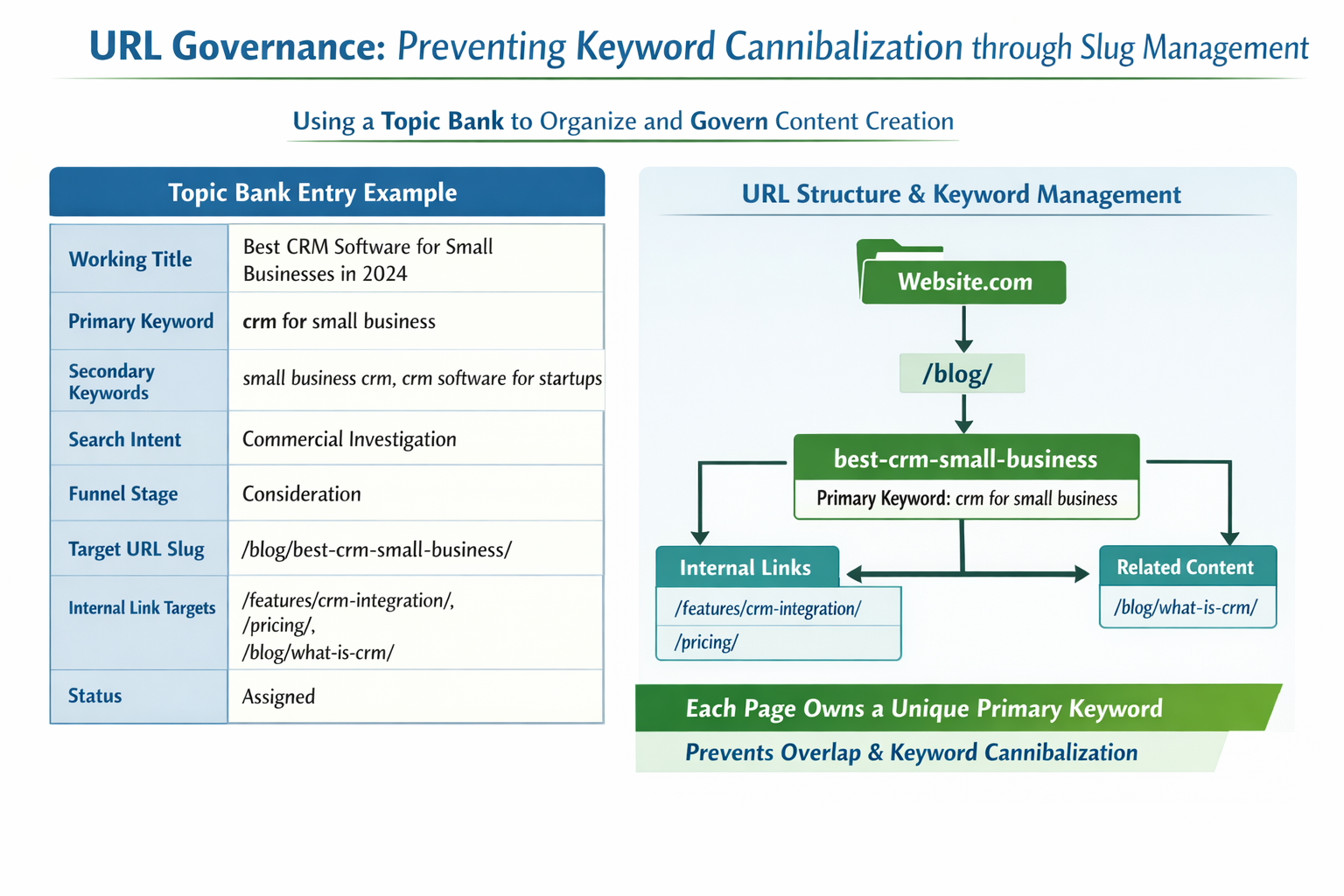
Real-World Example: A Topic Bank Entry in Action
Abstract field definitions only help so much. Here's how a hypothetical SaaS company selling project management software might fill out a single topic bank row:
| Field | Example Entry |
| Working Title | Best CRM Software for Small Businesses in 2024 |
| Primary Keyword | crm for small business |
| Secondary Keywords | small business crm, crm software for startups, affordable crm tools |
| Search Intent | Commercial investigation |
| Funnel Stage | Consideration |
| Target URL Slug | /blog/best-crm-small-business/ |
| Internal Link Targets | /features/crm-integration/, /pricing/, /blog/what-is-crm/ |
| Status | Assigned |
Notice how every field works together. The primary keyword is singular and specific. The intent classification (commercial investigation) tells the writer to compare options rather than explain concepts. The internal link targets ensure this consideration-stage piece connects to both an informational post for readers who need background and a conversion page for those ready to act.
When a writer opens this assignment, there's no ambiguity about what to create or how it fits the larger content ecosystem.
Assigning Primary Intent
Search intent determines whether a page belongs in your topic bank at all. Google's systems have become remarkably good at matching results to intent, which means misaligned content rarely ranks regardless of optimization [2].
Use these categories:
Informational: The searcher wants to learn something. No purchase intent. Examples include "what is keyword cannibalization" or "how to build a content calendar."
Commercial investigation: The searcher is researching solutions but hasn't decided. They're comparing options. Examples include "best content marketing tools" or "AI writing software comparison."
Transactional: The searcher is ready to act. They want to buy, sign up, or download. Examples include "content writing service pricing" or "hire blog writers."
Navigational: The searcher wants a specific page or brand. Rarely relevant for new content creation.
Each piece of content in your topic bank should serve one intent. If a keyword could satisfy multiple intents, check the SERP. Google has already decided which intent dominates for that query.
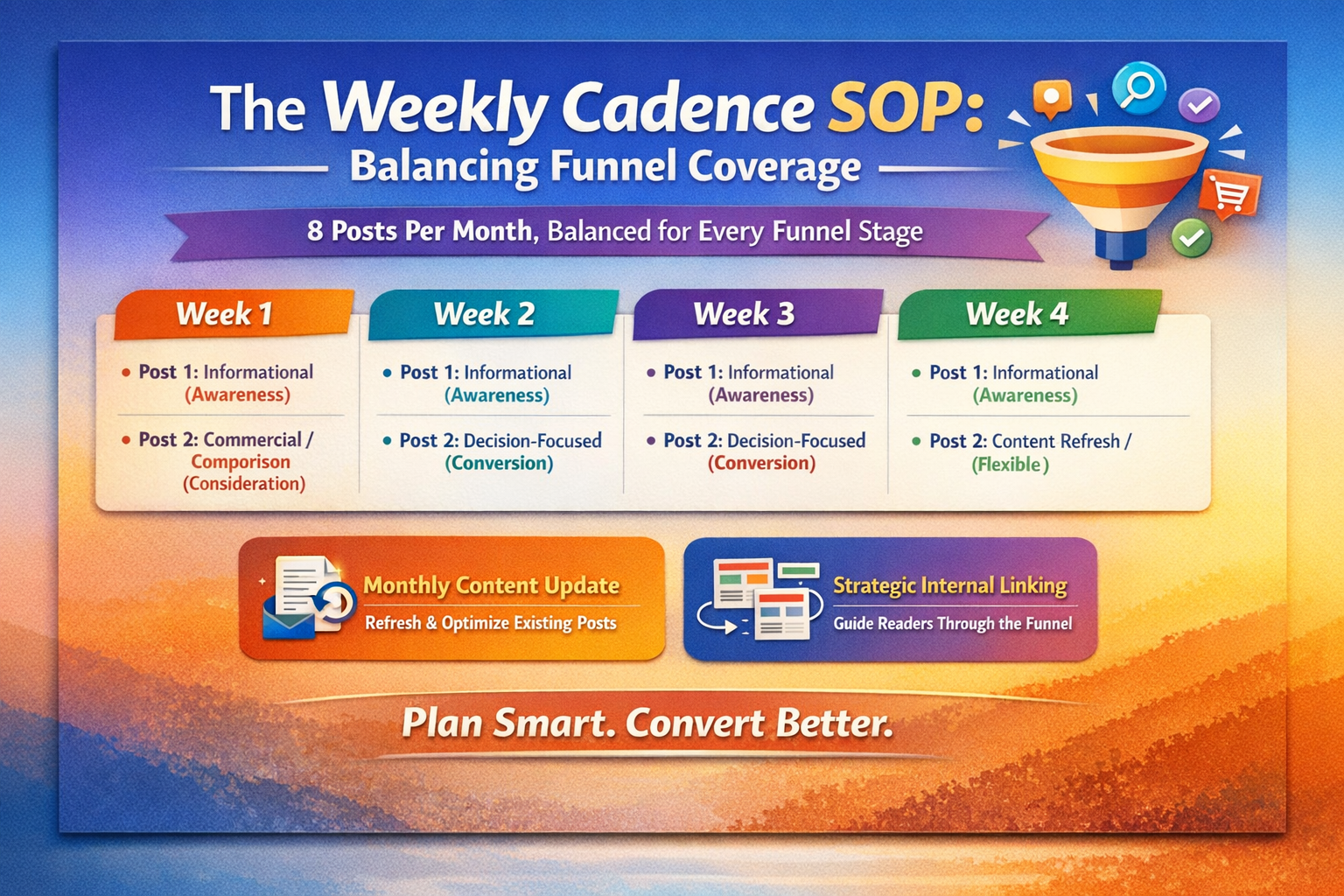
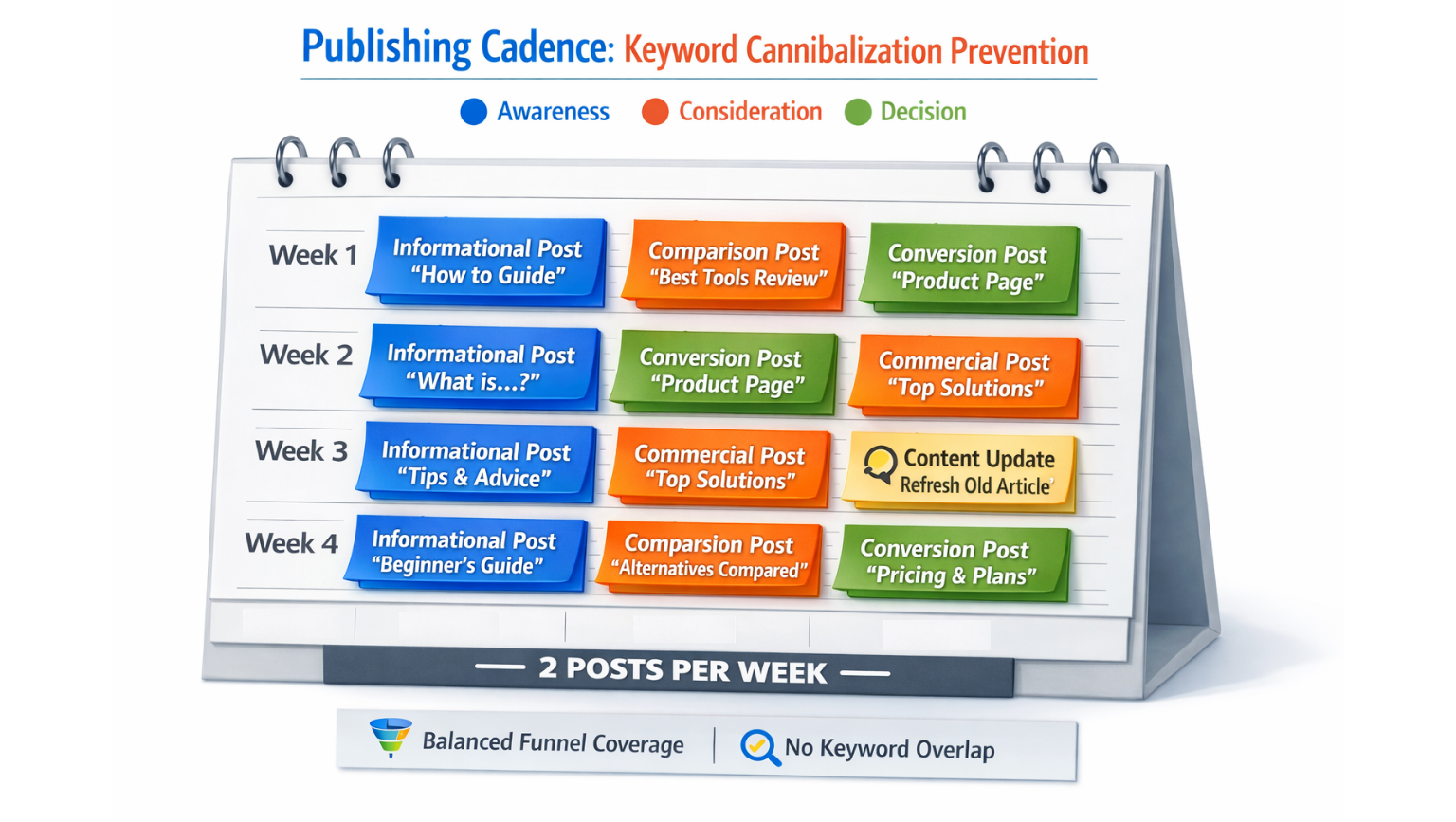
The Weekly Cadence SOP: Balancing Funnel Coverage
Publishing two posts per week gives you roughly eight content slots per month. That's enough volume to cover all funnel stages—if you plan intentionally.
Here's the distribution framework that maintains balance without rigidity:
Week 1:
Post 1: Informational (awareness)
Post 2: Commercial or comparison (consideration)
Week 2:
Post 1: Informational (awareness)
Post 2: Decision-stage or product-focused (conversion)
Week 3:
Post 1: Informational (awareness)
Post 2: Commercial or comparison (consideration)
Week 4:
Post 1: Informational (awareness)
Post 2: Flexible based on content gaps
This cadence ensures you're consistently building topical authority through informational content while maintaining a steady pipeline of conversion-focused pieces. The ratio roughly follows how buyers actually move through the funnel—more time researching, less time deciding.
Adjust based on your business needs. E-commerce sites might weight toward commercial content. SaaS companies often need more educational material to support longer sales cycles.
Content Updates Count as Publishing Slots
Here's what most cadence frameworks miss: not every slot needs to be a new post.
One of the most effective ways to prevent cannibalization is updating existing content instead of creating something new that competes with it. If your topic bank audit reveals an older post targeting a similar keyword, the smart move is often refreshing that piece rather than adding another competitor to your own site.
Reserve one of your monthly slots for strategic content updates. This might mean:
Expanding a thin post that's ranking on page two
Consolidating two underperforming articles into one stronger piece
Refreshing outdated statistics or examples in a decaying post
This approach serves double duty: it prevents cannibalization by strengthening existing content, and it often produces faster ranking improvements than publishing something entirely new.
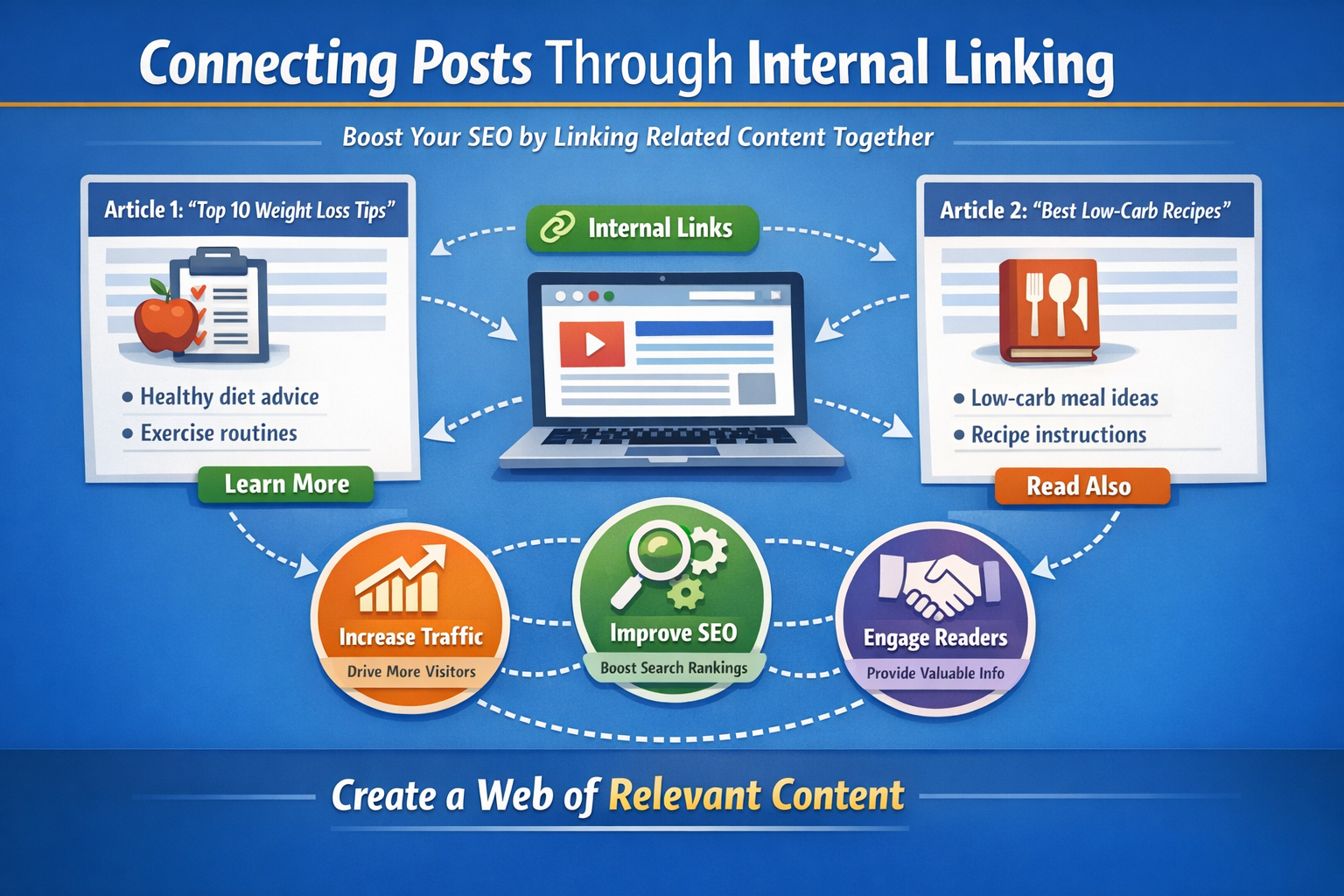
Connecting Posts Through Internal Linking
Every topic bank entry should include designated internal link targets before writing begins. This prevents the common problem of isolated content that never connects to your conversion pages.
Follow this linking logic:
Informational posts link to related commercial or comparison content
Commercial posts link to product pages, pricing, or trial signups
Decision-stage posts link directly to conversion actions
Map these relationships in your topic bank. When a writer opens an assignment, they should see exactly which pages to reference and link.
Research from Ahrefs indicates that internal links help distribute page authority throughout your site and help search engines understand content relationships [3]. Strategic internal linking also keeps readers moving through your funnel rather than bouncing after a single article.
The URL Map Rule-Set: Preventing Cannibalization Before Publication
Cannibalization often starts with poor URL structure. When multiple pages live in similar URL paths targeting similar terms, Google's crawlers struggle to differentiate them.
Implement these URL governance rules:
Rule 1: One target keyword per URL slug
The operative word here is slug—the final portion of your URL path. If /blog/content-marketing-strategy/ exists, no other slug should target that exact keyword phrase.
Note: This doesn't mean you can never repeat words in your URL structure. A site might have both /blog/content-marketing/strategy/ and /blog/content-marketing/examples/ without conflict, because the slugs target different keywords. The rule prevents multiple pages with slugs like /content-marketing-strategy/ and /content-marketing-strategy-guide/ from competing for identical terms.
Rule 2: Intent determines URL structure
Informational: /blog/how-to-[topic]/ or /blog/what-is-[topic]/
Commercial: /blog/best-[topic]/ or /comparisons/[topic]/
Transactional: /services/[topic]/ or /solutions/[topic]/
Rule 3: Check before assigning
Before any topic enters your content calendar, search your existing URL inventory. Use a simple site search (site:yourdomain.com "keyword") to catch potential conflicts.
Rule 4: Document decisions
When you consciously choose to publish related content, document why. "This how-to guide targets beginners while the existing guide targets advanced practitioners" is a valid distinction. "This seemed like a good topic" is not.
Running the Cannibalization Check
Before finalizing any topic bank entry, run this quick audit:
Search your site for the primary keyword
Review any pages ranking for that term in Google Search Console
Check your topic bank for similar keywords or overlapping intent
If overlap exists, either consolidate, differentiate, or abandon
Many SEO professionals recommend consolidating competing pages when cannibalization is identified, either by merging content or implementing redirects [4]. Prevention through governance is far less painful than retroactive fixes.
Monthly Topic Bank Maintenance
A topic bank isn't a set-it-and-forget-it asset. Monthly reviews catch drift before it becomes problematic.
Review checklist:
Audit for new keyword overlaps as content publishes
Update internal link maps to include recently published pieces
Remove or archive topics that no longer align with business goals
Add emerging topics based on search trends or competitive gaps
Verify funnel distribution stays balanced
Flag underperforming posts as candidates for updates or consolidation
Where New Topics Come From
During monthly maintenance, you're not just auditing—you're also identifying gaps. Pull new topic candidates from these sources:
Google Search Console: Review the "Queries" report for terms your site appears for but hasn't explicitly targeted. These are often low-hanging opportunities.
Competitor content audits: Identify topics competitors rank for that you haven't covered.
Customer questions: Sales calls, support tickets, and community discussions reveal what your audience actually wants to know.
Industry news: Emerging trends or algorithm updates often create timely content opportunities.
Set a calendar reminder. The thirty minutes you spend on monthly maintenance saves hours of cannibalization cleanup later.
When to Outsource Topic Bank Management
Building and maintaining a topic bank SOP requires consistent attention. You need someone checking for conflicts, assigning intent, mapping links, and enforcing governance rules every week.
For teams publishing at scale, this operational overhead often exceeds available bandwidth. The strategy is clear, but execution falters because nobody has time to run the system.
This is where managed content services provide leverage. Instead of maintaining the topic bank yourself, you hand governance to a team that specializes in exactly this kind of operational consistency.
A well-run content engine handles keyword research, intent mapping, cannibalization prevention, and internal linking as part of the standard workflow. You review and approve; they manage the system.
Making This Work Long-Term
The SOP outlined here isn't complicated. One primary keyword per page. Clear intent assignment. URL governance. Funnel-balanced publishing. Monthly maintenance.
The challenge is consistency. Week after week, month after month, someone needs to enforce these rules and catch exceptions before they publish.
Start by documenting your current topic bank using the framework above. Audit existing content for cannibalization. Build the habit of checking before assigning new topics.
Organic traffic compounds when your content works together rather than against itself. Every page should strengthen the others, not compete for the same rankings.
That's the difference between a content program that plateaus and one that builds momentum over time.
Ready to stop managing your topic bank and start seeing results? The Mighty Quill handles keyword research, cannibalization governance, and publishing cadence as part of our done-for-you Blog Engine. Get two custom articles delivered in 48 hours—free. Try the Blog Engine today.

Frequently Asked Questions
What is keyword cannibalization and why does it hurt rankings?
Keyword cannibalization occurs when multiple pages on your site target the same search query, forcing Google to choose between them. This splits your ranking authority across competing pages instead of concentrating it on one strong piece. The result is often weaker performance for all affected pages. Fixing cannibalization typically requires consolidating content, adding redirects, or clearly differentiating intent between pages.
How do I know if my existing content is cannibalizing itself?
Check Google Search Console for queries where multiple pages from your site appear in the results. If two or more URLs rank for the same keyword and traffic is inconsistent, cannibalization may be occurring. You can also search "site:yourdomain.com keyword" to see all indexed pages containing that term. Pages with overlapping primary keywords and similar intent are the most likely culprits.
How many blog posts should target each funnel stage?
There's no universal ratio, but a sustainable balance for most businesses is roughly 50-60% informational content, 25-30% commercial or comparison content, and 15-20% decision-stage content. Informational posts build topical authority and traffic volume. Commercial content captures consideration-stage searches. Decision-stage content converts readers who are ready to act. Adjust based on your sales cycle length and audience behavior.
Can I target the same keyword from different angles?
Only if the search intent genuinely differs. A beginner guide and an advanced tutorial might target related keywords without competing if searchers clearly want different content. However, if the SERP shows Google treats both variations as the same query, you're creating cannibalization risk. When in doubt, choose one page to own the keyword and link supporting content to it rather than having multiple pages compete.
How often should I update my topic bank?
Monthly reviews are the minimum for active publishing programs. Check for new cannibalization risks as content publishes, update internal linking maps, and refine topic priorities based on performance data. Quarterly deep audits help catch strategic drift and identify content gaps. The topic bank should be a living document that evolves with your content program, not a static spreadsheet created once and forgotten.
About Our Editorial Standards
This article was developed by The Mighty Quill's content team, which combines practical SEO experience with systematic content operations. Our recommendations are grounded in established search optimization principles and real-world publishing workflows. We specialize in helping businesses build sustainable organic traffic through consistent, strategically planned content programs that avoid common pitfalls like keyword cannibalization.
Cited Works
[1] Semrush — "What Is Keyword Cannibalization & How to Fix It." https://www.semrush.com/blog/keyword-cannibalization/
[2] Google Search Central — "Understanding search intent." https://developers.google.com/search/docs/fundamentals/creating-helpful-content
[3] Ahrefs — "Internal Links for SEO: An Actionable Guide." https://ahrefs.com/blog/internal-links-for-seo/
[4] Moz — "Keyword Cannibalization: What It Is and How to Fix It." https://moz.com/blog/keyword-cannibalization