The rules changed. Not gradually—suddenly.
Google's AI Overviews now answer millions of queries before users ever see a single blue link. For marketers who built their entire SEO strategy around ranking in positions one through three, this shift feels like the ground disappeared beneath their feet.
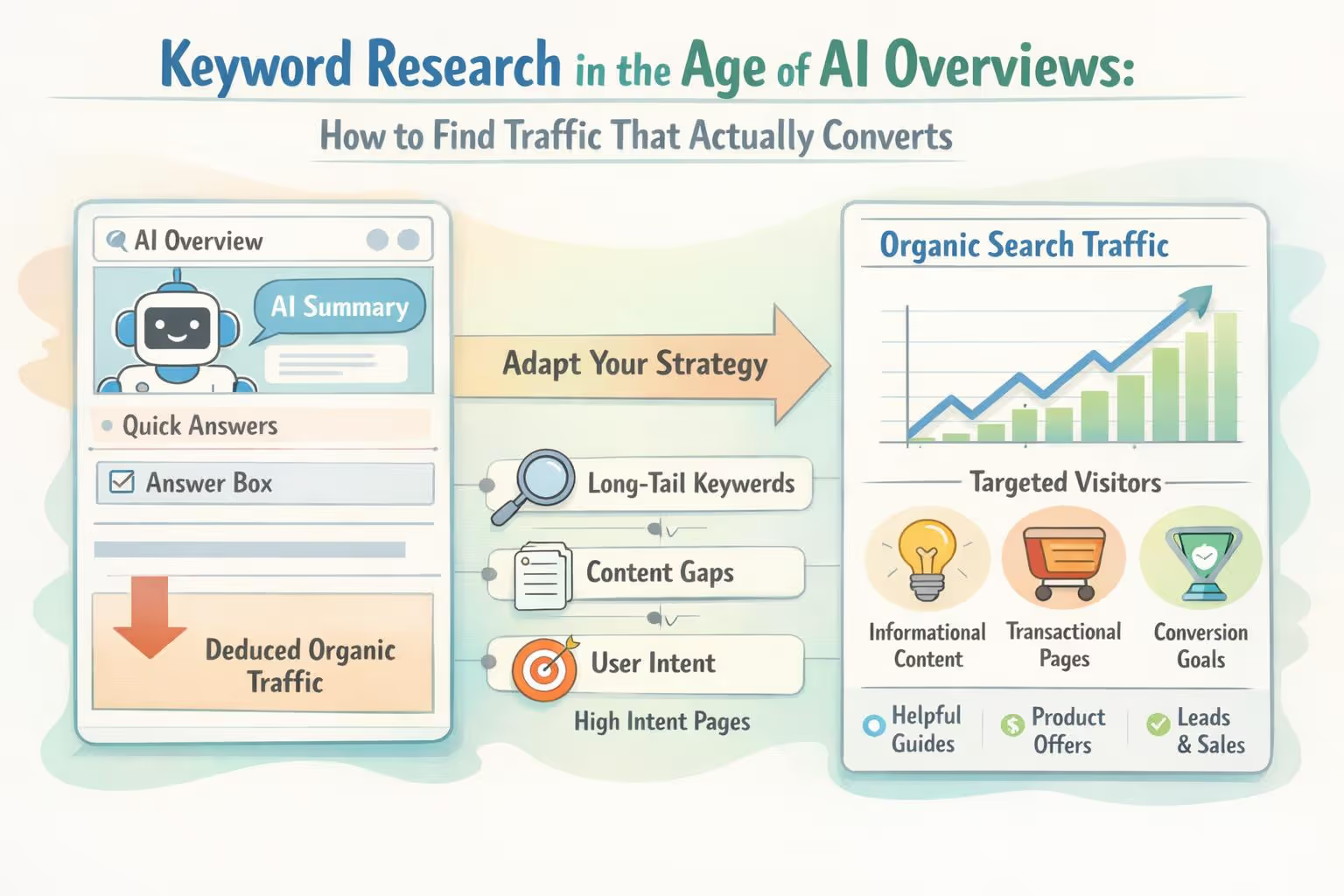
But here's what most people miss: keyword research in the age of AI Overviews isn't dead. It's just different. The old playbook—find high-volume keywords, write content, rank, collect traffic—no longer works the way it used to. The new playbook rewards something else entirely: strategic keyword selection that targets queries AI can't fully satisfy.
This guide breaks down exactly how to adapt your keyword research strategy for 2025 and beyond. You'll learn which types of keywords still drive traffic, which ones AI has essentially claimed, and how to build a topic bank that compounds your visibility over time.
What AI Overviews Actually Changed About Search
Google's AI Overviews (formerly Search Generative Experience) represent the most significant shift in search behavior since mobile-first indexing. When users ask straightforward questions, Google now synthesizes an AI-generated response directly in the search results [1].
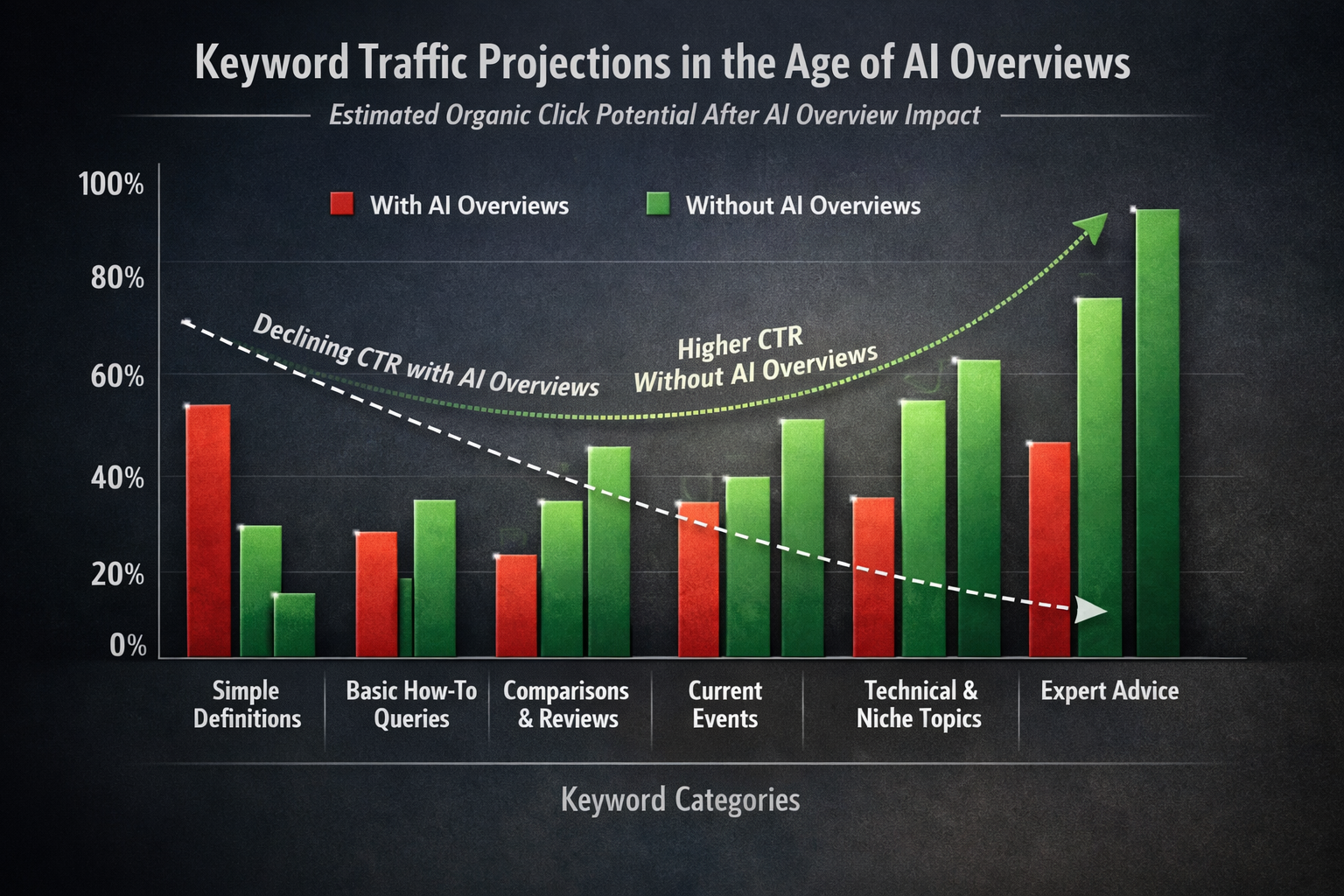
The immediate impact? Click-through rates for certain query types dropped dramatically. Research from Authoritas found that AI Overviews reduced organic clicks by an average of 34.5% for queries where they appeared [2]. For simple informational queries—the kind that can be answered in a paragraph or two—the decline is even steeper.
This doesn't mean SEO is over. It means the type of keywords worth targeting has fundamentally shifted.
Think of it this way: AI Overviews excel at answering "what is" and "how does X work" questions. They struggle with nuanced comparisons, experience-based recommendations, current events, and anything requiring context that changes frequently.
Your job now is to find the queries where human-created content still wins.
The New Keyword Research Framework for 2025
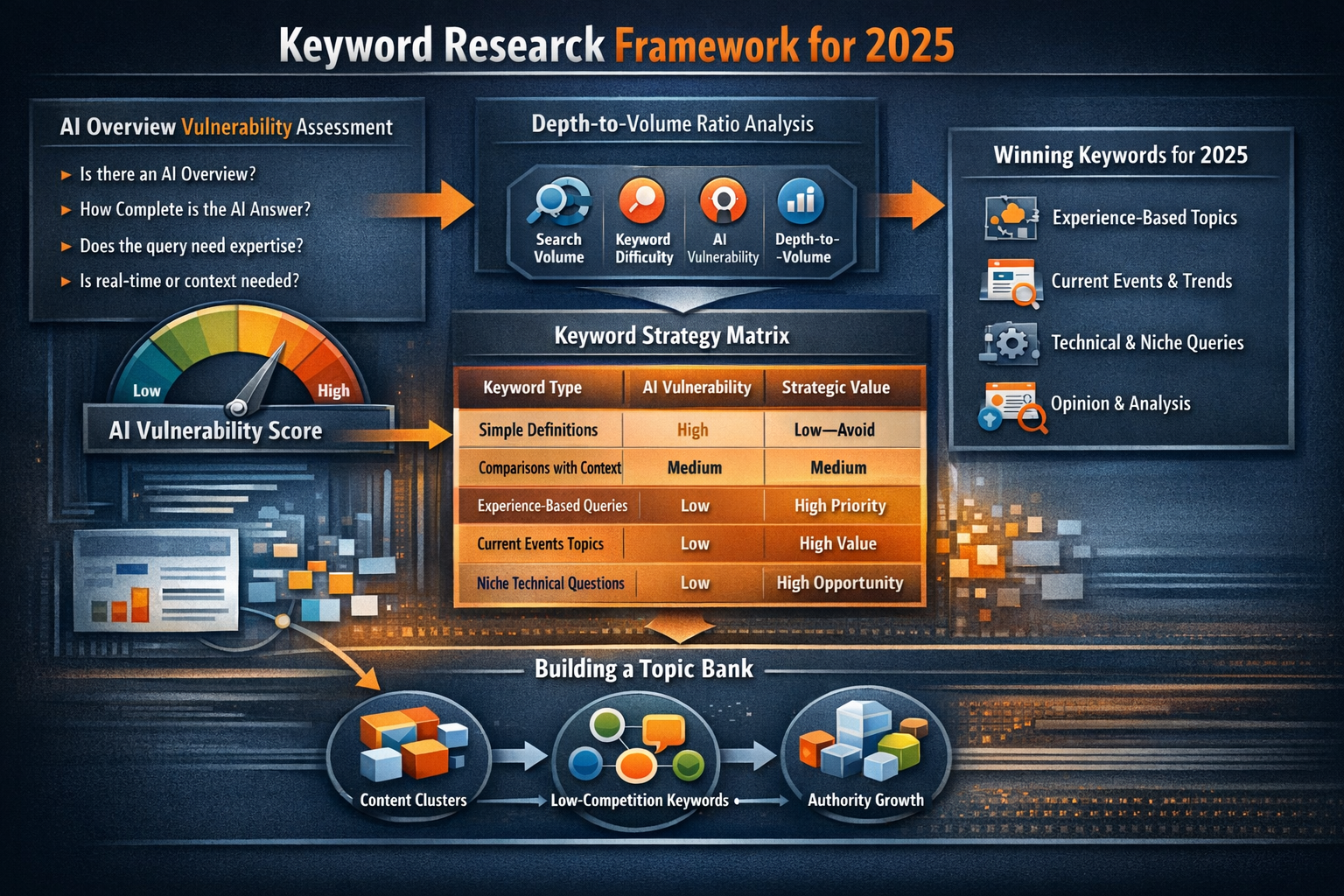
Traditional keyword research focused almost exclusively on three metrics: search volume, keyword difficulty, and commercial intent. Those metrics still matter—but they're no longer sufficient.
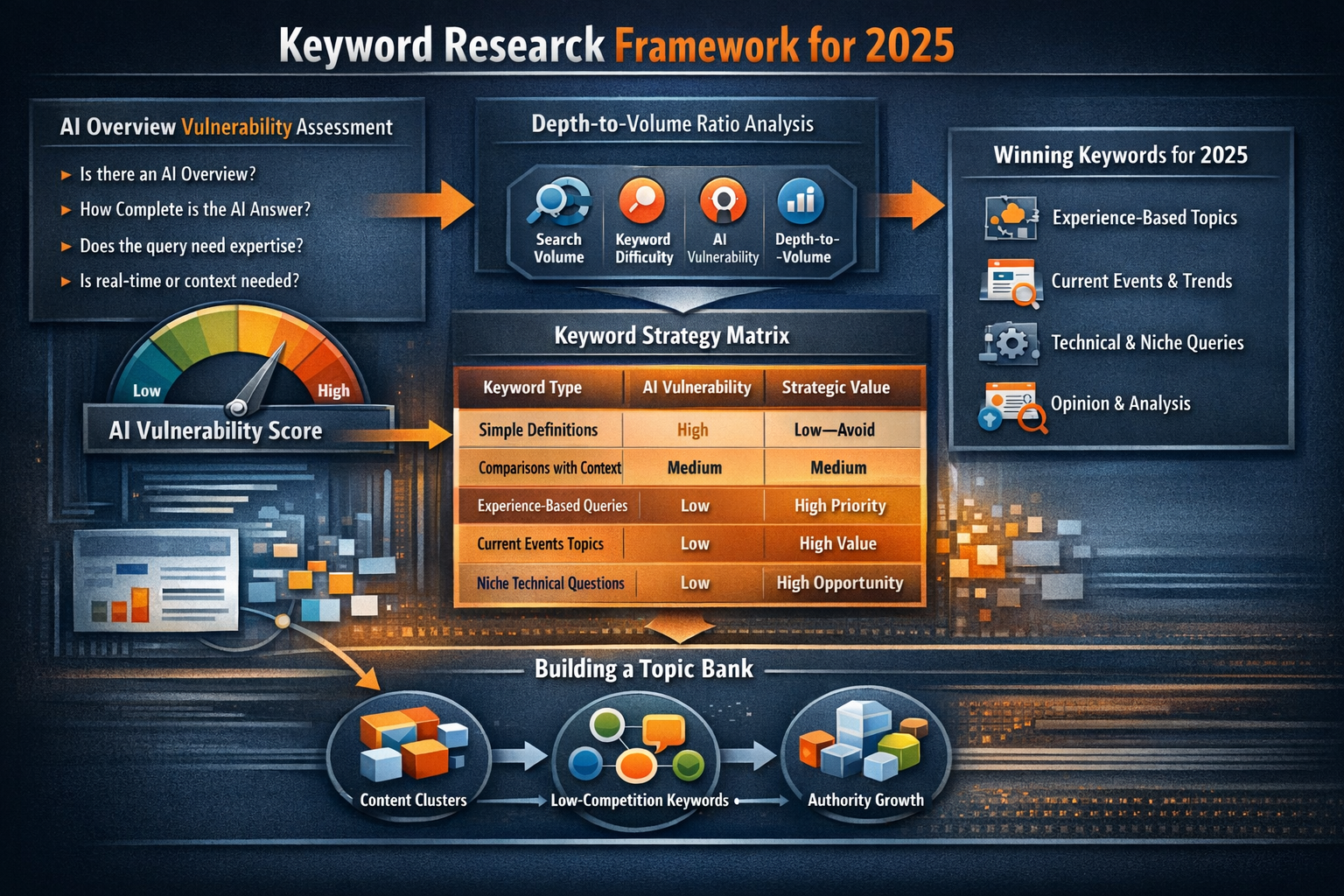
The updated framework adds two critical filters:
1. AI Overview Vulnerability
Before targeting any keyword, you need to assess whether AI Overviews appear for that query and how comprehensively they answer the user's intent. Keywords where AI provides a complete, satisfying answer are increasingly low-value. Keywords where AI provides a partial answer (or none at all) represent opportunity.
2. Depth-to-Volume Ratio
This measures how much expertise, nuance, or updated information a topic requires relative to its search volume. High-depth queries—those requiring detailed analysis, personal experience, or current data—remain valuable even if AI Overviews appear, because users recognize the AI response as insufficient.
Here's how the new framework looks in practice:
| Keyword Type | AI Vulnerability | Strategic Value |
| Simple definitions | High | Low—avoid these |
| Step-by-step basics | High | Low unless you add unique value |
| Comparisons with context | Medium | Medium—depends on execution |
| Experience-based queries | Low | High—prioritize these |
| Current/time-sensitive topics | Low | High—AI data often lags |
| Niche technical questions | Low | High—AI lacks depth |
Search Volume Analysis in an AI-First World
Here's an uncomfortable truth: high search volume no longer correlates with high traffic potential the way it once did.
A keyword with 10,000 monthly searches might send you 300 visitors if AI Overviews capture 97% of the clicks. Meanwhile, a keyword with 500 monthly searches—but no AI Overview—might deliver 200 visitors. The math has changed.
This means search volume analysis now requires an additional step: estimating actual click-through potential after AI captures its share.
Practical approach:
Use your preferred keyword tool to identify search volume
Manually check whether AI Overviews appear for that query
Assess how complete the AI answer is (partial answers = higher CTR opportunity)
Adjust your traffic estimates accordingly
Some SEO professionals now apply a "click modifier" to their traffic projections—reducing estimated traffic by 40-60% for keywords where AI Overviews provide comprehensive answers [3].
Building a Low-Competition Topic Bank
The smartest SEO strategies in 2025 don't chase individual keywords. They build topic banks—curated collections of interconnected keywords that establish authority across an entire subject area.
Why does this matter more now than ever?
Because Google's systems increasingly evaluate topical authority when deciding whether to feature AI Overviews versus traditional results. Sites that demonstrate deep expertise across a topic cluster often retain visibility even when AI answers appear [4].
How to Identify Low-Competition Keyword Clusters
Step 1: Start with your core expertise
What does your business genuinely know better than most? That's your foundation. AI can synthesize general information from anywhere, but it struggles to replicate genuine expertise and experience.
Step 2: Map the questions your audience actually asks
Beyond traditional keyword tools, mine these sources:
Customer support tickets and sales call transcripts
Industry forums and Reddit communities
Comments on competitor content
Your own site's internal search data
These sources reveal how real people phrase their questions—often in ways that keyword tools miss entirely.
Step 3: Prioritize queries where AI falls short
For each potential keyword, ask:
Does this require up-to-date information?
Does answering well require personal experience or opinion?
Is the topic too niche for AI to have sufficient training data?
Does a complete answer require context AI doesn't have?
Queries where you answer "yes" to any of these questions deserve priority in your topic bank.
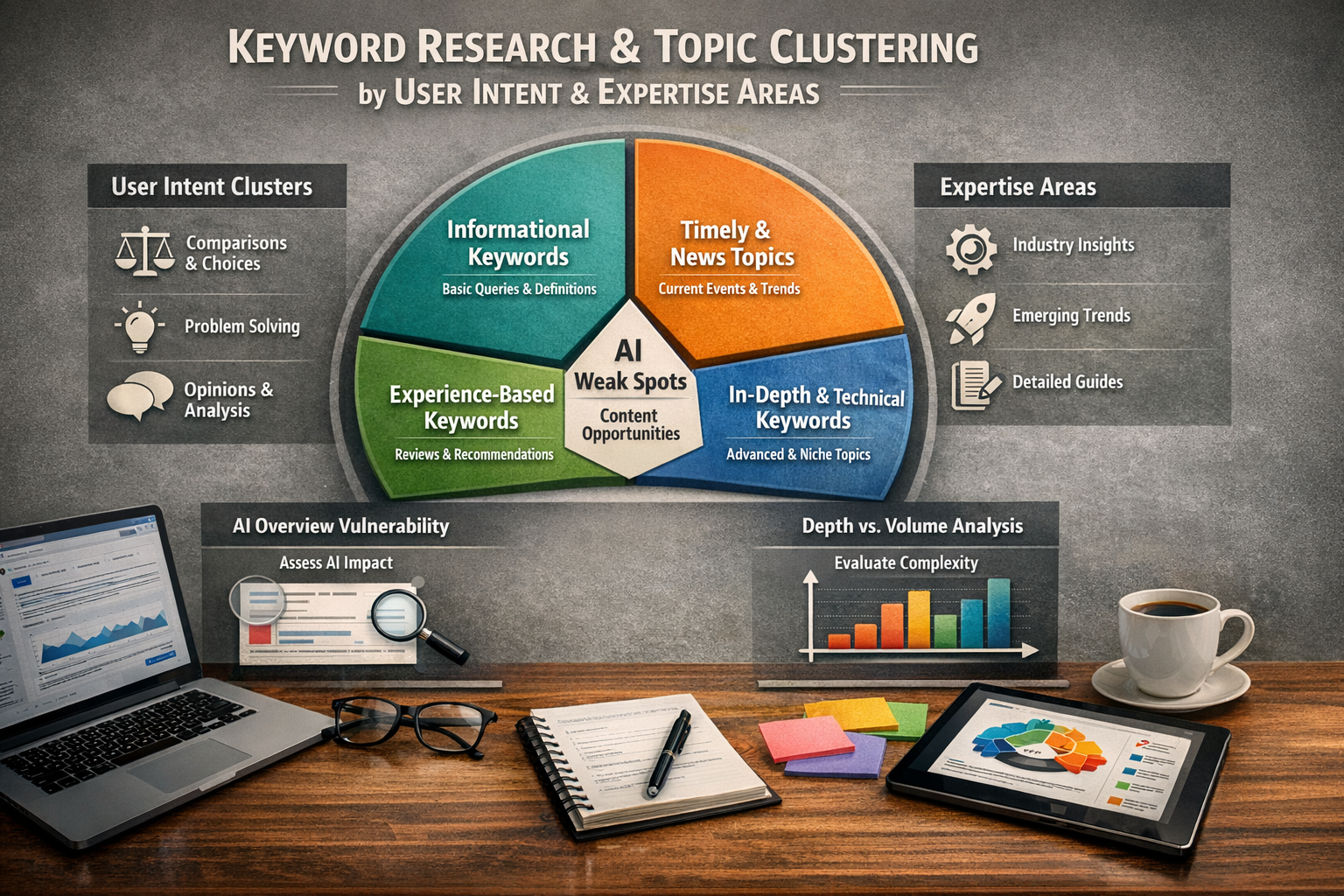
Step 4: Cluster by intent, not just topic
Group keywords based on what users actually want to accomplish, not just semantic similarity. A cluster around "email marketing" might include:
Beginners wanting to understand basics (lower priority—AI handles this well)
Practitioners comparing specific platforms (higher priority—requires current, nuanced analysis)
Strategists seeking advanced segmentation tactics (highest priority—experience-based)
Keywords AI Overviews Can't Capture
Certain query types consistently resist AI takeover. Building your content strategy around these categories creates sustainable traffic in an uncertain search landscape.
Experience-Required Queries
Queries that implicitly ask "what should I do in my specific situation" require judgment that AI can't reliably provide. These include:
"Should I..." comparison queries
"What's the best X for Y" recommendations
"How do I handle..." problem-solving questions
Reviews and case studies with first-hand experience
Current Events and Trends
AI Overviews rely on training data that, by definition, lags behind real-time developments. Content covering:
Recent industry changes
Emerging tools and platforms
Updated regulations or guidelines
Current market conditions
...maintains value because AI literally can't provide current answers [5].
Nuanced Technical Topics
AI excels at explaining established concepts but struggles with edge cases, exceptions, and advanced applications. Technical content targeting:
Specific use-case implementations
Troubleshooting unusual problems
Integration between multiple systems
Advanced configuration options
...requires depth that AI summaries can't match.
Opinion and Analysis
Queries seeking expert perspective—not just facts—remain difficult for AI to satisfy:
Industry predictions and trend analysis
Strategic recommendations
Comparative opinions
"Why" explanations requiring interpretation
Practical Tools for AI-Era Keyword Research
The fundamental tools remain useful—Ahrefs, Semrush, Moz, and Google's own Keyword Planner still provide essential data. But using them effectively now requires additional steps.
For search volume and competition data:Traditional tools work fine here. Just remember that these metrics no longer tell the whole story.
For AI Overview detection:Currently, manual checking remains the most reliable method. Search your target keywords in an incognito browser and note whether AI Overviews appear. Some tools are beginning to track AI Overview presence, but the feature rolls out inconsistently across users and regions.
For identifying content gaps:Analyze what information AI Overviews provide versus what users actually need. The gap between these two represents your opportunity. Pay attention to "People Also Ask" boxes—these often reveal follow-up questions that AI summaries don't fully address.
For topic clustering:Tools like Clearscope, Surfer, and MarketMuse help identify semantically related terms. Use them to build comprehensive topic clusters rather than targeting isolated keywords.
Turning Research Into a Publishing Strategy
Keyword research without execution is just an interesting spreadsheet. Here's how to translate your AI-era keyword research into content that actually ranks and drives traffic.
Prioritize based on the new criteria
Score each keyword opportunity across multiple dimensions:
Search volume (traditional metric)
Keyword difficulty (traditional metric)
AI Overview presence (new metric)
AI answer completeness (new metric)
Your genuine expertise level (often overlooked)
Keywords scoring well across all five dimensions deserve immediate attention.
Match content depth to query complexity
Not every keyword needs a 3,000-word guide. Some queries deserve concise, direct answers. Others require comprehensive coverage. Let the user's actual intent guide your content length—not arbitrary word count targets.
Build content that AI can't replicate
For each piece, ask: "What can I add that AI cannot?"
Original research or data
First-hand experience and case studies
Expert interviews and quotes
Current information and updates
Strong opinions backed by reasoning
Content that includes these elements competes on dimensions where AI has inherent limitations.
Publish consistently to compound authority
One excellent article rarely moves the needle. A sustained publishing cadence—two to three quality pieces weekly—builds the topical authority that protects your visibility as AI continues evolving [6].
This is where many businesses stall. They know what keywords to target. They understand the strategy. But consistent execution proves too resource-intensive to maintain.
Why Consistency Beats One-Time Efforts
Search algorithms increasingly reward websites that publish relevant content consistently over time. This isn't speculation—it's observable in how Google evaluates expertise and authority [7].
A website that publishes eight high-quality articles per month builds topical authority faster than one that publishes twenty articles once and then goes silent for six months. The compounding effect of consistent publishing creates a moat that competitors—and AI—struggle to overcome.
The challenge is execution. Most marketing teams know they should publish more frequently. They simply lack the bandwidth to research keywords properly, create quality content, and maintain a sustainable cadence.
This is exactly why automated content systems have gained traction among growth-focused businesses. When keyword research and content creation run on autopilot, the compounding benefits actually materialize instead of remaining theoretical.
Ready to turn keyword research into consistent organic traffic? The Mighty Quill builds topic banks and publishes SEO-optimized content weekly—so your site captures the traffic AI Overviews can't claim. Start your free trial and get two custom articles in 48 hours.
Frequently Asked Questions
How do AI Overviews affect keyword research strategy?
AI Overviews reduce click-through rates for queries where they provide complete answers—research suggests organic clicks drop by roughly a third when AI Overviews appear. Effective keyword research now requires assessing whether AI can fully satisfy a query's intent. Keywords where AI provides only partial answers, or none at all, represent the strongest opportunities for organic traffic.
What types of keywords still drive organic traffic in 2025?
Experience-based queries, time-sensitive topics, nuanced comparisons, and niche technical questions remain valuable because AI struggles to address them comprehensively. Keywords requiring current information, expert judgment, or first-hand experience consistently maintain higher click-through rates even as AI Overviews expand across search results.
How do I build a topic bank for SEO?
Start by identifying your genuine areas of expertise—topics where you can add perspective AI cannot replicate. Map questions your audience actually asks through customer interactions, forums, and competitor content. Cluster keywords by user intent rather than just topical similarity, and prioritize queries where AI Overviews either don't appear or provide incomplete answers.
Should I still target high-volume keywords?
High volume alone no longer indicates high traffic potential. A keyword with significant search volume but a comprehensive AI Overview may deliver fewer actual visitors than a lower-volume keyword with no AI presence. Evaluate search volume alongside AI Overview presence and answer completeness to estimate realistic traffic potential.
How often should I publish content for SEO results?
Consistency matters more than volume, but most businesses see measurable results publishing two to three quality articles weekly. This cadence builds topical authority over time, which helps protect visibility as search continues evolving. Sporadic publishing—even of excellent content—rarely delivers the compounding benefits that sustained effort produces.
About This Guide
This article was produced by The Mighty Quill, an AI-powered content engine that helps growth-focused businesses build sustainable organic traffic. Our team combines deep SEO expertise with systematic content production, drawing on over fifteen years of digital marketing experience. We track search algorithm changes, test strategies across multiple industries, and translate emerging best practices into actionable guidance for businesses navigating the evolving search landscape.
Cited Works
[1] Google — "AI Overviews and Your Website." https://developers.google.com/search/docs/appearance/ai-overviews
[2] Authoritas — "How AI Overviews Impact Organic Click-Through Rates." https://www.authoritas.com/blog/ai-overviews-seo-impact
[3] Search Engine Journal — "Click-Through Rate Changes in the Age of AI Search." https://www.searchenginejournal.com/ctr-ai-search-study/
[4] Search Engine Land — "Topical Authority and AI Overviews." https://searchengineland.com/topical-authority-ai-overviews-guide
[5] Google Search Central — "Creating Helpful, Reliable, People-First Content." https://developers.google.com/search/docs/fundamentals/creating-helpful-content
[6] HubSpot — "How Often Should Companies Blog?" https://blog.hubspot.com/marketing/blogging-frequency-benchmarks
[7] Google — "How Search Works: Ranking Results." https://www.google.com/search/howsearchworks/how-search-works/ranking-results/