The speculation is over. Google has made its position on AI-generated content unambiguous—and if you're still hesitating to use AI in your content strategy, you're operating on outdated assumptions.
For years, SEO professionals worked under a fog of uncertainty. Would Google penalize AI content? Should you hide the fact that machines helped write your blog posts? The anxiety was real, and it created paralysis. Teams delayed adopting AI tools, fearing algorithmic punishment that never came.
Here's what Google actually says: the search engine doesn't care whether AI wrote your content. Google cares whether your content helps people.
This distinction reshapes how you should think about AI content for SEO. Understanding exactly what Google's guidelines state—not what forums speculate—transforms your approach to content marketing in 2026 and beyond.
Google's Official Stance on AI-Generated Content
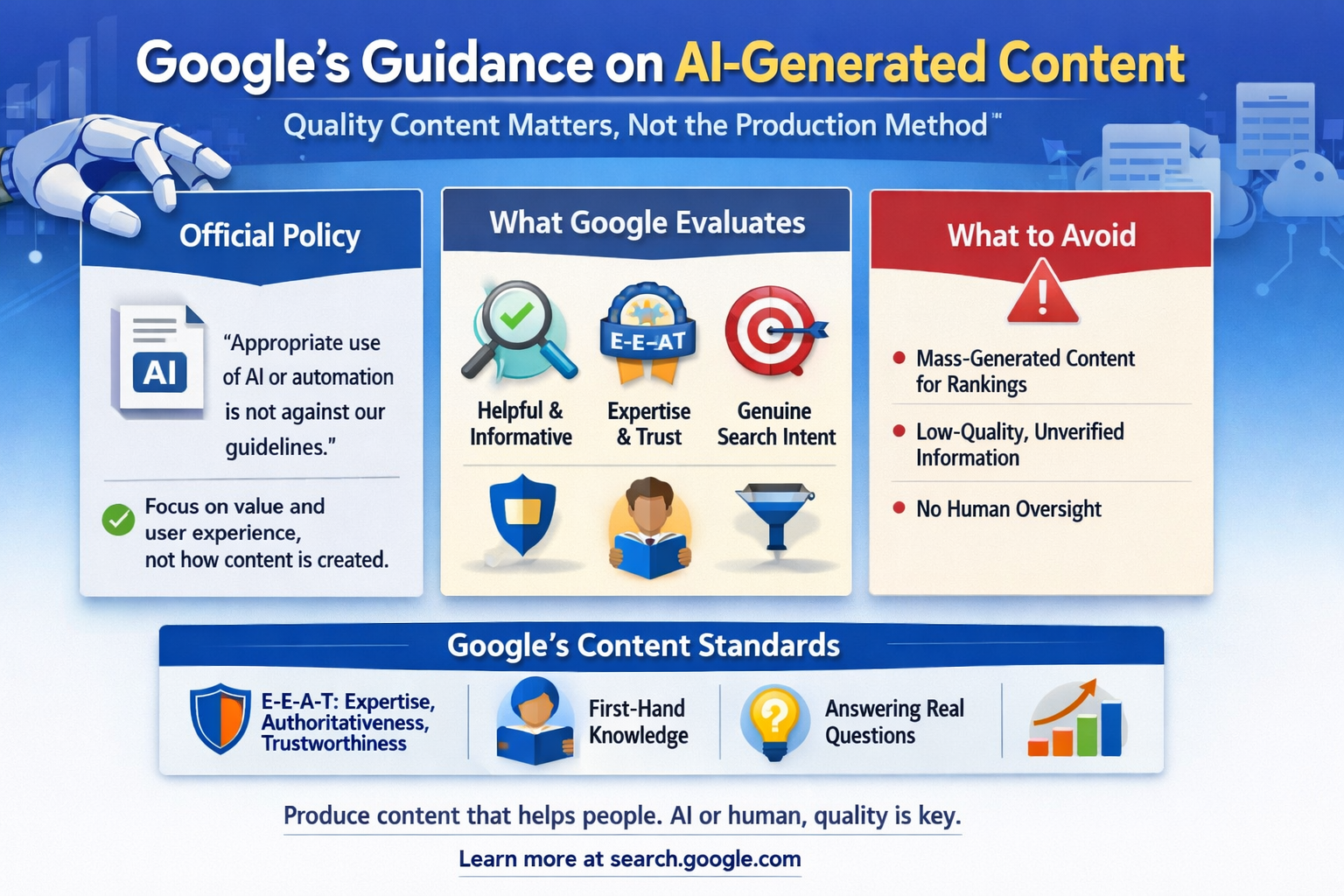
Google's position comes directly from its Search Central documentation, leaving no room for interpretation. The guidance states explicitly that "appropriate use of AI or automation is not against our guidelines" [1]. This single sentence dismantles the myth that AI content faces inherent penalties.
But context matters. Google's support for AI content comes with a specific condition: the content must demonstrate value to users. The search engine evaluates content based on quality and helpfulness—not production method.
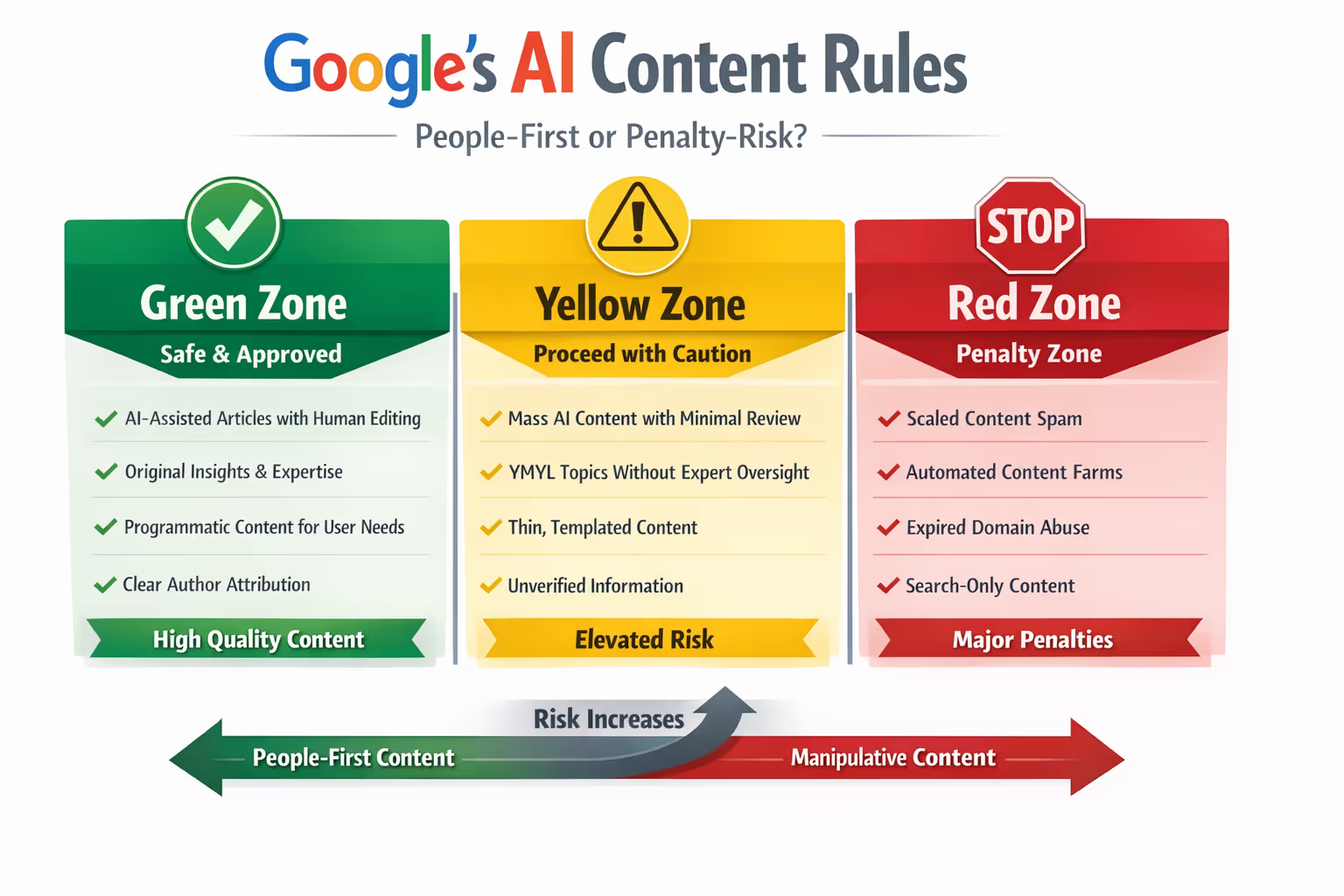
The foundational updates of late 2024 reinforced this stance while clarifying boundaries that remain in effect today. These policies define scaled content abuse as generating content "for the primary purpose of manipulating search rankings" [2].
Notice the critical distinction here. The problem isn't AI generation itself. The problem is manipulative intent combined with low-quality output.
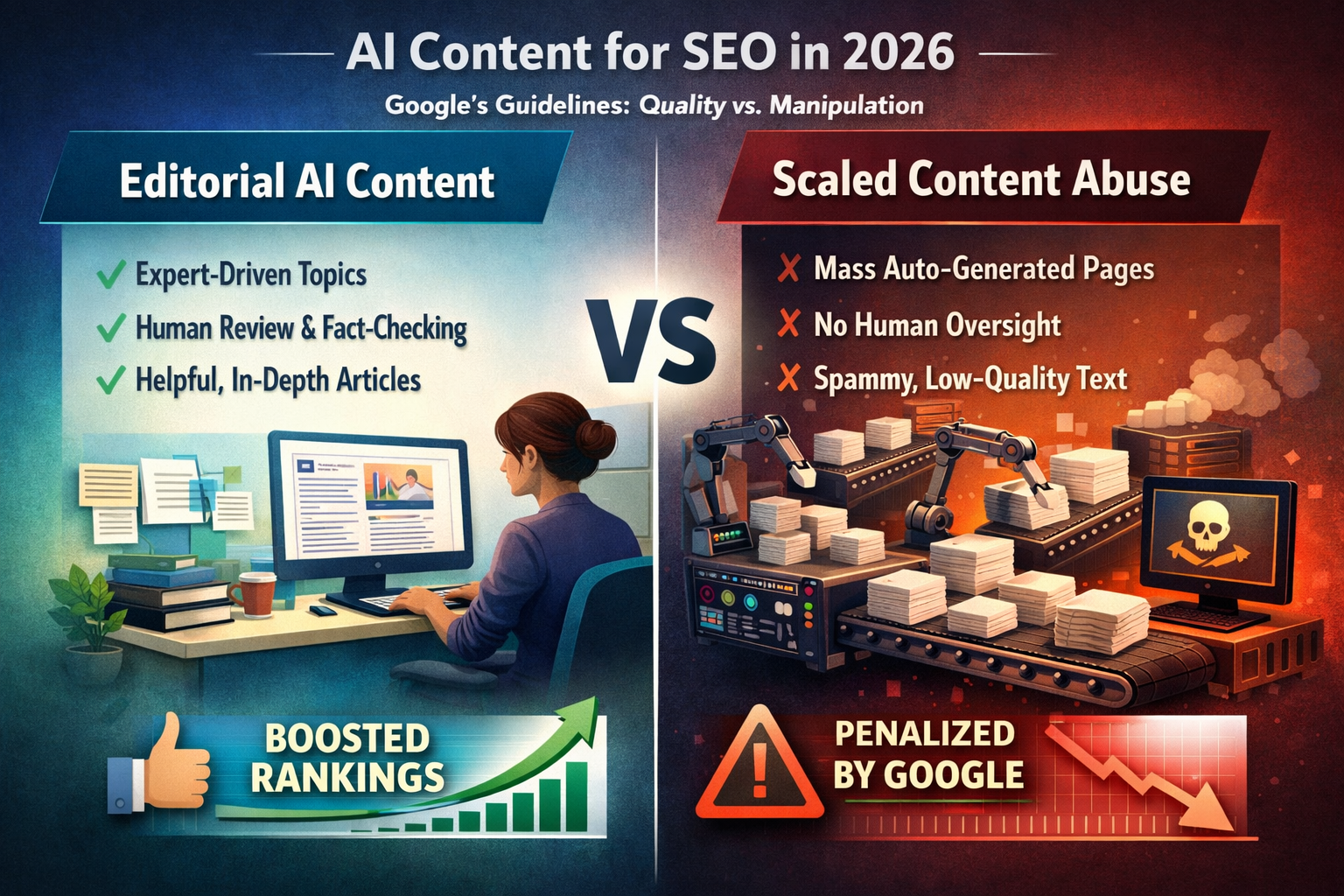
Where the Line Gets Drawn: Editorial AI vs. Scaled Abuse
Understanding this boundary determines whether your AI content strategy succeeds or fails.
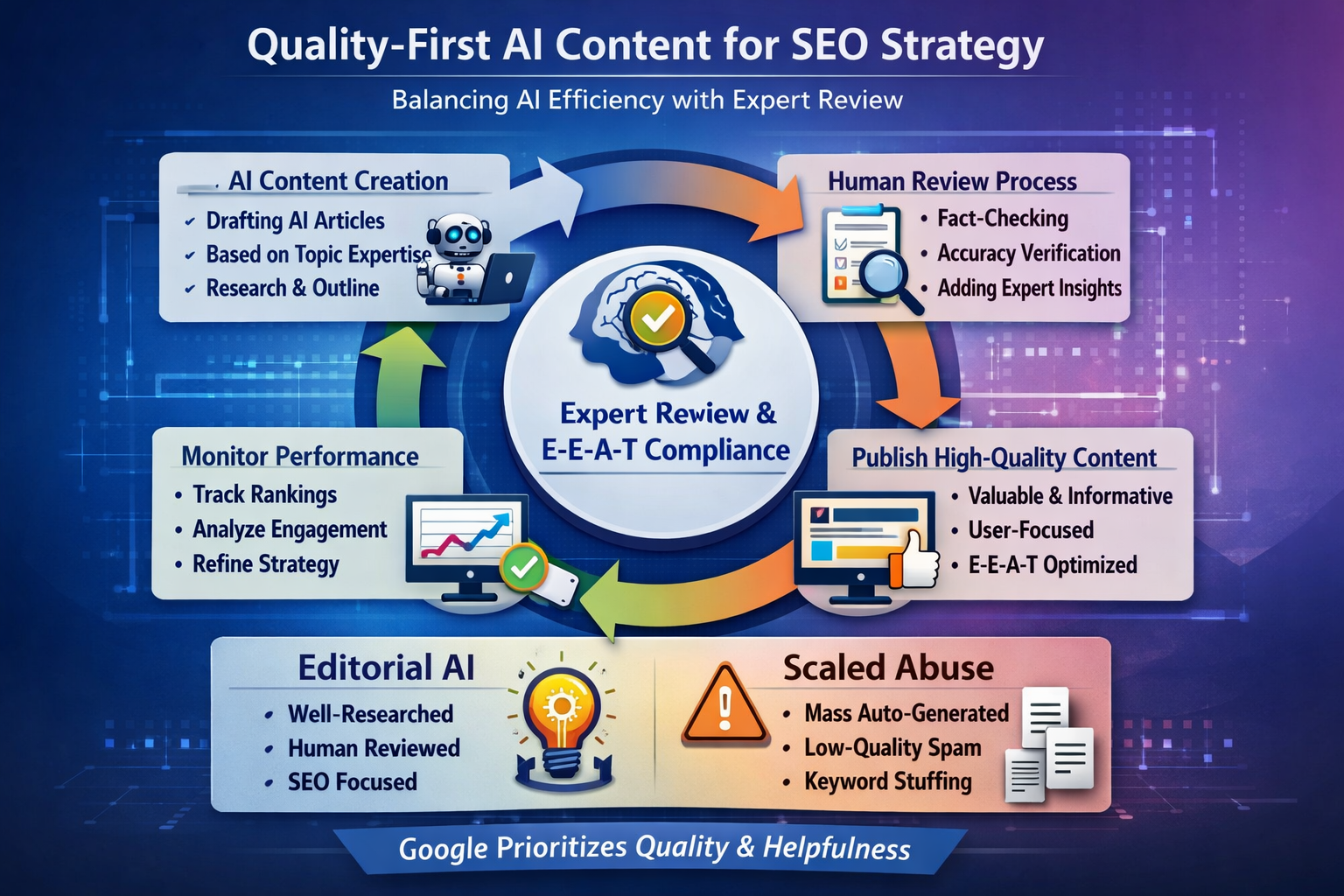
Editorial AI usage looks like this:
Using AI to draft well-researched articles on topics where you have genuine expertise
Publishing 2-3 AI-assisted articles weekly with human review and fact-checking
Generating content that answers specific questions your audience actually asks
Scaled content abuse looks like this:
Auto-generating thousands of pages targeting every keyword permutation in your industry
Publishing AI content with no human oversight, review, or quality control
Creating content purely to capture search traffic without providing real value
The difference isn't volume—it's intent and execution. A company publishing 50 helpful, AI-assisted articles per month operates well within Google's guidelines. A company auto-generating 5,000 thin pages hoping to rank for long-tail keywords crosses into spam territory.
Google's systems have become increasingly effective at identifying the latter. The search engine measures user satisfaction signals, not AI fingerprints.
The Helpful Content Standard: What Google Actually Measures
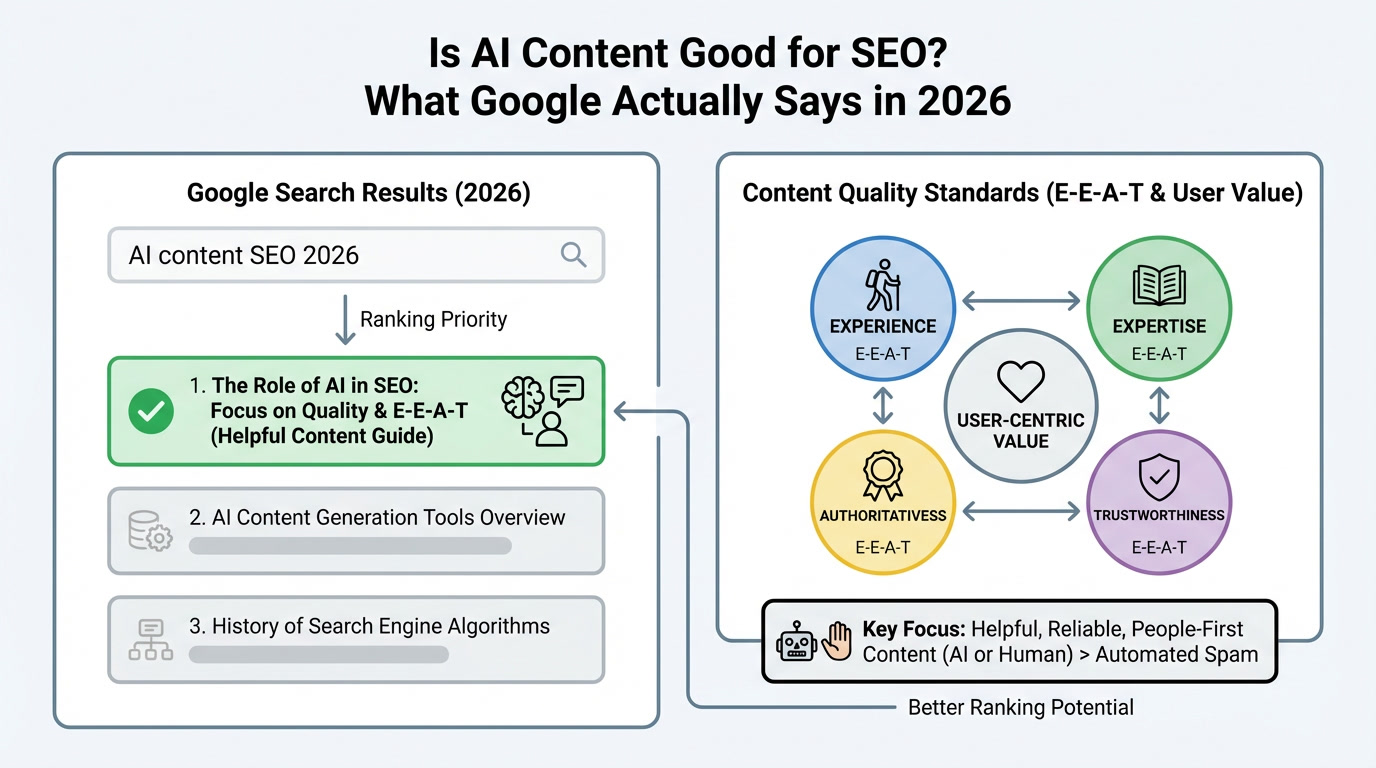
Google's helpful content system evaluates whether your content delivers genuine value to searchers. This system doesn't detect AI fingerprints. It measures whether people find what they're looking for.
According to Google's documentation, helpful content demonstrates several characteristics:
First-hand expertise or deep knowledge of the subject matter
Clear answers to the questions searchers actually ask
Satisfying depth that leaves readers feeling informed
Original analysis or insights beyond surface-level summaries [3]
Content failing these standards struggles regardless of who—or what—created it. Human writers producing thin, derivative articles face the same algorithmic headwinds as poorly prompted AI tools churning out generic paragraphs.
The implications for AI content are straightforward. When AI tools generate well-researched, expertly structured content that genuinely serves reader intent, Google rewards it. When AI produces hollow word salad optimized for keywords but devoid of substance, Google filters it out.
How User Behavior Signals Quality
Google doesn't need to detect whether content is AI-generated. The search engine reads user behavior instead.
When visitors land on a page and quickly return to search results, that signals dissatisfaction. When visitors stay, scroll, click internal links, and don't immediately bounce back—that signals the content answered their question.
These engagement patterns—often called dwell time and pogo-sticking—influence how Google evaluates content quality over time. AI-generated content that keeps readers engaged performs identically to human-written content that does the same.
The production method becomes invisible. Only the outcome matters.
E-E-A-T Requirements Apply Equally to AI Content
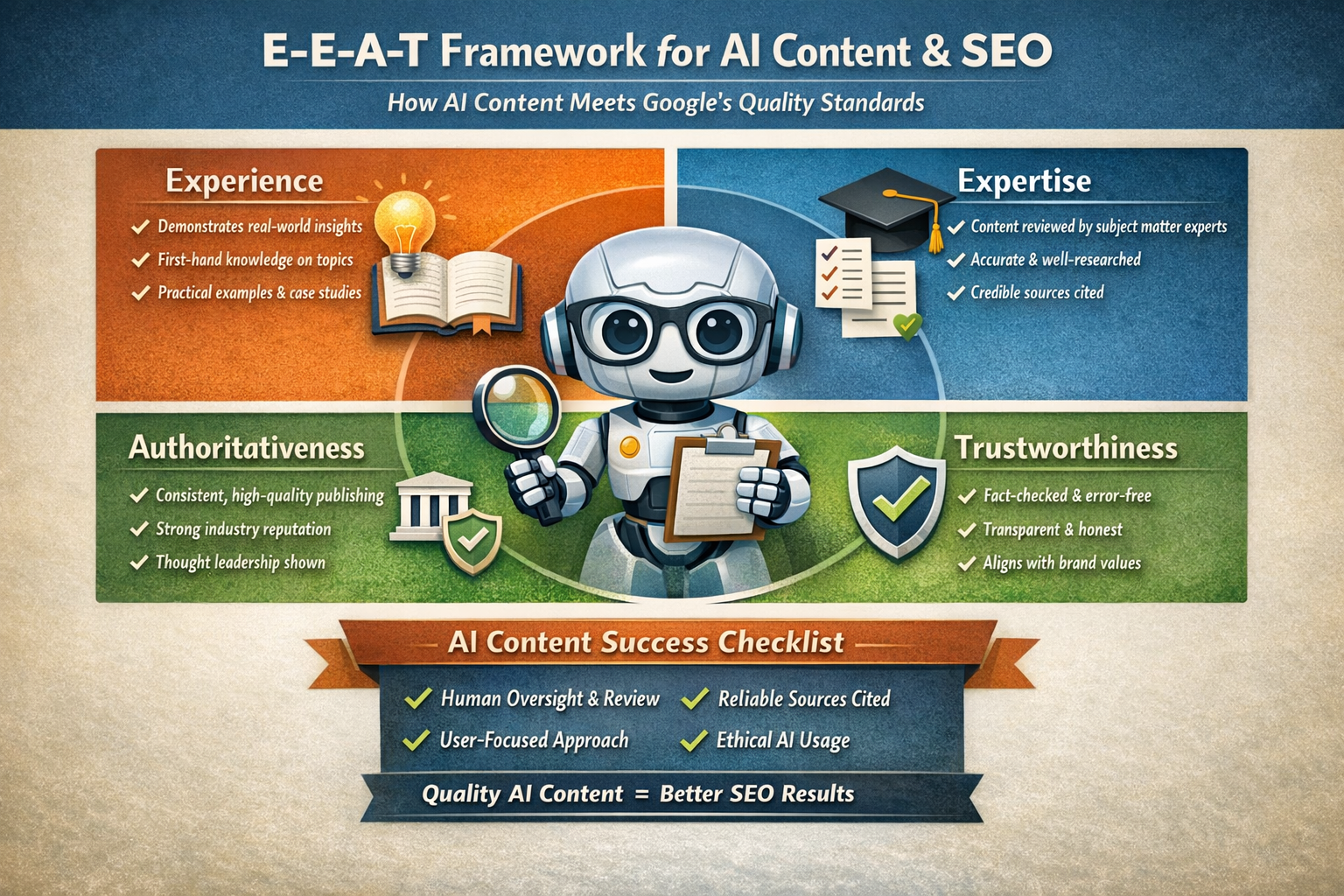
Google's E-E-A-T framework—Experience, Expertise, Authoritativeness, and Trustworthiness—shapes how content gets evaluated across all topics. These quality signals matter especially for YMYL (Your Money or Your Life) content covering health, finance, and safety.
Nothing in Google's E-E-A-T guidelines singles out AI content for different treatment. The standards apply universally.
Here's what this means practically. AI content demonstrating genuine expertise—through accurate information, proper sourcing, and substantive analysis—satisfies E-E-A-T requirements. AI content lacking these elements fails the same standards that trip up lazy human writers.
Google's quality rater guidelines emphasize evaluating "the quality of the main content" and "the reputation of the website and content creators" [4]. Raters assess what's on the page and who stands behind it. They don't run detection algorithms guessing whether paragraphs emerged from human fingers or AI systems.
The Human Oversight Checklist
This framework actually advantages businesses using AI strategically—when domain experts guide the process. Before publishing any AI-assisted content, verify these elements:
Accuracy Review
Has a subject matter expert verified all factual claims?
Are statistics, dates, and technical details correct?
Have you removed or corrected any AI hallucinations?
Expertise Signals
Does the content demonstrate real knowledge of the topic?
Are insights specific rather than generic?
Would someone with deep experience recognize this as credible?
Source Quality
Are claims supported by reliable sources?
Have you added citations where appropriate?
Does the content reference authoritative industry information?
Brand Alignment
Does the tone match your company's voice?
Is the perspective consistent with your expertise?
Would you confidently attach your name to this content?
When AI drafts pass this checklist, they satisfy E-E-A-T requirements effectively. The human expertise gets embedded into the content through the review process itself.
Why Quality-First AI Content Outperforms in Search
AI content built on solid foundations performs comparably to human-written content in search rankings. The logic behind this performance connects directly to how search engines evaluate quality.
Consistency builds authority.
Search engines reward websites that publish helpful content regularly. A site adding two or three valuable articles weekly accumulates topical authority faster than a site publishing sporadically. AI tools enable this publishing consistency without requiring proportional increases in staff or budget.
The compounding effect matters. Month over month, consistent publishing builds a content library that signals expertise to search engines. Sporadic human-only teams struggle to maintain this cadence.
Structure improves engagement.
Well-configured AI systems produce content with proper heading hierarchies, logical flow, and reader-friendly formatting. These structural elements keep visitors on the page longer—and engagement metrics influence rankings.
When content is easy to scan and navigate, readers find what they need. They stay longer. They click to other pages. These signals tell Google the content serves its purpose.
Speed captures emerging demand.
Timely content addressing new questions captures search demand while competitors are still researching. AI acceleration provides genuine competitive advantage for trending topics and emerging queries.
By the time a human writer researches, outlines, drafts, and edits a piece on a breaking topic, AI-assisted teams have already published and started ranking.
Expert guidance scales.
The businesses seeing the strongest AI content performance share common characteristics. They invest in proper topic research before generating content. They ensure subject matter experts review output. They optimize for reader value rather than keyword stuffing.
These practices align precisely with what Google rewards—regardless of production method.
Common Misconceptions That Hold Teams Back
Despite Google's clear guidance, several myths persist in the SEO community. Let's address them directly.
"Google Will Eventually Penalize AI Content"
This speculation lacks any foundation in Google's stated policies. The search engine has consistently emphasized rewarding helpful content and penalizing spam—regardless of creation method. The guidelines explicitly affirm that automation isn't inherently problematic [1].
Google's trajectory points toward better quality detection, not AI detection. Future updates will likely become more sophisticated at identifying content that fails to serve users—whether humans or machines created it.
Betting your strategy on imagined future penalties means missing present opportunities while competitors capture organic traffic.
"AI Content Always Sounds Generic"
Quality varies dramatically based on configuration, prompting, and oversight.
Consider the difference between asking AI to "write a blog post about SEO" versus providing detailed context: your company's expertise, your audience's specific challenges, your unique perspective on the topic, and examples of your brand voice.
The first prompt produces forgettable content. The second produces something worth reading.
Poorly implemented AI produces bland output. Well-implemented AI, guided by brand voice guidelines and expert review, produces content readers find valuable and engaging. The technology has matured significantly—modern AI systems trained on quality frameworks generate nuanced, authoritative content when properly configured.
"You Must Disclose AI Usage for SEO"
Google's guidelines don't require disclosure of AI assistance. The search engine evaluates content quality, not production method transparency.
Some publishers disclose AI usage for audience trust reasons. Others focus purely on content quality. This remains a brand decision rather than an SEO requirement.
Search rankings depend on helpfulness and accuracy—not on whether you mention AI involvement.
Building an AI Content Strategy That Ranks
Effective AI content for SEO requires intentional strategy—not just tool access. The businesses capturing organic traffic with AI content follow specific principles.
Start with genuine topic authority.
AI amplifies existing expertise. Companies with real knowledge in their field—demonstrated through products, services, and customer relationships—produce superior AI content because they can guide and validate output accurately.
If you lack expertise in a topic area, AI won't manufacture it for you. But if you have expertise and struggle to translate it into consistent content, AI bridges that gap effectively.
Prioritize search intent alignment.
Every piece of content should answer specific questions your audience actually asks. AI excels at comprehensive coverage when given clear intent targets.
Before generating content, understand why someone searches for a term. Are they looking to learn? Compare options? Make a purchase? Content matching this intent outperforms content that merely includes the right keywords.
Implement expert review workflows.
Subject matter experts reviewing AI output catch errors, add nuance, and ensure accuracy. This human oversight layer transforms generic AI drafts into authoritative content.
The review doesn't need to take hours. A knowledgeable reviewer can scan an AI draft in 15-20 minutes, flagging inaccuracies and adding specific examples from real experience. This small investment dramatically improves content quality.
Maintain consistent publishing schedules.
Search engines reward fresh, consistent content from authoritative sources. AI enables publishing cadences that build cumulative organic traffic—something sporadic human-only teams struggle to maintain.
Two to three quality articles per week, sustained over months, creates compounding returns that occasional publishing never achieves.
Optimize for reader experience.
Proper formatting, clear structure, and satisfying depth matter as much as keyword placement. AI tools configured for readability produce content that keeps visitors engaged—and engagement drives rankings.
The Competitive Reality
Businesses hesitating on AI content face an uncomfortable truth. Competitors embracing quality-first AI content are capturing organic traffic today. Every month of delay means lost visibility and leads flowing elsewhere.
Google's guidance removes the risk concern. The question isn't whether AI content can rank—it clearly can. The question is whether your team will execute effectively.
The winners in today's search landscape combine AI efficiency with human expertise. They publish consistently. They maintain quality standards. They build topical authority month after month.
The losers either avoid AI entirely—limiting their content output—or misuse AI by generating low-quality spam that Google rightfully ignores.
Your position in this competitive landscape depends entirely on execution decisions you control.
Build Your AI Content Engine
Understanding Google's AI content stance is step one. Implementing a system that captures organic traffic consistently is the real opportunity.
If you're ready to transform your website into a 24/7 organic traffic engine—with AI-powered content that meets Google's quality standards—explore how The Mighty Quill can deliver 2-3 SEO-optimized articles weekly without the hiring headaches.
Try the Blog Engine free and receive 2 custom articles within 48 hours.
Frequently Asked Questions
Does Google penalize AI-generated content?
No. Google's official guidelines state that appropriate use of AI is not against their policies. The search engine evaluates content based on quality and helpfulness to users—not production method. Content failing quality standards gets filtered regardless of whether humans or AI created it. The key factor is whether content genuinely serves searcher intent with accurate, valuable information.
How can AI content satisfy E-E-A-T requirements?
AI content satisfies E-E-A-T when guided by genuine subject matter expertise and reviewed for accuracy. Experience and expertise come from the humans directing the AI—their industry knowledge and ability to validate output. Authoritativeness builds through consistent quality publishing from reputable sources. Trust develops when content proves accurate and helpful over time. The review process embeds human expertise into AI-generated drafts.
What's the difference between acceptable AI content and scaled content abuse?
Acceptable AI content serves users with genuinely helpful, accurate information—regardless of volume. Scaled content abuse involves generating large amounts of content primarily to manipulate rankings, with no regard for quality or user value. A company publishing 50 helpful AI-assisted articles monthly operates within guidelines. A company auto-generating thousands of thin pages targeting every keyword permutation crosses into spam territory.
Should I disclose that AI helped write my content?
Google doesn't require AI disclosure for SEO purposes. This remains a brand decision based on your audience relationship preferences. Some publishers disclose for transparency reasons, while others focus purely on content quality. Search rankings depend on helpfulness and accuracy—not on whether you mention AI involvement. Consider your audience's expectations when making this decision.
What makes AI content rank well in Google search?
AI content ranks well when it demonstrates genuine expertise, answers user questions comprehensively, and provides satisfying depth. Proper structure, accurate information, and alignment with search intent matter more than the production method. Content optimized for reader value rather than keyword manipulation consistently outperforms shallow alternatives. User engagement signals—how long visitors stay and whether they find what they need—ultimately determine ranking success.
About Our Editorial Standards
This article reflects The Mighty Quill's commitment to accurate, well-researched content marketing guidance. Our team combines over 15 years of digital marketing experience with current search industry documentation. We cite official sources directly rather than relying on speculation. Every recommendation aligns with Google's published guidelines and proven content marketing principles. Our expertise comes from building real content systems that drive measurable organic traffic results for clients across SaaS, e-commerce, and service industries.
Cited Works
[1] Google Search Central — "Google Search's guidance about AI-generated content." https://developers.google.com/search/docs/fundamentals/creating-helpful-content
[2] Google Search Central — "Spam policies for Google web search." https://developers.google.com/search/docs/essentials/spam-policies
[3] Google Search Central — "Creating helpful, reliable, people-first content." https://developers.google.com/search/docs/fundamentals/creating-helpful-content
[4] Google — "Search Quality Rater Guidelines." https://static.googleusercontent.com/media/guidelines.raterhub.com/en//searchqualityevaluatorguidelines.pdf