
Key Takeaways:
Information gain measures the unique value your content adds beyond what already exists—and it's becoming the primary ranking factor for B2B content
Your "Topical Delta" (proprietary insights, original data, firsthand expertise) is the only defensible advantage against AI summarization
Traditional SERP analysis fails because matching existing content means zero information gain
Building content around what you uniquely know—not search volume—creates compounding organic visibility
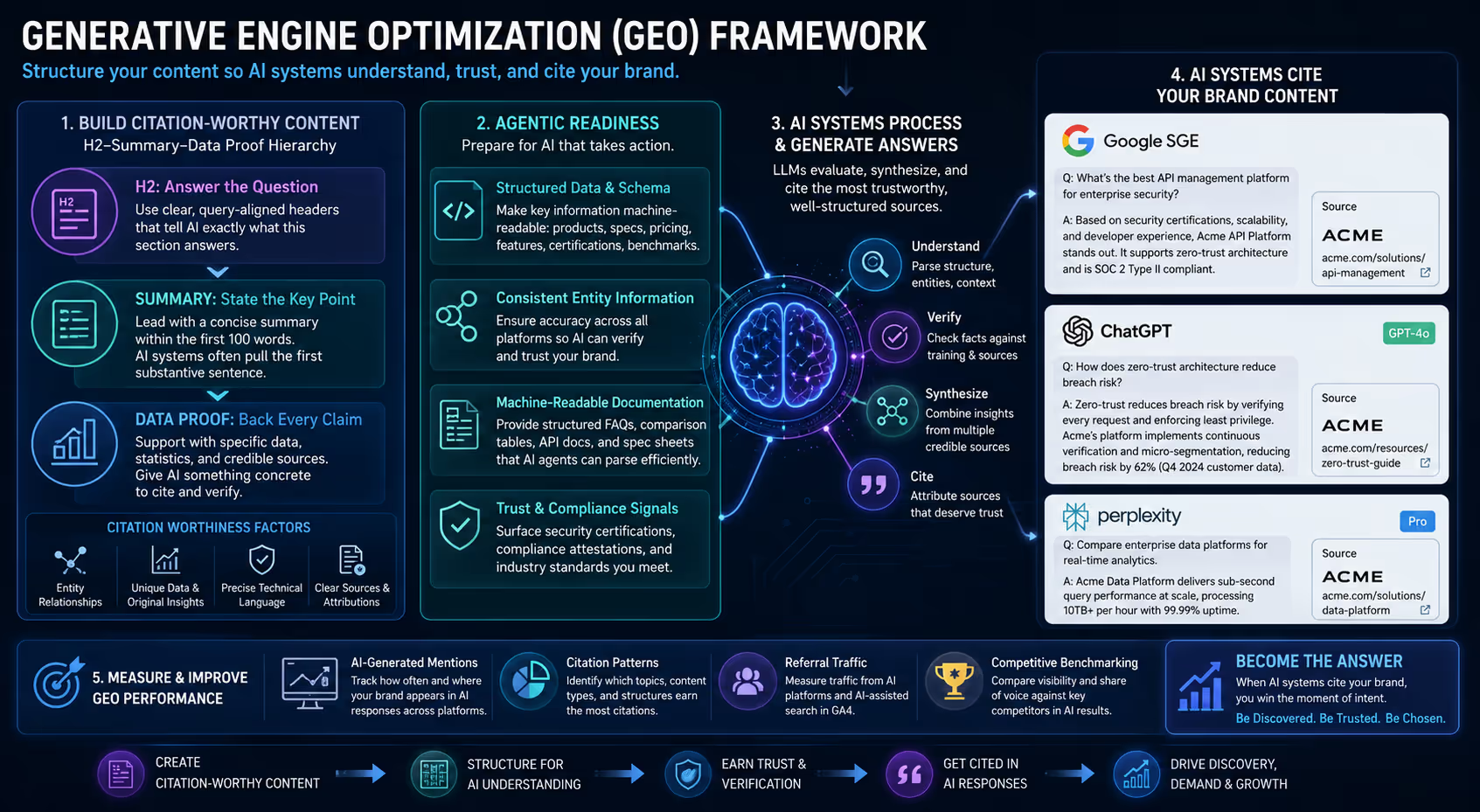
Google's Helpful Content system and AI citation models both reward sources that contribute genuinely new information
Most B2B blogs fail for the same reason: they say nothing new.
Every day, millions of posts hit the internet rehashing identical ideas, citing the same three sources, and offering no original perspective. Google's algorithms—particularly the Helpful Content system rolled out and refined over recent years—have evolved specifically to filter out this redundancy. AI assistants synthesizing answers for searchers do the same.
Information gain has become the defining factor separating content that ranks from content that disappears. For B2B marketers, understanding this shift isn't optional anymore. To dive deeper into this, read our article on Information Gain In Content Marketing Ai Search Era.
What Information Gain Actually Means for Search
Information gain, in the context of search algorithms, measures how much new value a piece of content adds compared to what already exists on a topic. Google's patent on information gain scoring (US10496663B2, granted in 2020) describes systems that evaluate whether content contributes something beyond the top-ranking results [1].
The logic is straightforward: if someone could learn everything in your article by reading the first three search results, your content provides no reason to rank.
This concept has appeared in Google's patent literature and search quality discussions for years. But it matters far more now because of two converging forces:
First, Google's Helpful Content updates explicitly target "content created primarily for search engines rather than people." Content that aggregates without adding value falls squarely in the crosshairs.
Second, AI systems have fundamentally changed how content gets evaluated and cited. Large language models synthesize information from across the web. When they generate answers, they draw from sources that contributed something distinct—not from sources that repeated what others already said.

The Topical Delta: Your Only Defensible Advantage
When we audit B2B content libraries, the most common failure point we see is this: companies publish content about topics they should know deeply, but the actual articles contain nothing their competitors couldn't write.
The "Topical Delta" represents the gap between what's already known about a subject and what your organization uniquely understands. It's the proprietary insight, the original data point, the perspective that exists nowhere else.
Large language models excel at summarizing existing knowledge. What they cannot do is generate original research, proprietary benchmarks, or firsthand expertise that doesn't exist anywhere else.
Your Topical Delta is the content LLMs must cite because they cannot fabricate it.
Consider what this means practically:
Generic how-to guides can be summarized by any AI
Industry statistics repeated from other sources add no new information
Original survey data from your customer base cannot be replicated
Proprietary frameworks tested in real client engagements are yours alone
Documented failures and what you learned from them carry inherent credibility
The companies winning organic visibility aren't producing more content. They're producing content with higher information gain—content built on their unique Topical Delta.
Why Traditional SERP Analysis Falls Short
Most SEO strategies still begin with analyzing current search results. Teams look at what's ranking, identify common themes, and create something "better" by being more comprehensive or better formatted.
This approach made sense when search engines primarily rewarded thorough coverage of existing topics. It fails when algorithms actively penalize redundancy.
Current SERP analysis tells you what was valuable—not what's needed next. By the time you've published your comprehensive guide that matches what competitors already offer, the algorithm has already indexed dozens of similar pieces. Your information gain approaches zero.
The citation models emerging across AI-powered search prioritize sources that contribute something distinct [2]. When an AI assistant answers a query, it draws from sources that added unique value to the topic. Rehashed content doesn't make the cut.
This creates a counterintuitive reality: matching what currently ranks often guarantees you won't rank at all.
Building Content Strategy Around Unique Data Points
Shifting from coverage-based content to information-gain content requires rethinking how you develop topics entirely.
Start with what you know that others don't
Every B2B company has proprietary knowledge hiding in plain sight:
Customer behavior patterns from your platform or service delivery
Implementation insights from working with specific industries
Performance benchmarks from campaigns or projects
Failure patterns that teach valuable lessons
This internal knowledge becomes the foundation for content that cannot be commoditized.
Develop original research pipelines
Survey data, case study documentation, and internal benchmarking create assets competitors cannot replicate. A single original statistic cited across the industry provides more ranking leverage than dozens of generic articles.
A concrete example: turning support tickets into content gold
Here's how this works in practice. A B2B SaaS company we worked with had three years of customer support tickets sitting in Zendesk. By analyzing patterns in those tickets, they identified the seven most common implementation mistakes their customers made during onboarding.
They turned that into an article: "7 Implementation Mistakes That Delay Time-to-Value (Based on 2,400 Support Tickets)."

That single piece of content—built entirely from proprietary data—now ranks for twelve different keyword variations. It gets cited in industry newsletters. Competitors can write about implementation best practices, but they cannot replicate the data behind those specific seven mistakes.
That's information gain in action.
Document frameworks born from practice
Methodologies you've developed through actual work carry inherent credibility. "We tried X and here's what happened" beats "here's what experts recommend" every time. Both search algorithms and AI systems reward this kind of structured, original thinking.
Interview internal experts systematically
Subject matter experts hold knowledge that never makes it into published content. Your sales team knows the three objections that kill deals. Your customer success team knows why implementations fail. Your engineers know the technical constraints competitors won't admit.
Build a simple monthly interview process: thirty minutes with one internal expert, recorded and transcribed. Ask them: "What do you know about [topic] that you've never seen written about anywhere?" The answers become article foundations.
Build topic banks around your delta, not search volume
High-volume keywords attract the most competition and the most redundant content. Topics where your unique expertise intersects with genuine market need—even at lower volume—deliver compounding returns.

The Compounding Effect of High-Gain Content
Information gain doesn't just affect individual rankings. It changes how your entire domain builds authority over time.
When your content consistently contributes new value to topics, several things happen:
Search engines recognize your domain as a primary source, not an aggregator. This influences how all your content gets evaluated—not just the pieces with original research. Google's systems assess site-level quality patterns, meaning a track record of high-gain content improves the starting position for everything you publish [3].
AI citation systems begin associating your brand with authoritative information on specific topics. As AI-assisted search grows through features like Google's AI Overviews, this association becomes increasingly valuable.
Other publishers cite your original data, creating backlink profiles built on genuine editorial merit. You're not chasing links—links find you because you have something worth referencing.
Your content library becomes harder to replicate. Competitors can copy your format. They cannot copy your data.
This is what compounding organic growth actually looks like. Not more content, but more defensible content.

Practical Steps to Increase Information Gain
Implementing information gain strategy doesn't require rebuilding your entire content operation. Start with these shifts:
Audit existing content for unique value. Review your top-performing pieces. How many contain information unavailable elsewhere? Where could original data or proprietary insight be added? Flag articles that are purely aggregative—they're candidates for either enrichment or retirement.
Create original data from operations. Your CRM, support tickets, project retrospectives, and campaign results all contain potential content gold. Build a quarterly process to extract and anonymize insights worth sharing. Even simple internal surveys ("What surprised you most about projects this quarter?") generate usable material.
Interview internal experts systematically. Create a rotating schedule. Record conversations. Ask specifically about what they know that isn't commonly discussed in industry content.
Test and document methodologies. When you develop an approach that works, document the results with specifics. Include what didn't work along the way—that honesty differentiates your content from generic best-practice lists.
Prioritize depth over breadth in topic selection. Better to own a narrow topic with genuine expertise than compete for broad terms where you offer nothing new.
What This Means for B2B Content Investment
The information gain imperative changes how smart marketing leaders think about content ROI.
Volume-based strategies—publishing as much as possible to capture long-tail traffic—deliver diminishing returns when algorithms actively deprioritize redundant content.
Investment in original research, proprietary frameworks, and expert-driven content generates asymmetric returns. One piece with genuine information gain outperforms dozens without it.
This doesn't mean publishing less. It means publishing differently. Building content engines that systematically capture and distribute your organization's unique knowledge creates sustainable competitive advantage.
The teams winning organic visibility aren't the ones producing the most content. They're the ones producing content that no one else can.
Ready to build content around your unique Topical Delta? Let our experts develop a custom Topic Bank that captures your proprietary insights and turns them into ranking assets. Book a strategy call to see how it works.

Frequently Asked Questions
What is information gain in SEO?
Information gain measures how much new, unique value your content adds compared to what already exists on a topic. Google's patent on this concept (US10496663B2) describes systems that evaluate whether content contributes something beyond available information. High information gain means your content offers something searchers can't find elsewhere—original data, proprietary insights, or perspectives based on firsthand experience. Content with zero information gain simply repeats what's already ranking.
How do AI systems affect content rankings?
AI systems synthesize information from across the web and prioritize sources that contribute distinct value when generating citations. Content that merely summarizes existing knowledge gets passed over in favor of original sources. This means the traditional approach of creating "comprehensive" content by combining what others have written becomes less effective as AI-assisted search features—like Google's AI Overviews—expand their reach and influence.
What is a Topical Delta?
A Topical Delta represents the gap between commonly available knowledge and what your organization uniquely understands about a subject. It includes proprietary data, frameworks developed through practice, and insights from direct experience that cannot be found elsewhere. Building content strategy around your Topical Delta creates assets that competitors and AI systems cannot replicate—giving you defensible organic visibility.
How do I create content with high information gain?
Start by identifying knowledge your organization holds that isn't widely published—customer behavior data, implementation insights, performance benchmarks, or methodologies you've developed. Build systematic processes to capture this internal expertise: interview subject matter experts monthly, analyze patterns in support tickets, and document what you learn from projects. Prioritize original research and documented case studies over coverage of topics already well-documented elsewhere.
Why doesn't traditional SERP analysis work anymore?
Traditional SERP analysis shows what was valuable enough to rank, not what's needed to add new value. Creating content that matches existing top results means your information gain approaches zero—you're adding nothing new. Google's Helpful Content system and emerging AI citation models increasingly penalize this redundancy. "Match and improve" strategies fail when the algorithm specifically rewards what's different, not what's similar.
Cited Works
[1] Google Patents — "Information Gain Score Patent (US10496663B2)." https://patents.google.com/patent/US10496663B2/
[2] Ahrefs — "How AI Search Is Changing Content Requirements." https://ahrefs.com/blog/ai-search-optimization/
[3] Google Search Central — "Creating Helpful, Reliable, People-First Content." https://developers.google.com/search/docs/fundamentals/creating-helpful-content