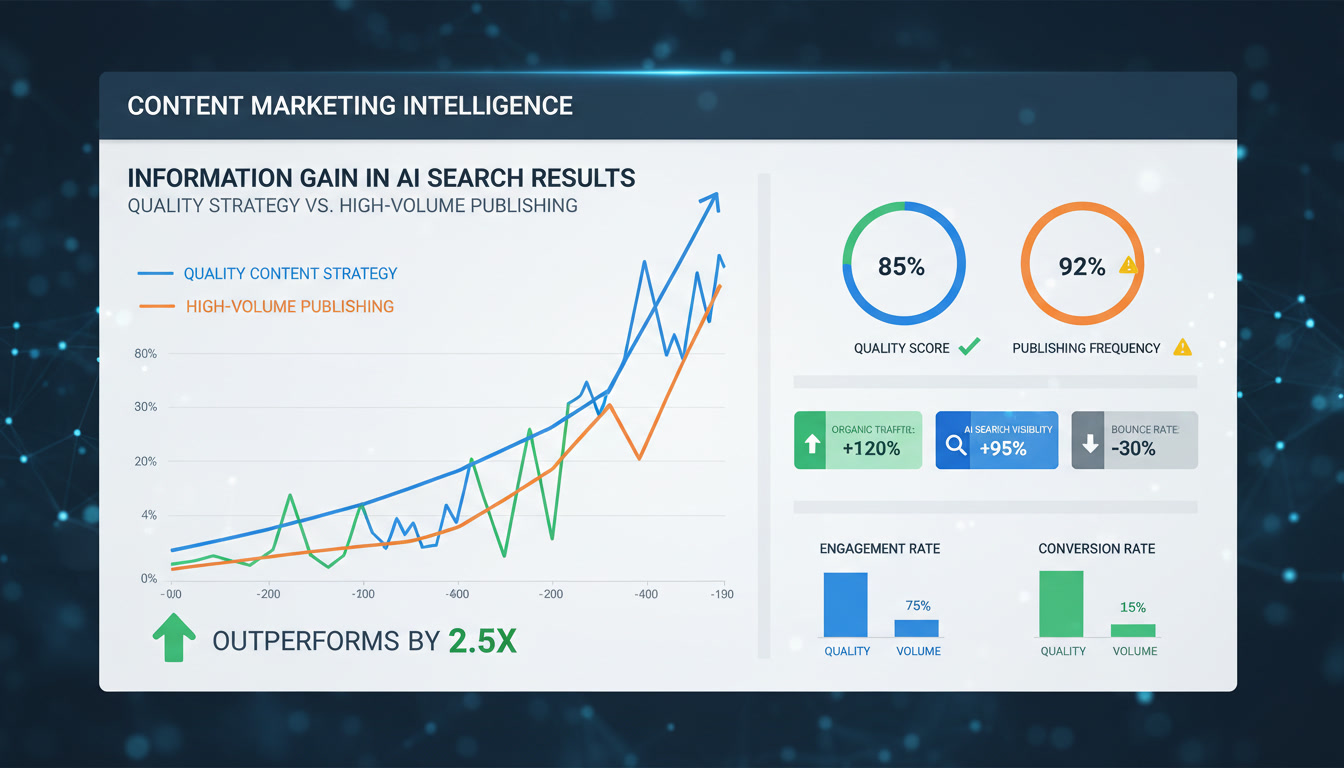
For years, the formula was simple: publish more, rank more. Load your blog with keyword-stuffed posts and watch traffic trickle in.
That playbook stopped working—and most content teams haven't caught up.
Search engines, and the AI systems now powering them, have fundamentally changed how they evaluate content. Google's algorithms now prioritize what researchers call "information gain": the degree to which your content adds something new to the conversation [1]. Meanwhile, AI-powered search assistants like Google's AI Overviews and Bing's Copilot synthesize answers from the web, rewarding sources that contribute unique insights while filtering out redundant ones [2].
High-volume publishing isn't just ineffective anymore. It's actively working against you.
But here's what most content marketers miss: volume itself isn't the problem. The problem is volume without information gain. This distinction changes everything about how you should approach content strategy—and understanding it creates an opportunity that most of your competitors will ignore.
What Information Gain Actually Means for Your Content
Information gain isn't marketing jargon. It's a technical concept from machine learning that Google has adapted for search quality evaluation, referenced in patents and documentation as a way to measure content value [1].
At its core, information gain measures how much new, useful information a piece of content provides compared to what already exists on a topic. When someone searches for "how to improve website conversion rates," Google doesn't just look for pages that mention the topic. It evaluates whether each result adds something the searcher couldn't find elsewhere.
Think of it as a delta—the difference between what your content offers and what's already ranking. A high delta means you're contributing genuine value. A low delta means you're essentially repeating what ten other pages already say.
Here's why this matters now more than ever: AI search systems are specifically designed to identify and synthesize novel information [3]. When ChatGPT or Google's AI Overview generates an answer, it pulls from sources that provide distinct contributions. Content that merely restates common knowledge gets filtered out entirely.
The implications are significant:
Consensus content is invisible. If your article says the same things as every other result, AI systems have no reason to cite you.
Unique data wins. Original research, proprietary insights, and fresh perspectives create the information gain that algorithms reward.
Depth beats breadth. One genuinely insightful article outperforms ten shallow ones—not just for readers, but for search visibility.
The High-Volume Trap: How More Content Became a Liability
Publishing frequency used to be a competitive advantage. More pages meant more keyword targets, more internal links, more chances to rank. Some sites still operate this way, churning out dozens of posts weekly.
The problem is that most of that content provides zero information gain—and search engines have gotten remarkably good at detecting this.
When you prioritize volume over insight, you inevitably produce what Google's quality guidelines describe as "thin content"—pages that exist primarily to target keywords rather than genuinely help users [4]. And thin content doesn't just fail to rank. It can actively harm your site's overall authority.
Here's the mechanism: search engines evaluate your domain's trustworthiness partly based on your content quality average. A site with fifty excellent articles and two hundred mediocre ones doesn't get credit for the fifty. The mediocre majority drags down the domain's perceived expertise [5].
This creates a compounding problem that we've seen play out repeatedly across client sites:
Low-quality pages accumulate, diluting domain authority
New content inherits lower baseline trust
Even good articles struggle to rank because the domain itself is penalized
Teams respond by publishing more content to compensate
Quality suffers further
It's a death spiral disguised as a growth strategy.
The AI era accelerates this problem. Large language models have been trained on essentially the entire internet—they recognize when you're saying what's already been said [6]. Publishing more of the same doesn't help. It teaches AI systems that your site isn't a source of original insight.
Information Gain in Practice: Low-Delta vs. High-Delta Content
Understanding the concept is one thing. Seeing it in action clarifies why this matters so much.
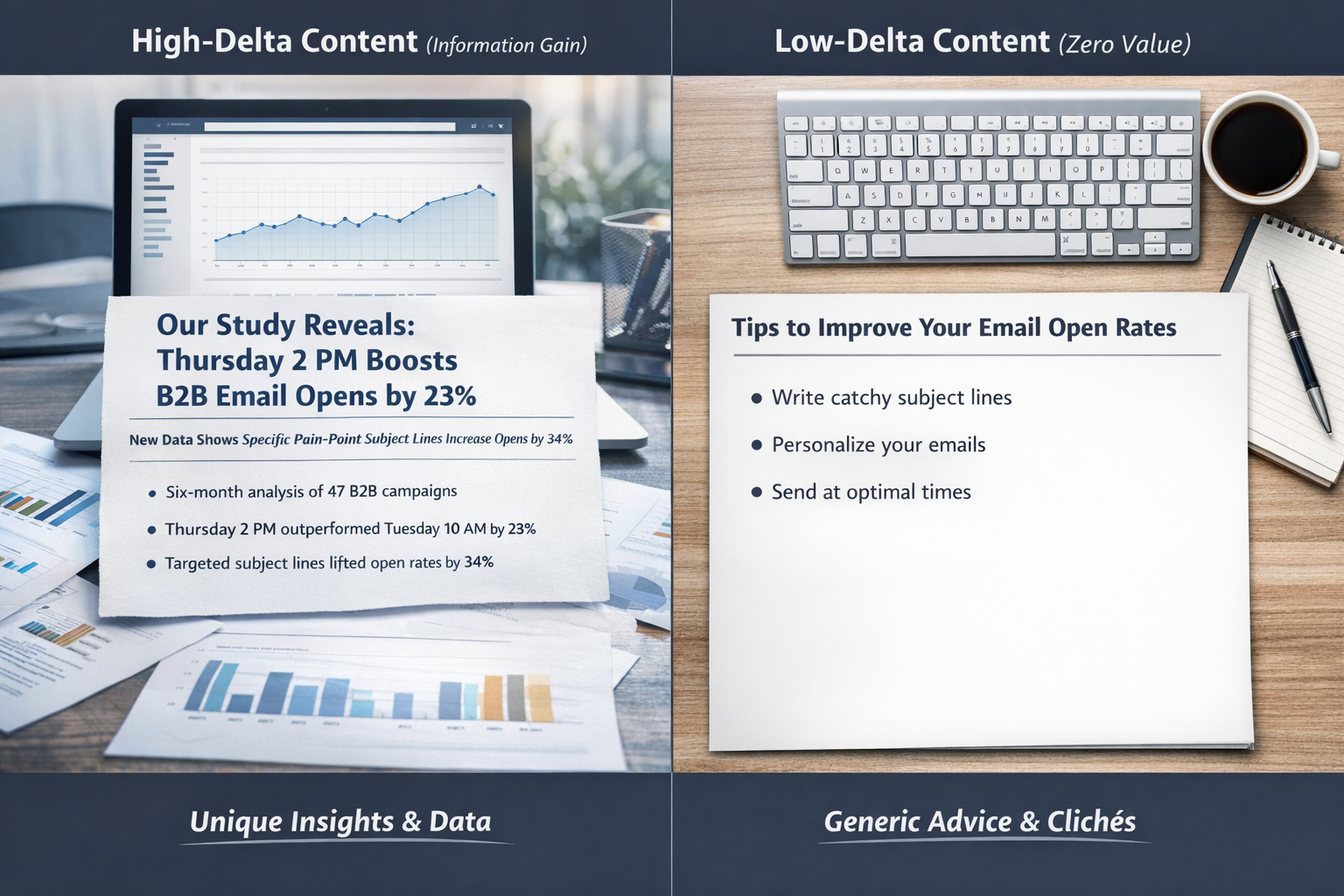
Consider two approaches to the same topic: "How to improve email open rates."
Low-Delta Content (Zero Information Gain):
"Email open rates are important for your marketing success. To improve them, write compelling subject lines, personalize your emails, and send at optimal times. Testing different approaches can help you find what works best for your audience."
This says nothing a reader couldn't find in any of the other fifty articles on this topic. It's technically accurate. It's also invisible to AI systems because it adds nothing to the existing conversation.
High-Delta Content (Genuine Information Gain):
"After analyzing send-time performance across 47 client accounts over six months, we found that the conventional wisdom about 'optimal send times' is largely wrong for B2B audiences. Tuesday at 10am—the most commonly recommended slot—actually showed 23% lower open rates than Thursday at 2pm in our data. More importantly, send time mattered far less than subject line specificity: emails referencing a specific pain point by name outperformed generic benefit-focused subject lines by 34%, regardless of when they were sent."
The second version provides specific data, challenges existing assumptions, and gives readers something actionable they can't find elsewhere. That's information gain.
The difference isn't about writing quality or length. It's about whether your content adds to the sum total of knowledge on a topic—or just reorganizes what's already there.
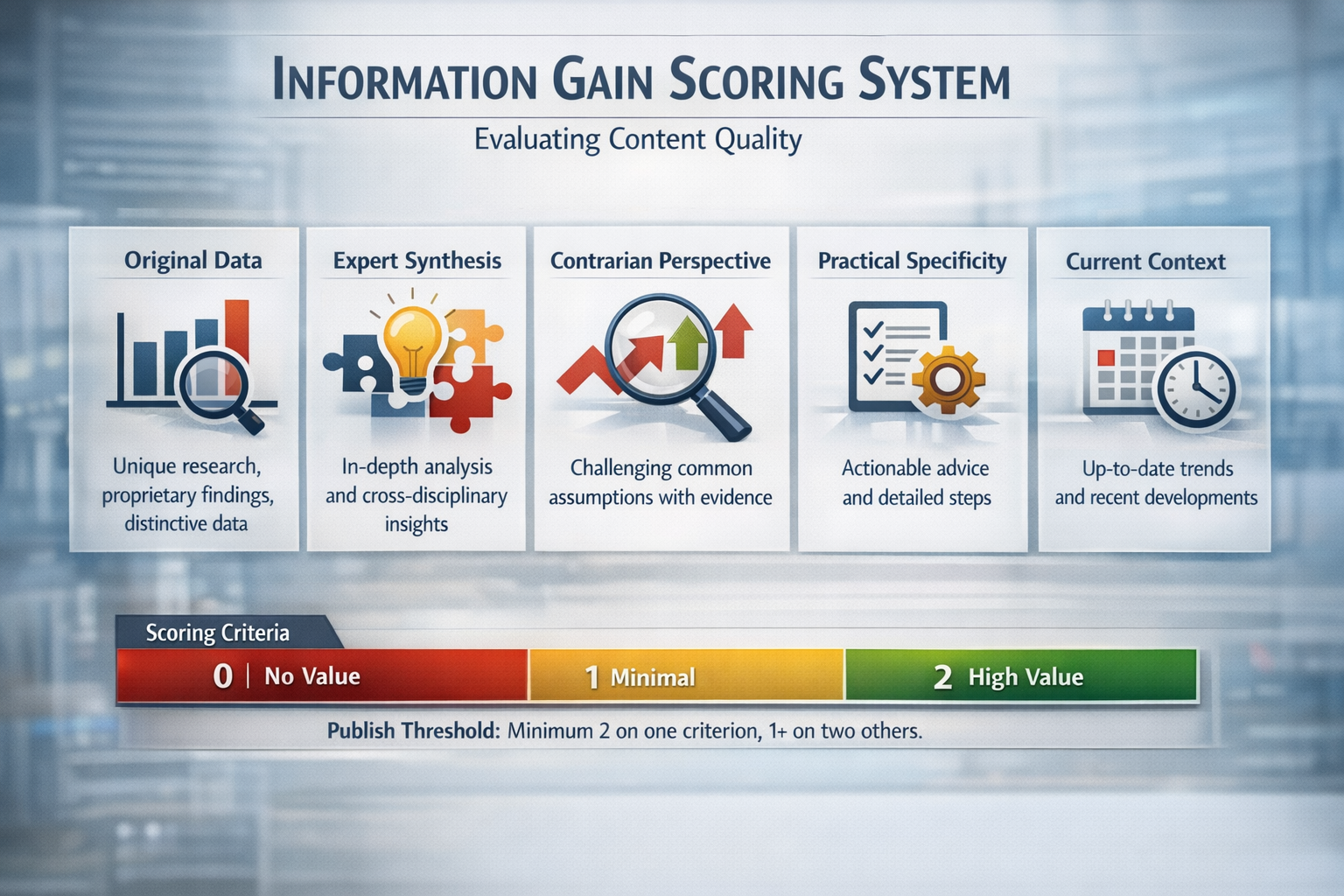
The Information Gain Scoring System
At Mighty Quill, we evaluate every piece of content against specific criteria before it publishes. This isn't about gut instinct—it's a systematic check that ensures we're meeting the information gain threshold.
Here's the framework we use, with specific questions for each criterion:
1. Original Data or Evidence
Questions to ask:
Does this article include any data, findings, or examples that came from our own work or research?
Is there at least one specific number, percentage, or result that a reader couldn't find in the top three existing results?
Can we cite a source that isn't already being cited by everyone else?
Why it matters: Nothing creates information gain faster than proprietary data. When you share findings from your own surveys, experiments, client work, or analytics, you're providing something literally no one else can offer.
This doesn't require massive budgets. Even simple internal observations—like "we tested X approach across Y clients and saw Z results"—create genuine value. The key is specificity. Vague claims add nothing.
2. Expert Synthesis
Questions to ask:
Does this article connect ideas from multiple domains in a way that creates new understanding?
Are we drawing on expertise or experience that most writers on this topic don't have?
Would a specialist in this field find the connections we're making interesting or useful?
Why it matters: Sometimes the value isn't new data but a new way of connecting existing information. Expert synthesis means bringing together insights from multiple domains to create understanding that didn't exist before.
For example: explaining how a behavioral psychology principle applies to website design, or connecting an economic trend to content marketing strategy. You're not discovering new facts—you're creating new meaning.
3. Contrarian Perspective (With Evidence)
Questions to ask:
Does the consensus on this topic have gaps, limitations, or blind spots we can address?
Do we have evidence or reasoning that challenges conventional wisdom?
Is there something everyone assumes that might not be true?
Why it matters: The safest content is often the least valuable. When every article on a topic reaches the same conclusion, there's an opportunity for genuine insight in the opposing view.
This doesn't mean being contrarian for attention. It means having the expertise and evidence to challenge consensus when consensus is incomplete. That's high-information-gain territory.
4. Practical Specificity
Questions to ask:
Could a reader implement what we're describing without needing additional research?
Are we providing specific steps, frameworks, or criteria—not just general principles?
Is there something a reader will remember and actually use?
Why it matters: Generic advice is everywhere. Specific, actionable guidance is rare.
Compare "create quality content" to "here are the five questions we ask before publishing any article, and the specific threshold each answer needs to meet." The latter provides information gain because it gives readers something they can actually apply.
5. Current Context
Questions to ask:
Does this article incorporate recent developments, changes, or examples?
Would this content have been different if we'd written it six months ago?
Are we acknowledging current realities rather than writing timeless generalities?
Why it matters: Information value decays over time. What was insightful last year may be obvious today. Content that incorporates current developments—new algorithm changes, emerging tools, recent industry shifts—maintains its information gain delta.
This is why evergreen content still needs periodic updates. The underlying principles may be timeless, but the context that makes them relevant keeps shifting.
The Scoring Threshold
We score content on a simple scale for each criterion:
| Score | Meaning |
| 0 | No evidence of this criterion |
| 1 | Minimal presence—could be stronger |
| 2 | Clear presence—adds genuine value |
Publishing threshold: A piece needs to score at least 2 on one criterion and at least 1 on two others. Anything below that goes back for revision or gets scrapped entirely.
This might sound strict, but it's the filter that separates content that compounds in value from content that disappears into obscurity.
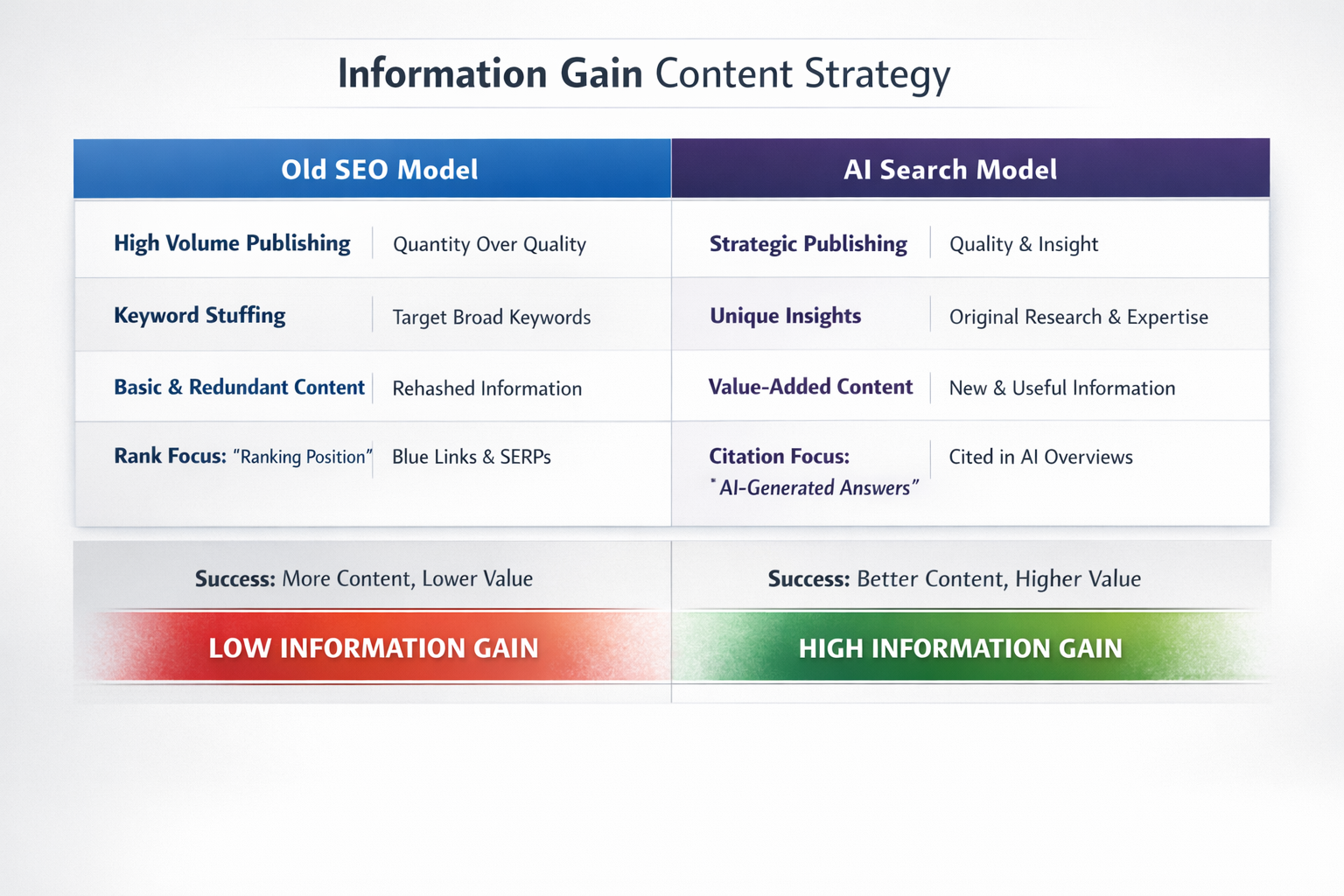
Why AI Search Rewards Depth Over Frequency
Google's shift toward AI-generated search results has profound implications for content strategy. Understanding the mechanics helps explain why quality now beats quantity more decisively than ever.
When Google's AI Overview generates an answer, it doesn't just pull from the top-ranking result. It synthesizes information from multiple sources, selecting passages that contribute distinct value to the response [2]. Sources that provide unique insights get cited. Sources that repeat common knowledge get ignored.
This creates a winner-take-all dynamic for information gain. If your content says something genuinely new, AI systems have a reason to cite you. If it doesn't, you become invisible—not just lower-ranked, but excluded entirely from the synthesized answer.
The same principle applies to conversational AI assistants. These systems are designed to provide comprehensive answers by drawing on diverse sources. Redundant content doesn't help them achieve that goal, so it gets filtered out [3].
For content creators, the rules have fundamentally changed:
| Old SEO Model | AI Search Model |
| Publish frequently to maximize keyword coverage | Publish strategically to maximize information gain |
| Target broad keywords with general content | Target specific queries with deep expertise |
| Compete for blue links | Compete for citation in AI-generated answers |
| Success = ranking position | Success = being synthesized as a source |
| Volume creates visibility | Volume without delta creates invisibility |
The sites winning in AI search aren't necessarily publishing more. They're publishing content that AI systems need to cite because no one else provides that specific insight.
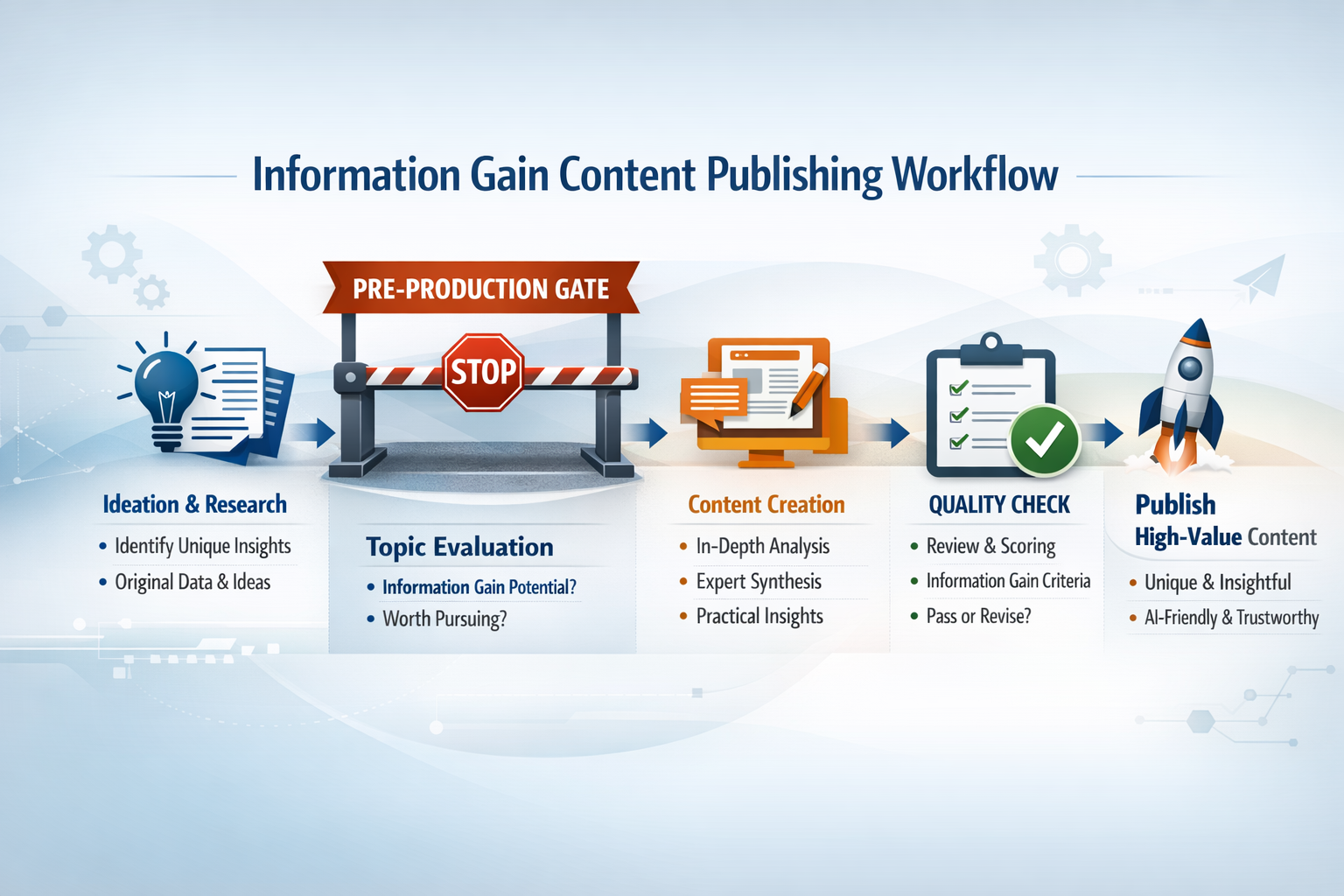
The Quality-First Publishing System
Shifting from quantity to quality doesn't mean publishing rarely. It means publishing strategically—ensuring every piece of content meets the information gain threshold before it goes live.
Here's the system we use at Mighty Quill:
Pre-Production Gate
Before writing begins, evaluate whether the topic offers genuine information gain potential:
What can we say that others can't? If the answer is "nothing," the topic isn't worth pursuing yet—you need to develop the insight first.
Do we have unique data, experience, or expertise? Original insights require original sources.
What's the current content quality for this query? Weak competition creates opportunity; strong competition requires exceptional value to compete.
What's the specific angle? "General overview" isn't an angle. "Here's what our data shows that contradicts conventional wisdom" is an angle.
Production Standards
During creation, maintain focus on information gain:
Lead with your unique angle, not generic background
Include specific data, examples, or frameworks that readers can't find elsewhere
Connect ideas across domains to create new understanding
Provide actionable detail, not abstract advice
Cut any section that doesn't add value a reader couldn't get elsewhere
Post-Production Quality Check
Before publishing, run through the scoring system above and verify:
Does this article say something genuinely new?
Would an expert in this field find something useful here?
Is there a specific insight a reader will remember and potentially share?
Does this contribute to the conversation or just restate it?
If the score doesn't meet threshold, the content needs revision—or shouldn't publish at all.
Cadence Calibration
The right publishing frequency isn't universal. It depends on your capacity to maintain information gain at scale.
Some teams can publish high-value content daily because they have deep expertise, proprietary data, and efficient systems. Others produce their best work monthly because that's how long it takes to develop genuine insights.
The optimal cadence is whatever frequency allows you to maintain quality standards consistently. Publishing three excellent articles per week creates more value than publishing ten mediocre ones—and the compounding effects are dramatically different over time.
Building Authority in the Information Gain Era
The good news: this shift creates enormous opportunity for content teams willing to adapt.
When most competitors are still chasing volume, committing to information gain creates differentiation. You become the source that AI systems cite, the result that searchers trust, the authority in your space.
Building that authority requires patience. Unlike volume-based strategies that show quick vanity metrics, quality-first approaches compound over time. A genuinely valuable article continues generating traffic and citations for years. A thin content piece disappears into obscurity almost immediately.
The economics favor quality decisively. One article that ranks and gets cited for years delivers more value than dozens that never gain traction. The time invested in creating genuine insight pays dividends that quick-turn content never can.
This is especially true for AI search visibility. As AI systems become more sophisticated at identifying original sources, the advantage of being a high-information-gain publisher compounds. You're not just winning today's queries—you're training AI systems to recognize your domain as authoritative.
Your Quality-First Content Strategy
The era of quantity over quality is definitively over. Search engines and AI systems now reward content that contributes genuine information gain while filtering out thin, derivative content.
But this isn't a limitation—it's a filter. Most content creators won't adapt. They'll continue chasing volume, producing content that AI systems increasingly ignore.
That creates your opportunity. By committing to information gain as your primary metric—and building systems to maintain that standard consistently—you position your content to win in a landscape where most competitors are optimizing for the wrong goal.
The question isn't whether to make this shift. The question is whether you'll make it before your competitors figure this out.
Ready to build a content engine that prioritizes information gain? Download our Information Gain Checklist to evaluate your content against the criteria that matter for AI search visibility—and start publishing content that actually earns traffic.
Frequently Asked Questions
What exactly is information gain in SEO?
Information gain measures how much new, useful information a piece of content provides compared to existing results for the same query. Google uses this concept—referenced in patents and search quality documentation—to identify content that genuinely adds value versus content that merely repeats what's already available. High information gain means your content contributes unique insights, original data, or fresh perspectives that searchers can't find elsewhere. It's the delta between your content and everything else ranking for that topic.
How do I know if my content has enough information gain?
Evaluate your content against three key questions: Does it include data, examples, or insights that competitors don't have? Would an expert in the field find something useful from reading it? Can readers take specific action based on information they couldn't find elsewhere? If you answer "no" to all three, your content likely lacks sufficient information gain. Use the scoring system in this article to systematically evaluate each piece before publishing.
Can I still publish frequently while focusing on quality?
Yes, but only if you can maintain quality standards at that pace. The optimal publishing frequency is whatever allows you to consistently produce content with genuine information gain. Some teams achieve this daily because they have deep expertise and efficient systems. Others produce their best work weekly or monthly. Volume becomes a liability only when it forces you to publish content that doesn't meet your quality threshold. The goal is consistency at your sustainable quality level, not arbitrary frequency targets.
How does AI search change content strategy differently than traditional SEO?
AI search systems synthesize answers by selecting passages from sources that provide distinct value—not just sources that rank well. Content that repeats common knowledge gets excluded from AI-generated responses entirely, regardless of traditional ranking factors. This creates a winner-take-all dynamic where high-information-gain content gets cited repeatedly while derivative content becomes invisible. Success now means being synthesized as a source, not just appearing in blue links.
What's the fastest way to increase information gain in my content?
Original data creates information gain faster than any other approach. Share findings from internal experiments, client work, surveys, or analytics that only you have access to. Even simple proprietary observations provide something competitors cannot replicate. Beyond data, focus on expert synthesis—connecting ideas from multiple domains in ways that create new understanding. Specificity is key: concrete findings create value, while vague claims add nothing to the conversation.
About The Mighty Quill
The Mighty Quill is an AI-powered content engine built by marketers who've spent years testing what actually works for organic growth. Our founder Mario brings 15+ years of digital marketing experience across Amazon PPC, e-commerce SEO, and content strategy. We built our system specifically because we watched too many companies waste resources on high-volume content that search engines increasingly ignore. Every article we produce goes through the information gain framework described in this piece—because we've seen firsthand that consistent quality compounds while thin content disappears. That's the standard we maintain for our clients, and it's why we wrote this guide.
Cited Works
[1] Google Search Central — "Creating helpful, reliable, people-first content." https://developers.google.com/search/docs/fundamentals/creating-helpful-content
[2] Search Engine Journal — "How Google's AI Overviews Are Changing SEO." https://www.searchenginejournal.com/google-ai-overviews-seo/
[3] OpenAI — "GPT-4 Technical Report." https://openai.com/research/gpt-4
[4] Google Search Central — "Spam policies for Google web search." https://developers.google.com/search/docs/essentials/spam-policies
[5] Moz — "Domain Authority: What It Is & How It's Calculated." https://moz.com/learn/seo/domain-authority
[6] Stanford HAI — "Foundation Models: Opportunities and Risks." https://hai.stanford.edu/news/foundation-models-opportunities-and-risks