Your website is supposed to be working for you around the clock. Instead, it sits there. Static. Gathering digital dust while competitors cruise past, collecting traffic, leads, and market share you should be capturing.
Sound familiar?
Most businesses invest heavily upfront in their website—sharp design, compelling copy, maybe even some initial SEO work. Then life happens. The blog section goes quiet. Months pass. That powerful asset you built becomes like a van parked idle in the driveway, engine cold, going absolutely nowhere.
Here's the uncomfortable truth: a website without fresh content isn't just underperforming. It's actively losing ground.
The Flatline Problem: When Traffic Metrics Stop Moving
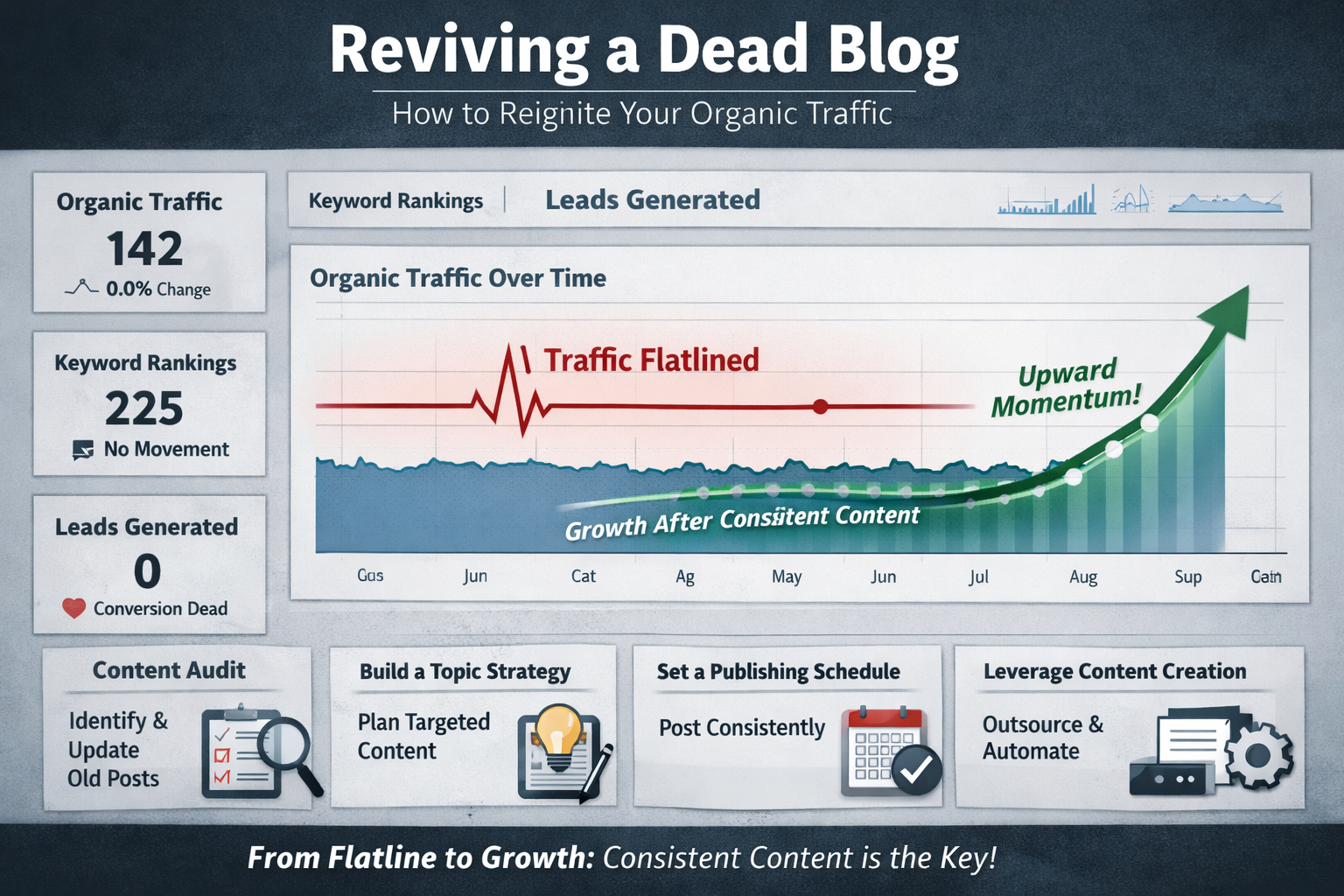
Every marketing leader knows the feeling. You pull up Google Analytics, hoping to see upward momentum. Instead, you see the same flat line you saw last month. And the month before that.
Organic traffic has stalled. Keyword rankings have plateaued—or worse, started slipping. Your competitors are publishing consistently, answering questions your potential customers are asking, and Google is rewarding them for it.
Meanwhile, your blog's last post is timestamped from six months ago.
This isn't a traffic problem. It's a content velocity problem. And it's costing you market share every single day you don't address it.
As HubSpot's research on blogging frequency demonstrates, companies that publish consistently see significantly more traffic than those publishing sporadically. Search engines favor websites that demonstrate ongoing relevance through consistent publishing. When your content cadence drops to zero, algorithms interpret that silence as a signal that your site may not be the most current or authoritative source on your topics.
The result? Your pages gradually slide down search results while more active competitors climb.
Why Most Blogs Stall Out
The intention is always there. Every business owner and marketing manager knows they should be publishing regularly. So why do so many blogs go dormant?
Time scarcity is the usual culprit. Between managing campaigns, analyzing data, and handling the dozen other fires that need putting out, content creation falls to the bottom of the priority list. Writing a quality blog post takes research, outlining, drafting, editing, and optimization. That's hours most teams simply don't have.
According to the Content Marketing Institute's B2B research, resource constraints remain one of the top challenges content marketers face year after year.
Inconsistent freelancer relationships don't help. You find a writer, brief them extensively, wait for drafts, send revision requests, and then they disappear. Starting over with someone new means rebuilding context from scratch. It's exhausting.
Topic fatigue sets in fast. Coming up with fresh, relevant ideas week after week is harder than it looks. Without a strategic keyword and topic bank, teams often default to writing about whatever comes to mind—which rarely aligns with what potential customers are actually searching for.
The perfectionism trap catches many. Waiting for the "perfect" post means nothing gets published. Meanwhile, competitors shipping good-enough content consistently are building authority that compounds over time.
The pattern is predictable. Initial enthusiasm leads to a few strong posts. Then frequency drops. Then gaps appear. Then the blog goes silent entirely.
The Hidden Cost of Content Gaps
When your blog sits idle, you're not just missing out on new traffic. You're actively bleeding market share to competitors who understand that content compounds.
Search visibility erodes. Google's algorithms increasingly favor topical authority—demonstrating comprehensive expertise across related subjects. A dormant blog can't build that depth. Each month without new content is a month your competitors extend their lead. Moz's SEO guide explains how consistent content signals relevance and authority to search engines.
Lead generation stalls. Organic traffic is often the highest-quality traffic. Visitors who find you through search are actively looking for solutions you provide. Without fresh content targeting relevant queries, that pipeline dries up.
Brand authority diminishes. In B2B especially, prospects research extensively before reaching out. A blog full of outdated posts signals a company that may not be keeping up with industry developments. First impressions form fast.
Paid advertising costs rise. When organic traffic flatlines, the pressure to compensate with paid channels increases. But ad costs keep climbing, and the moment you stop spending, that traffic vanishes. It's renting attention instead of owning it.
The businesses capturing market share right now aren't necessarily creating better content than you could. They're simply creating it more consistently.
How Often Should You Blog for SEO?
Let's define what "consistent" means in practical terms, because this is one of the most common questions marketing teams ask.
For most B2B companies, two to three quality posts per week creates meaningful momentum. Orbit Media's annual blogging survey found that bloggers who publish more frequently report stronger results—but only when quality remains high.
That frequency is enough to:
Signal ongoing activity to search engines
Cover a breadth of relevant topics over time
Build a content library that compounds in value
Capture emerging search opportunities while they're fresh
Each post should be:
Strategically selected based on keyword research and audience intent
Properly optimized with on-page SEO, internal links, and schema markup
Genuinely useful to readers, not just search engines
Published on schedule without gaps or excuses
This isn't about churning out volume for volume's sake. Low-quality content that nobody reads won't move the needle. But high-quality content published inconsistently won't either.
The magic happens at the intersection: valuable content delivered reliably, week after week.
How to Revive a Dead Blog: A Step-by-Step Process
Restarting a stalled content engine doesn't require heroics. It requires systems.
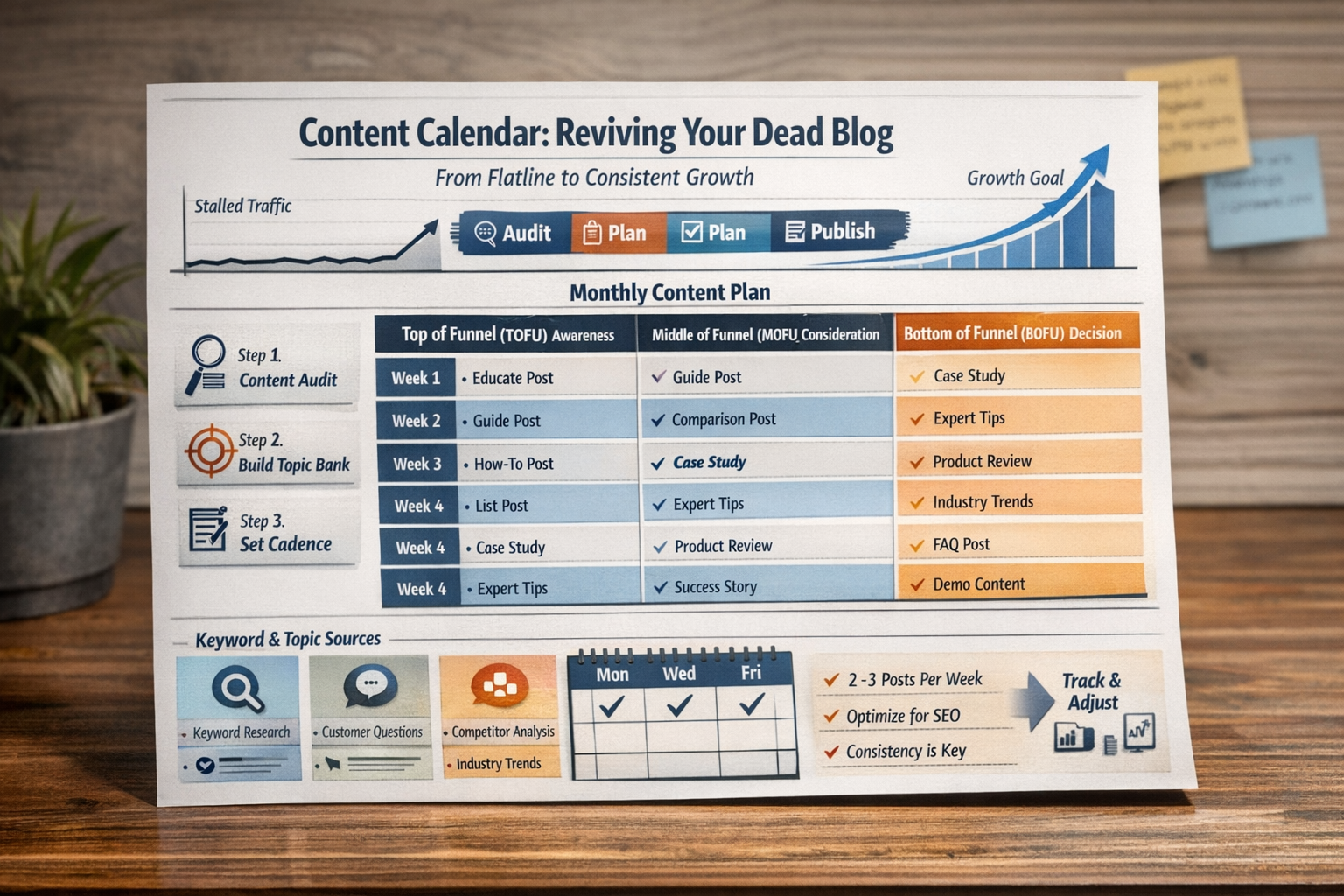
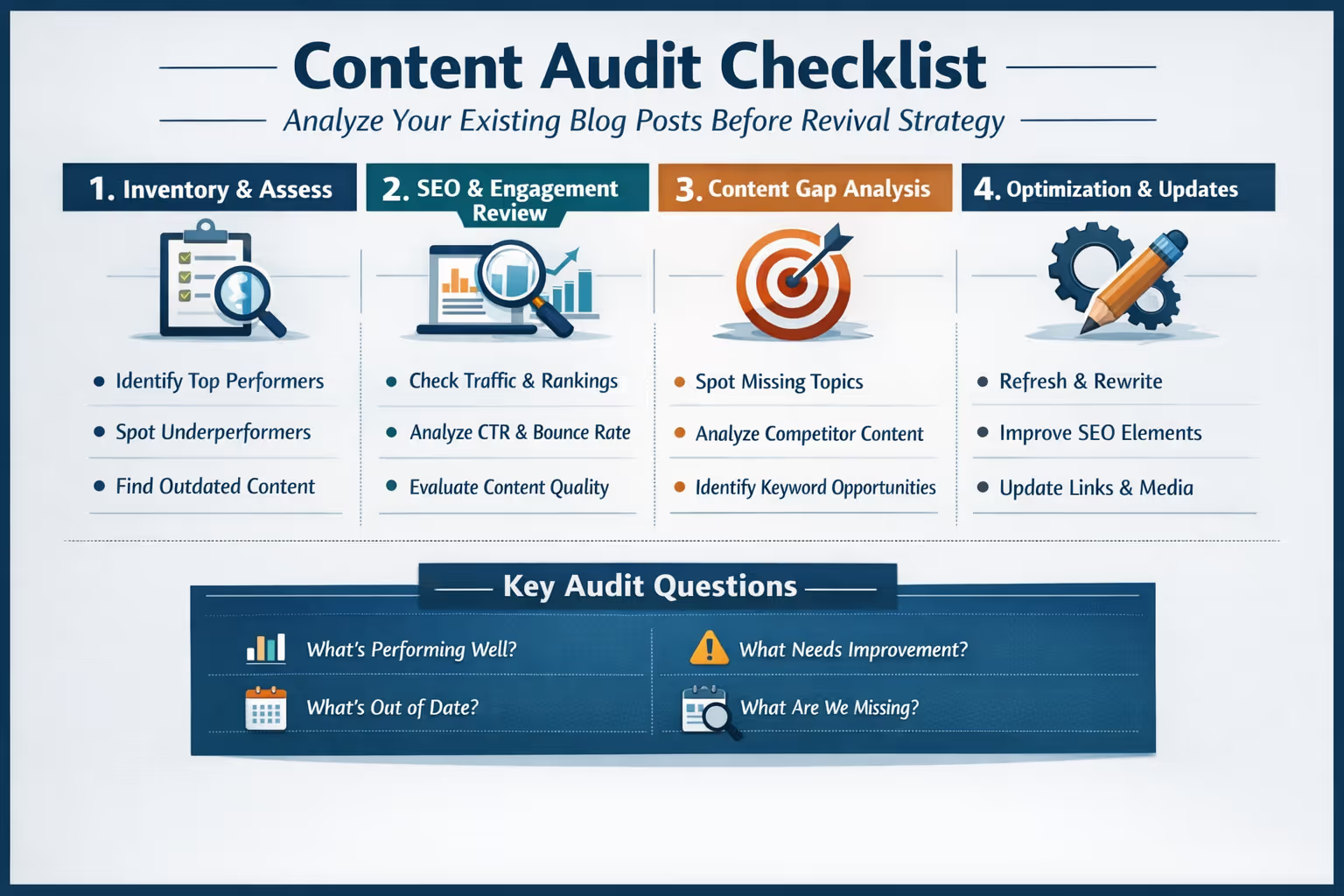
Step 1: Conduct a Content Audit
Before creating anything new, understand what you have. A proper content audit answers three critical questions:
What's still working? Open Google Search Console and identify posts that still generate impressions or clicks. These are assets worth protecting and potentially updating.
What's underperforming despite potential? Look for posts with high impressions but low click-through rates. These might need better titles, meta descriptions, or updated content to convert visibility into traffic.
What's completely outdated? Find posts with statistics from years ago, references to discontinued products, or advice that's no longer accurate. These either need significant updates or consolidation into fresher content.
Tools that help with this process include Google Search Console (free), Google Analytics, and SEO platforms like Ahrefs, SEMrush, or Ubersuggest.
This audit reveals gaps and opportunities. It also prevents duplicate efforts and ensures new content builds on existing strengths rather than starting from zero.
Step 2: Build a Strategic Topic Bank
Random content creation leads to random results. A topic bank—organized by search intent, keyword difficulty, and strategic priority—ensures every post serves a purpose.
Organize topics by funnel stage:
Top of Funnel (TOFU): Educational content for people just discovering the problem (e.g., "What is content velocity?")
Middle of Funnel (MOFU): Comparison and evaluation content for people exploring solutions (e.g., "In-house vs. outsourced content creation")
Bottom of Funnel (BOFU): Decision-stage content for people ready to act (e.g., case studies, product comparisons, pricing guides)
Pull topics from multiple sources:
Keyword research tools showing what your audience actively searches for
Customer questions and objections your sales team hears repeatedly
Competitor content gaps you can fill with better, more comprehensive answers
Industry trends worth addressing while they're relevant
Prioritize by impact potential:
Search volume (how many people are looking for this?)
Keyword difficulty (can you realistically rank?)
Business relevance (does this attract your ideal customer?)
Content gap (are competitors already dominating, or is there room?)
This bank becomes your publishing roadmap for months ahead, eliminating the "what should we write about?" paralysis that stalls so many teams.
Step 3: Establish a Sustainable Cadence
Pick a publishing frequency you can actually maintain. Two posts per week is better than promising five and delivering one.
Build this cadence into your operational workflow:
Assign clear ownership. Someone needs to be accountable for the content calendar, even if they're not writing every post.
Set non-negotiable deadlines. Treat content like any other business-critical deliverable—because it is.
Create a review process. Draft → Edit → Optimize → Publish. Know who handles each step.
Block time for content work. If it's not on the calendar, it won't happen.
The goal isn't perfection. It's consistency. A good post published beats a great post stuck in drafts.
Step 4: Consider Systematizing the Entire Process
For many teams, the most effective solution is removing content creation from the internal to-do list entirely.
Option A: Hire dedicated content staff. This works if you have budget for a full-time writer or content manager, plus the capacity to manage them effectively.
Option B: Build a reliable freelancer network. This requires significant time investment in finding, vetting, and coordinating multiple contractors.
Option C: Use a done-for-you content engine. A service that handles research, writing, optimization, and publishing on a fixed schedule frees your team to focus on strategy and growth.
As CI Web Group explains, automated content systems can keep a website publishing daily without requiring constant internal attention—making your site work harder than any single team member could.
This approach eliminates the bottlenecks that caused your blog to stall in the first place. No more chasing freelancers. No more wondering what to write about. No more weeks slipping by without a single new post.
The right choice depends on your resources, expertise, and how quickly you need to see results.
How Long Does It Take to Revive Organic Traffic?
Here's what most businesses underestimate: content compounds, but it takes time.
A single blog post published today might generate modest traffic initially. But if it's well-optimized and genuinely useful, it continues attracting visitors for months or years. Multiply that by two posts per week, fifty-two weeks per year, and the math changes dramatically.
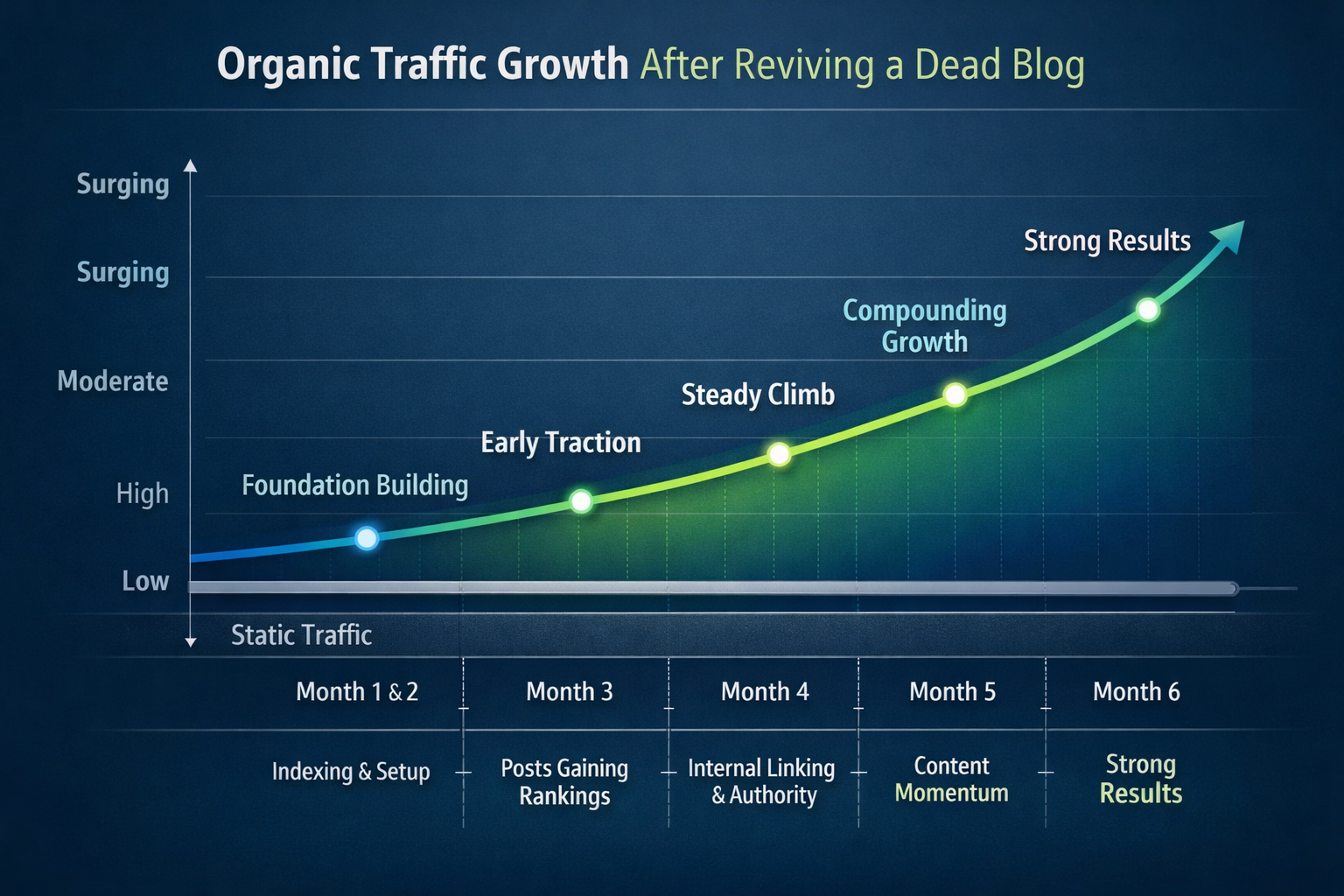
Typical timeline for consistent publishers:
Months 1-2: Foundation building. Posts get indexed, but traffic gains are minimal.
Months 3-4: Early traction. Some posts start ranking for long-tail keywords. Traffic begins climbing.
Months 5-6: Compounding begins. Your content library creates internal linking opportunities. Topical authority starts developing.
Months 6-12: Meaningful results. Most businesses see substantial improvements in organic impressions within the first year of consistent publishing.
After six months of consistent publishing, you're not competing with a handful of posts. You're competing with a library. Each piece reinforces the others, building topical authority that makes ranking for new keywords progressively easier.
Domain authority increases. Lead volume grows. Market share shifts.
The businesses dominating search results in your industry aren't smarter than you. They simply started earlier—and they never stopped.
The good news? Starting today means you're ahead of everyone who waits until tomorrow.
Your Next Move
Your blog has been parked long enough. The engine works fine. It just needs fuel.
Consistent, strategic content is that fuel. Without it, your website remains an underutilized asset—impressive on the surface, going nowhere in practice.
With it, you build an organic traffic engine that works continuously, capturing market share while competitors wonder why their rankings keep slipping.
The question isn't whether content marketing works. The question is whether you'll commit to the consistency required to make it work for you.
Ready to stop watching your traffic flatline? Book a strategy call to discuss how a done-for-you content engine can restart your organic growth—without adding more to your team's plate.
Frequently Asked Questions
How often should a business blog be updated for SEO in 2024?
Most businesses see meaningful results publishing two to three quality posts per week. This frequency signals ongoing activity to search engines while building topical authority across related subjects. The key is sustainable consistency—regular publishing over months matters far more than occasional bursts of activity followed by long gaps. Start with a cadence you can maintain, then scale up as you build systems.
Why does organic traffic flatline even with existing blog content?
Search algorithms favor fresh, comprehensive content. When publishing stops, your site signals reduced relevance compared to competitors actively adding new material. Additionally, search landscapes evolve constantly—topics you ranked for previously may now have more competition, your statistics become outdated, and new questions your audience asks remain unanswered on your site. Content requires ongoing investment to maintain rankings.
What's the difference between content quantity and content velocity?
Quantity measures total posts published. Velocity measures publishing pace over time. A blog with fifty old posts and no recent activity has quantity but zero velocity. Search engines increasingly reward velocity because it indicates a site actively maintaining relevance and authority. Both metrics matter, but velocity often determines who captures emerging opportunities first and signals to algorithms that your site deserves frequent crawling.
How long does it take to see results from consistent blog publishing?
Most businesses begin noticing measurable improvements in organic traffic within three to six months of consistent publishing. SEO compounds over time—early posts build foundation while newer content reinforces authority. Expect modest gains initially, with acceleration as your content library grows and search engines recognize your topical depth. The businesses seeing the best results commit to at least twelve months of consistent publishing.
Can outsourcing content creation match internal quality standards?
Yes, when structured properly. Effective content partners invest time understanding your audience, voice, and strategic goals before writing. They build topic banks based on keyword research and competitive analysis, then deliver drafts for your approval before publishing. This approach often produces more consistent quality than internal teams stretched thin across competing priorities, and eliminates the gaps that cause blogs to go dormant.
About This Content
This article was produced by The Mighty Quill's content team, combining deep expertise in SEO strategy and content marketing. With over fifteen years of experience in digital marketing—including hands-on work with SaaS companies, e-commerce brands, and growth-focused agencies—our team understands the operational challenges that cause blogs to stall and the systematic approaches that restart organic growth. We publish content designed to help businesses build sustainable visibility in an increasingly competitive search landscape.
Cited Works
HubSpot — "How Often Should You Blog? [New Benchmark Data]." https://blog.hubspot.com/marketing/blogging-frequency-benchmarks
Search Engine Journal — "How Often Should You Publish Blog Posts for SEO?" https://www.searchenginejournal.com/how-often-publish-blog-posts-seo/
Content Marketing Institute — "B2B Content Marketing Insights: 2024 Research." https://contentmarketinginstitute.com/articles/b2b-content-marketing-research
Moz — "The Beginner's Guide to SEO: Measuring & Tracking Success." https://moz.com/beginners-guide-to-seo
Orbit Media — "Blogging Statistics and Trends: The Survey of 1000+ Bloggers." https://www.orbitmedia.com/blog/blogging-statistics/
CI Web Group — "AI SEO Blogging & Automated Daily Blogging." https://www.ciwebgroup.com/services/blogging
The Mighty Quill — "Why 'Quantity over Quality' is Dead in AI Search." https://www.themightyquill.com/why-quantity-over-quality-is-dead-in-ai-search/