You've seen the pitch a dozen times: "Get free sample articles. See the quality for yourself."
But here's what actually happens. You receive those samples, skim them, think "Yeah, these look fine," and sign up. Three months later, the content isn't moving the needle, and you're not sure why.
The problem isn't the free trial. It's that most buyers have no systematic way to evaluate content quality beyond gut feel.
This 48-hour framework gives you a structured, repeatable scorecard for assessing sample articles before you commit to any content service. Use it on The Mighty Quill's free trial, use it on competitors, use it on your current provider. The criteria don't care who wrote the content—they measure what actually predicts performance.
Why Gut-Feel Evaluations Waste Money
Traditional content assessment usually sounds like this: Does it read well? Does it sound smart? Do I like the headline?
These questions aren't useless—but they're dangerously incomplete.
Research from the Content Marketing Institute shows that organizations using documented, measurable criteria for content see significantly higher success rates than those relying on subjective assessments [1]. Yet most buyers evaluate sample content the same way they'd judge a restaurant menu: "This looks appetizing enough."
The result? Misaligned expectations. Wasted budgets. The slow realization that "good writing" and "content that performs" are two very different things.
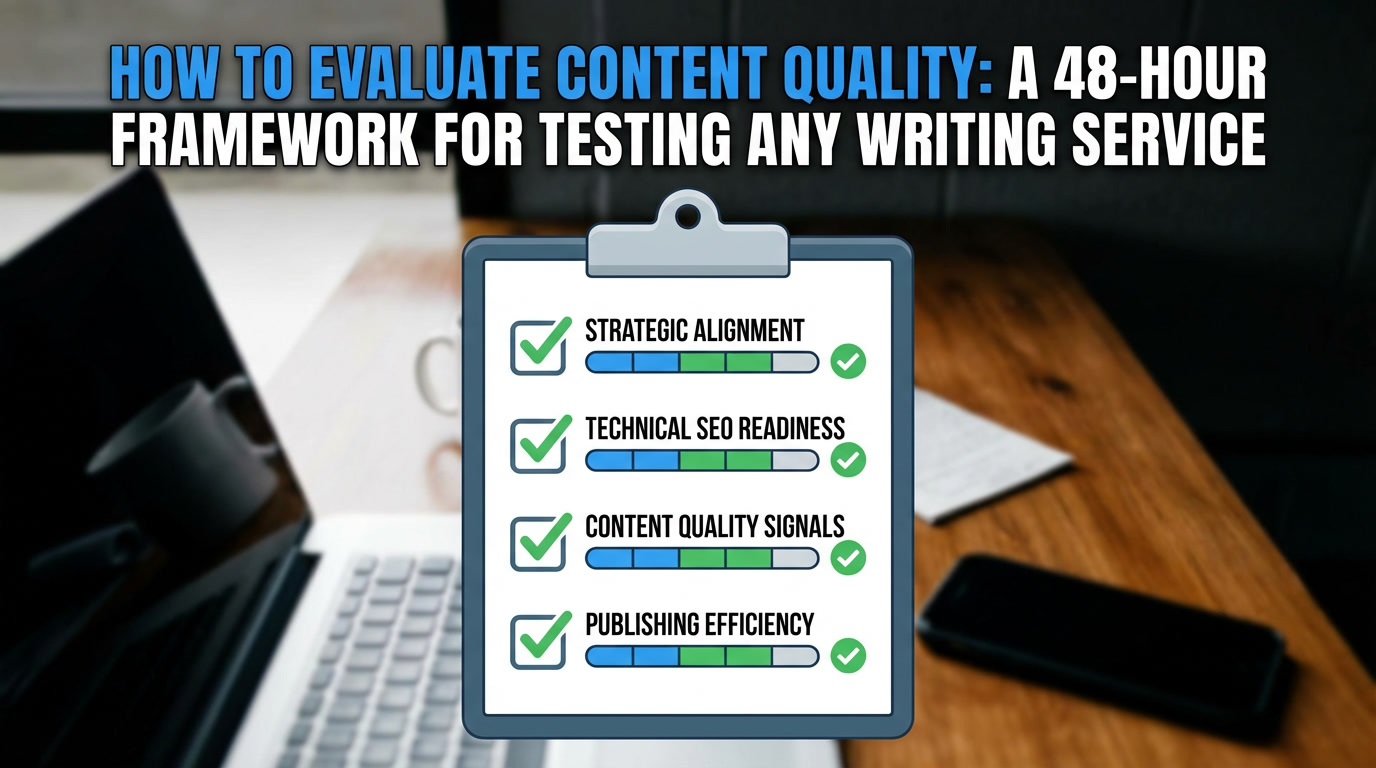
A proper evaluation framework measures what matters: strategic alignment, technical SEO readiness, content substance, and real-world publishing requirements.
The 48-Hour Content Quality Evaluation Framework
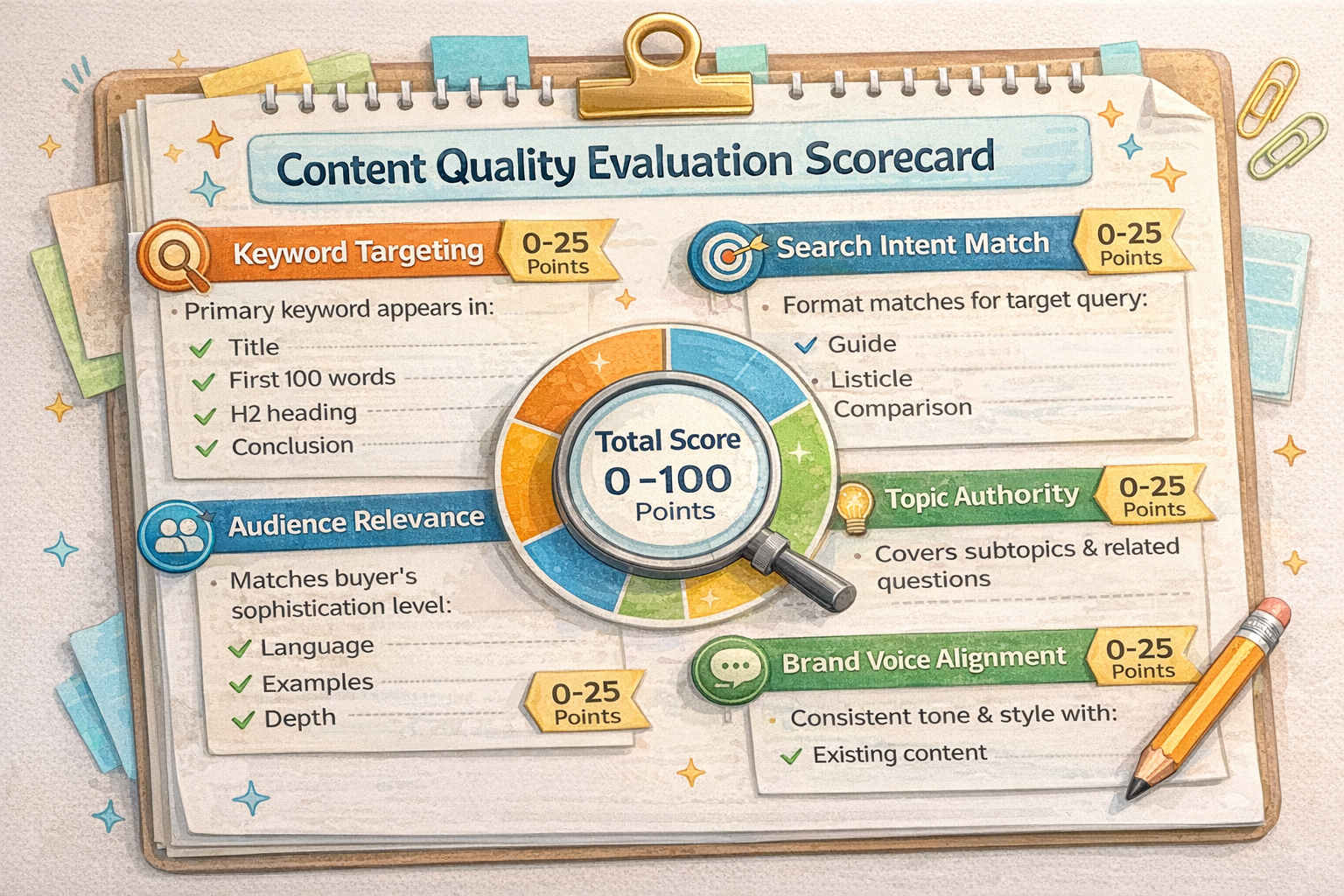
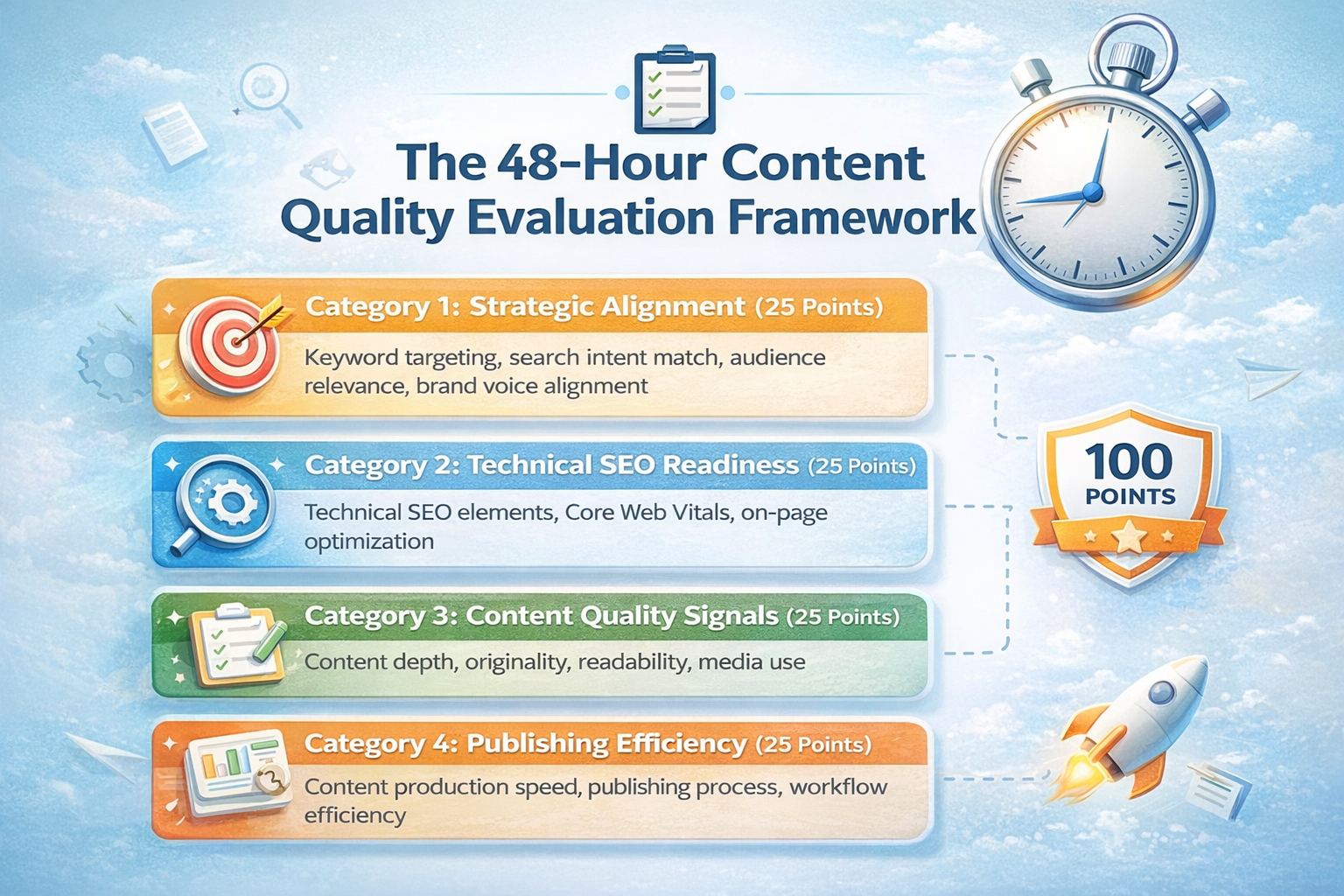
This framework breaks assessment into four categories worth 25 points each. Every criterion is observable and specific—no subjective impressions, no "I just feel like it's good."
Run every sample through this scorecard before signing anything.
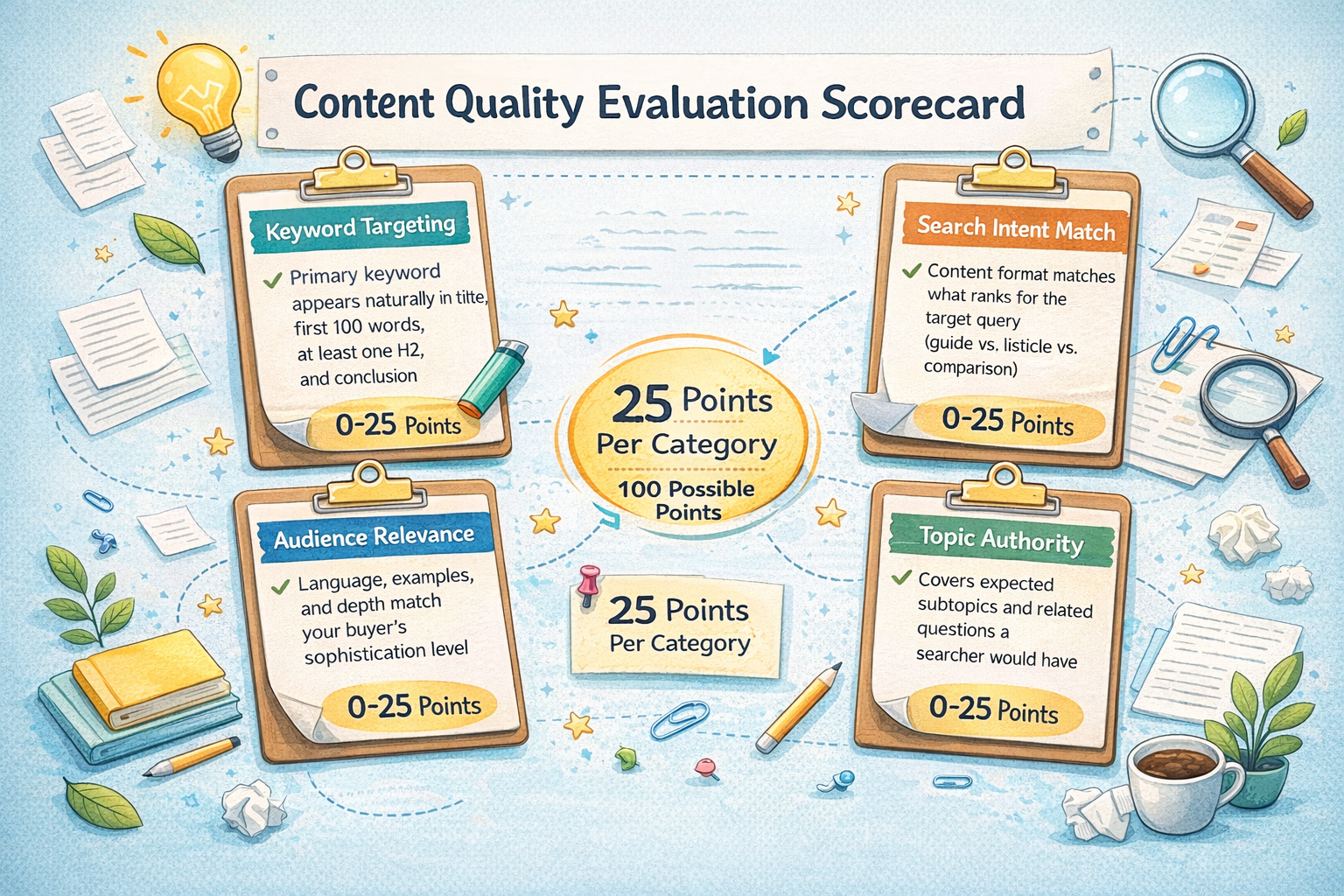
Category 1: Strategic Alignment (25 Points)
Strategic alignment determines whether the content actually serves your business goals or just fills space on your blog.
Scoring Criteria:
| Element | What to Look For | Points |
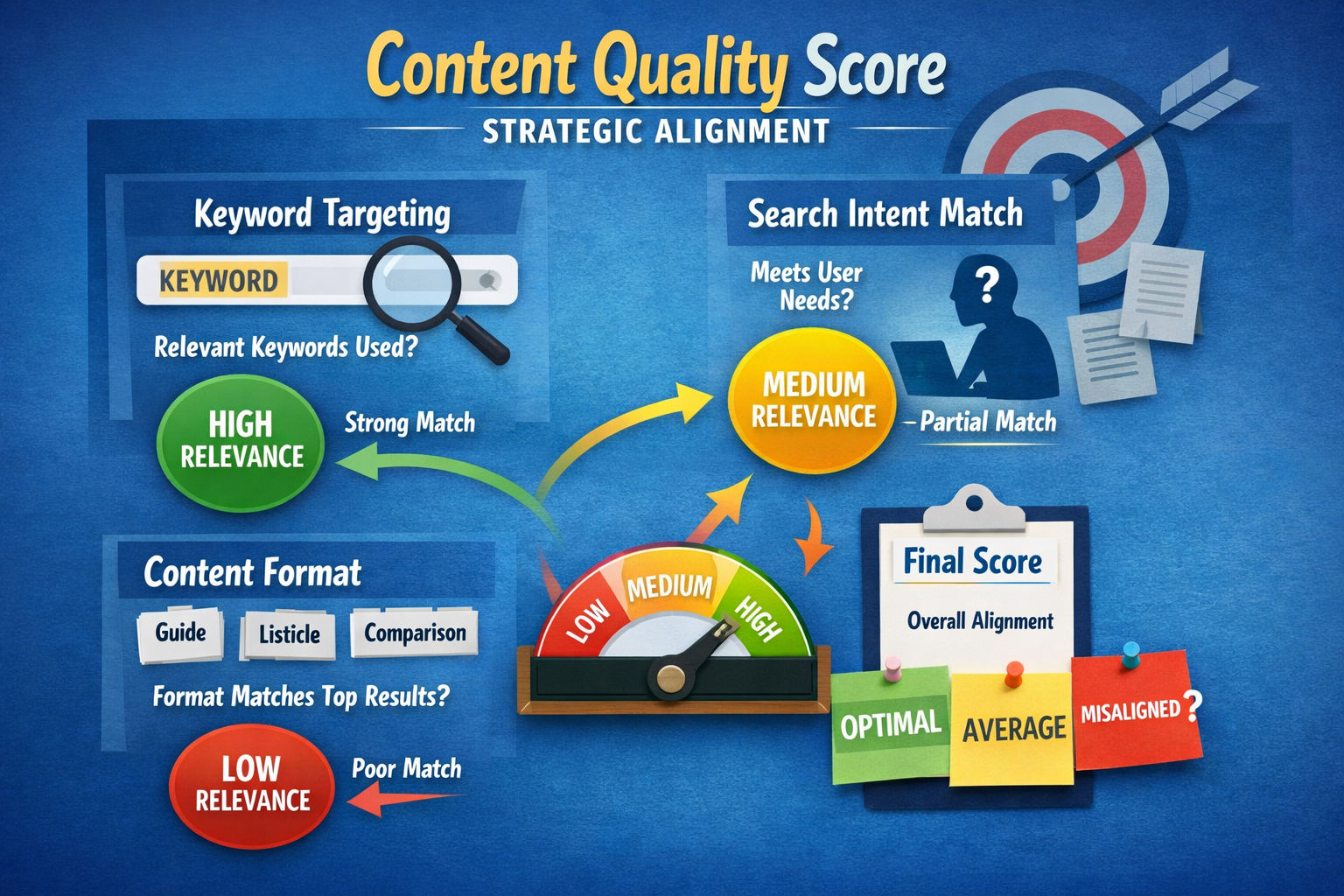
| Keyword targeting | Primary keyword appears naturally in title, first 100 words, at least one H2, and conclusion | 0-5 |
| Search intent match | Content format matches what ranks for the target query (guide vs. listicle vs. comparison) | 0-5 |
| Audience relevance | Language, examples, and depth match your buyer's sophistication level | 0-5 |
| Topic authority | Covers expected subtopics and related questions a searcher would have | 0-5 |
| Brand voice alignment | Tone and style feel consistent with your existing content | 0-5 |
How to evaluate:
Search your target keyword in Google. Compare the sample article's format and depth against the top three results. Does your sample answer the same core questions? Does it go deeper in meaningful ways?
Content that ignores what's already ranking is content that won't compete.
Category 2: Technical SEO Readiness (25 Points)
Great writing that isn't technically optimized is like a billboard facing a wall. Search engines need proper structure to understand, index, and rank your content.
Scoring Criteria:
| Element | What to Look For | Points |
| Header hierarchy | Clear H1 → H2 → H3 structure with logical flow | 0-5 |
| Meta readiness | Title tag and meta description either provided or easily extractable from content | 0-5 |
| Internal link opportunities | Content naturally references topics you already cover (or should cover) | 0-5 |
| Schema compatibility | FAQ sections, how-to steps, or other structured data opportunities present | 0-5 |
| URL/slug suggestion | Clean, keyword-focused URL structure recommended by the writer | 0-5 |
A note on technical elements: Writers provide inputs and recommendations for technical SEO—suggested slugs, meta descriptions, schema-ready formatting. Your CMS and technical team control the final implementation. Good content arrives with these recommendations baked in; great content makes implementation effortless.
Internal Links + Meta + Schema Readiness Checklist:
Before publishing any content, verify these elements are present or easily addable:
[ ] Title tag under 60 characters including primary keyword
[ ] Meta description between 150-160 characters with clear value proposition
[ ] At least 2-3 internal link opportunities to existing site pages
[ ] FAQ section with 3-5 questions (enables FAQ schema)
[ ] Clear step-by-step sections where applicable (enables HowTo schema)
[ ] Header tags used for structure, not just styling
[ ] Image alt text suggestions included for any recommended visuals
[ ] Suggested URL slug that's clean and keyword-focused
If your sample articles arrive without these elements—or at least clear notes on where they should go—you'll spend hours retrofitting every piece before it's publish-ready.
Category 3: Content Quality Signals (25 Points)
This category measures substance. Not whether you like the writing, but whether it demonstrates genuine expertise and provides real value.
Scoring Criteria:
| Element | What to Look For | Points |
| Specificity | Concrete examples, data points, or frameworks vs. vague generalities | 0-5 |
| Originality | Fresh angles or insights vs. rehashed common knowledge | 0-5 |
| Accuracy | Claims are verifiable and properly attributed when needed | 0-5 |
| Readability | Short paragraphs, clear sentences, easy to scan | 0-5 |
| Actionability | Reader can do something with this information | 0-5 |
Red flags that kill conversions:
Generic paragraphs: Content that could apply to any company in any industry signals zero expertise. If you could swap your competitor's name into the article without changing anything else, it's filler.
Zombie statistics: Data from years ago presented as current insight. "Studies show that 70% of buyers..." followed by a source from 2016 doesn't build credibility—it erodes it.
Obvious advice dressed as insight: "It's important to understand your audience" is not a content strategy. It's a placeholder for actual thinking.
AI pattern markers: Watch for repetitive sentence structures, overuse of transition phrases like "furthermore" and "moreover," and suspiciously perfect parallelism. Content should read like a knowledgeable human wrote it—because that's what builds trust.
Hedging everything: Content that never takes a position says nothing memorable. "Some experts believe X, while others argue Y" without any synthesis is a sign the writer doesn't actually understand the topic.
Quality content takes positions, provides evidence, and gives readers something they can use. Generic content hedges everything and disappears from memory the moment the tab closes.
Category 4: Publishing Efficiency (25 Points)
Even excellent content fails if it creates operational headaches. This category measures how much work stands between receiving a draft and clicking "Publish."
Scoring Criteria:
| Element | What to Look For | Points |
| Format consistency | Delivered in your preferred format (Google Doc, Word, CMS-ready) | 0-5 |
| Revision clarity | Easy to leave comments and request changes | 0-5 |
| Media guidance | Image suggestions, alt text, or visual placement notes included | 0-5 |
| Publishing instructions | Any special formatting or CMS notes provided | 0-5 |
| Turnaround predictability | Delivered when promised with clear communication | 0-5 |
A content service that delivers polished drafts requiring minimal intervention is worth significantly more than one that sends rough copy needing hours of cleanup—even if the raw writing quality is similar.
How to Use This Scorecard
Calculate your total score across all four categories (100 points maximum).
Interpreting Results:
85-100 points: Exceptional quality. This provider understands both content strategy and execution. Move forward with confidence.
70-84 points: Strong foundation with room for improvement. Discuss specific gaps before committing to identify whether they're fixable or fundamental.
55-69 points: Significant concerns. The content may require substantial rework to meet your standards. Proceed cautiously or request additional samples.
Below 55 points: Major red flags. Either this provider isn't the right fit, or there's a serious misalignment in expectations. Don't commit based on hope.

Beyond the Score: Questions Worth Asking
Numbers tell part of the story. Before signing any agreement, these questions reveal whether a content partner will actually work for your specific situation.
Ask about process:
How do you determine topic priorities?
What happens if I don't approve a draft?
How do you handle industry-specific terminology or technical accuracy?
Ask about outcomes:
Can you share examples of content that's actually ranking for other clients?
What does your typical client see after 90 days of consistent publishing?
How do you measure success beyond just delivering articles?
Ask about fit:
What types of clients do you work best with?
What would make us a bad fit for your service?
How do you handle feedback and revisions?
Providers who answer these questions directly—with specifics rather than vague assurances—tend to deliver better results. Evasion is information.
The Real Test: Consistency Over Time
A 48-hour evaluation framework helps you avoid obvious mismatches. But the true test of any content service is what happens over months, not days.
According to Ahrefs research, content typically takes three to six months to reach its ranking potential [2]. That means your initial evaluation should focus less on immediate perfection and more on identifying a provider capable of sustained quality.
Ask yourself: Based on these samples, do I trust this provider to deliver at this level 50 times in a row?
Because that's what consistent content marketing actually requires.
Making the Framework Work for You
Download or recreate this scorecard before requesting your next batch of sample articles. Run every sample through the same criteria, regardless of provider.
This approach accomplishes three things:
Removes subjective bias. You're measuring observable criteria, not gut reactions.
Creates accountability. Providers who know you're evaluating systematically tend to deliver better work.
Establishes baselines. When you do commit to a service, you have documented expectations to reference.
The goal isn't finding content that scores 100/100. The goal is finding content that consistently scores high enough to move your business forward—and a provider relationship structured to maintain that standard.
Start With a Real Test
Ready to put this framework into practice?
Request two free sample articles from The Mighty Quill, delivered within 48 hours. Run them through this scorecard. See exactly where they land.
If the samples score well, you'll have confidence that consistent publishing will actually compound your organic visibility. If they don't, you've invested nothing but an email address.
Try for Free → Get 2 custom articles in 48 hours. Evaluate them properly. Then decide.
Frequently Asked Questions
What makes this evaluation framework different from just reading sample articles?
This framework uses objective, measurable criteria instead of subjective impressions. Rather than asking "Do I like this?" you're measuring specific elements like keyword placement, technical SEO readiness, and publishing efficiency. These criteria predict actual performance because they're based on what search engines and readers respond to—not what feels good in the moment.
How long should I spend evaluating each sample article?
Plan for 15-20 minutes per article when using this framework thoroughly. The first evaluation takes longest as you familiarize yourself with the criteria. Subsequent evaluations become faster. Investing this time upfront prevents months of frustration with content that looked good but didn't perform.
Can I use this framework to evaluate my existing content?
Absolutely. Running your current content through this scorecard often reveals why certain pieces underperform. Many teams discover their existing content scores poorly on technical SEO readiness or strategic alignment—gaps that explain stagnant organic traffic despite regular publishing.
What's the minimum acceptable score for moving forward with a content provider?
For most businesses, 70 points represents a reasonable threshold. Below that, you'll likely spend significant time compensating for content gaps. However, consider which categories matter most to your situation. A company with strong internal editing might accept lower publishing efficiency scores, while a team without SEO expertise needs higher technical readiness scores.
How do I know if poor sample quality reflects the provider or just a bad brief?
Request a second round of samples with a more detailed brief. Quality providers improve significantly with better input. If scores remain low despite clear direction, the issue is capability, not communication. This distinction matters because the right provider with the right information produces dramatically different results.
About This Guide
This framework was developed by The Mighty Quill, an AI-powered content engine serving SaaS companies, e-commerce brands, and marketing agencies. Our team combines over 15 years of digital marketing experience with systematic content production processes designed to deliver measurable organic growth. We publish this evaluation framework because informed buyers make better partners—and because our content consistently scores well when measured objectively.
Sources
[1] Content Marketing Institute — "B2B Content Marketing Research: Benchmarks, Budgets, and Trends." https://contentmarketinginstitute.com/research/
[2] Ahrefs — "How Long Does It Take to Rank in Google?" https://ahrefs.com/blog/how-long-does-it-take-to-rank/