Your blog traffic is flatlining—and it's not because you're publishing less. It's because you're optimizing for a search engine that doesn't exist anymore.
Google's AI Overviews now appear in a significant portion of search results, pulling answers directly from web content and displaying them before traditional blue links [1]. For businesses relying on organic traffic, this shift demands a new question: is your content subscription actually built to compete in this environment?
Most "best blog writing services" listicles miss the point entirely. They compare pricing tiers and turnaround times while ignoring the technical requirements that determine whether your content gets cited by AI systems—or buried beneath them.
This guide is different. It's a practical evaluation framework for choosing a GEO-ready blog content subscription, focused on the specific capabilities that matter for Generative Engine Optimization: schema implementation, citation practices, approval workflows, and publishing protocols.
Why Traditional Blog Services Fall Short in the AI Search Era
The content subscription you hired two years ago probably wasn't designed for today's search landscape. Here's what changed.
Google's AI Overviews synthesize information from multiple sources and present consolidated answers at the top of search results pages [1]. These AI-generated summaries often answer user queries directly, reducing clicks to individual websites unless that content is deemed authoritative enough to cite.
Traditional blog services optimized for keyword density and word count. That approach produced content that ranked through sheer volume. But AI systems evaluate content differently. They look for:
Clear, direct answers to specific questions
Structured information that's easy to extract
Citations and sources that verify claims
Schema markup that helps machines understand context
A content subscription that doesn't address these factors is optimizing for a version of search that no longer exists.
We learned this the hard way. Watching client traffic plateau despite consistent publishing forced us to rebuild our entire approach around what AI systems actually reward—not what worked in 2021.
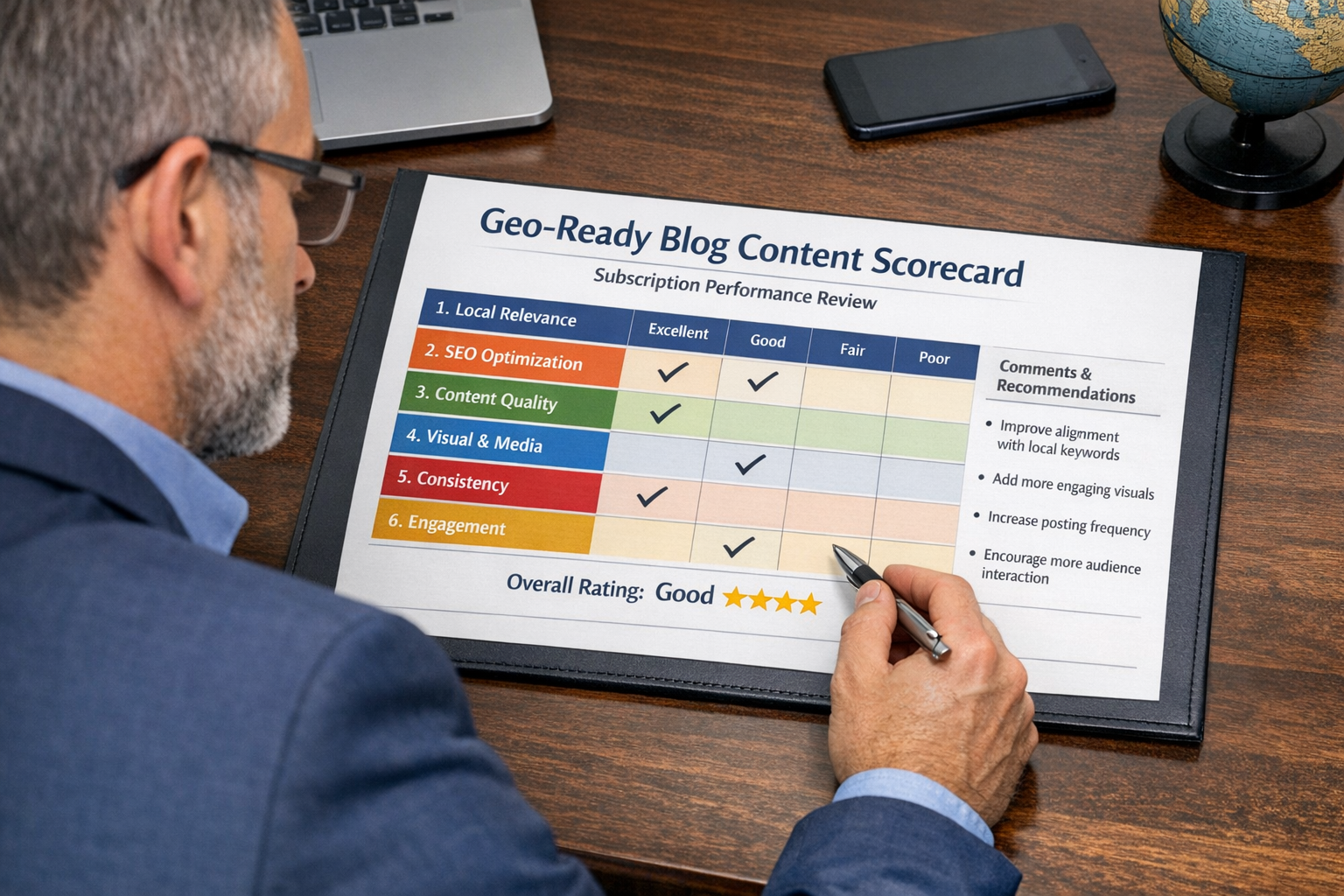
The GEO-Ready Content Subscription Scorecard
Use this framework to evaluate any blog content subscription you're considering. Score each capability from 0–3 (0 = not offered, 1 = basic, 2 = solid, 3 = excellent), then total your results.
Tip: Print this scorecard or keep it open during vendor calls. The questions below are designed to reveal whether a service has genuinely adapted—or is just using new terminology for old practices.
Schema and Structured Data Implementation
What to look for: Does the service implement FAQ schema, HowTo schema, Article schema, and other relevant structured data markup on every piece of content?
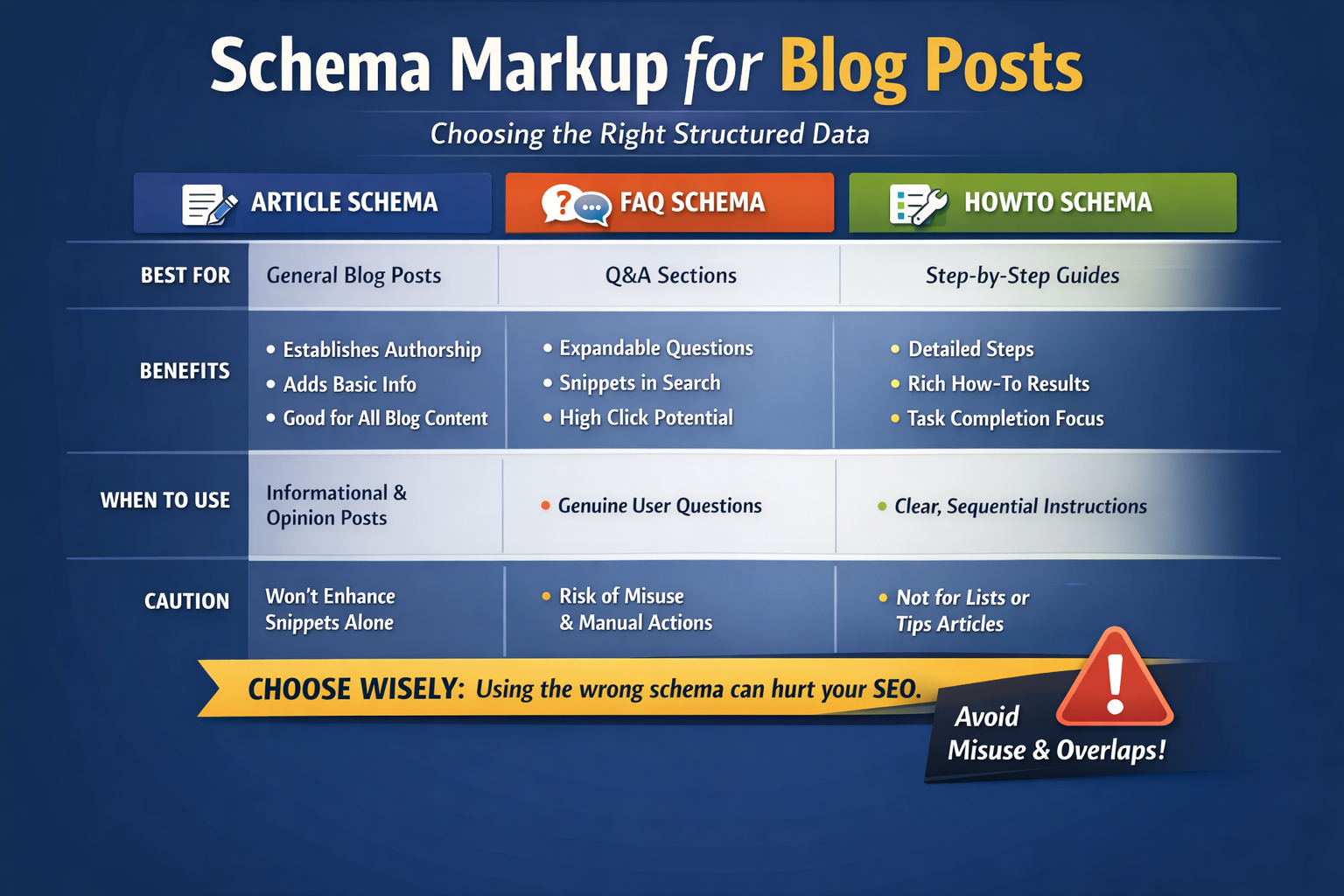
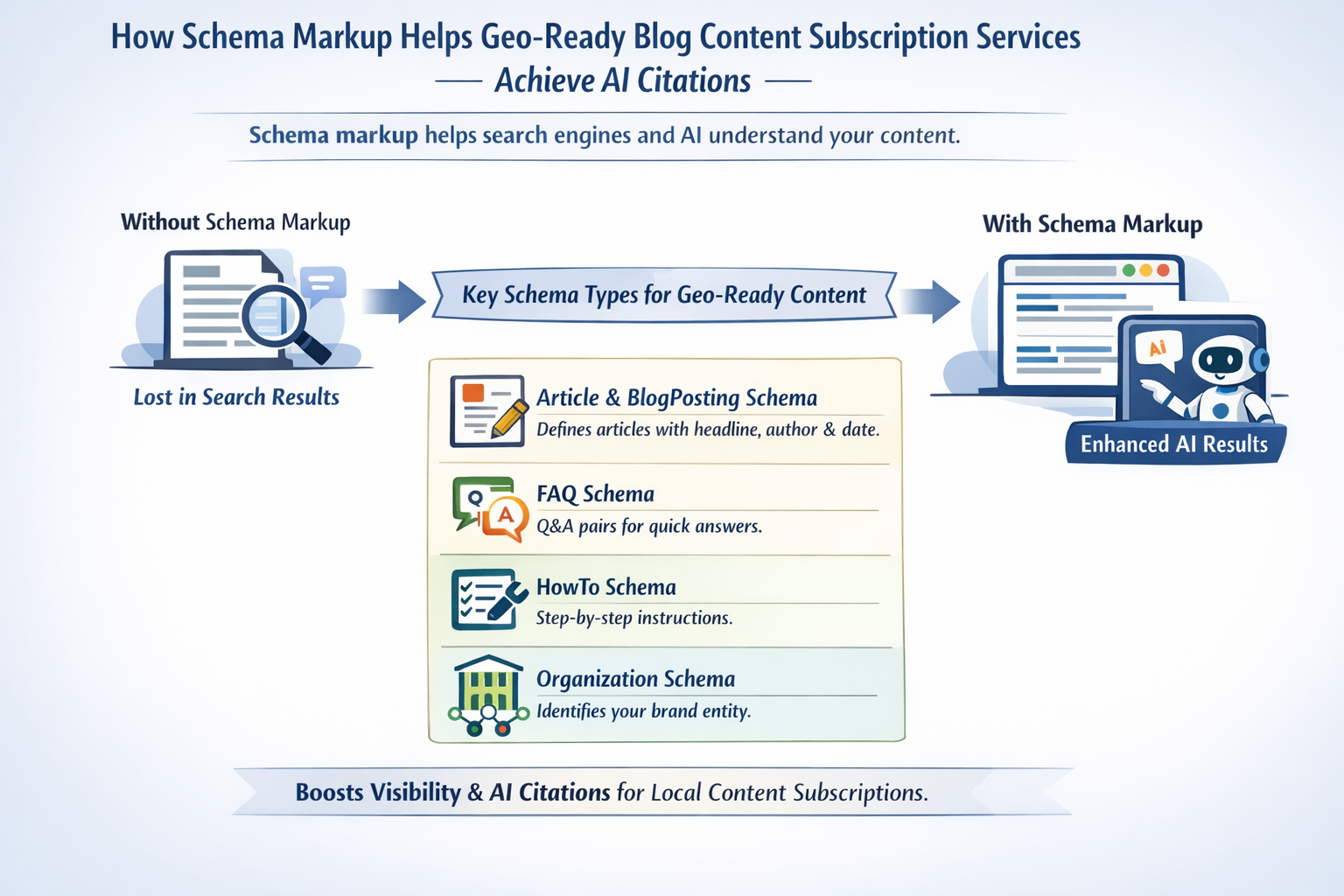
Schema markup helps search engines and AI systems understand the structure and meaning of your content [2]. Without it, even well-written articles may not surface in featured snippets or AI-generated answers.
Specific schema types that matter:
Article or BlogPosting schema: The baseline. Tells search engines this is editorial content with a headline, author, and publish date.
FAQ schema: Structures question-and-answer pairs so AI systems can extract them directly.
HowTo schema: Marks up step-by-step instructions for procedural content.
Organization schema: Establishes your brand entity for knowledge graph connections.
Questions to ask vendors:
Do you implement schema markup on every article, or is it an add-on?
Which schema types do you use, and how do you decide which applies?
Do you validate schema before publishing to catch errors?
How do you handle schema updates when Google changes requirements?
Red flags: Services that don't mention schema at all, or that charge extra for "technical SEO" without specifying what's included.
Scoring guide:
| Score | Criteria |
| 0 | No schema implementation |
| 1 | Basic Article schema only |
| 2 | Multiple schema types, implemented consistently |
| 3 | Comprehensive schema strategy with validation and monitoring |
Citation Practices and Source Quality
What to look for: Does the service cite authoritative sources, and do they have a documented process for verifying claims?
AI systems increasingly evaluate content trustworthiness based on citation quality [3]. Content that makes claims without sources, or that cites low-quality sources, is less likely to be featured in AI Overviews.
Questions to ask vendors:
What's your process for fact-checking and sourcing claims?
Do you use inline citations, and what format do you follow?
What source tiers do you consider authoritative?
How do you handle topics where authoritative sources are limited?
Red flags: Services that promise high volume without mentioning research or sourcing processes. Content mills often prioritize speed over accuracy.
Scoring guide:
| Score | Criteria |
| 0 | No citations or sourcing process |
| 1 | Occasional citations, inconsistent sourcing |
| 2 | Regular citations from documented source tiers |
| 3 | Rigorous fact-checking with tiered sourcing hierarchy |
Internal Linking and Site Architecture
What to look for: Does the service understand your site structure and implement strategic internal links that strengthen topical authority?
Internal links help search engines understand the relationship between your content pieces and identify your site's areas of expertise [4]. For AI systems evaluating topical authority, strong internal linking signals depth of coverage.
Questions to ask vendors:
Do you review our existing content before creating new pieces?
How do you identify internal linking opportunities?
Do you create content clusters around core topics?
How do you handle linking to commercial pages versus informational content?
Red flags: Services that deliver isolated articles with no consideration for existing site content or overall content strategy.
Scoring guide:
| Score | Criteria |
| 0 | No internal linking strategy |
| 1 | Basic links added without strategic consideration |
| 2 | Intentional linking based on site structure |
| 3 | Comprehensive topical clustering with documented link strategy |
Approval Workflow and Quality Control
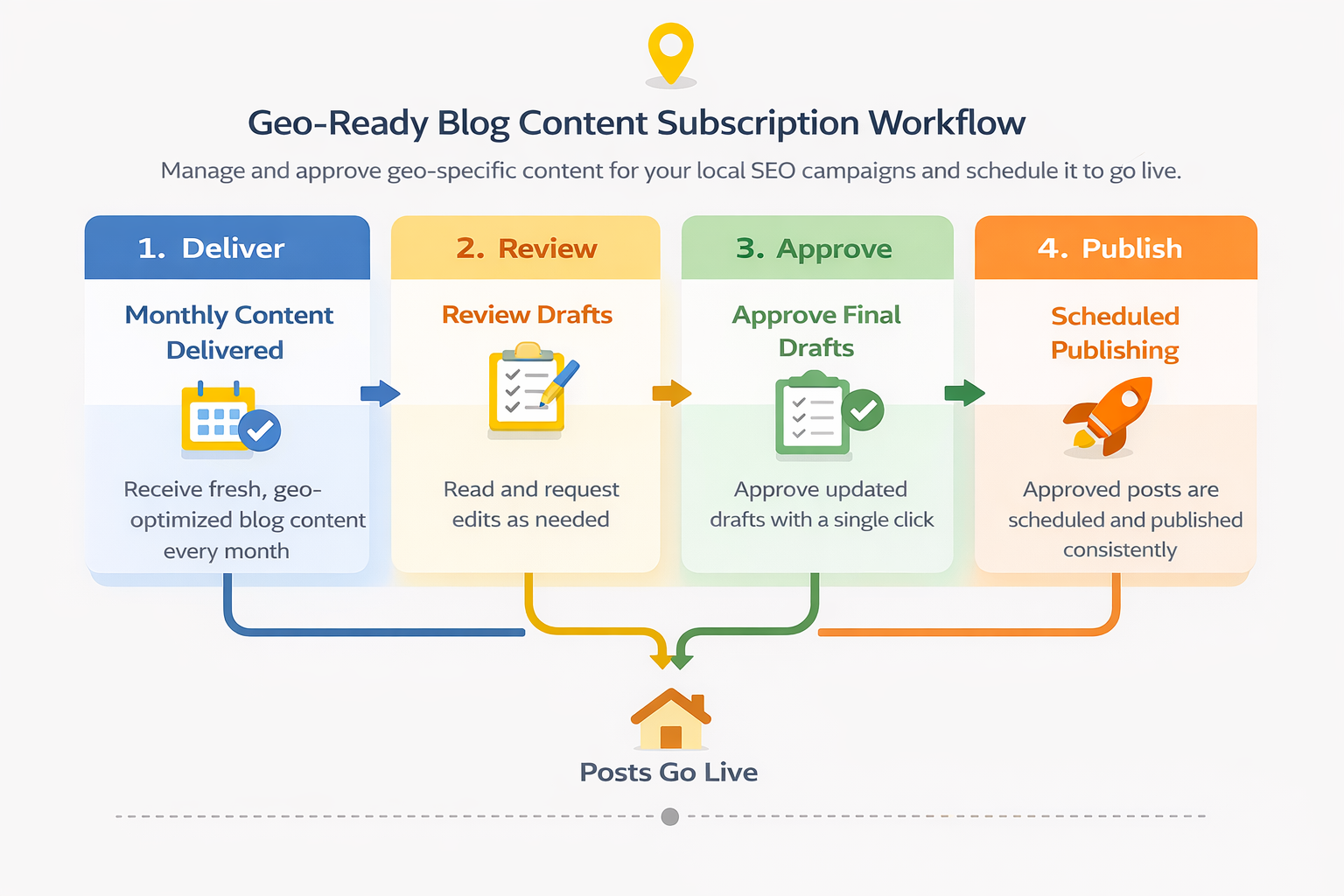
What to look for: Does the service have a clear approval process that gives you control without creating bottlenecks?
Content quality directly impacts AI citation likelihood. A service without a structured review process is gambling with your brand reputation and search visibility.
Questions to ask vendors:
What does your approval workflow look like?
How many revision rounds are included?
Do you have human editors review AI-generated drafts?
How quickly can we approve or request changes?
Red flags: Services with no approval step (articles go live automatically) or excessively complicated approval processes that slow publishing cadence.
Scoring guide:
| Score | Criteria |
| 0 | No approval process |
| 1 | Basic approval with limited revision options |
| 2 | Clear workflow with reasonable revision rounds |
| 3 | Streamlined approval with one-click options and fast turnaround |
Publishing Cadence and Consistency
What to look for: Does the service maintain a predictable publishing schedule that builds topical authority over time?
Consistent publishing signals to search engines that your site is active and authoritative [5]. Sporadic content—three posts one week, nothing for a month—undermines this signal.
Questions to ask vendors:
What publishing frequency do you recommend for our goals?
How do you handle scheduling and calendar management?
What happens if we need to pause or adjust the schedule?
Do you publish directly to our CMS, or do we handle that?
Red flags: Services that don't commit to specific publishing frequencies or that require you to manage all scheduling and uploading.
Scoring guide:
| Score | Criteria |
| 0 | No consistent publishing schedule |
| 1 | Flexible but inconsistent cadence |
| 2 | Predictable schedule with some flexibility |
| 3 | Guaranteed cadence with done-for-you publishing |
AI Overview Optimization
What to look for: Does the service specifically optimize content for AI-generated search results, not just traditional rankings?
This is the critical differentiator. Services that haven't adapted their approach for Generative Engine Optimization are optimizing for yesterday's search landscape.
Questions to ask vendors:
How do you structure content to increase AI Overview citation likelihood?
Do you optimize for conversational queries that trigger AI-generated answers?
How do you balance traditional SEO with GEO requirements?
Can you show examples of client content that's been cited in AI Overviews?
Red flags: Services that haven't updated their process for AI search features, or that claim AI Overviews don't affect their approach.
Scoring guide:
| Score | Criteria |
| 0 | No GEO-specific optimization |
| 1 | Awareness of AI search but no documented approach |
| 2 | Specific GEO tactics incorporated into content process |
| 3 | Proven track record of AI Overview citations with documented methodology |
How to Interpret Your Scorecard Results
Total possible score: 18
Before diving into the detailed categories, use this quick reference to understand where any vendor falls:
| Score Range | Verdict | Recommendation |
| 15–18 | GEO-Ready | Proceed with confidence; review results quarterly |
| 10–14 | Partially Ready | Identify weak areas; determine if gaps are acceptable |
| 5–9 | Significant Gaps | Likely optimizing for outdated search; cost savings may not be worth opportunity cost |
| 0–4 | Not Recommended | Service hasn't adapted to fundamental search changes |
What GEO-Ready Content Actually Looks Like
Beyond the scorecard, here's what distinguishes content built for AI citation from content that merely fills a blog.
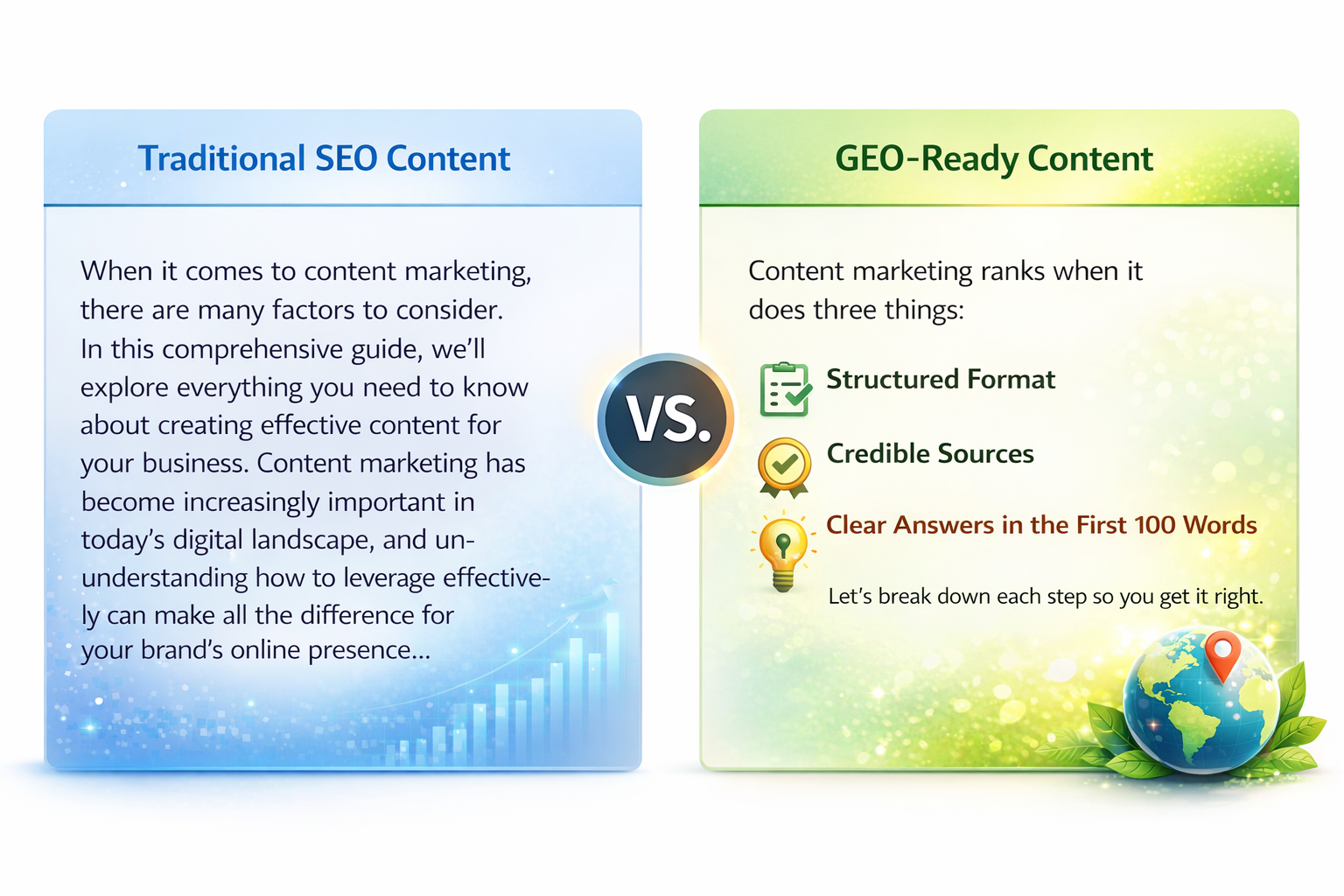
Side-by-Side Comparison
Traditional SEO content (optimized for 2020):
"When it comes to content marketing, there are many factors to consider. In this comprehensive guide, we'll explore everything you need to know about creating effective content for your business. Content marketing has become increasingly important in today's digital landscape, and understanding how to leverage it effectively can make all the difference for your brand's online presence..."
GEO-ready content (optimized for AI citation):
"Content marketing drives results when it answers specific questions clearly. The three factors that determine whether AI systems cite your content: structured formatting, authoritative sources, and direct answers in the first 100 words. Here's how each works."
Notice the difference. The first buries information in filler. The second leads with the answer, uses specific numbers, and signals structure immediately.
Key Characteristics of GEO-Ready Content
Clear, direct answers in the first 100 words. AI systems often pull answers from early paragraphs. Content that buries the answer after extensive setup is less likely to be cited.
Structured formatting with descriptive headers. H2 and H3 tags that clearly describe section content help AI systems identify relevant passages for specific queries.
Concise paragraphs focused on single ideas. Long, meandering paragraphs are harder for AI systems to extract useful information from.
Explicit expertise signals. Author credentials, company background, and clear statements of experience help establish E-E-A-T (Experience, Expertise, Authoritativeness, Trustworthiness) [6].
Question-and-answer formatting where appropriate. FAQ sections and Q&A structures align well with how AI systems match content to user queries.
The Cost of Choosing Wrong
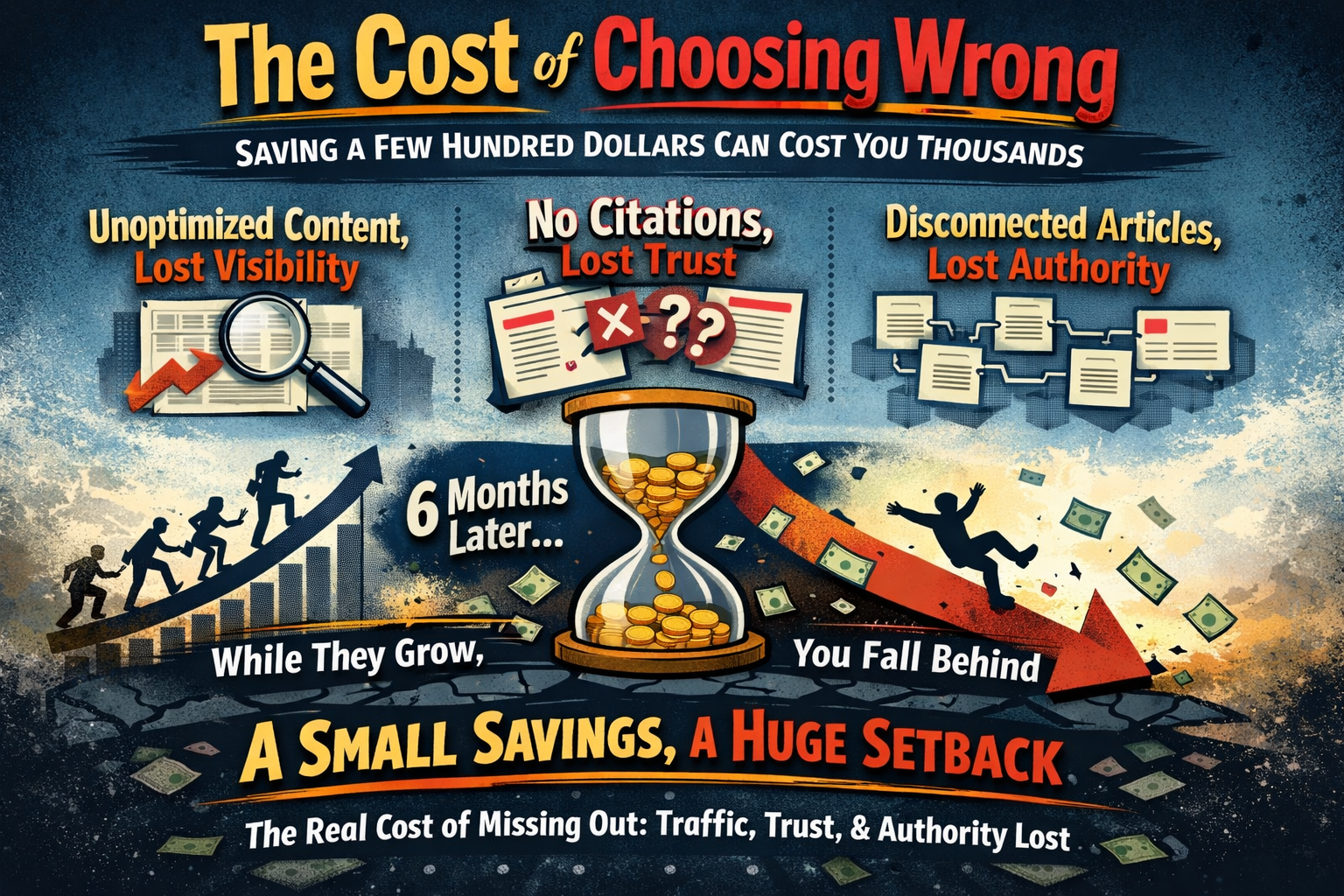
Selecting a content subscription that isn't GEO-ready has compounding consequences.
Every article published without proper schema is a missed opportunity for enhanced search visibility. Every uncited claim is a trust signal you're not sending. Every isolated article without internal links is a failure to build topical authority.
Over six months, that adds up. While competitors accumulate AI citations and compound their organic traffic, your content investment generates diminishing returns.
The price difference between a basic content service and a GEO-ready one is typically modest—often a few hundred dollars per month. The opportunity cost of choosing wrong is significantly higher.
Questions Most Buyers Forget to Ask
Beyond the scorecard categories, these questions reveal how seriously a service takes content quality:
"What happens when Google updates its AI features?"
Good answer: We monitor search updates and adjust our approach accordingly.
Bad answer: We don't worry about that—we focus on fundamentals.
"Can I see examples of content you've published that ranks for competitive terms?"
Good answer: Here are three examples with performance data.
Bad answer: We don't track that / our clients keep that confidential.
"How do you handle topics outside your writers' expertise?"
Good answer: We have a research process and subject matter review for specialized topics.
Bad answer: Our writers are generalists who can write about anything.
"What's your refund or cancellation policy?"
Good answer: Clear terms with reasonable flexibility.
Bad answer: Vague or nonexistent policy.
Building Your Evaluation Shortlist
Start your search with these practical steps:
Identify 3–5 potential services through referrals, reviews, or search
Request a discovery call or trial with each
Use the scorecard during each conversation
Request sample content (ideally on a topic relevant to your business)
Evaluate samples for schema, citations, structure, and readability
Compare total scores and make your decision
The trial period is critical. Any service confident in their capabilities should offer a low-risk way to evaluate their work before committing to a long-term subscription.
Grade Our Work Using This Exact Rubric
The Mighty Quill offers a free trial—two ready-to-publish articles within 48 hours—so you can apply this scorecard to real content before making a decision.
Don't just take our word for it. Use the checklist above as your evaluation rubric. Score our schema implementation. Check our citations. Evaluate our structure. If we don't measure up, you'll know exactly why—and you'll have lost nothing but a few minutes of your time.
Frequently Asked Questions
What is Generative Engine Optimization (GEO)?
Generative Engine Optimization is the practice of creating content specifically designed to be cited by AI-powered search features like Google's AI Overviews. It builds on traditional SEO but adds emphasis on structured data, clear answers, authoritative citations, and formatting that AI systems can easily parse and reference. The goal is visibility in AI-generated summaries, not just traditional blue links.
How often should a content subscription publish for best results?
Most businesses see meaningful results with two to three articles per week, published consistently over at least three to six months. Consistency matters more than volume—publishing sporadically undermines the compounding effect that builds topical authority over time. A predictable cadence signals to search engines that your site is actively maintained and authoritative.
Can AI-generated content rank in AI Overviews?
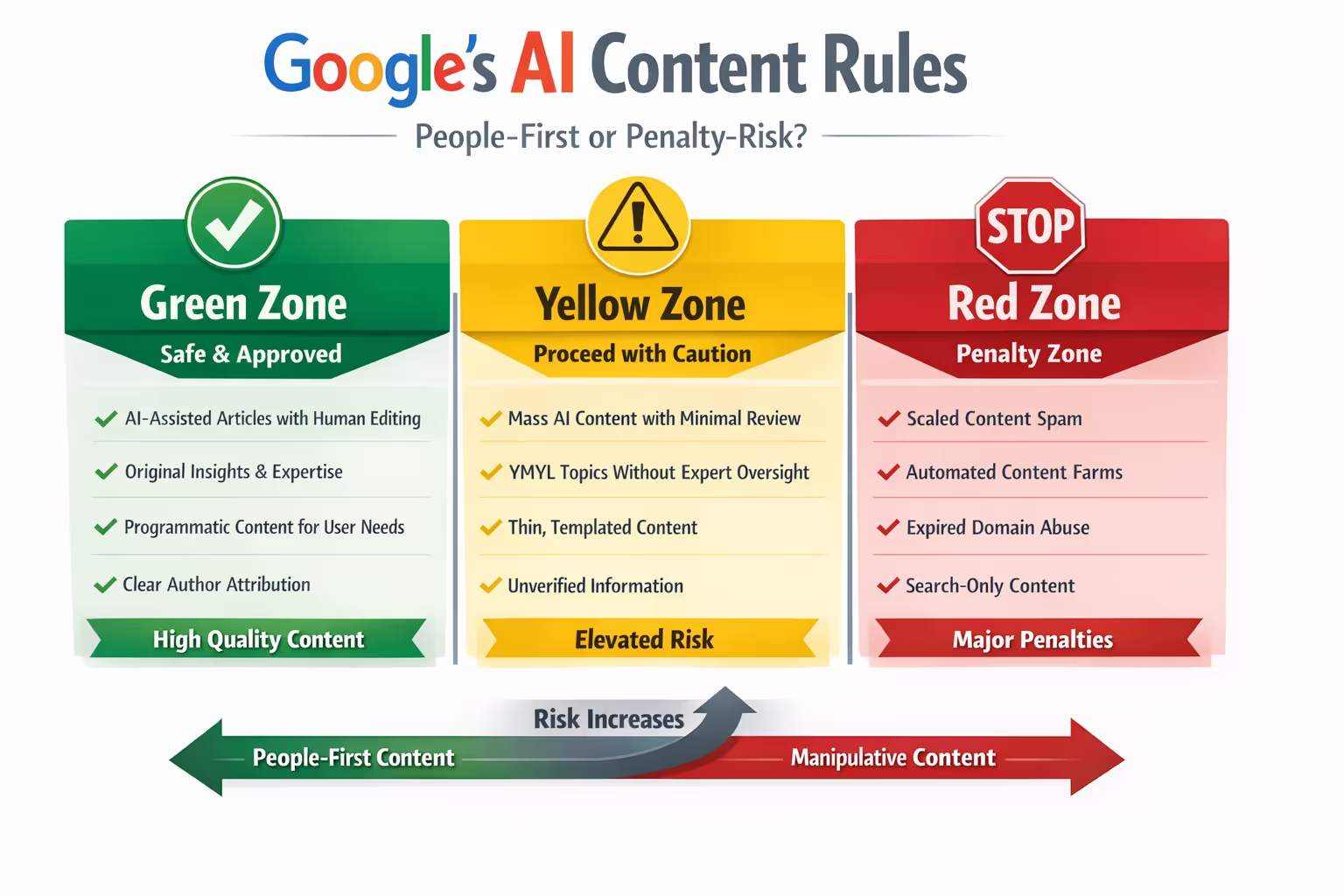
Yes, but quality matters significantly. AI-generated content that's been reviewed by humans, properly structured, and thoroughly cited can perform well. Content that's obviously machine-generated without editing typically underperforms because it lacks the depth and accuracy that AI systems prioritize when selecting sources to cite.
How long does it take to see results from a GEO-focused content strategy?
Initial indexing typically happens within days, but meaningful traffic and citation improvements usually emerge over 60 to 90 days. Content SEO compounds over time—the articles you publish today continue generating traffic for months or years when properly optimized. Patience and consistency are essential.
What's the difference between AI Overviews and traditional featured snippets?
Featured snippets extract a single passage from one source and display it at the top of search results. AI Overviews synthesize information from multiple sources into a consolidated answer, often citing several websites within the response. This means your content can be cited alongside competitors—making clarity, structure, and authority even more important for visibility.
About The Mighty Quill
The Mighty Quill was founded by Mario, a digital marketing professional with over fifteen years of experience in SEO and content strategy. Our team recognized that AI-driven search demanded a new approach to content—one that combines strategic keyword research, proper schema implementation, rigorous citation practices, and human editorial oversight. We've built our blog engine specifically for businesses that need consistent, high-quality content optimized for both traditional search and AI-powered discovery.
Cited Works
[1] Google — "AI Overviews and how they work." https://blog.google/products/search/ai-overviews-search/
[2] Google Search Central — "Introduction to structured data markup." https://developers.google.com/search/docs/appearance/structured-data/intro-structured-data
[3] Google Search Central — "Creating helpful, reliable, people-first content." https://developers.google.com/search/docs/fundamentals/creating-helpful-content
[4] Moz — "Internal Links for SEO." https://moz.com/learn/seo/internal-link
[5] Search Engine Journal — "How Often Should You Blog for SEO?" https://www.searchenginejournal.com/how-often-should-you-blog-for-seo/
[6] Google Search Central — "E-E-A-T and quality rater guidelines." https://developers.google.com/search/docs/fundamentals/creating-helpful-content