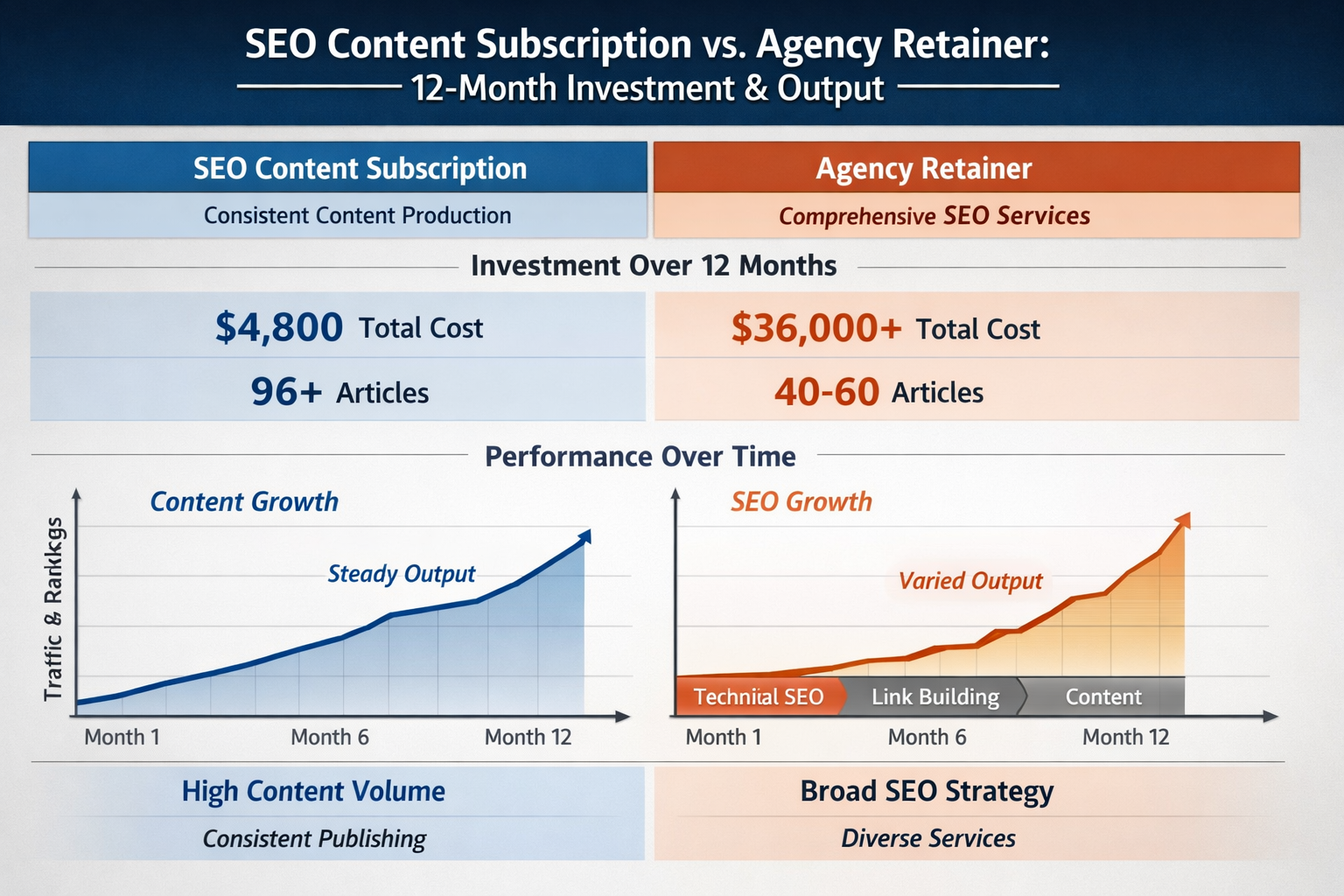
It's 4:47 PM on a Friday. You're staring at an empty blog queue that was supposed to have three posts ready for next week. The brief you wrote two weeks ago is still sitting in a shared folder, unassigned. Your writer asked a clarifying question on Tuesday that you forgot to answer. And somewhere in your inbox is a half-finished draft that needs "just a few more edits" before it can go live.
This is content chaos. And it happens to nearly every marketing team, regardless of budget or headcount.
Your content strategy looks brilliant on paper. The topic clusters make sense. The keyword research is thorough. The editorial calendar spans six months of carefully planned posts. Yet somehow, execution falls apart within weeks.
The problem isn't strategy. It's operations. The fix isn't another brainstorm session or a fancier project management tool. It's a weekly editorial cadence that actually runs without heroic effort—one you can sustain in 90 minutes or less per week.
Here's how to build one that sticks.
Why Most Content Operations Fail Before They Start
The typical content workflow looks something like this: someone gets inspired, writes a brief, the brief sits in a queue, a writer eventually picks it up, revisions happen (slowly), and the post publishes weeks after it was relevant.
Research from the Content Marketing Institute shows that only 29% of B2B marketers consider their content marketing "very successful" [1]. The gap between ambition and execution isn't talent—it's system design.
A separate study from CoSchedule found that marketers who document their processes are 414% more likely to report success than those who don't [2]. The difference isn't working harder. It's having a repeatable system that removes decisions from the daily grind.
Content chaos happens when three things are missing:
Clear role ownership at each stage. When "the team" is responsible, no one is responsible. Every handoff needs a name attached.
Timeboxed commitments instead of open-ended tasks. "Review this when you get a chance" becomes "review this never." Deadlines create momentum.
A feedback loop that catches drift before it compounds. Without weekly checkpoints, small delays become missed months.
Without these, even well-resourced teams default to reactive publishing. Posts go out when someone finally has time, not when the calendar says they should.
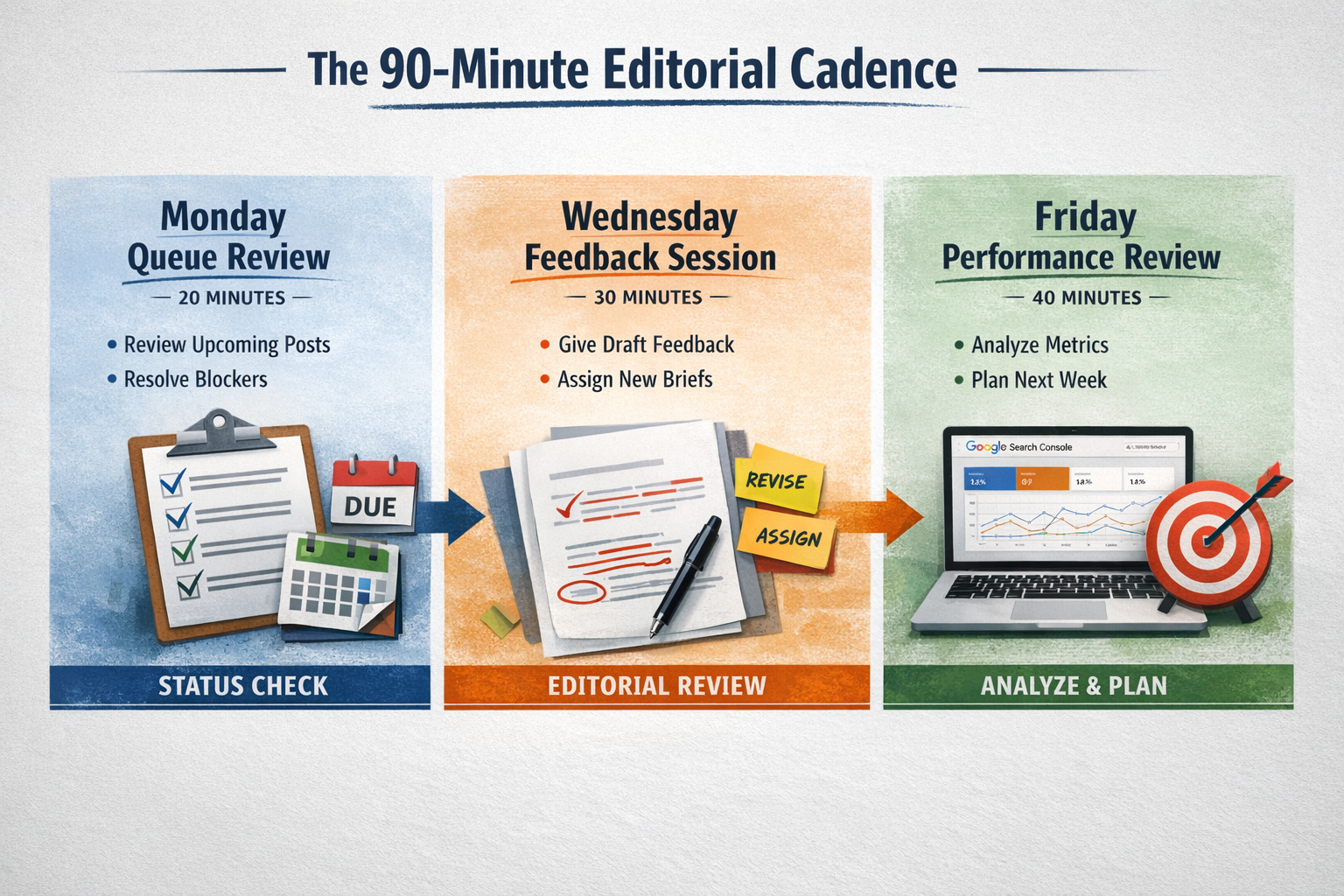
The Content Rhythm Framework: 90 Minutes That Move the Needle
A sustainable editorial cadence isn't about working harder. It's about compressing decisions into predictable windows so the rest of your week stays clear.
Here's a weekly content rhythm that keeps production moving without consuming your calendar.
Monday: The 20-Minute Queue Review
Start each week with a single question: what's publishing this week, and is it ready?
This isn't a planning session. It's a status check. You're looking at:
Which posts are approved and scheduled
Which posts need final review before publish
Any blockers that could delay the week's output
Common blockers to watch for:
Missing subject matter expert quotes or technical verification
Graphics or featured images stuck in design review
Compliance or legal approval pending
Writer waiting on clarification from a brief that wasn't specific enough
If something's stuck, this is when you flag it—not Thursday afternoon when the queue runs dry. The Monday review is triage, not treatment. Identify the problem, assign the owner, set a deadline to resolve it by Wednesday.
Time commitment: 20 minutes
Owner: Content lead or marketing manager
Wednesday: The 30-Minute Brief-to-Draft Handoff
Midweek is for moving the pipeline forward. This is when new briefs get assigned or existing drafts get feedback.
The key here is specificity. Vague feedback creates revision loops that eat days. Clear feedback gets resolved in one pass.
Bad feedback: "Make it punchier."
Good feedback: "The intro buries the lead. Move the statistic about conversion rates to sentence two, and cut the first paragraph entirely."
Bad feedback: "This doesn't feel right."
Good feedback: "The tone is too formal for our brand. Rewrite the opening section as if you're explaining this to a smart colleague over coffee, not presenting to a board room."
Batch your feedback. Review two or three pieces in one sitting rather than context-switching throughout the day. Your brain needs time to recalibrate between tasks, and scattered feedback sessions waste that transition time repeatedly.
Time commitment: 30 minutes
Owner: Editor or content strategist
Friday: The 40-Minute Performance + Planning Loop
End the week by looking backward and forward. This session has two parts.
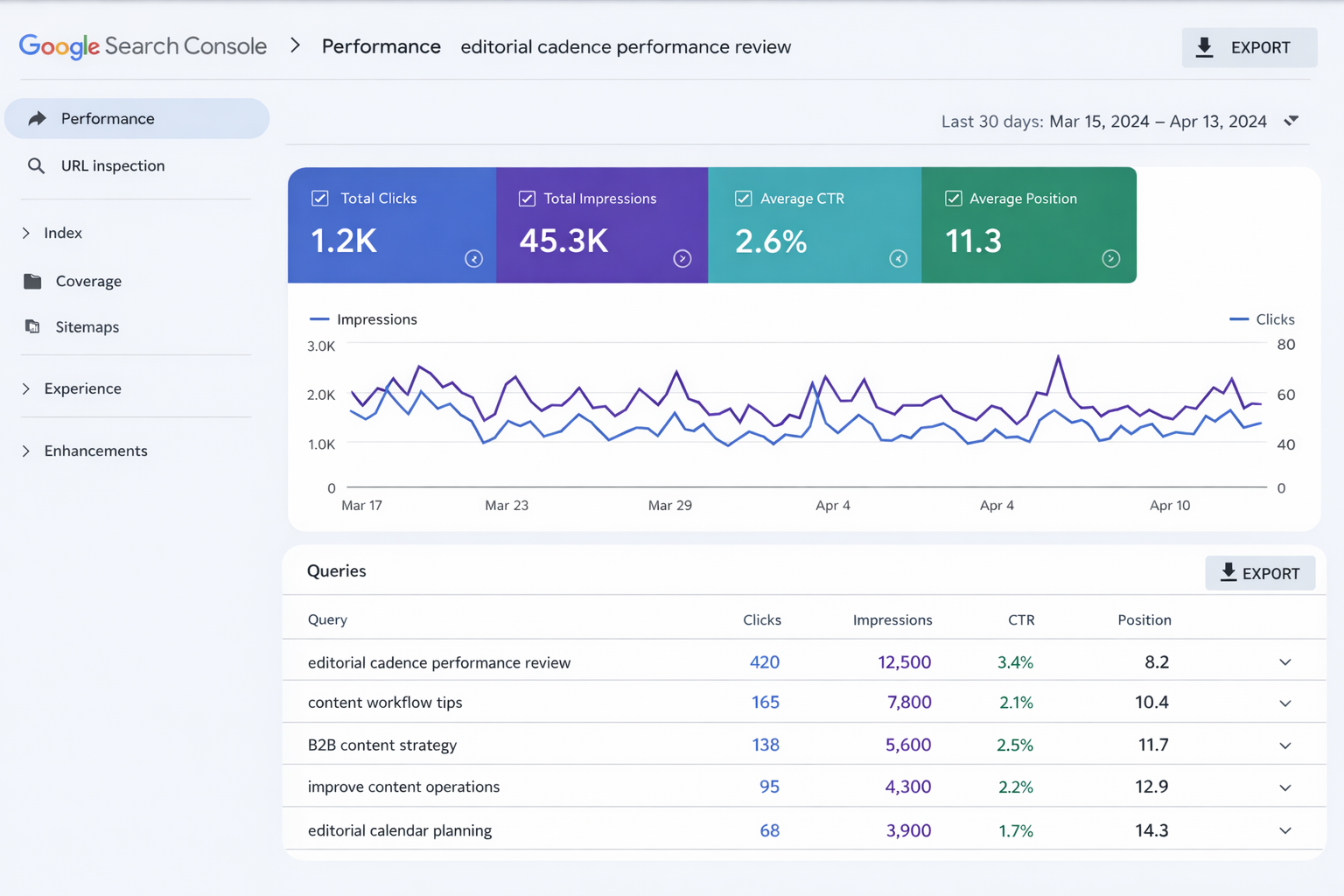
Part one (20 minutes): Performance review in Google Search Console
Pull up Search Console and answer three questions:
Which posts from the past 30 days are gaining impressions? These are your early winners—consider expanding them or creating related content.
Which existing posts are declining and might need updates? A 20% drop in impressions over 60 days is a signal worth investigating.
Are there new queries showing up that suggest content gaps? Look at the "Queries" report for terms you're ranking on positions 8-20—these are opportunities to optimize existing content or create new pieces.
You're not doing deep analysis here. You're scanning for signals that inform next week's priorities.
Part two (20 minutes): Next week's queue confirmation
Confirm what's publishing next week. If there's a gap, assign the brief now—not Monday morning when everyone's already behind.
Review the topic calendar. Does next week's content still make sense given what you learned from Search Console? If a particular topic is suddenly gaining traction, consider prioritizing related content. If something feels stale, swap it out.
Time commitment: 40 minutes
Owner: Content lead with input from SEO (if separate role)
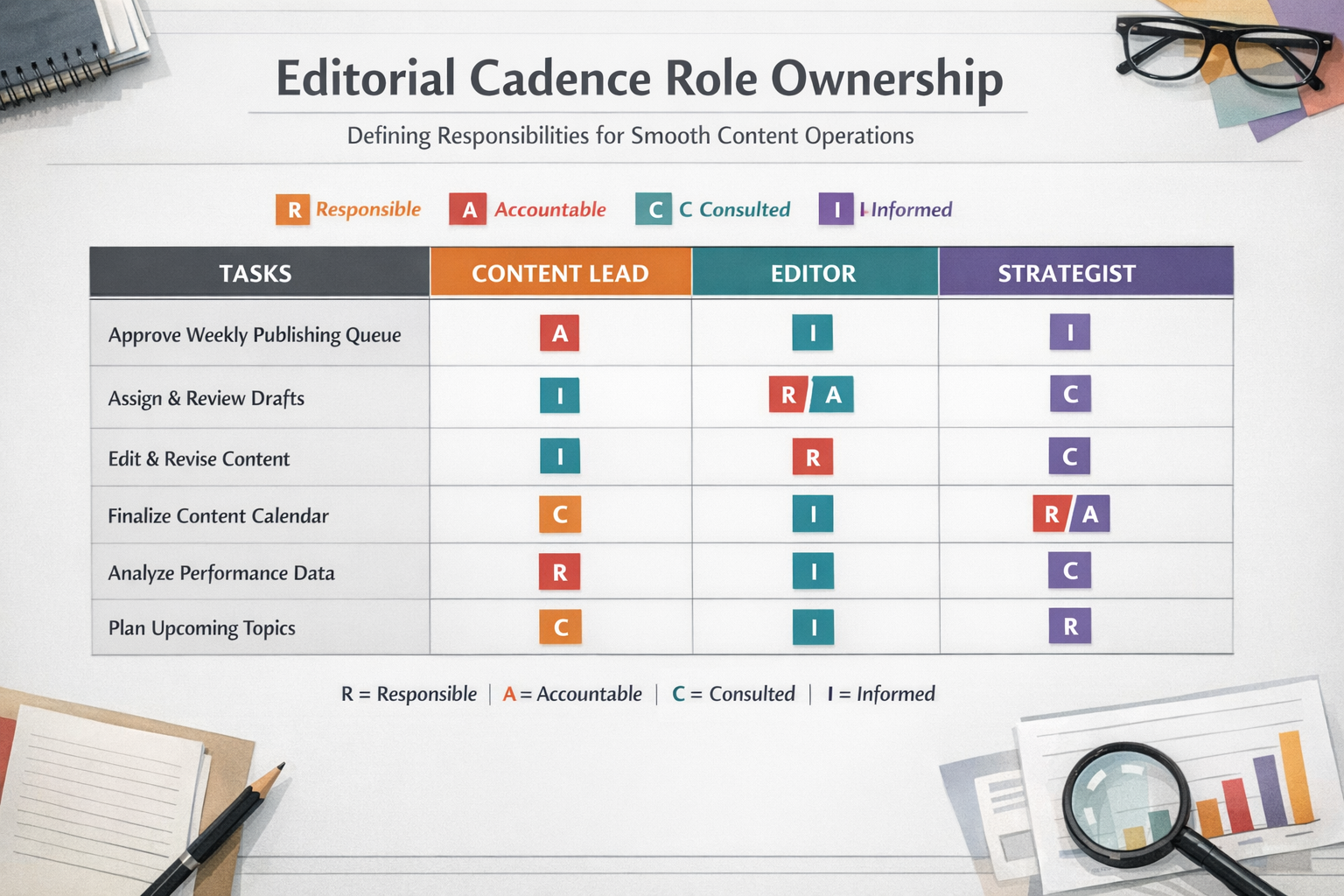
Role Clarity: Who Does What and When
Content operations break down when ownership is fuzzy. "The team" doesn't publish blog posts. Specific people with specific deadlines do.
Here's a simple RACI-style breakdown for a lean content operation:
| Task | Owner | Deadline |
| Approve weekly publishing queue | Content Lead | Monday EOD |
| Deliver draft feedback | Editor | Wednesday EOD |
| Finalize next week's briefs | Content Strategist | Friday EOD |
| Publish approved posts | Publisher (or automation) | Per schedule |
| Pull Search Console data | SEO Lead or Content Lead | Friday morning |
If you're a team of one, you wear all these hats—but the deadlines still matter. Timeboxing forces prioritization. When you know Wednesday afternoon is feedback time, you stop letting drafts languish in your inbox indefinitely.
Tools to Run Your 90-Minute Cadence
You don't need expensive software to run effective content operations. You need clear ownership and consistent habits. That said, the right tools reduce friction.
For visual thinkers and small teams: Trello works well. Create columns for each stage (Brief, Drafting, Review, Scheduled, Published) and move cards across as content progresses. The visual board makes Monday's queue review nearly instant.
For teams with multiple stakeholders: Asana or Monday.com add more structure—assignees, due dates, dependencies, and comment threads keep everyone aligned without lengthy status meetings.
For solo operators or budget-conscious teams: A well-structured Google Sheet handles everything. Columns for Topic, Status, Owner, Draft Due, Publish Date, and Performance Notes give you full visibility in one tab.
The tool matters less than the discipline. Pick one, standardize it, and actually use it every week.
The Content Scorecard: Track Your Hit Rate
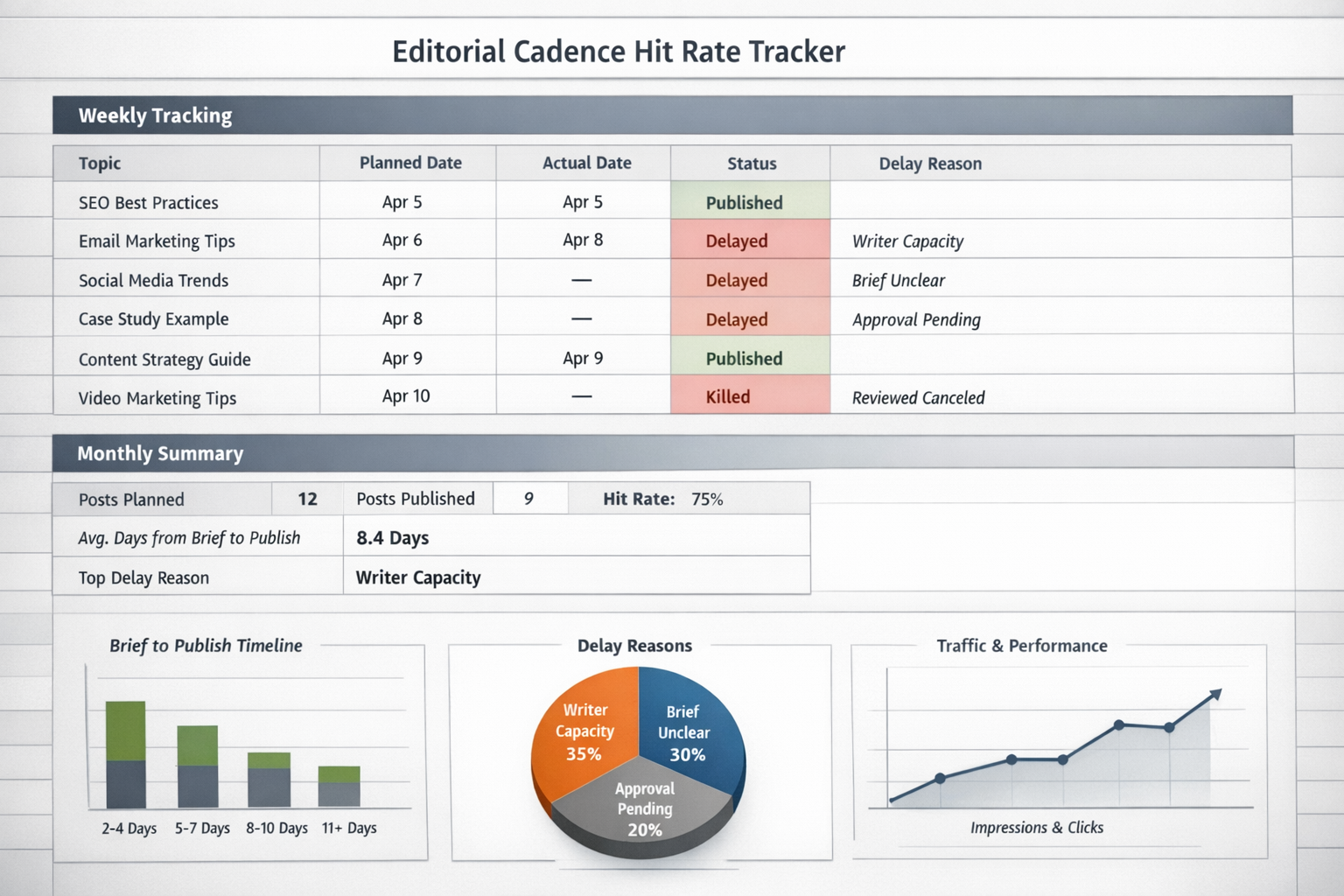
The "Visible Scorekeeping" principle sounds abstract until you build it. Here's what a simple content scorecard looks like:
Weekly tracking columns:
Topic: What was supposed to publish
Planned Date: When it was scheduled
Actual Date: When it actually went live
Status: Published / Delayed / Killed
Delay Reason: (if applicable) Brief unclear / Writer capacity / Review bottleneck / Approval pending
Monthly summary row:
Posts planned vs. published (your "hit rate")
Average days from brief to publish
Most common delay reason
Teams that track their hit rate publicly tend to maintain it. When you can see that you've published 7 of 8 planned posts this month, you protect that streak. When you see the same bottleneck appearing three weeks in a row, you fix it.
SLA Expectations: What "On Time" Actually Means
Service level agreements aren't just for enterprise software contracts. They're useful anywhere handoffs happen.
If you work with writers, editors, or external partners, define what "on time" means:
Brief delivery: 48 hours before draft deadline
First draft: 5 business days from brief receipt
Feedback turnaround: 24 hours from draft receipt
Final revision: 48 hours from feedback
Publish-ready: 24 hours before scheduled publish date
These timelines aren't arbitrary. They create buffer for the inevitable hiccups—a sick day, a clarifying question, a last-minute data check—without blowing up the schedule.
When SLAs slip consistently, that's diagnostic information. Either the timeline is unrealistic, the briefs aren't clear enough, or capacity doesn't match ambition. Each of those has a different fix.
The Monthly Reporting Loop That Keeps You Honest
Weekly rhythms handle execution. Monthly reviews handle direction.
Once per month, carve out 60 minutes to assess whether your content engine is actually working. This isn't a vanity metrics review. It's a calibration session.
What to Measure Monthly
From Google Search Console:
Total impressions and clicks (trending up, flat, or down?)
Average position for target keywords
New queries driving traffic (content gap opportunities)
Pages losing impressions over 60+ days (candidates for refresh)
From your publishing log:
Posts published vs. planned (hit rate)
Average time from brief to publish
Revision cycles per post (are drafts getting cleaner over time?)
From your conversion data:
Traffic-to-lead conversion rate on blog content
Which posts are driving demo requests, email signups, or other goal completions
Any correlation between content type and conversion performance
The Monthly Calibration Questions
Are we publishing at the cadence we committed to?
Is organic visibility trending in the right direction?
Which content types are earning traction, and should we double down?
What's one operational bottleneck we could fix next month?
Document the answers. Compare month over month. Small improvements compound faster than you'd expect—a 10% efficiency gain each month means your operation is twice as effective within a year.
Building the Habit: Why Consistency Beats Intensity
The hardest part of editorial cadence isn't the system design. It's the first six weeks of actually running it.
Content operations are habit-dependent. Miss two Mondays in a row, and the queue review stops feeling mandatory. Let Friday's performance check slide, and you're flying blind by month two. The system only works if you protect it.
Calendar blocking: Put the 90 minutes on your calendar as recurring, protected time. Treat it like a meeting with your most important client—because your organic traffic pipeline is exactly that.
Visible scorekeeping: Post your hit rate where the team can see it. A shared dashboard or even a Slack message each Friday ("8/8 posts published this month") creates gentle accountability.
Start small, then expand: Don't try to implement everything in week one. Start with the Monday queue review. Add Wednesday's feedback batch in week two. Add Friday's performance loop in week three. By week four, you have a complete system built on established habits rather than good intentions.
When to Hand Off the Cadence
Running a 90-minute weekly rhythm is sustainable for one person managing a modest publishing schedule—say, one to two posts per week. But as volume increases, the math changes.
Signs you've hit the ceiling:
You're consistently missing publish dates despite running the cadence
Feedback quality is dropping because you're rushing through reviews
You're spending more time on operations than on strategy
The backlog of content ideas keeps growing while output stays flat
If you're targeting more than two posts per week with full SEO optimization, internal linking, schema markup, and performance tracking, you have three options:
Hire dedicated content operations staff. This makes sense if content is core to your business model and you have budget for a full-time role.
Reduce publishing frequency. Better to publish one excellent post per week than four mediocre ones. Quality compounds; volume without quality doesn't.
Outsource the execution layer. Keep strategy in-house while offloading the brief-to-publish pipeline. This frees your 90 minutes for higher-leverage work—analyzing performance, identifying opportunities, and making strategic decisions.
Start This Week
You don't need to overhaul your entire content operation. You need to start one habit and protect it.
Week one: Try the Monday queue review. Twenty minutes. Look at what's supposed to publish this week and confirm it's ready. If it's not, identify the blocker and assign someone to fix it.
Week two: Add the Wednesday feedback batch. Thirty minutes. Review any drafts in your queue with specific, actionable feedback.
Week three: Add Friday's performance loop. Forty minutes. Check Search Console, confirm next week's queue, and note any signals worth acting on.
Week four: You have a functioning content rhythm running on 90 minutes instead of scattered panic.
The goal isn't perfection. It's a system that runs consistently—one that catches problems early, moves content forward predictably, and gives you data to improve over time.
Ready to skip the ramp-up? The Mighty Quill runs the entire editorial cadence for you—from keyword research to publishing—so you stay focused on strategy while your blog publishes like clockwork. Try it free with two custom articles delivered in 48 hours.
Frequently Asked Questions
How long does it take to see results from a consistent editorial cadence?
Most teams notice operational improvements within four to six weeks—fewer missed deadlines, cleaner drafts, and less last-minute scrambling. SEO results take longer, typically three to six months, because search engines need time to crawl, index, and evaluate new content before ranking improvements appear. The operational wins come first; the traffic wins follow.
What if I don't have a dedicated content team?
The 90-minute framework works for solo operators. You'll wear multiple hats, but the timeboxing matters more when resources are limited. The structure prevents content work from expanding to fill every available hour while still maintaining forward progress. Start with just the Monday review and add sessions as capacity allows.
How do I know if my publishing cadence is aggressive enough?
Check your Search Console data monthly. If impressions and clicks are trending upward and you're maintaining quality, your cadence is working. If traffic is flat despite consistent publishing, the issue is likely content quality or keyword targeting—not volume. One well-optimized post often outperforms three rushed ones.
Should I prioritize new content or updating old posts?
Both, but weight toward new content early in your program to build topical coverage. Once you have a library of 20+ published posts, allocate roughly 20% of your editorial capacity to refreshing declining pages. Search Console's performance report shows which posts are losing impressions over time—those are your refresh candidates.
What tools do I need to run this cadence?
At minimum: Google Search Console for performance data, a shared document or spreadsheet for your publishing calendar, and a task management tool (even a simple one) for tracking handoffs. You don't need expensive software to run effective content operations—you need clear ownership, consistent habits, and the discipline to protect your 90 minutes each week.
About The Mighty Quill
The Mighty Quill is an AI-powered content engine built by marketers who spent years running editorial operations the hard way. Our team combines over 15 years of SEO and content marketing experience with systems designed for sustainable publishing. We've helped SaaS companies, e-commerce brands, and agencies build organic traffic that compounds month over month—without the chaos of managing freelancers or the inconsistency of DIY blogging.
Cited Works
[1] Content Marketing Institute — "B2B Content Marketing: Benchmarks, Budgets, and Trends." https://contentmarketinginstitute.com/research/
[2] CoSchedule — "Marketing Statistics." https://coschedule.com/marketing-statistics