Zero-click searches now account for roughly 60% of Google queries. For e-commerce brands, that statistic should sting: your blog content either becomes the source AI cites—or it vanishes from the conversation entirely.
Google's Search Generative Experience (SGE) and AI-powered assistants now synthesize answers before users reach your website [1]. Your product pages might still rank for transactional queries, but your blog? That's where visibility compounds or collapses in 2025's search landscape.
E-commerce blogs have a structural advantage most brands waste. You own products, categories, pricing data, and real customer questions that AI systems need to understand. The brands capturing citations right now aren't chasing keywords—they're building answer-ready content architectures that AI can parse, extract, and surface.
This guide breaks down the specific tactics that work when AI mediates the search experience—and where most e-commerce content strategies fall short.
Why Most E-commerce Blog Strategies Fail in AI Search
Traditional e-commerce blog playbooks assumed users would click through to find answers. You'd target a keyword, publish a post, build backlinks, wait for rankings. That model is breaking.
SGE synthesizes answers directly in search results, pulling from multiple sources and presenting information users need without requiring a click [2]. Generic "gift guide" posts and thin product roundups don't provide the substantive answers AI systems prioritize. Meanwhile, competitors with deeper, better-structured content capture the citations you're missing.
The real problem: AI systems evaluate content based on three factors your existing posts probably ignore:
How clearly your content answers specific questions
How well it's structured for extraction
Whether it demonstrates genuine expertise in your product category [3]
Surface-level optimization—keyword density, meta tags alone, basic internal linking—no longer moves the needle. AI systems can identify filler content, and they increasingly skip it.
Warning: If your blog consists primarily of "Top 10" listicles with minimal product context or generic advice that could appear on any retailer's site, you're likely invisible in AI-generated answers.
Building Answer-Ready Content Architecture
Answer-ready content isn't synonymous with "well-written" content. It's content engineered for AI extraction—structured so systems can identify, isolate, and cite your answers.
Start With Question-Based Content Mapping
Identify every question your potential customers ask throughout their buying journey. Mine these sources:
Google's "People Also Ask" sections for your target keywords
Your customer service logs and support tickets
AnswerThePublic and similar question-research tools [4]
Product review sections (yours and competitors')
Reddit and forum discussions in your niche
For a coffee equipment retailer, this might surface questions like: "Why does my espresso taste sour?" "What grind size for pour-over?" "How often should I descale my machine?"
Structure for Extraction
Place direct answers within the first two to three paragraphs of each section. AI systems favor content that provides clear, extractable responses early—not posts that bury insights beneath lengthy introductions.
Effective formatting for AI extraction:
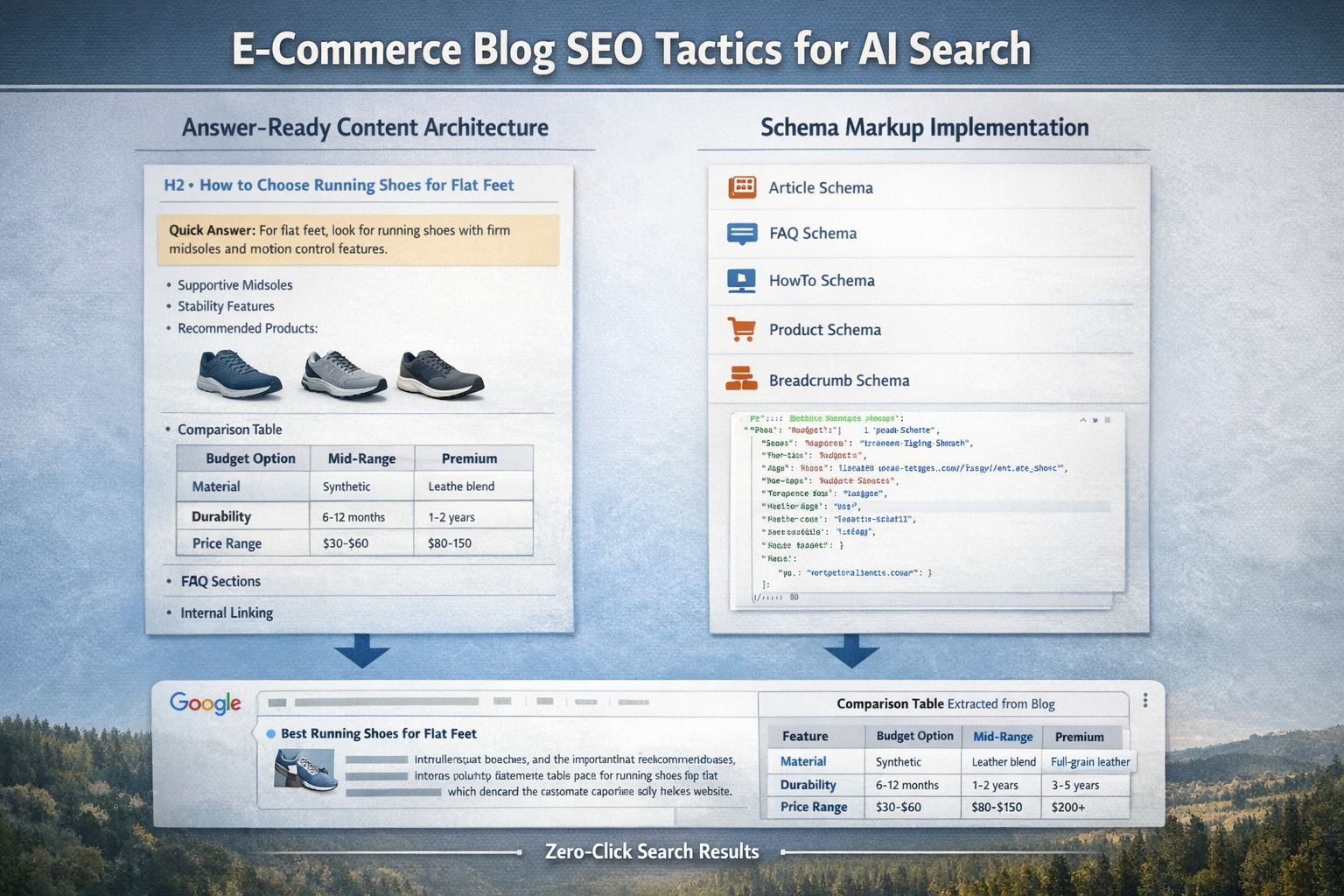
H2 headings that mirror common search queries (e.g., "How to Choose Running Shoes for Flat Feet")
H3 subheadings that break down components of each answer
Short paragraphs—two to four sentences maximum—that AI can isolate
Bulleted lists for step-by-step processes or feature comparisons
Definition blocks that provide clear, citable explanations of key concepts
For e-commerce specifically, integrate product recommendations naturally. If you're writing about choosing running shoes for flat feet, include specific products from your catalog with clear reasoning—not generic advice that could appear on any retailer's blog.
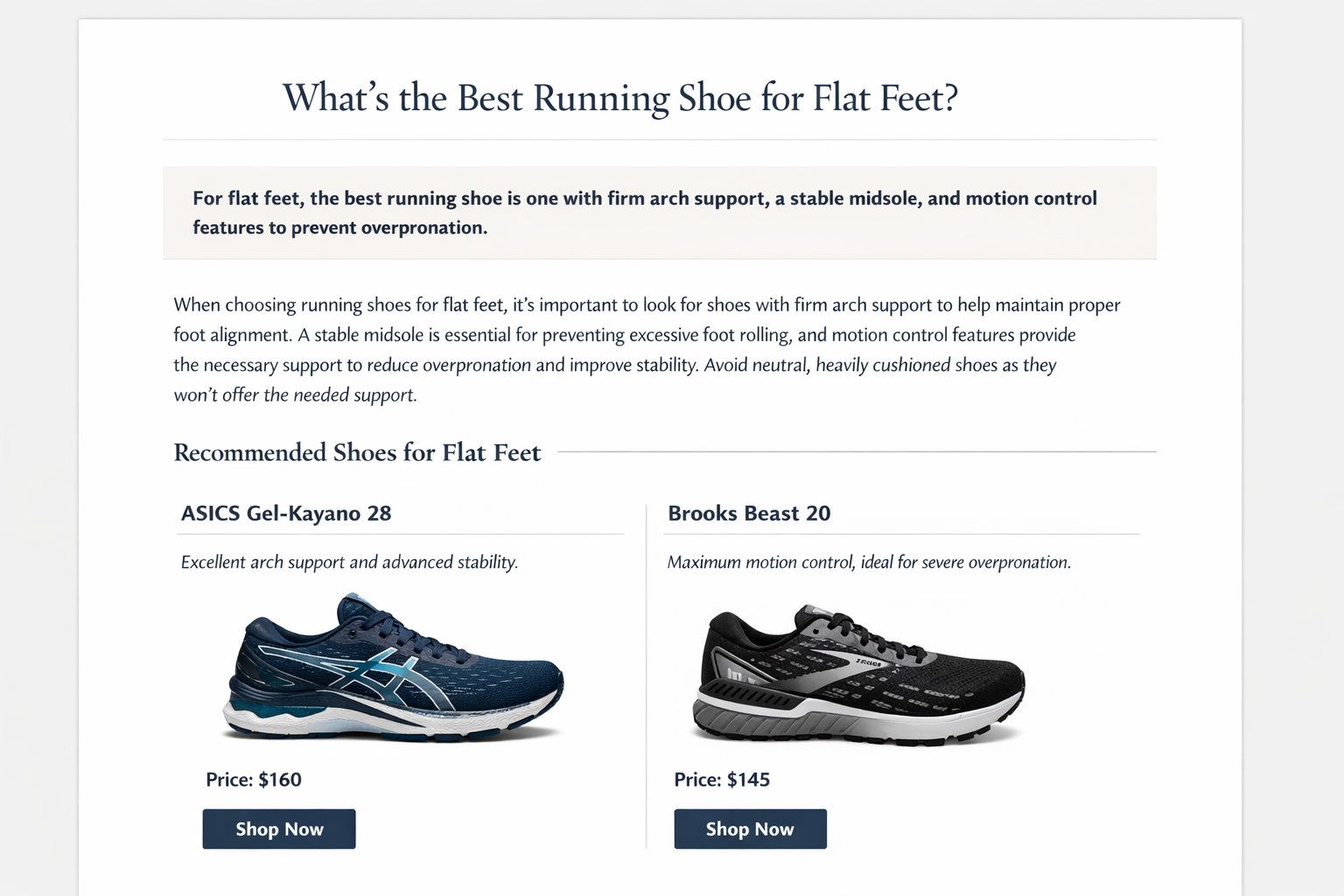
[Visual: Example of a well-structured blog section showing an H2 question heading, a direct two-sentence answer, followed by supporting details and a product recommendation with reasoning]
Schema Markup Implementation for E-commerce Blogs
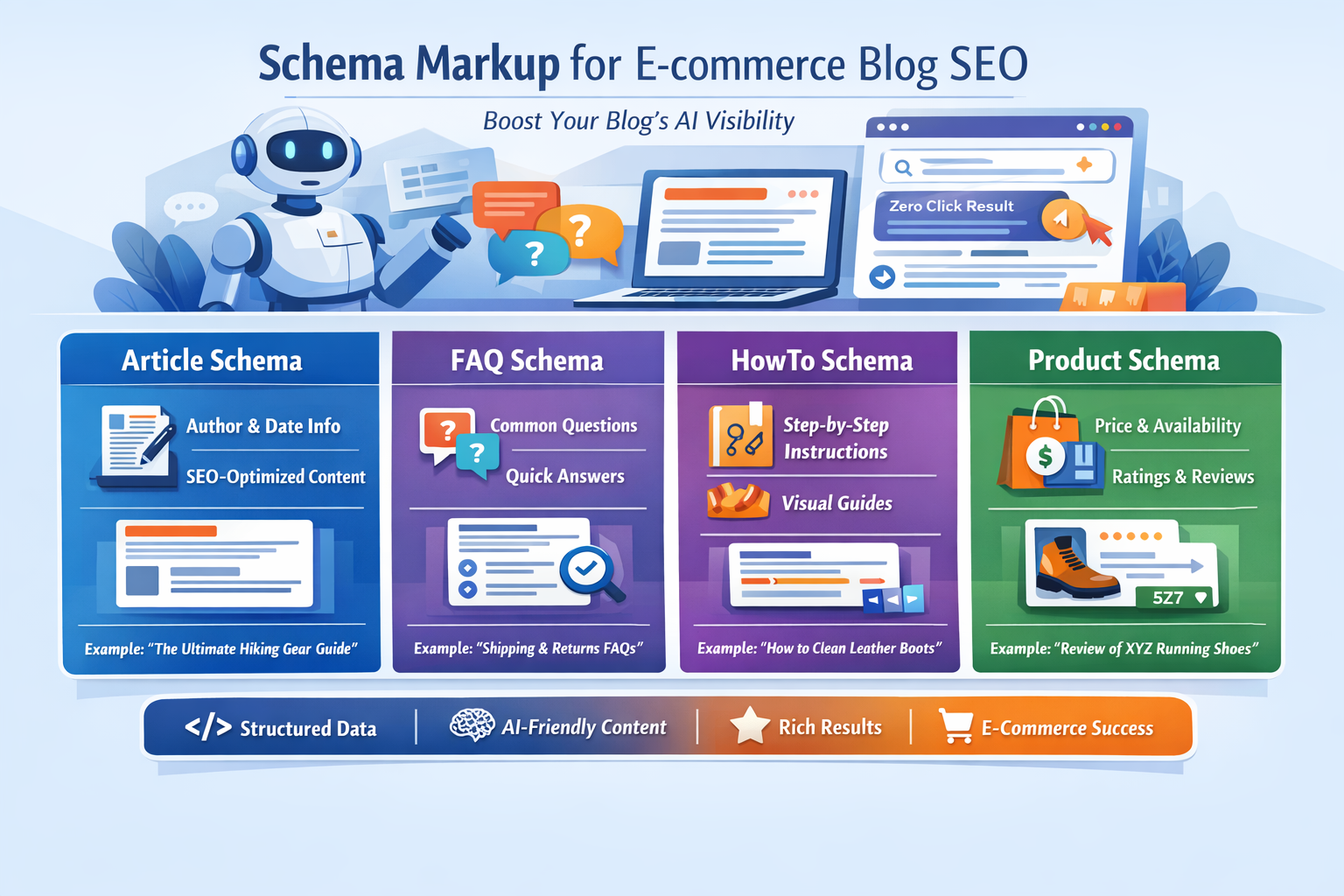
Schema markup tells search engines and AI systems exactly what your content contains. For e-commerce blogs, proper implementation separates content that gets cited from content that gets ignored.
Essential Schema Types for E-commerce Blog Content
Article Schema: Apply to every blog post with proper author attribution, publication dates, and clear headlines. This establishes your content as a legitimate, timestamped source [5].
FAQ Schema: When your content answers multiple related questions, FAQ schema helps AI systems identify and extract each answer individually. This is particularly powerful for product education content.
HowTo Schema: For tutorial content—assembly guides, styling tips, product care instructions—HowTo schema structures your steps in a format AI can directly reference.
Product Schema: When blog posts reference specific products, embed product schema with pricing, availability, and review aggregates where applicable [6].
BreadcrumbList Schema: Helps AI understand where your content sits within your site's information architecture—establishing topical relationships between your blog and product categories.
Implementation by Platform
Shopify: Apps like JSON-LD for SEO or Schema Plus handle most schema types automatically. For FAQ and HowTo schema, you'll likely need custom Liquid template modifications or a dedicated schema app.
WordPress/WooCommerce: Plugins like Rank Math, Yoast Premium, or Schema Pro offer comprehensive schema support. WooCommerce product schema integrates directly with blog posts referencing specific products.
Custom platforms: Implement JSON-LD directly in your page templates. Google's Rich Results Test validates your markup before publishing [7].
Implementation check: Validate schema on every blog post before publishing. Malformed or incomplete schema provides no benefit—AI systems simply ignore it.
Content Structures That AI Systems Favor
AI systems extract information differently than human readers scan content. Optimizing for both requires intentional structural choices.
Definition Boxes
When introducing concepts, provide clear definitions that AI can pull directly:
Drop shipping: A retail fulfillment method where the seller doesn't hold inventory. When a customer places an order, the seller purchases the item from a third party who ships directly to the customer.
This boxed definition in an e-commerce logistics post becomes citable content.
Comparison Tables
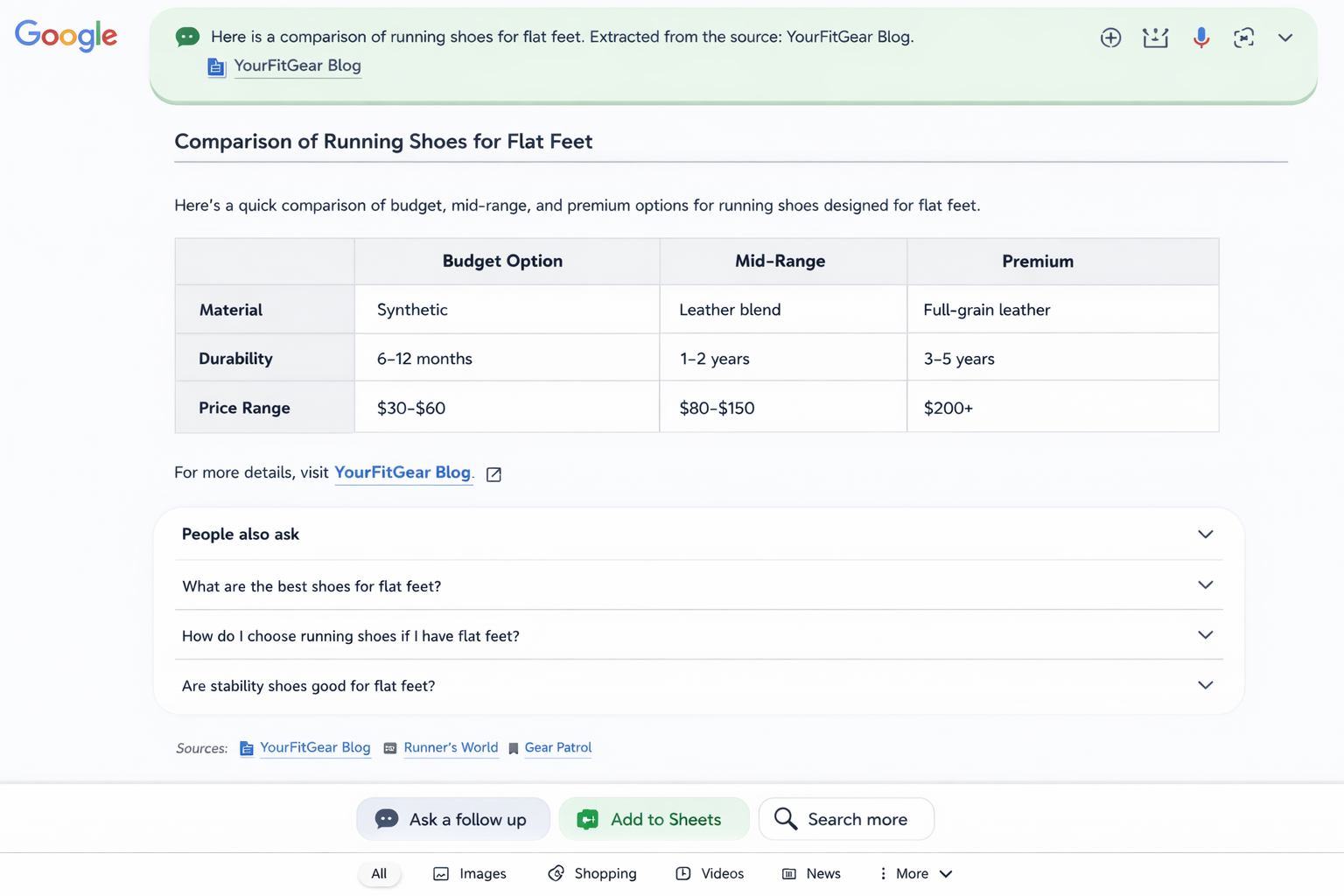
AI systems excel at extracting tabular data. Product comparisons, feature matrices, and pricing tables provide clear, structured information.
| Feature | Budget Option | Mid-Range | Premium |
| Material | Synthetic | Leather blend | Full-grain leather |
| Durability | 6-12 months | 1-2 years | 3-5 years |
| Price Range | $30-60 | $80-150 | $200+ |
[Visual: Screenshot of a Google SGE result displaying a comparison table pulled from a product blog post]
Summary Blocks
Include TL;DR summaries at the beginning or end of longer posts:
Quick answer: For flat feet, look for running shoes with firm midsoles, straight lasts, and motion control features. Avoid heavily cushioned neutral shoes, which allow excessive pronation.
Cited Statistics and Data
AI systems weight factual, specific claims higher than vague assertions. Include data points with sources:
"The average e-commerce site conversion rate sits around 2.5-3%, but sites with active blogs see visitor-to-customer conversion rates 13% higher than those without regular content publishing" [8].
Expert Attribution
Content with clear expertise signals performs better in AI-mediated search. Include quotes from your team's product specialists or verifiable customer experiences with proper attribution.
Internal Linking for Topical Authority
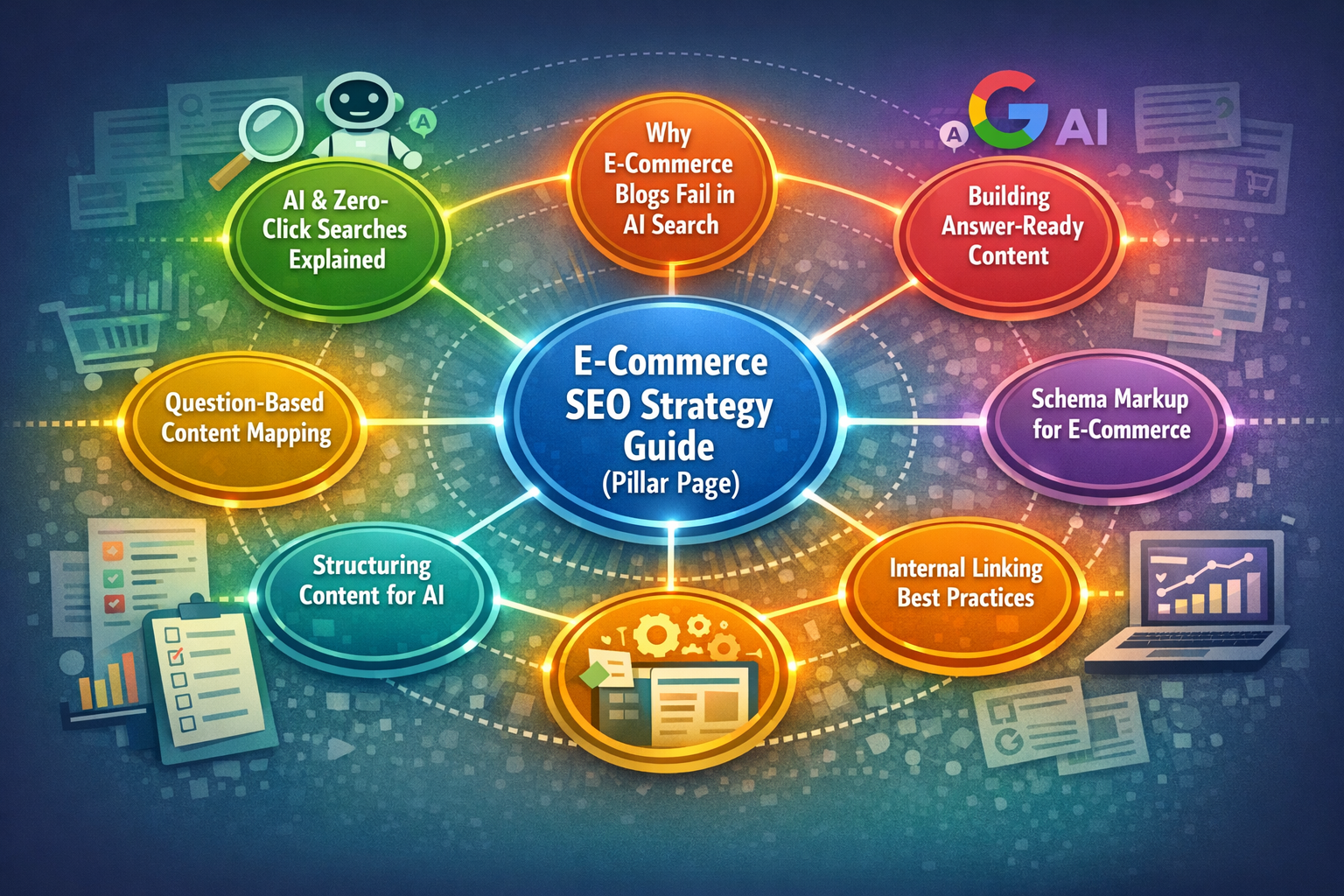
E-commerce blogs frequently fail at internal linking—either ignoring it entirely or implementing it without strategy. In AI search, internal linking establishes the topical authority that determines citation priority.
Building Topic Clusters
Organize content around your core product categories. For an outdoor gear retailer:
Cluster: Hiking Equipment
Pillar page: "The Complete Guide to Hiking Gear"
Supporting posts: "How to Choose Hiking Boots for Different Terrain," "Backpack Sizing Guide," "Trekking Pole Benefits and Selection"
Each supporting post links back to the pillar and to related posts within the cluster. The pillar page links out to all supporting content.
Fixing Orphan Pages
An orphan page has no internal links pointing to it—invisible to both users navigating your site and AI systems mapping your content relationships. Audit your blog regularly using tools like Screaming Frog or Sitebulb to identify orphaned content.
Anchor Text Strategy for AI
AI systems parse anchor text to understand content relationships. Use natural language anchors that describe the linked content:
Effective: "Learn how to measure your foot for hiking boots"
Less effective: "click here" or "read more"
Avoid: Exact-match keyword stuffing in anchors, which signals manipulation
Connecting Blog to Commerce
Link blog content to relevant product and category pages where contextually appropriate. A post about "choosing the right tent size for family camping" should naturally link to:
Your family tent category page
Two to three specific recommended products with brief context
Related content about campsite selection or sleeping bag sizing
This creates information pathways AI systems can follow to understand your site's expertise scope.
E-commerce Content Types That Earn Citations
Certain content formats consistently outperform for e-commerce blogs in AI search.
Buying Guides With Decision Frameworks
Move beyond "best products" lists. Structure guides around how readers should make decisions based on their specific situations.
Include:
Decision criteria (budget, use case, experience level)
Trade-off explanations (durability vs. weight, features vs. price)
Clear recommendations for different user profiles
Reasoning that demonstrates genuine product expertise
Product Care and Maintenance Content
This evergreen content type generates consistent search traffic and demonstrates deep product knowledge. AI systems frequently cite care instructions and maintenance guidance because users actively seek this information.
"How to clean leather boots," "coffee grinder maintenance schedule," "extending the life of your camping gear"—these queries have clear answers your content can own.
Problem-Solution Posts
Direct answers to specific user problems align perfectly with AI search priorities:
"Why does my espresso taste bitter?"
"How to remove water stains from wood furniture"
"Why won't my tent zipper close properly?"
Structure these posts with the problem as the H1, a direct solution summary in the first paragraph, then detailed troubleshooting steps.
Behind-the-Scenes and Process Content
Manufacturing processes, sourcing decisions, and quality control explanations build trust signals that both AI systems and human readers value [9]. This content demonstrates expertise competitors can't easily replicate.
Customer Implementation Stories
Detailed examples showing how customers use your products provide social proof and specific, citable scenarios. "How Sarah organized her 500-square-foot kitchen with our storage system" gives AI concrete examples to reference.
Technical SEO Foundations
Technical SEO becomes more critical—not less—when AI mediates search. AI systems need to crawl, understand, and trust your content before citing it.
Speed and Core Web Vitals
Slow-loading pages signal poor user experience. Google has confirmed Core Web Vitals as ranking factors, and AI systems incorporate these signals when determining source quality [10].
For e-commerce blogs specifically:
Compress and lazy-load product images
Minimize JavaScript blocking above-the-fold content
Use a CDN for global content delivery
Mobile-First Structure
Most e-commerce research happens on mobile devices. Ensure your blog content renders properly, loads quickly, and remains readable on smaller screens. Tables should be responsive or scroll horizontally.
URL Architecture
Descriptive, hierarchical URLs help AI systems understand content organization:
Clear: /blog/hiking/how-to-choose-hiking-boots
Unclear: /blog/post?id=4523
Crawl Efficiency
Submit comprehensive XML sitemaps including all blog content with accurate lastmod dates
Implement self-referencing canonical tags on every post
Ensure HTTPS across your entire blog
Fix broken internal links that waste crawl budget
Measuring Performance in AI Search
Traditional SEO metrics don't fully capture performance when AI mediates results. Expand your measurement framework.
Track AI Visibility
Featured snippet ownership: Monitor when your content appears in Google's featured snippets and AI Overviews. Tools like Semrush and Ahrefs track featured snippet positions [11].
Zero-click query performance: Use Google Search Console to identify queries where your content appears but receives minimal clicks. High impressions with low clicks often indicate AI is answering directly from your content—valuable visibility even without the traffic.
Citation Monitoring
Manually check AI assistants (ChatGPT, Perplexity, Google SGE) for your target queries periodically. Note when your content is cited versus competitors. This qualitative data reveals citation patterns that automated tools miss.
Topical Authority Indicators
Track ranking improvements across topic clusters rather than individual keywords. Improvement across related terms signals growing topical authority—exactly what AI systems reward.
Implementation Checklist
[ ] Set up featured snippet tracking in your SEO tool
[ ] Create a monthly AI citation audit for top 10 target queries
[ ] Monitor Search Console for high-impression, low-click patterns
[ ] Track cluster-level ranking changes, not just individual keywords
Publishing Consistency and Content Velocity
AI systems reward freshness and consistency. A blog that publishes sporadically sends weaker authority signals than one maintaining a predictable cadence.
Finding Sustainable Velocity
For e-commerce blogs, aim for consistent weekly publishing rather than burst campaigns. Two to three quality posts per week builds momentum that compounds over time—both in search visibility and AI system trust [12].
Quality always trumps quantity, but quantity without consistency rarely builds the authority needed for AI citation. Find a sustainable cadence and maintain it for months, not weeks.
Seasonal Content Timing
Plan and publish seasonal content (holiday gift guides, summer product roundups, back-to-school features) well before peak search demand. AI systems need time to crawl, understand, and index this content before it becomes relevant.
For holiday content, publish no later than early October. For summer seasonality, target March or April publication dates.
Adapting as AI Search Evolves
AI search isn't static. Google continues refining SGE, and competing AI assistants reshape how users find information continuously.
Stay Informed
Monitor algorithm updates and AI search changes through reliable sources: Search Engine Journal, Moz, and Google's Search Central Blog provide timely, accurate analysis [13].
Test and Iterate
Test different content structures and measure results. What works for AI extraction today may evolve as these systems become more sophisticated. Run experiments with formatting, schema types, and content depth—then track citation patterns.
Build Audience Relationships Beyond Search
Email lists, social followings, and direct traffic provide stability when search algorithms shift. Don't build your entire traffic strategy on a single channel, regardless of how well you optimize for it.
Focus on Genuine Expertise
AI systems are increasingly sophisticated at identifying truly helpful content versus SEO-optimized filler. The brands that win long-term create content worth citing—regardless of algorithmic changes. Deep product knowledge, original insights, and genuine expertise become competitive moats that AI systems recognize and reward.
Ready to build an e-commerce blog that earns visibility in AI search? Try The Mighty Quill free and receive two optimized blog posts within 48 hours—structured for answer-ready AI search performance.
Frequently Asked Questions
How does AI search change SEO for e-commerce blogs specifically?
AI search prioritizes content that directly answers user questions in extractable formats. For e-commerce blogs, this means structuring product information, buying guides, and educational content so AI systems can cite specific answers. Traditional keyword optimization matters less than content architecture, schema markup, and demonstrated expertise in your product categories. Your unique advantage is product-specific knowledge competitors can't easily replicate.
What schema markup types matter most for e-commerce blog content?
Article, FAQ, and HowTo schema provide the most value for e-commerce blogs. Article schema establishes authorship and publication credentials. FAQ schema helps AI extract multiple answers from single posts. HowTo schema structures tutorials in formats AI can directly reference [14]. Product schema adds value when blog posts reference specific items from your catalog with pricing and availability data.
How often should an e-commerce blog publish for AI search visibility?
Consistent weekly publishing builds stronger authority signals than sporadic content bursts. Most successful e-commerce blogs publish two to three quality posts per week. The key is sustainability—maintaining a predictable cadence allows topical authority to compound over months. Erratic publishing, even with high-quality content, signals less reliability to AI systems evaluating source trustworthiness.
What content types perform best for e-commerce in AI search?
Buying guides with decision frameworks, product care content, and problem-solution posts perform strongest. AI systems favor content answering specific questions with clear, extractable information. Comparison tables, definition blocks, and summary sections give AI structured data to cite. Avoid thin listicles and generic advice that doesn't leverage your specific product expertise—AI systems increasingly recognize and skip this content.
How can I tell if AI systems are citing my e-commerce blog content?
Monitor featured snippet appearances in Google Search Console and track AI Overview inclusions using SEO tools like Semrush or Ahrefs. Manually check AI assistants (ChatGPT, Perplexity, Google SGE) for your target queries monthly. Zero-click patterns in Search Console—high impressions with minimal clicks—often indicate AI is answering directly from your content, representing valuable visibility even without direct traffic.
About Our Expertise
This guide draws on established SEO principles and emerging best practices for AI-mediated search. The Mighty Quill specializes in creating answer-ready, SEO-optimized blog content for growth-focused e-commerce brands. Our approach combines strategic keyword research, proper schema implementation, and consistent publishing designed for the AI search era. We help e-commerce teams build content systems that generate compounding organic traffic and establish topical authority in competitive markets.
Cited Works
Google — "A new way to search with generative AI." https://blog.google/products/search/generative-ai-search/
Search Engine Journal — "Google SGE: What It Is & How It Impacts SEO." https://www.searchenginejournal.com/google-sge/
Google — "Creating helpful, reliable, people-first content." https://developers.google.com/search/docs/fundamentals/creating-helpful-content
Moz — "The Beginner's Guide to SEO."
https://moz.com/beginners-guide-to-seo
Schema.org — "Article Schema."
https://schema.org/Article
Schema.org — "Product Schema."
https://schema.org/Product
Google — "Rich Results Test."
https://search.google.com/test/rich-results
Nielsen Norman Group — "How Users Read on the Web." https://www.nngroup.com/articles/how-users-read-on-the-web/
Edelman — "Trust Barometer Special Report: Brand Trust." https://www.edelman.com/trust/brand-trust
Google — "Core Web Vitals & Page Experience." https://developers.google.com/search/docs/appearance/core-web-vitals
Semrush — "Position Tracking Tool."
https://www.semrush.com/position-tracking/
Content Marketing Institute — "B2B Content Marketing Research." https://contentmarketinginstitute.com/research/
Google — "Google Search Central Blog."
https://developers.google.com/search/blog
Google — "Understand how structured data works."
https://developers.google.com/search/docs/appearance/structured-data/intro-structured-data