Marketing teams are drowning. Not in ideas—in execution.
The promise of blog automation was supposed to fix this. AI writing tools like ChatGPT and Jasper. SEO platforms like SurferSEO and Clearscope. Content calendars in Notion or Asana. The whole stack. But here's what nobody told you: the tools aren't the bottleneck. The approach is.
When most people search for "blog automation," they're looking for software—a tool that speeds up writing or schedules posts automatically. That's one type of automation. But there's another kind: service-based automation, where an external partner handles the entire content pipeline on your behalf. Both reduce manual labor. They just do it in fundamentally different ways.
Done-for-you vs DIY blog automation represents two philosophies about where your team's time should go. One asks you to become an expert operator of increasingly complex tools. The other asks you to become an expert approver of finished work. That distinction matters more than any feature comparison ever could.
This guide breaks down exactly how much time each approach actually demands—and which one makes sense for teams already stretched thin.
Why Marketing Team Burnout Makes This Decision Urgent
Let's start with an uncomfortable truth: your content team is probably exhausted.
According to research from Orbit Media, 61% of content marketers report experiencing burnout [1]. That's not a minor inconvenience. It's a structural failure in how most organizations approach content production.
The burnout isn't happening because people lack motivation. It happens because the gap between content expectations and content capacity keeps widening. Leadership wants more blog posts, more SEO visibility, more thought leadership pieces. Teams want to deliver. But somewhere between strategy meetings and actual publishing, the math stops working.
Blog automation was supposed to close that gap. For some teams, it has. But the type of automation you choose determines whether you're solving the problem or just redistributing it.
DIY automation—building your own stack of AI writing tools, SEO software, and publishing workflows—can dramatically speed up content creation. The problem is that someone still needs to run it. Done-for-you automation removes that burden entirely by outsourcing the operation itself, not just individual tasks.

What DIY Blog Automation Actually Looks Like
DIY blog automation means your team owns the process. You select the tools, build the workflows, and manage execution internally.
The appeal is obvious: control. You decide which AI writing tool to use—ChatGPT, Jasper, Claude, or something else. You configure your SEO optimization in SurferSEO or Clearscope. You train prompts on your brand voice. You build content calendars in Notion, Asana, or Monday.com. You optimize, publish, and iterate without external dependencies.
Here's what that control actually costs in weekly hours for a team producing quality content (not AI-generated filler that search engines increasingly ignore):
Typical DIY Blog Automation Time Investment (2-3 posts per week):
| Task | Weekly Hours |
| Keyword research and topic selection (Ahrefs, SEMrush) | 2-3 hours |
| AI prompt engineering and draft generation (ChatGPT, Jasper) | 1-2 hours |
| Editing and fact-checking AI output | 3-5 hours |
| On-page SEO optimization (SurferSEO, Clearscope) | 1-2 hours |
| Image sourcing and formatting (Canva, stock libraries) | 1-2 hours |
| CMS upload and publishing (WordPress, Webflow) | 1 hour |
| Internal linking and schema markup | 1-2 hours |
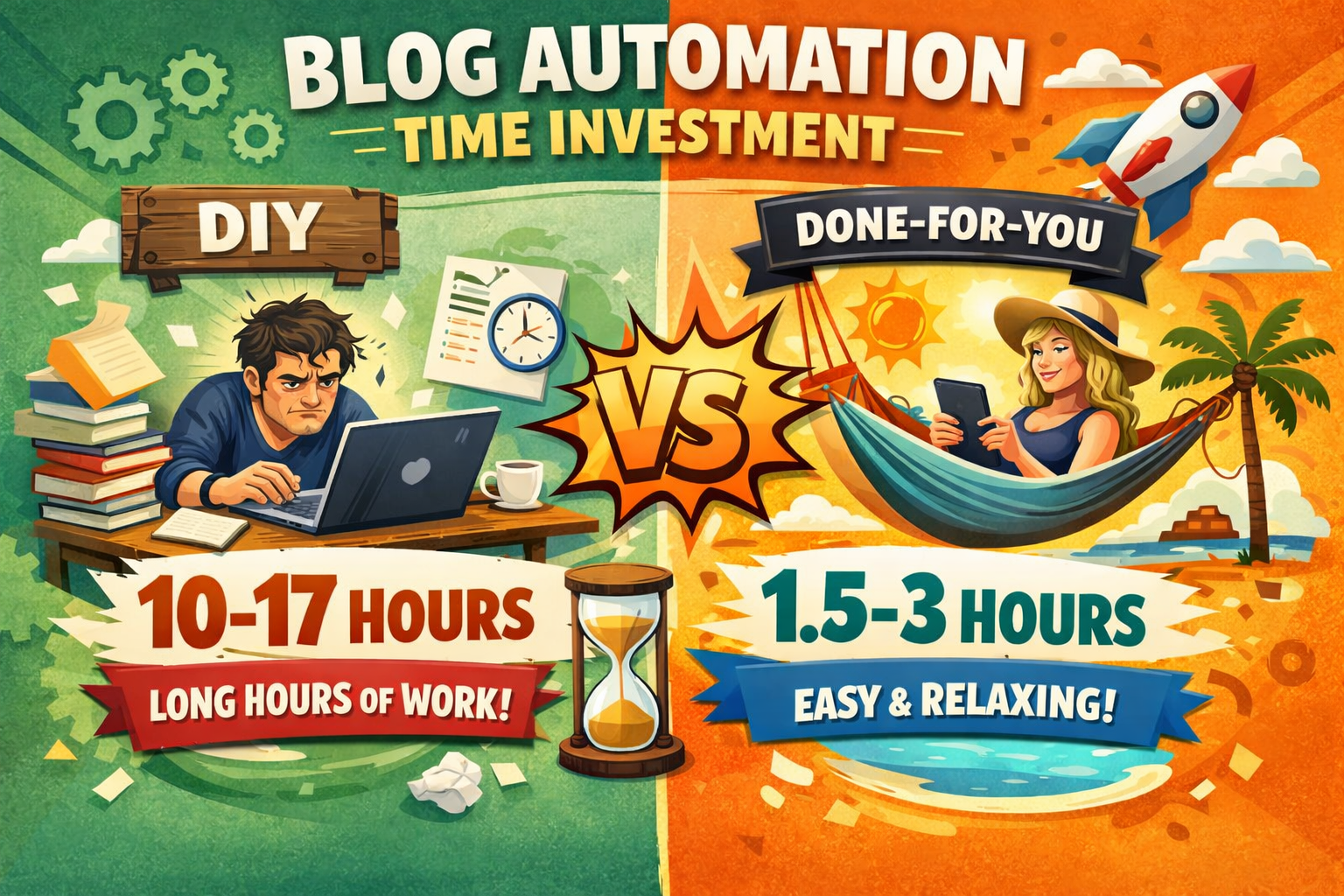
| Total | 10-17 hours |
That's one to two full workdays every week—assuming nothing goes wrong.
A caveat: experienced operators can work faster. Someone who's mastered prompt engineering and has streamlined workflows might land on the lower end of these ranges. But most marketing teams aren't staffed with dedicated content operations specialists. They're staffed with generalists juggling multiple priorities.
The hidden cost? Context switching. Your content manager isn't just running the automation. They're also attending strategy meetings, coordinating with sales, responding to leadership requests, and probably handling three other projects simultaneously. Those 10-17 hours rarely happen in focused blocks. They're scattered across the week, which research consistently shows reduces productivity and increases stress [2].
The DIY Tool Stack Cost
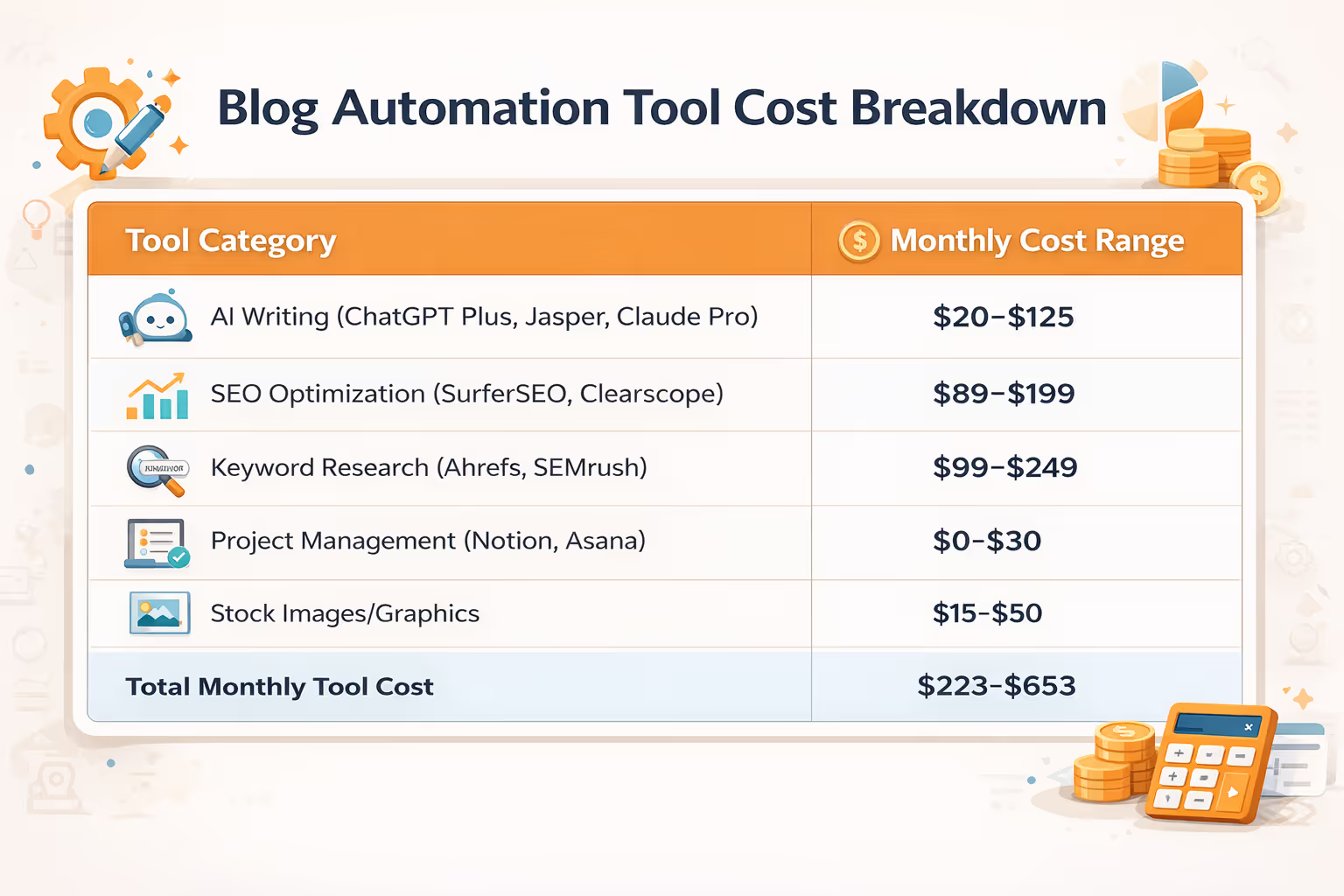
Beyond time, there's the financial investment in maintaining a competitive DIY setup:
| Tool Category | Monthly Cost Range |
| AI Writing (ChatGPT Plus, Jasper, Claude Pro) | $20-$125 |
| SEO Optimization (SurferSEO, Clearscope) | $89-$199 |
| Keyword Research (Ahrefs, SEMrush) | $99-$249 |
| Project Management (Notion, Asana) | $0-$30 |
| Stock Images/Graphics | $15-$50 |
| Total Monthly Tool Cost | $223-$653 |
These numbers add up. And they don't include the learning curve required to use each tool effectively—or the ongoing education needed as platforms evolve.
What Done-For-You Blog Automation Actually Looks Like
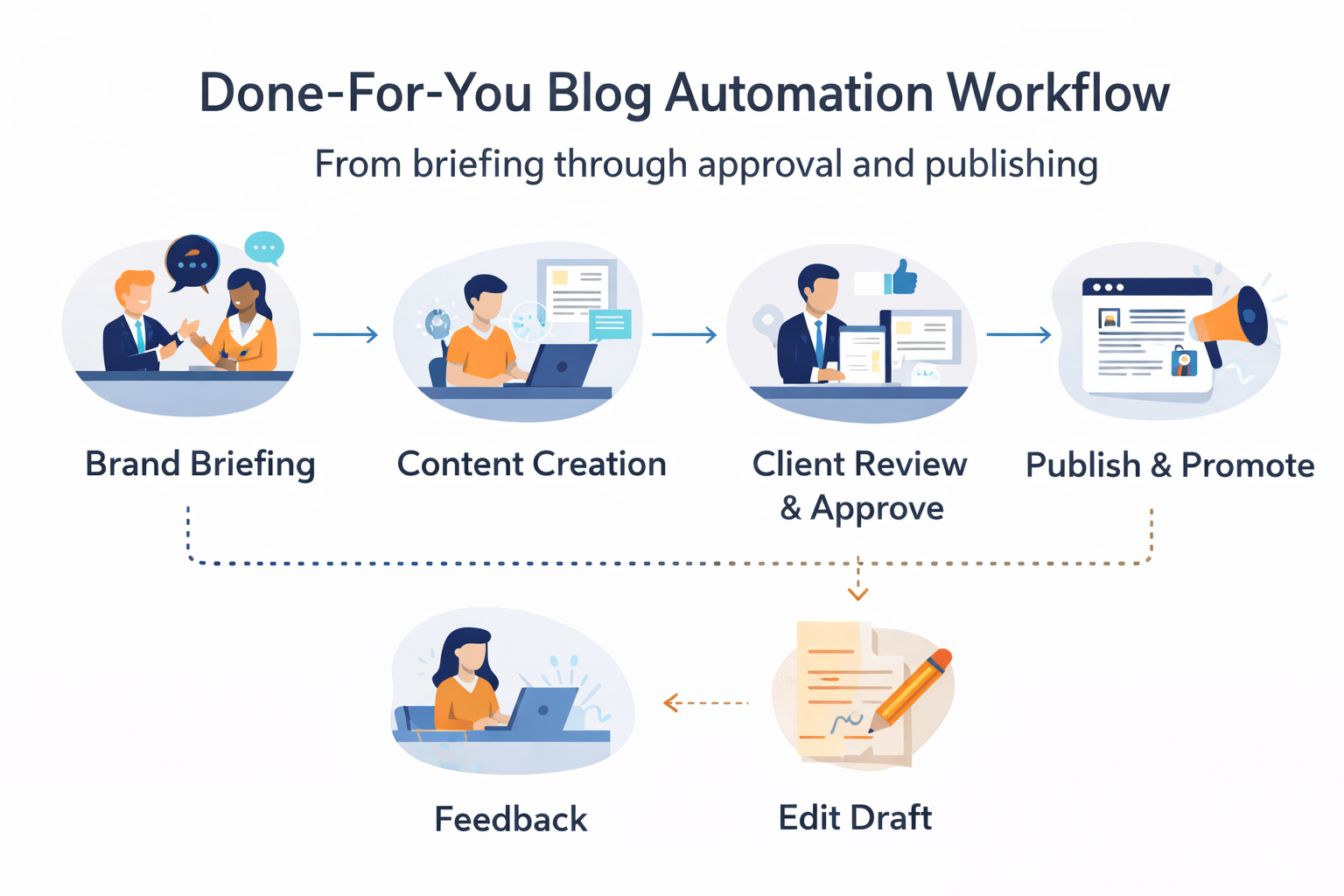
Done-for-you blog automation flips the model. An external partner handles research, drafting, optimization, and often publishing. Your team's role shifts from operator to approver.
The "automation" in this model isn't software you run—it's a system that runs without your direct involvement. The partner uses their own tools, processes, and expertise. You receive finished content ready for review.
Typical Done-For-You Time Investment (2-3 posts per week):
| Task | Weekly Hours |
| Initial onboarding and brand briefing | 2-4 hours (one-time) |
| Reviewing and approving drafts | 1-2 hours |
| Occasional feedback and direction | 0.5-1 hour |
| Weekly Total (after onboarding) | 1.5-3 hours |
The math is stark. Done-for-you approaches typically require 80-85% less weekly time investment compared to DIY automation.
But time savings alone don't tell the whole story. The type of time matters too.
Reviewing and approving content is cognitively easier than creating it. Your team isn't starting from a blank page or wrestling with AI prompts. They're evaluating existing work against known standards. That's a fundamentally different—and less draining—mental task.
The Real Cost Comparison: Beyond Hours
Time investment is the obvious metric. Here are the ones most teams forget to calculate:
Opportunity Cost
Every hour your content manager spends wrestling with AI prompts in ChatGPT or optimizing drafts in SurferSEO is an hour not spent on strategy, analysis, or high-value creative work. DIY automation often consumes your most capable people with operational tasks that don't leverage their expertise.
What could your marketing lead accomplish with 10-15 extra hours per week? Campaign strategy. Customer research. Competitive analysis. The work that actually moves the business forward.
Learning Curve
AI tools evolve constantly. ChatGPT updates its models. SurferSEO changes its scoring algorithms. New competitors emerge. Staying proficient requires ongoing education. HubSpot's research indicates that marketers spend significant time each week just keeping up with industry changes and tool updates [3]. DIY automation adds to that burden substantially.
Quality Variance
DIY automation quality depends entirely on your team's skill with the tools—and their available bandwidth on any given week. Some weeks you produce excellent content. Other weeks—when Q4 planning kicks in or a product launch demands attention—quality drops or publishing stops entirely.
Done-for-you models provide more consistent output because production capacity isn't competing with your internal calendar. The content keeps flowing regardless of what else is happening in your organization.
Burnout Risk
This brings us back to that 61% burnout statistic. DIY automation doesn't reduce workload—it transforms it. Your team trades one type of work (manual writing) for another type (managing AI systems, optimizing outputs, maintaining workflows). For teams already at capacity, that transformation doesn't solve the underlying problem.
Done-for-you automation genuinely removes work from your team's plate. The difference between "doing it faster" and "not doing it at all" is the difference between redistributing stress and eliminating it.
When DIY Blog Automation Makes Sense
DIY isn't wrong for everyone. It's wrong for most stretched teams—but not all.
DIY blog automation works when:
You have dedicated content operations staff. If someone's primary job is managing the content pipeline—not squeezing it between other responsibilities—DIY becomes viable. This person can develop genuine expertise with the tools and maintain consistent quality.
Your team genuinely enjoys the process. Some marketers love optimizing AI workflows. They find satisfaction in crafting perfect prompts, testing new tools, and refining systems. If that's your team, DIY can be energizing rather than draining. Just make sure you're not confusing enthusiasm for capacity.
Budget constraints are severe. Early-stage startups with more time than money may need to DIY initially. A founder spending evenings learning ChatGPT and SurferSEO is making a rational trade-off. Just recognize this as a temporary measure, not a permanent solution. As the company grows, the founder's time becomes too valuable for content operations.
You need hyper-specialized content. Certain technical or regulated industries—think medical devices, financial compliance, or deep enterprise software—may require in-house expertise that's genuinely difficult to outsource. If your content demands specialized knowledge that external partners can't realistically acquire, DIY may be necessary.
When Done-For-You Blog Automation Makes Sense
Done-for-you approaches work best when:
Your team is already stretched. This is the most common scenario. If content consistently falls to the bottom of the priority list, adding more tools won't help. Removing the workload will. Your team's constraint isn't capability—it's capacity.
Consistency matters more than control. Publishing reliably every week compounds over time. Google's algorithms reward consistent publishing signals [4]. Your audience expects regular content. Sporadic bursts of DIY content—no matter how well-optimized in the moment—can't match steady output sustained over months.
You value outcomes over process. Some teams care deeply about how content gets made. They want hands-on involvement at every stage. Others care about results: traffic, leads, authority. Done-for-you is built for the latter mindset. If you just want content that performs without managing the machinery, outsourcing makes sense.
Your content team should be doing higher-value work. Strategic planning, customer research, campaign development, and sales enablement all benefit from your team's attention more than prompt engineering does. Done-for-you frees your people to focus on work that leverages their unique knowledge of your business.
How to Calculate Your Team's Real Time Savings
Here's a framework for estimating the impact:
Step 1: Track current time investment honestly.
For two weeks, have your content team log hours spent on every blog-related task. Include the hidden work: Slack discussions about topics, research rabbit holes, revision cycles, tool troubleshooting. Most teams underestimate their actual time investment by 40-60% because so much of it happens in scattered fragments.
Step 2: Identify your effective hourly cost.
Take your content team's fully loaded cost (salary plus benefits plus overhead) and divide by productive hours. For most marketing teams, this lands between $50-$100 per hour, depending on seniority and location.
Step 3: Calculate weekly content cost.
Multiply hours by effective hourly rate. If your team spends 15 hours weekly on blog content at $75/hour, that's $1,125 per week—or roughly $4,500 per month in labor costs alone. Add tool subscriptions ($200-$650/month), and you're approaching $5,000 monthly for DIY content operations.
Step 4: Compare against done-for-you alternatives.
Done-for-you blog services typically range from $250-$800 per month for consistent weekly publishing. Even at the higher end, the direct cost is often 80% lower than fully-loaded DIY when you account for both labor and tools.
Step 5: Factor in opportunity cost.
What could your team accomplish with 10-15 extra hours weekly? If those hours go toward initiatives that generate revenue or improve retention, the ROI on outsourcing extends far beyond the content itself.
The Consistency Factor: Why Regularity Beats Intensity
Content marketing compounds. Publishing three solid posts weekly for six months beats publishing 50 posts in one month then going quiet.
Google's algorithms reward consistent publishing signals [4]. Fresh content tells search engines your site is active and maintained. Regular publishing builds topical authority over time. Your audience learns to expect and return for new material.
DIY automation makes consistency difficult because it competes for attention with everything else on your plate. When Q4 planning kicks in, the blog suffers. When a product launch demands focus, publishing gaps appear. When key team members take vacation, the content calendar falls apart.
Done-for-you models decouple your publishing consistency from your internal capacity fluctuations. Content keeps flowing even when your team is slammed with other priorities. That reliability is often the difference between content that compounds into real traffic and content that stalls before it gains momentum.
The Quality Question: Does Outsourcing Sacrifice Standards?
This is the fear that keeps many teams locked into DIY: "Nobody knows our business like we do."
That's true. But it's also less relevant than it seems.
Effective done-for-you partners invest heavily in understanding your business, audience, and voice during onboarding. They document your preferences, study your existing content, and learn your terminology. The initial kickoff requires your expertise. Ongoing production requires your approval. But the heavy lifting—research, drafting, optimization—doesn't require your hands on keyboard.
The real quality question isn't "who writes it?" It's "does it perform?"
Content that ranks, attracts visitors, and generates leads is high-quality content—regardless of who produced it. Content that never gets published because your team didn't have time isn't high-quality. It's invisible. The best post your team could theoretically write means nothing if it stays stuck in the ideas phase indefinitely.
You maintain editorial control by reviewing and approving all content before publication. Done-for-you doesn't mean hands-off—it means hands-off production with hands-on approval.
Making the Transition: From DIY to Done-For-You
If you're considering shifting from DIY to done-for-you, here's how to make it work:
Start with a trial period. Most reputable services offer sample content before commitment. Use this to evaluate quality fit without risk. Pay attention to how well they capture your voice after minimal guidance—that's a signal of their process quality.
Document your brand voice thoroughly. The better your onboarding materials, the faster a partner can match your standards. Include examples of content you love, content you don't, and specific language preferences. Share your style guide if you have one. Explain the technical terminology your audience expects.
Maintain editorial oversight. Done-for-you doesn't mean you disappear. You should review and approve every piece before publication. That review time is the investment; everything else gets outsourced. Most teams find that 15-30 minutes per article is sufficient once the partner understands their standards.
Set clear success metrics. Define what "working" looks like before you start. Traffic growth? Lead generation? Publishing consistency? Keyword rankings? Know your targets so you can evaluate honestly after 90 days. Content marketing compounds slowly—give the approach time to demonstrate results.
The Bottom Line on Blog Automation ROI
For most marketing teams, done-for-you blog automation delivers meaningfully better ROI than DIY. Not because the tools are different—but because the time investment is fundamentally lower.
DIY automation requires 10-17 hours weekly plus $200-$650 in tool costs. Done-for-you requires 1.5-3 hours weekly at comparable or lower total cost. That's not a marginal improvement. It's an order-of-magnitude difference in how much of your team's capacity gets consumed.
More importantly, done-for-you approaches protect your team from burnout by removing production burden rather than just shifting it. When 61% of content marketers are already burned out, that protection has value beyond any spreadsheet calculation.
The question isn't whether you can run blog automation yourself. Most teams can—at least for a while. The question is whether doing so represents the highest and best use of your team's limited time and energy.
For the majority of growth-focused organizations, the answer is no. The better path is treating content production as infrastructure you subscribe to, not a capability you build internally.
Ready to see what hands-off content production actually looks like? Try our free trial—we'll deliver two custom articles within 48 hours, no commitment required.
Frequently Asked Questions
How much time does DIY blog automation really take each week?
Most teams underestimate significantly. When you account for keyword research in tools like Ahrefs, AI prompt optimization in ChatGPT or Jasper, editing, fact-checking, SEO work in SurferSEO, and publishing, realistic estimates range from 10-17 hours weekly for 2-3 quality posts. That's before counting productivity loss from context switching. Experienced operators can work faster, but most marketing generalists don't have that level of specialization.
Will done-for-you content match my brand voice?
Quality done-for-you services invest heavily in onboarding to understand your brand voice, audience, and standards. You maintain editorial control by reviewing and approving all content before publication. The result should feel like your team wrote it—because you shaped the direction, provided the context, and approved the final product. If something misses the mark, feedback loops help the partner improve quickly.
What's the break-even point for outsourcing blog content?
Calculate your team's fully loaded hourly cost (typically $50-100/hour for marketing staff), multiply by weekly content hours, and add tool subscription costs ($200-$650/month). Compare against done-for-you pricing. Most teams find outsourcing costs 60-80% less than internal production while freeing significant capacity for higher-value work that leverages their unique business knowledge.
Can automation help with content team burnout?
DIY automation often redistributes burnout rather than solving it—your team trades manual writing for AI management and tool optimization. Done-for-you automation genuinely reduces workload by eliminating production responsibilities entirely. Given that 61% of content marketers report burnout, this distinction matters for long-term team sustainability and retention.
How quickly can I expect results from consistent blog publishing?
Content marketing compounds over time. Most organizations see measurable traffic improvements within 90 days of consistent publishing, with significant momentum building over 6-12 months. The key is regularity—done-for-you models excel here because publishing doesn't depend on your internal capacity fluctuations. Sporadic content rarely achieves the same compounding effect.
About Our Expertise
The Mighty Quill was founded by marketers who spent years managing content operations firsthand—and experienced the burnout that comes with trying to scale blog production internally. Our team combines deep SEO expertise with practical understanding of what marketing teams actually need: consistent, high-quality content that performs, delivered without adding to your workload. We've helped SaaS companies, e-commerce brands, and agencies build sustainable content engines that drive organic traffic month after month.
Works Cited
[1] Orbit Media Studios — "Annual Blogging Survey." https://www.orbitmedia.com/blog/blogging-statistics/
[2] American Psychological Association — "Multitasking: Switching Costs." https://www.apa.org/topics/research/multitasking
[3] HubSpot — "State of Marketing Report." https://www.hubspot.com/state-of-marketing
[4] Search Engine Journal — "How Publishing Frequency Affects SEO." https://www.searchenginejournal.com/google-posting-frequency-rankings/