The number on the invoice never tells the whole story.
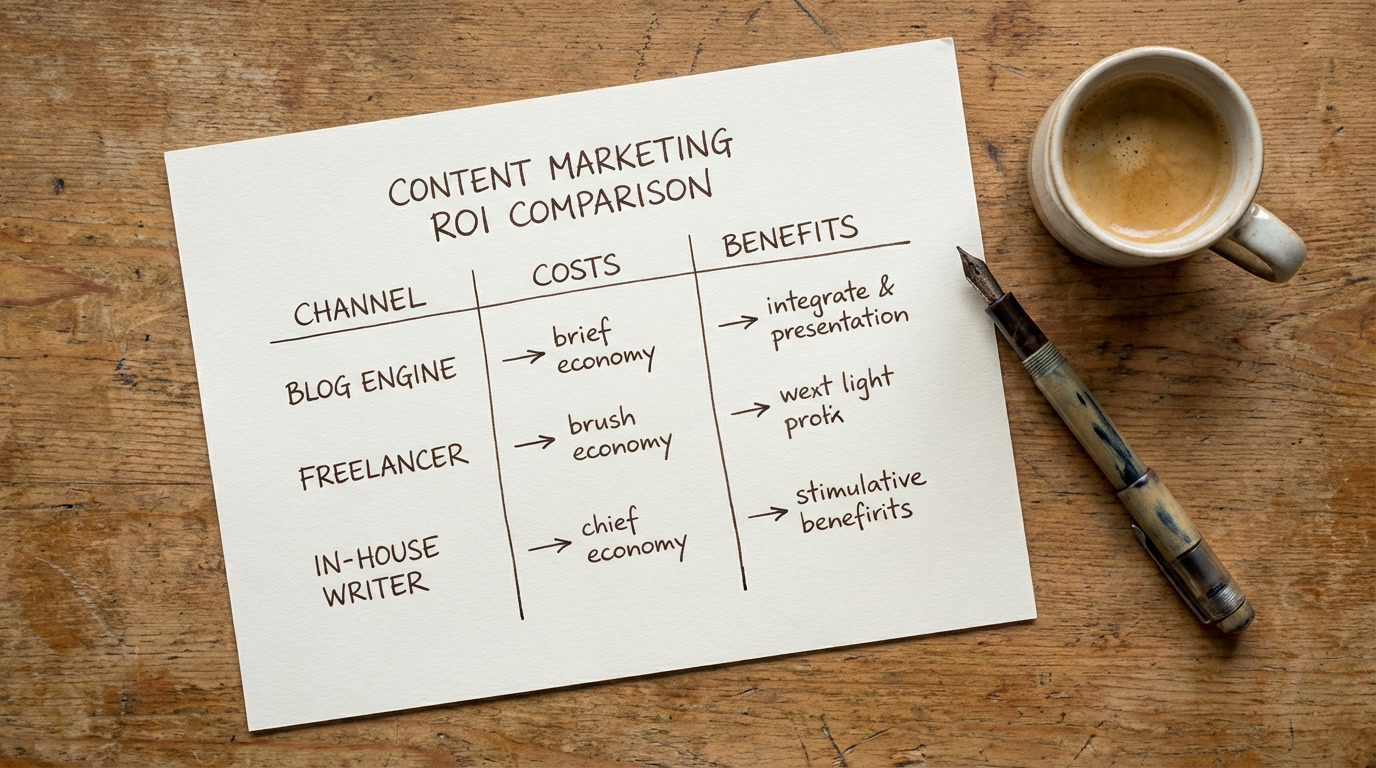
When you're comparing content options, the sticker price—$250 for a blog engine, $150 per article from a freelancer, or $5,000/month for an in-house writer—looks like a straightforward decision. Run the numbers, pick the cheapest per-word rate, move on.
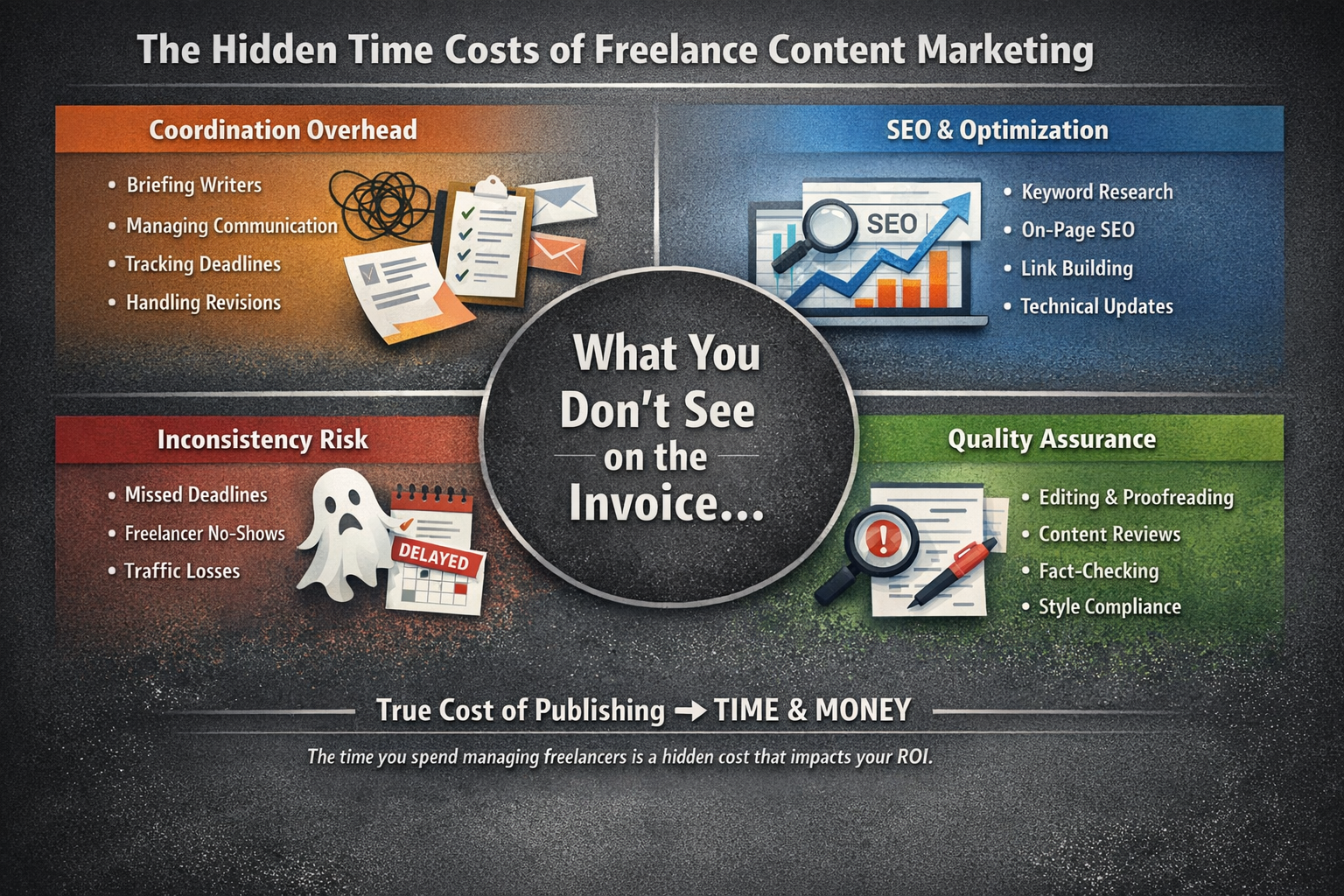
But here's what that math misses: the total cost of publishing extends far beyond the writing itself. There's the coordination overhead. The quality assurance. The SEO optimization. The consistency risk when your freelancer disappears mid-project or your in-house writer calls in sick for a week.
This article breaks down the honest ROI math for three common content approaches—blog engines, freelancers, and in-house teams—so you can see what you're actually buying at each price point. We'll look at real scenarios for SaaS companies, ecommerce brands, and agencies, because the right choice depends heavily on your specific context.
And yes, we'll be candid about where a blog engine doesn't fit—because understanding the limitations makes the comparison actually useful.
The Hidden Costs Most Comparisons Ignore
Before we dig into specific numbers, let's establish what "total cost of publishing" actually means. Every piece of content that goes live on your site involves several layers of work:
Direct production costs include the obvious: writing, editing, and revisions. This is what most people calculate when comparing options.
Coordination overhead includes briefing writers, managing communication, tracking deadlines, handling revisions, and maintaining quality standards across multiple pieces. According to research from the Content Marketing Institute, content teams spend roughly 25% of their time on coordination and project management rather than actual content creation [1].
SEO operations cover keyword research, on-page optimization, internal linking, schema markup, and technical implementation. These tasks are often treated as "someone else's job"—until you realize they're not getting done at all.
Consistency risk represents the opportunity cost when publishing stops. A freelancer who ghosts you doesn't just cost you one article—they cost you the compounding organic traffic that article would have generated over months and years.
Let's apply these factors to each option.
Option 1: The Blog Engine Model ($250–$400/month)
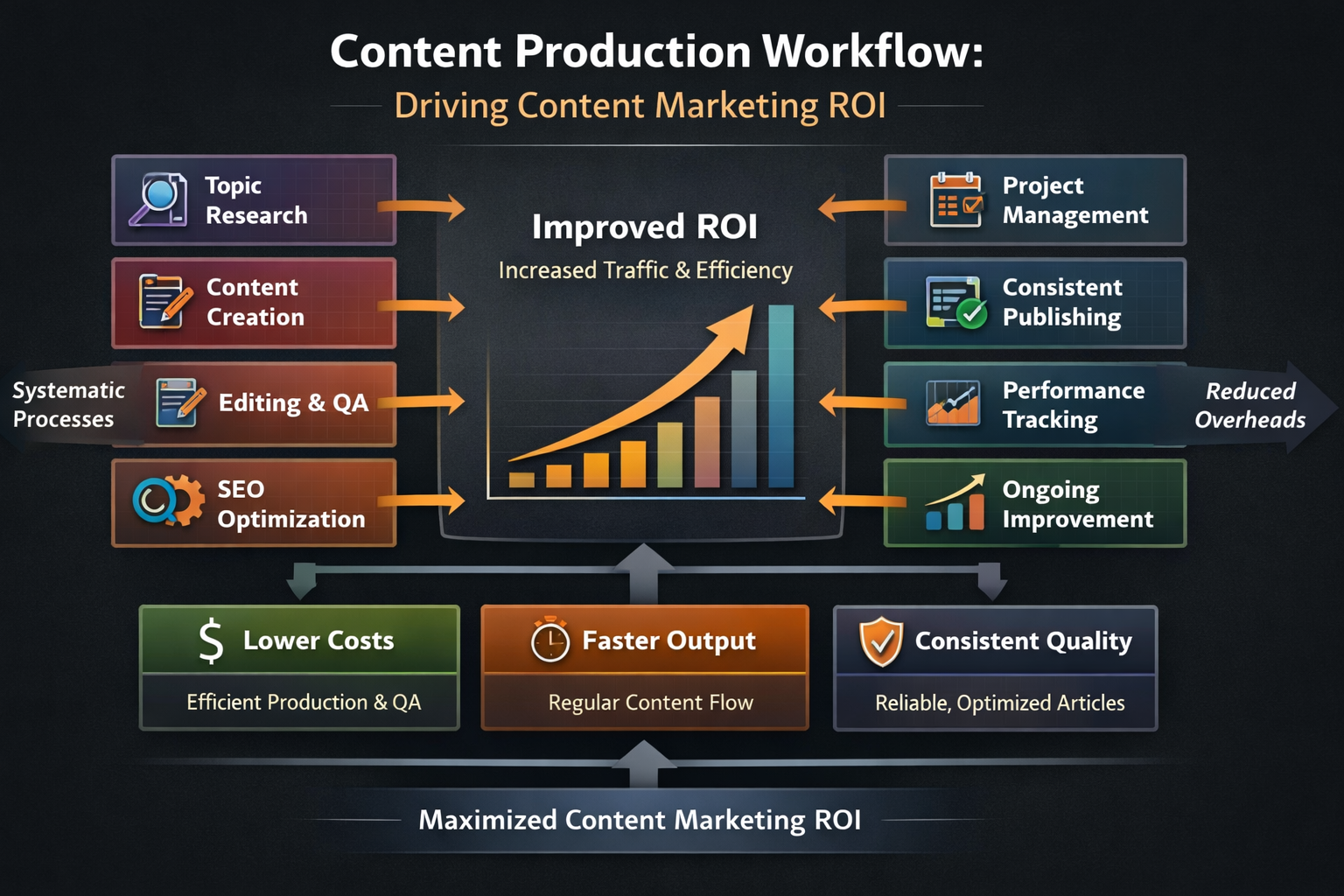
A blog engine like The Mighty Quill operates on a subscription model: you pay a fixed monthly rate for a set number of articles, typically 2–3 per week. The service handles everything from topic research to final publishing.
What You're Actually Buying
| Component | Included | Your Time Required |
| Keyword/topic research | Yes | 0 hours |
| Writing (2 articles/week) | Yes | 0 hours |
| Editing and QA | Yes | 0 hours |
| SEO optimization | Yes ($400 tier) | 0 hours |
| Publishing | Yes ($400 tier) | 0 hours |
| Revision management | Yes | ~30 min/week for approvals |
Monthly cost: $250–$400Monthly time investment: 2–4 hoursEffective cost per article: ~$31–$50
The $31/Article Question
Let's address the obvious skepticism: How can content at $31 per article be any good?
Fair question. At that price point, most people assume you're getting raw AI output—the kind of generic fluff that search engines increasingly ignore.
Here's what actually makes the economics work: blog engines build systems around efficiency, not shortcuts. The model combines AI-assisted drafting with human editorial oversight and structured workflows. Topic research happens once and informs multiple pieces. Style guides are established upfront rather than re-explained every assignment. Quality control is built into the process rather than bolted on after.
Think of it like any subscription service that achieves scale—the per-unit cost drops because the infrastructure supports consistent production. You're not paying for one article; you're paying for access to a content system.
That said, this model works best for consistent top-of-funnel and mid-funnel content: educational blog posts, industry insights, how-to guides, and SEO-driven articles. It's not designed for highly technical documentation, original research, or thought leadership pieces that require deep proprietary knowledge.
The Consistency Factor
Content marketing compounds over time. Research from HubSpot shows that companies publishing 16+ blog posts per month get 3.5x more traffic than those publishing 0–4 posts [2]. But that benefit only materializes if you actually publish consistently.
Blog engines are designed around this principle. Two articles per week means 8–10 posts per month, every month, without fail. That consistency is built into the service model.
Option 2: The Freelancer Model ($100–$300/article)
Freelance writers offer flexibility and specialization. You can hire subject-matter experts, scale up or down as needed, and pay only for what you use.
What You're Actually Buying
| Component | Included | Your Time Required |
| Keyword/topic research | Sometimes | 2–4 hours/month |
| Writing | Yes | 0 hours |
| Editing and QA | Rarely | 1–2 hours/article |
| SEO optimization | Rarely | 1–2 hours/article |
| Publishing | No | 30–60 min/article |
| Revision management | Yes | Variable |
Monthly cost (8 articles): $800–$2,400 in writer feesMonthly time investment: 15–30 hoursEffective cost per article: $100–$300 + your time
Here's where the math gets tricky. That $150/article rate doesn't include:
The 2 hours you spent writing the brief
The 45 minutes you spent giving feedback on the draft
The hour you spent adding internal links and optimizing the meta description
The 30 minutes you spent uploading and formatting in your CMS
When you factor in your time at even a conservative $50/hour, that $150 article actually costs $300–$400 in real resources.
The Coordination Tax
Managing freelancers is a skill. A good freelancer relationship requires:
Clear, documented brand guidelines
Detailed briefs for each piece
A reliable feedback loop
Backup writers when your primary is unavailable
According to a survey by Contently, 73% of marketers say managing freelancers takes more time than expected [3]. This "coordination tax" compounds as you scale.
There's also the scope creep problem. The $150 quote often expands: rush fees when you need something fast, revision charges when the first draft misses the mark, additional costs for images or formatting. What started as a predictable expense becomes variable.
If you're producing 2 articles per week with freelancers, you're effectively running a small editorial operation—whether you planned to or not.
When Freelancers Make Sense
Despite these challenges, freelancers excel in specific situations:
Deep subject matter expertise: A former engineer writing about technical architecture brings credibility a generalist can't match
One-off projects: Annual reports, specific campaigns, or experimental content types
Overflow capacity: Supplementing your primary content engine during product launches or peak seasons
The key is matching the model to the use case—not defaulting to freelancers because it feels like the "obvious" choice.
Option 3: The In-House Model ($4,000–$8,000/month)
Hiring a dedicated content writer gives you full control over your content operation. They learn your voice, understand your product, and become part of your team.
What You're Actually Buying
| Component | Included | Your Time Required |
| Keyword/topic research | Maybe | 2–4 hours/month (oversight) |
| Writing | Yes | 0 hours |
| Editing and QA | Sometimes | 2–4 hours/week |
| SEO optimization | Varies by skill set | 2–4 hours/week |
| Publishing | Usually | 0 hours |
| Management | No | 4–8 hours/week |
Monthly cost: $4,000–$8,000 (salary + benefits + tools)Monthly time investment: 20–40 hours (management + oversight)Effective cost per article (8/month): $500–$1,000
The Bureau of Labor Statistics puts the median salary for content writers at approximately $50,000–$70,000 annually, with total employer costs (benefits, taxes, equipment) adding 20–30% on top [4].
The Management Reality
In-house writers need management. They need feedback, direction, professional development, and coverage when they're sick or on vacation. The Content Marketing Institute reports that content teams with dedicated managers produce 60% more content than those without [1].
If you don't have someone to manage your writer, you become that manager—whether it's in your job description or not.
There's also the ramp-up period. Most in-house writers take 2–3 months to fully understand your product, audience, and voice. During that time, you're paying full salary for reduced output.
When In-House Makes Sense
In-house hiring becomes the right choice when:
Content is a core competitive advantage: Companies where proprietary insights drive differentiation need writers embedded in the business
Volume justifies the overhead: At 20+ pieces per month, the management costs amortize more effectively
You need cross-functional integration: Writers who participate in product development, sales enablement, and customer research
Technical documentation is central: API guides, developer docs, and engineering content often require in-house expertise
For most companies under 50 employees focused primarily on blog content for SEO, the management overhead exceeds the benefits.
What About Traditional Marketing Agencies?
You might be wondering: what about outsourcing to a full-service content agency?
Agencies typically charge $1,000–$5,000+ per month for content services, depending on volume and complexity. They offer strategic oversight, account management, and often handle multiple content types (blog, social, email).
The agency model makes sense when you need comprehensive marketing support beyond just blog content—or when you're scaling rapidly and need a partner that can grow with you.
However, for companies specifically focused on consistent blog publishing for SEO, agencies often introduce more overhead than necessary. You're paying for account managers, strategy meetings, and coordination layers that a focused blog engine eliminates.
This comparison focuses on the blog-specific decision because that's where the ROI math differs most dramatically.
Scenario Analysis: Which Model Fits Your Situation?
The right choice depends on your specific context. Let's look at three common scenarios—with honest assessments of each option's fit.
Scenario A: SaaS Company (Series A, 20 employees)
Situation: You have product-market fit and need to build organic visibility. Your marketing team is 2 people, both stretched thin. You need educational content that speaks to technical decision-makers.
Blog Engine Assessment:
Pros: Immediate capacity, no management overhead, consistent output
Cons: Cannot produce deep technical documentation, API guides, or engineering content that requires hands-on product knowledge
Fit score: Strong for top-of-funnel educational content; weak for technical docs
Freelancer Assessment:
Pros: Can hire subject-matter experts with technical backgrounds
Cons: Coordination overhead falls on already-stretched team, consistency risk
Fit score: Moderate if you have capacity to manage; weak if you don't
In-House Assessment:
Pros: Deep product knowledge, embedded in the team
Cons: Expensive, single point of failure, 3-month ramp time
Fit score: Weak at this stage (better at Series B+ with dedicated content management)
Recommendation: Start with a blog engine to establish publishing cadence for educational content. Use freelance specialists for occasional deep-dive technical pieces. Plan for in-house hire when you reach 50+ employees and can justify dedicated management.
Scenario B: Ecommerce Brand ($2M ARR)
Situation: You sell specialty products and compete on expertise. Your content needs to demonstrate product knowledge and build trust. You have a marketing manager who handles everything from email to paid ads.
Blog Engine Assessment:
Pros: Frees up marketing manager's time, consistent publishing
Cons: Will need product-specific input for accuracy on detailed buying guides
Fit score: Strong for category education, industry trends, and how-to content
Freelancer Assessment:
Pros: Can hire writers in your niche
Cons: Marketing manager has no capacity to manage writers effectively
Fit score: Weak given coordination overhead
In-House Assessment:
Pros: Deep product knowledge
Cons: $60K+ salary for someone who writes 8 articles/month
Fit score: Weak unless content extends beyond blog (email, product descriptions, social)
Recommendation: Blog engine with clear product guidelines for the bulk of content. Use the time saved to focus on conversion optimization and email marketing—activities with more direct revenue impact.
Scenario C: Marketing Agency (15 clients)
Situation: You offer content marketing services but don't have the internal capacity to produce at scale. You need white-label content that you can deliver under your clients' brands.
Blog Engine Assessment:
Pros: Scalable, predictable costs, handles production
Cons: Requires clear per-client briefing system; less suited for clients needing highly custom thought leadership
Fit score: Strong for clients needing consistent SEO-driven content
Freelancer Assessment:
Pros: Flexible, can match writers to client industries
Cons: Managing 15+ client relationships with freelancers is a full-time job
Fit score: Moderate only if you hire a dedicated content manager
In-House Assessment:
Pros: Full control, custom work
Cons: Need 2–3 writers to handle 15 clients, plus management overhead
Fit score: Moderate at scale; expensive to start
Recommendation: Blog engine as your production backbone for clients who need consistent volume. Supplement with freelance specialists for clients requiring unique expertise or premium thought leadership positioning.
The Compounding Math Most People Miss
Here's the number that rarely appears in content ROI calculations: time to value.
Every day you're not publishing is a day you're not building organic traffic. Content compounds—but only if it exists. Research from Ahrefs shows that the average top-ranking page is 2+ years old [5]. The sooner you start publishing consistently, the sooner you start building that asset.
Consider two scenarios:
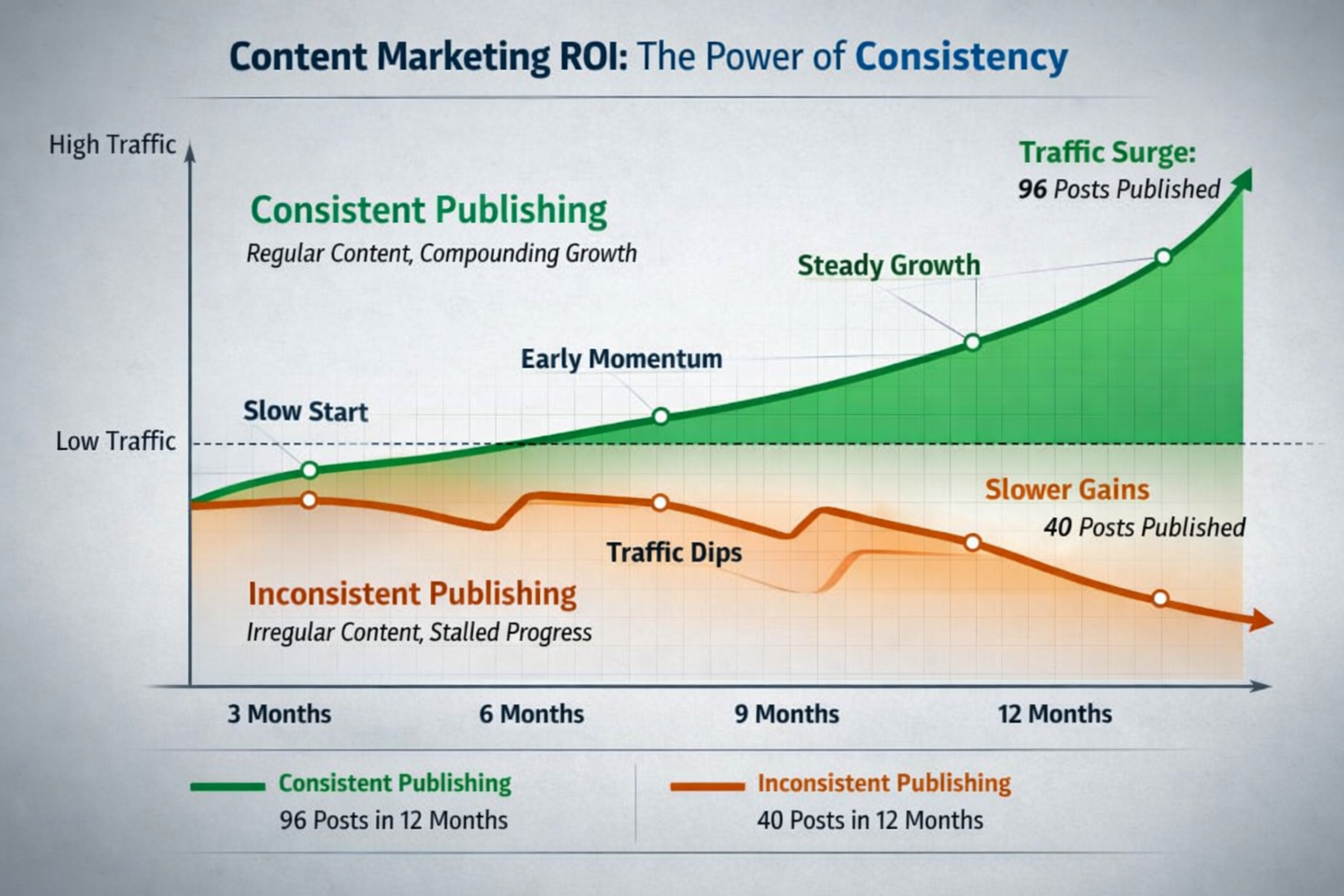
Company A spends 3 months "finding the right freelancer," then publishes inconsistently (averaging 4 posts/month). After 12 months, they have 40 posts.
Company B starts with a blog engine immediately and publishes 8 posts/month consistently. After 12 months, they have 96 posts.
Company B doesn't just have 2.4x more content—they have 2.4x more opportunities to rank, 2.4x more internal linking possibilities, and a 3-month head start on every single piece.
That head start matters. A lot.
Making the Decision: Questions to Ask Yourself
Before you choose an approach, answer these questions honestly:
Do you have someone who can manage content operations?If no, freelancers and in-house writers both become significantly more expensive (in time) than they appear.
How important is consistency to your strategy?If you're serious about organic growth, consistency isn't optional. Choose the option with the lowest consistency risk.
What's your realistic time horizon?If you need results in 90 days, you need volume now—not a 3-month ramp-up period.
What's the true cost of your time?Coordination overhead is real. If you're a founder or marketing lead, every hour spent managing content is an hour not spent on strategy, sales, or product.
What type of content do you actually need?A blog engine excels at consistent SEO-driven content. Original research, technical documentation, or thought leadership from named executives requires different solutions.
The Bottom Line
The honest ROI math looks like this:
| Model | Apparent Cost (8 articles/month) | True Cost (including time) | Consistency Risk | Best For |
| Blog Engine | $250–$400 | $300–$450 | Low | SEO-driven content at scale |
| Freelancers | $800–$2,400 | $1,400–$3,600 | Medium-High | Specialized expertise, overflow |
| In-House | $4,000–$8,000 | $5,500–$10,000 | Medium | High-volume, cross-functional needs |
The blog engine model isn't the right choice for everyone. If you need original research, proprietary thought leadership from named executives, or highly technical documentation, those require different approaches. If content strategy is a core competitive advantage requiring deep institutional knowledge, in-house makes sense despite the cost.
But for most growing companies—especially SaaS, ecommerce, and agencies—focused on consistent blog content for organic growth, the total cost of publishing makes the blog engine model significantly more efficient than the sticker price suggests.
The $250/month doesn't just buy you articles. It buys you consistency. It buys you time. It buys you the elimination of coordination overhead that silently eats into every other approach.
That's what the honest math shows.
Want to see if a blog engine fits your situation? The Mighty Quill offers a free 48-hour trial: 2 custom articles for your business, no commitment required. It's the fastest way to validate quality and fit before making a decision. [Start your free trial today.]
Frequently Asked Questions
How does a blog engine maintain quality at $31 per article?
Blog engines achieve efficiency through systems, not shortcuts. The model combines AI-assisted drafting with human editorial oversight, structured workflows, and established style guides. Topic research informs multiple pieces rather than starting from scratch each time. You're not paying for one article—you're accessing a content production system that amortizes costs across consistent output. Quality control is built into the process, and clients approve every piece before publication.
Can freelancers match the consistency of a blog engine?
Freelancers can be consistent, but it requires significant management investment on your end. You need backup writers, clear documentation, and a project management system to track deadlines. The Contently survey found 73% of marketers underestimate freelancer management time [3]. If you have a dedicated content manager, freelancers can work well. If content management falls on an already-stretched marketing lead, consistency usually suffers.
When does in-house hiring make sense over a blog engine?
In-house hiring typically makes sense when content is a core competitive advantage requiring proprietary knowledge, when you're producing 20+ pieces monthly (amortizing management costs), or when writers need deep integration with product development. For most companies below 50 employees focused on blog content for SEO, the management overhead and ramp-up time exceed the benefits compared to a blog engine.
What types of content are blog engines NOT suited for?
Blog engines excel at consistent, SEO-optimized educational content—but they're not designed for everything. Original research requiring primary data collection, highly technical API documentation, thought leadership attributed to specific executives, or content requiring deep proprietary product knowledge typically needs in-house expertise or specialized freelancers with hands-on access to your business.
How quickly can a blog engine start producing content?
Most blog engines can deliver initial content within 48–72 hours of onboarding. The full content calendar and topic bank usually take 1–2 weeks to develop. Compare this to 2–3 months for hiring and ramping up an in-house writer, or several weeks to find and vet reliable freelancers. Speed to value is one of the primary advantages of the blog engine model for companies that need to build organic visibility quickly.
About The Mighty Quill
The Mighty Quill was founded by Mario, a digital marketing professional with over 15 years of experience in SEO, content strategy, and ecommerce growth. After seeing too many companies struggle with inconsistent content—and watching blogs sit idle while organic opportunities passed them by—he built a system designed to solve the core problem: reliable, SEO-optimized content production without the management headache. The Mighty Quill combines AI-assisted efficiency with human editorial oversight to help SaaS companies, ecommerce brands, and agencies build sustainable organic traffic through consistent, quality-first publishing.
Cited Works
[1] Content Marketing Institute — "B2B Content Marketing Research Report." https://contentmarketinginstitute.com/research/
[2] HubSpot — "How Often Should Companies Blog?" https://blog.hubspot.com/marketing/blogging-frequency-benchmarks
[3] Contently — "The State of Content Marketing."
https://contently.com/strategist/
[4] Bureau of Labor Statistics — "Occupational Outlook Handbook: Writers and Authors." https://www.bls.gov/ooh/media-and-communication/writers-and-authors.htm
[5] Ahrefs — "How Long Does It Take to Rank in Google?"
https://ahrefs.com/blog/how-long-does-it-take-to-rank/