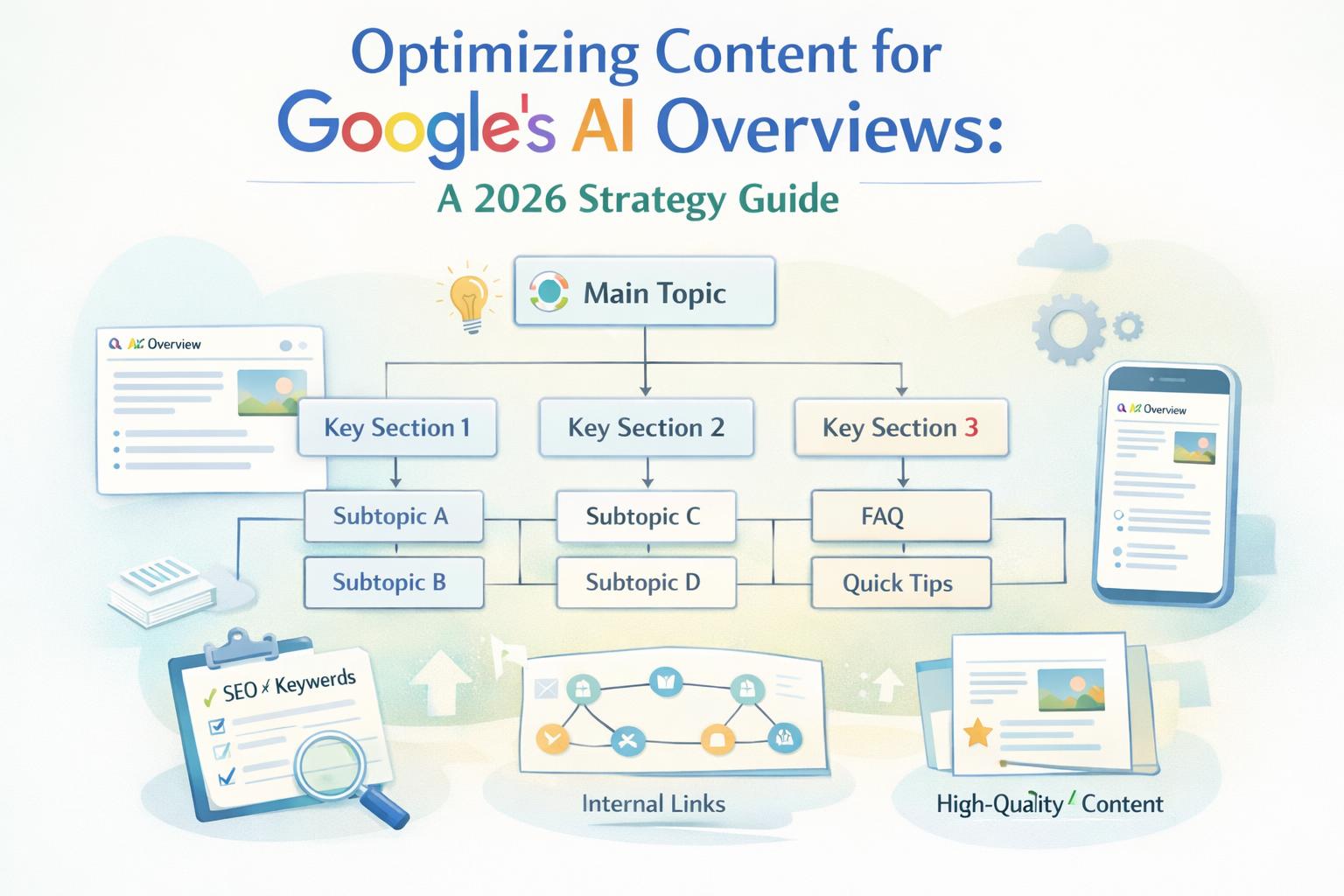
Google's AI Overviews have broken the old search playbook.
If you're still optimizing content the way you did two years ago, you've probably noticed the decline. Traffic's down. Rankings feel unstable. And those AI-generated summaries at the top of search results? They're pulling answers from somewhere—but increasingly, not from you.
Here's the uncomfortable truth: Google's generative search features now synthesize information from across the web and display it directly in the results [1]. Users get answers without clicking. Your carefully crafted blog post might be fueling those answers—or it might be getting ignored entirely.
The difference comes down to structure, authority, and whether your content is built for AI comprehension.
This guide covers what's actually working in 2026 for earning visibility in Google's AI-generated results—including the structural changes, E-E-A-T signals, and content strategies that get your work cited rather than bypassed.
Understanding AI Overviews and Why They Changed Everything
Let's get the terminology straight first. What Google initially called "Search Generative Experience" (SGE) during its beta phase has evolved into "AI Overviews"—the feature now live for billions of users worldwide [2]. If you're still targeting "SGE" as your primary keyword, you're optimizing for yesterday's searches.
AI Overviews work fundamentally differently than traditional search results. Instead of presenting ten blue links and letting users choose, Google's AI reads, synthesizes, and presents information directly. It pulls from multiple sources, combines perspectives, and generates a summary—often answering the user's question without requiring a single click.
This doesn't mean your website is irrelevant. Google's AI still needs source material. It actively cites the content it draws from, and users who want deeper information still click through. But the content that earns those citations looks different than what ranked well five years ago.
What Gets Selected for AI Overviews
Google's AI doesn't randomly pick sources. Through testing and observation, several patterns emerge in what content gets cited:
Topical authority matters more than ever. Sites demonstrating sustained expertise on a subject—through depth, consistency, and interconnected content—get preferenced over one-off articles.
Structure determines parseability. Content with clear hierarchies, logical organization, and explicit formatting gives AI systems confidence in extracting accurate information.
Factual specificity wins. Vague advice gets skipped. Concrete details, verifiable claims, and specific examples earn citations.
Freshness signals relevance. For evolving topics, outdated content gets deprioritized regardless of how well it once ranked [6].
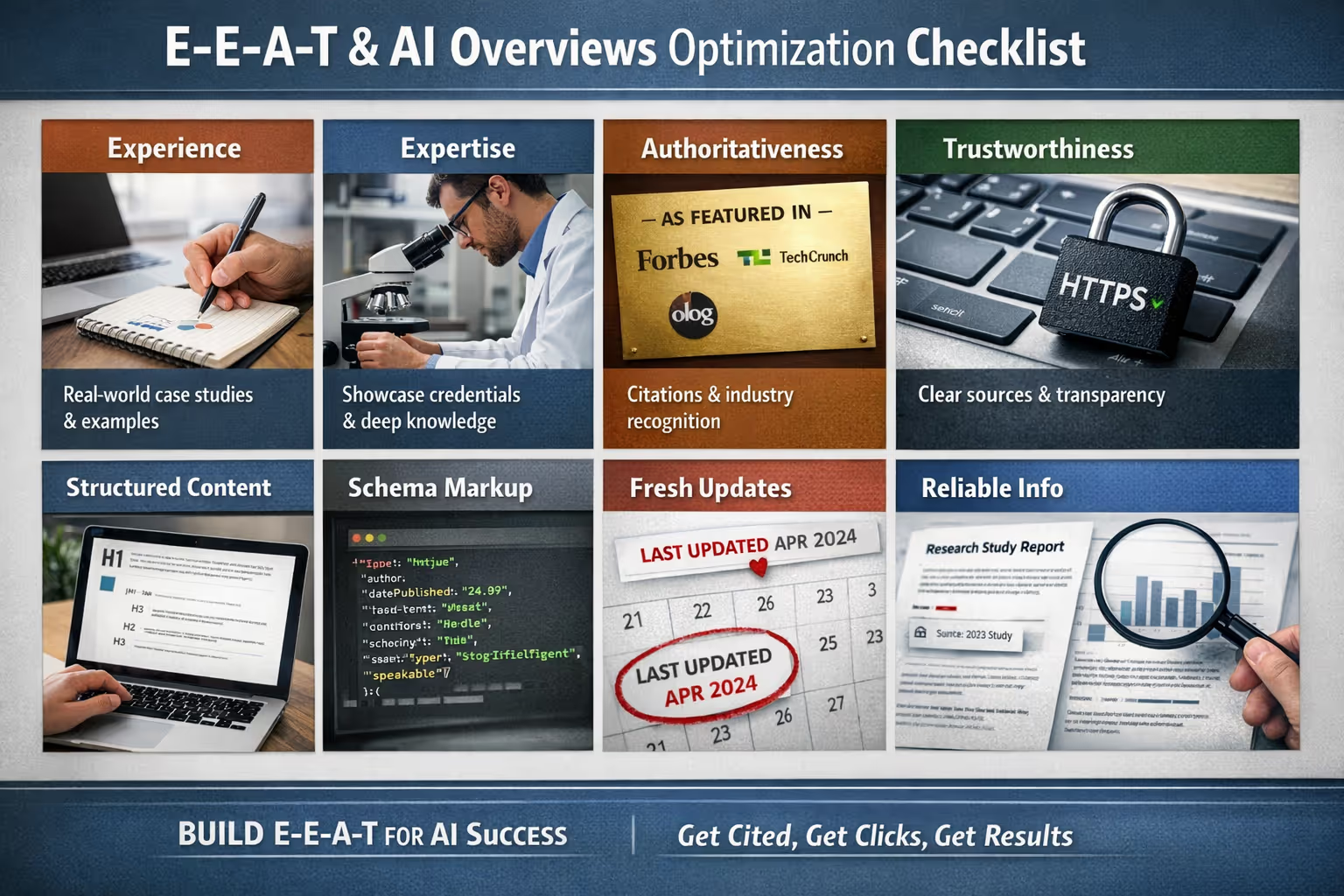
E-E-A-T signals establish trust. Experience, Expertise, Authoritativeness, and Trustworthiness indicators directly influence whether Google's AI treats your content as citation-worthy [3].
Understanding these factors isn't optional anymore. They form the foundation of any content strategy built for 2026 and beyond.
E-E-A-T: From Nice-to-Have to Non-Negotiable
Google's Quality Rater Guidelines have emphasized E-E-A-T signals for years. But AI Overviews amplified their importance dramatically. The AI needs to assess trustworthiness before synthesizing your content into an answer millions of people will see [4].
If your content doesn't demonstrate clear E-E-A-T signals, the AI has no reason to trust it—and plenty of reasons to choose competitors who do.
Experience: Prove You've Done the Thing
Generic advice that anyone could write performs poorly against content demonstrating hands-on knowledge. Google's AI can now detect the difference between theoretical knowledge and practical experience.
Before (weak experience signal):
"Internal linking is important for SEO. You should add internal links to your content."
After (strong experience signal):
"After restructuring our internal linking across 200+ blog posts, we tracked a 34% increase in pages per session within 60 days. The key insight: links placed within the first two paragraphs drove 3x more clicks than links buried at the end."
The difference? Specificity. Real numbers. Actual observations from doing the work.
Ways to demonstrate experience in your content:
Reference specific projects, timelines, and outcomes
Describe challenges you encountered and how you solved them
Include original data, screenshots, or documented processes
Share what didn't work alongside what did
Expertise: Show Domain Mastery
Expertise signals communicate that your content comes from someone who genuinely understands the subject—not someone who researched it for 20 minutes before writing.
Strong expertise indicators include:
Author credentials that matter: A byline from someone with relevant background carries weight. Generic "Staff Writer" attributions don't.
Coverage of nuance: Surface-level content skips the edge cases. Expert content addresses them directly.
Accurate terminology: Correct use of industry-specific language signals familiarity with the field.
Anticipation of questions: Experts know what readers will ask next and address it proactively.
Authoritativeness: Become the Source Others Reference
Authority isn't claimed—it's earned through recognition from others in your field. Google's AI evaluates not just your content, but how the broader web treats your site.
Building authority requires:
Earning citations from respected sources: When other authoritative sites link to your content, that signal compounds.
Developing content depth: A scattered blog covering dozens of unrelated topics signals nothing. Deep coverage of core areas signals expertise worth trusting.
Consistency over time: Publishing one great piece doesn't build authority. Sustained contribution to a topic area does.
Trustworthiness: Remove Every Reason for Doubt
Trust signals tell both users and AI systems that your content is reliable enough to cite confidently.
Essential trust elements:
Clear attribution for claims, statistics, and facts
Transparent information about who wrote the content and their qualifications
Accurate publication and last-updated dates
Secure site infrastructure (HTTPS, professional presentation)
Easy-to-find contact information and about pages
Structuring Content for AI Comprehension
Here's where many content teams fail: they write for humans only, assuming Google will figure out the structure. That assumption no longer holds.
AI systems process information differently than human readers. Optimizing for both requires intentional formatting choices that make your content's structure explicit.
Hierarchical Organization That AI Can Parse
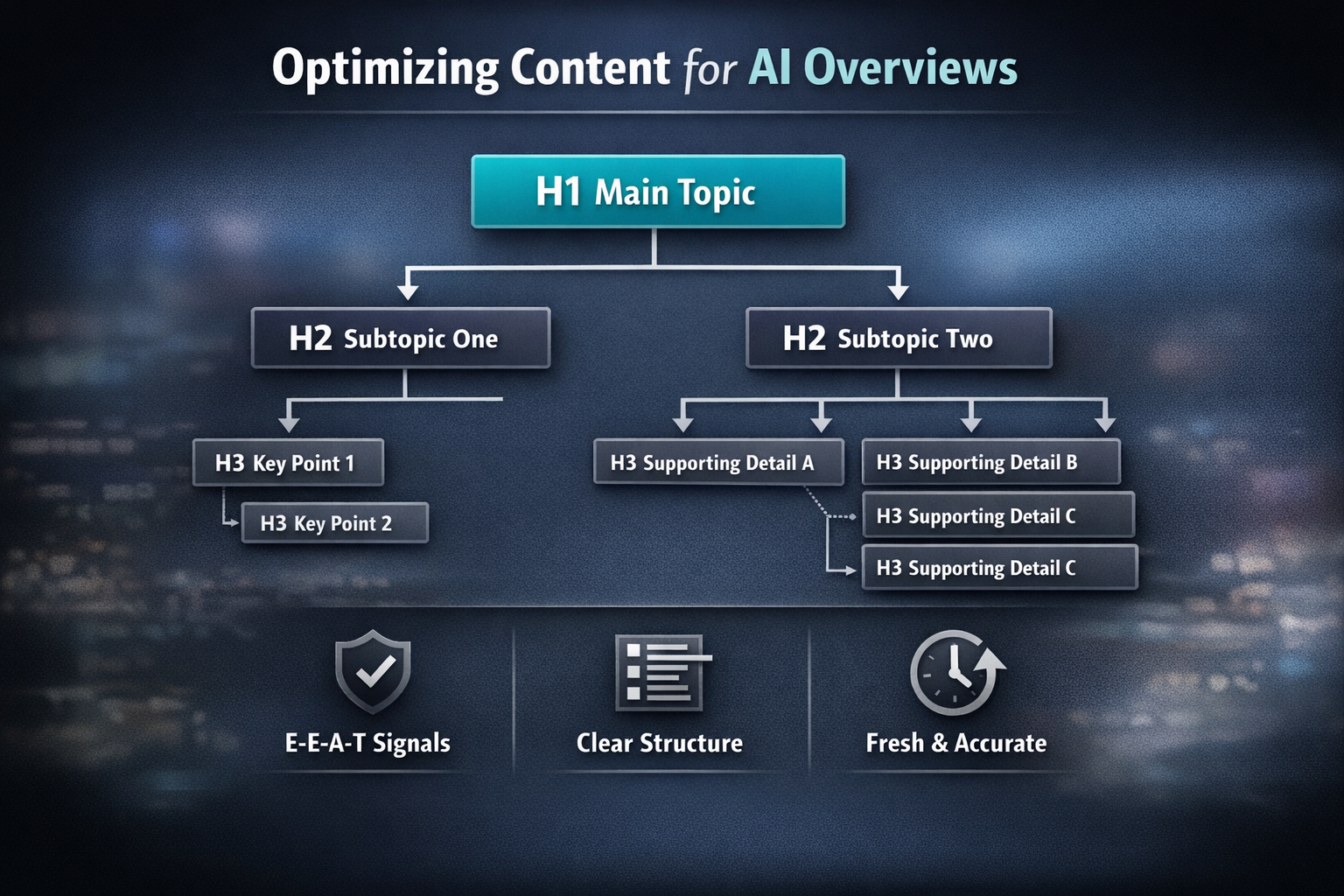
Logical heading structures help AI systems understand relationships between sections. This isn't about SEO tricks—it's about making your content's architecture visible.
Follow a consistent hierarchy:
H1: Primary topic (one per page, no exceptions)
H2: Major subtopics or sections
H3: Supporting points under each H2
Critical rule: each heading should accurately describe what follows. A heading like "The Interesting Part" might intrigue human readers, but it tells AI systems nothing. "How Schema Markup Improves AI Citation Rates" tells both humans and AI exactly what to expect.
Schema Markup That Actually Matters
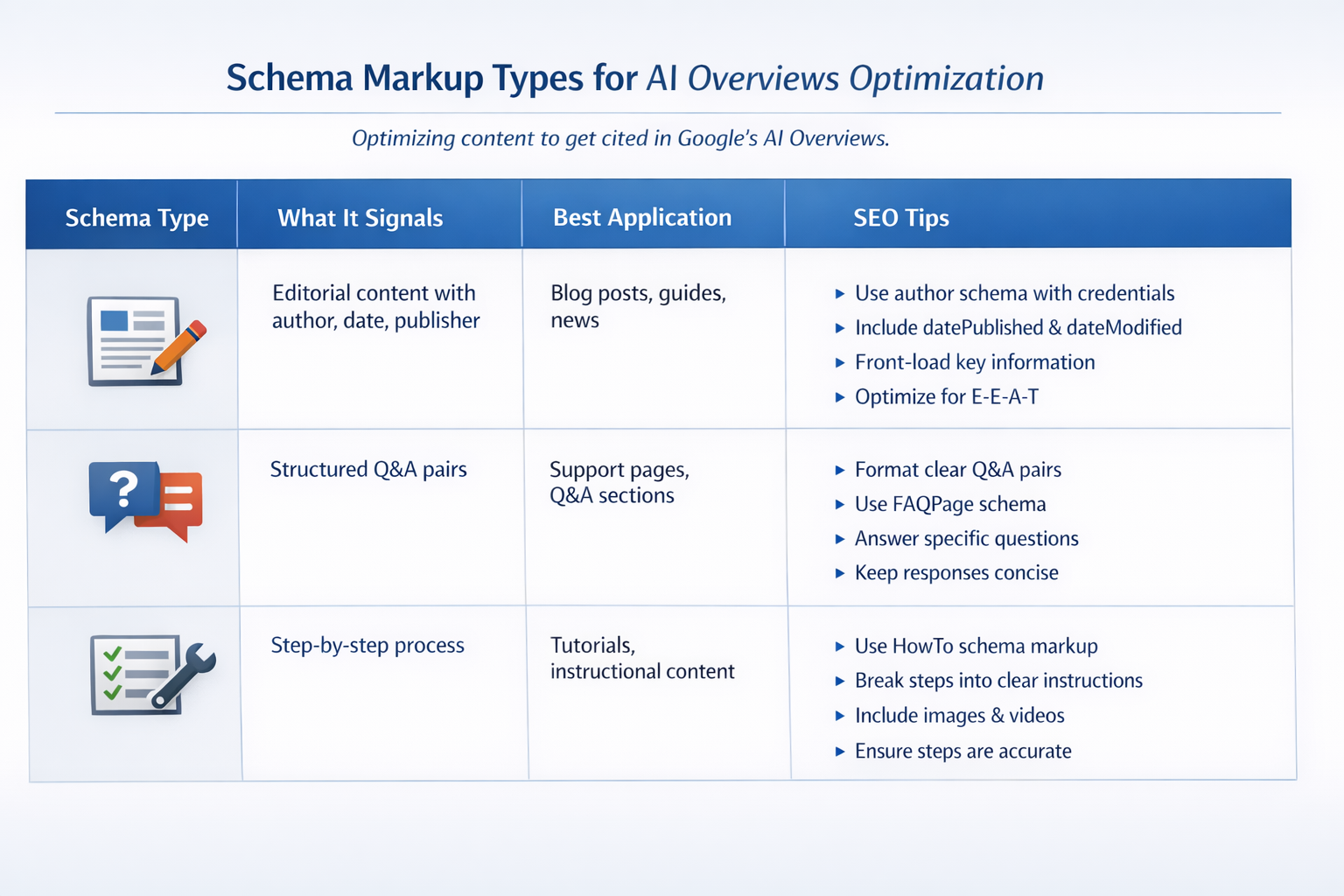
Schema markup provides explicit context about your content that AI systems interpret directly [5]. But not all schema types contribute equally to AI Overview visibility.
| Schema Type | What It Signals | Best Application |
| Article | Editorial content with author, date, publisher | Blog posts, guides, news |
| FAQ | Structured Q&A pairs | How-to content, support pages |
| HowTo | Step-by-step process | Tutorials, instructions |
| Person/Author | Creator credentials and expertise | E-E-A-T reinforcement |
| Speakable | Content optimized for voice/AI reading | Key paragraphs worth citing |
Implementation matters as much as presence. Broken or incorrect schema can hurt more than help. Use Google's Rich Results Test to validate your markup before publishing.
For Article schema specifically, include these properties:
author with linked Person schema
datePublished and dateModified
headline matching your H1
speakable for your most citation-worthy sections
Front-Loading Key Information
AI systems—like busy readers—benefit from content that delivers value immediately. The inverted pyramid model ensures that even partial excerpts capture your core message.
Structure each section to present:
The key takeaway or answer (first 1-2 sentences)
Supporting evidence or explanation (middle)
Additional context or nuance (end)
This approach means even if AI Overviews only pull your opening lines, they capture the essential information accurately.
Creating "Answer-Ready" Content Blocks
Certain sections of your content should function as standalone answers—complete enough to be cited independently while enticing enough to drive clicks for more detail.
Characteristics of answer-ready blocks:
Directly addresses a specific question
Provides complete, accurate information in 50-150 words
Uses clear, factual language without unnecessary hedging
Includes specific details that demonstrate expertise
Avoids dependent references ("as mentioned above")
Think of these blocks as pre-packaged excerpts. They should make sense extracted from context while clearly belonging to a more comprehensive resource.
Keyword Strategy for Generative Search
Traditional keyword research still matters, but AI Overviews require an expanded approach accounting for conversational queries and semantic relationships.
Conversational Query Targeting
Voice search and AI assistants conditioned users to search in natural language. AI Overviews reinforced this behavior by handling complex questions effectively.
Optimize for how people actually ask questions:
"What's the best way to structure content for AI search?"
"How do I get my blog posts cited in Google's AI answers?"
"Why isn't my content showing up in AI Overviews?"
These longer, more specific queries often have lower competition and higher intent than single-word targets. They also signal exactly what the searcher needs—making content alignment straightforward.
Building Topical Depth Over Breadth
AI Overviews reward comprehensive coverage. Publishing scattered content across dozens of unrelated topics signals nothing. Deep authority in core areas signals expertise worth trusting.
A cluster approach works:
Pillar content: Comprehensive guides covering broad topics (like this article)
Supporting content: Focused pieces addressing specific subtopics in depth
Strategic interlinking: Connections between related pieces demonstrating topical relationships
This structure signals expertise to both traditional algorithms and AI systems evaluating source authority.
Semantic Richness Without Keyword Stuffing
Search AI understands synonyms, related concepts, and contextual meaning. Rather than forcing exact-match keywords, use natural language incorporating semantic variations.
For a topic like "content optimization for AI Overviews," natural variations include:
Generative search visibility
Getting cited in AI answers
Google AI search optimization
Earning AI Overview citations
Appearing in generative results
Using these naturally throughout your content creates semantic richness that AI systems recognize—without the awkwardness of forced keyword placement.
Freshness: Why Update Schedules Now Matter
Content freshness has shifted from ranking factor to citation requirement. AI Overviews prioritize current information, particularly for topics where accuracy changes over time [6].
Building a Systematic Update Process
Static content ages out of citation consideration. A regular review cycle keeps your content competitive:
Quarterly reviews for evergreen content:
Verify all statistics and claims remain accurate
Update examples to reflect current conditions
Check that all links still work and point to relevant resources
Immediate updates when significant changes occur:
Algorithm updates affecting recommendations
New features or terminology (like SGE → AI Overviews)
Industry shifts invalidating previous advice
Annual comprehensive audits to identify:
Content needing retirement (permanently outdated)
Pieces requiring consolidation (overlapping coverage)
Gaps in topic coverage worth filling
Each update should include meaningful improvements—not just date changes. Google's systems distinguish between substantive updates and superficial modifications intended to fake freshness.
Signaling Freshness Appropriately
Make content currency visible to both users and AI:
Display accurate publication and last-updated dates prominently
Include datePublished and dateModified in schema markup
Reference current developments where relevant
Remove or update outdated examples, tools, and statistics
Add "Last reviewed [date]" indicators for comprehensive guides
Evergreen Foundations With Updated Details
Not all content requires constant updates. The most sustainable approach combines:
Timeless principles: Foundational concepts that remain stable
Current applications: Specific examples and tools reflecting current reality
Clear separation: Explicit distinction between what's permanent and what changes
This structure maximizes content longevity while maintaining the freshness signals AI systems evaluate.
Measuring AI Overview Performance
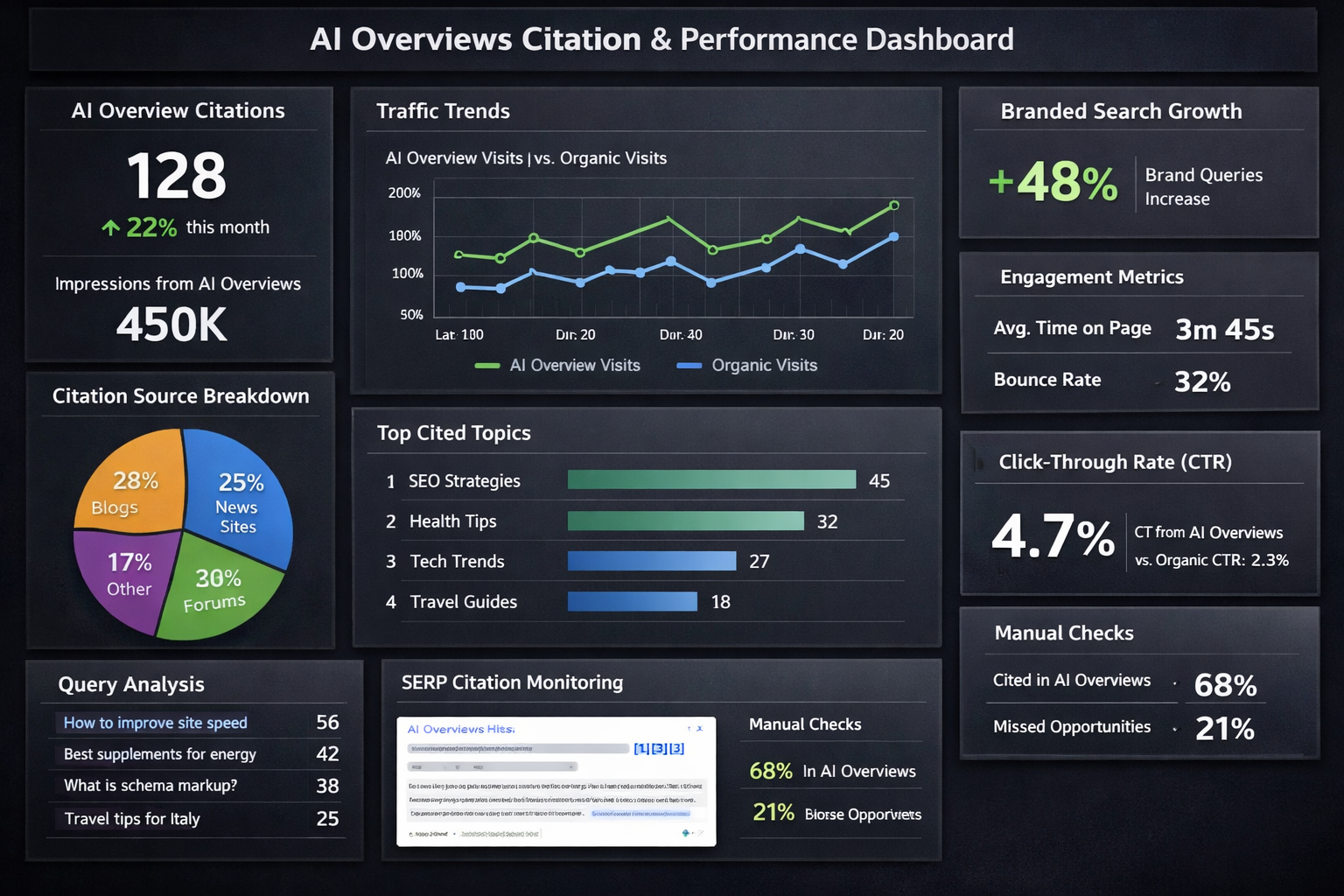
Here's the hard truth: directly measuring AI Overview citations remains difficult. Google doesn't provide a "cited in AI Overviews" metric in Search Console. But several approaches provide useful signals.
Proxy Metrics Worth Tracking
Impressions without clicks: High impression counts with low click-through rates may indicate AI Overview exposure—users saw your content mentioned but got their answer without clicking. This isn't necessarily bad; it often indicates citation visibility.
Manual citation monitoring: Regularly search your target queries and observe whether your content appears in AI Overviews. Document patterns over time.
Branded search volume changes: Growing brand searches may indicate AI Overview exposure building awareness even without direct clicks.
GSC query analysis: Filter for informational queries likely triggering AI Overviews using regex patterns. Queries starting with "how," "what," "why," or including "best way to" often generate AI results.
Behavioral Shifts to Monitor
AI Overview traffic behaves differently than traditional organic traffic:
Engagement depth: Users arriving via AI citations often engage more deeply—they've already seen the summary and want the full detail
Query specificity: Traffic from AI Overviews tends toward longer, more specific queries
Conversion patterns: These visitors may convert at different rates, requiring adjusted attribution models
Iterative Improvement Based on Data
Performance data should drive ongoing optimization:
Content earning AI citations likely shares structural characteristics worth replicating
Content consistently bypassed may need structural improvements, depth expansion, or freshness updates
Query gaps where competitors get cited reveal opportunities for new content or existing content updates
Common Mistakes That Kill AI Overview Visibility
Several common practices actively hurt your chances of appearing in AI-generated results.
Thin Content Without Genuine Depth
Brief, surface-level content that doesn't provide genuine value gets bypassed. AI systems have access to comprehensive sources across the entire web—they'll choose those over shallow alternatives every time.
If your article could be summarized in two sentences without losing meaningful information, it lacks the depth AI systems need for confident citation.
Missing Attribution and Source Credibility
Unsubstantiated claims reduce perceived trustworthiness. If you cite a statistic, link to the source. If you make a recommendation, explain why it works. If you reference research, make it findable.
AI systems evaluating citation worthiness weight source credibility heavily. Content full of "studies show" without actual studies linked gets treated with appropriate skepticism.
Technical Barriers to Indexing
Broken schema markup, slow load times, and mobile usability issues create barriers preventing content from proper evaluation. If Google can't efficiently crawl, render, and understand your content, it can't cite it—regardless of quality.
Regular technical audits should verify:
Schema validates without errors
Core Web Vitals meet thresholds
Mobile rendering matches desktop
No crawl errors in Search Console
Intent Mismatch
Content that technically covers a topic but doesn't address what users actually need underperforms consistently. If someone searches "how to optimize for AI Overviews" and your content is really about "history of Google's AI features," the mismatch kills citation potential.
Match content depth and format to genuine user intent behind target queries.
Building a Sustainable Strategy for Generative Search
Short-term tactics won't produce lasting results. AI systems get better at detecting manipulation over time—what works as a trick today fails tomorrow.
A sustainable approach requires:
Consistently valuable content: Every piece should provide genuine utility
Demonstrated expertise: Build real knowledge and show it clearly
Dual-optimized structure: Serve both human readers and AI comprehension
Technical excellence: Maintain infrastructure that enables discovery
Ongoing maintenance: Regular updates keeping content citation-worthy
The stakes have changed. AI-mediated search doesn't offer second chances to mediocre content. Every piece needs to earn its place in a system designed to surface only the best sources.
The businesses winning in this environment treat content as infrastructure—not a checkbox, but a system that compounds value over time through consistent quality and strategic structure.
Ready to build content that earns AI citations? Get started with 2 free articles delivered in 48 hours—structured for AI visibility, optimized for search, and built to compound. Try the Mighty Quill Blog Engine free.
Frequently Asked Questions
What are Google's AI Overviews and how do they differ from traditional search?
AI Overviews are Google's generative search feature that synthesizes information from multiple sources and presents AI-generated summaries directly in search results. Unlike traditional search that displays ten links for users to choose from, AI Overviews answer questions directly—while citing the sources they draw from. Users can get comprehensive answers without clicking through, fundamentally changing how content earns visibility.
How do AI Overviews affect website traffic?
AI Overviews can reduce click-through rates for informational queries where users get sufficient answers in the summary itself. However, content that earns citations gains significant visibility and credibility. The key shift: create content valuable enough to be cited as a source, which drives qualified traffic from users seeking deeper information than the overview provides.
What content structure performs best for AI Overview optimization?
Clear hierarchical organization with descriptive headings, properly implemented schema markup, and "answer-ready" content blocks perform best. Front-load key information in each section, use short paragraphs, and structure specific sections to provide complete standalone answers. The goal: make your content's architecture explicit so AI systems can parse and cite it confidently.
How important are E-E-A-T signals for appearing in AI Overviews?
E-E-A-T signals have become critical for AI Overview citations. Google's AI preferentially cites content from sources demonstrating clear experience, expertise, authoritativeness, and trustworthiness. Building these signals—through author credentials, original insights, accurate sourcing, and consistent quality—directly determines whether your content gets selected for citation.
How often should content be updated to maintain AI Overview visibility?
Update frequency depends on topic volatility. Rapidly evolving subjects require more frequent updates, while foundational content may need only quarterly accuracy reviews. The key distinction: make meaningful improvements that reflect genuine changes—not superficial date modifications. Google's systems distinguish between substantive updates and manipulation attempts.
About This Content
This guide was developed by The Mighty Quill, an AI-powered content engine built specifically for organic search visibility. We combine deep expertise in SEO strategy with systematic content production methods refined across hundreds of client engagements. We monitor search evolution continuously—including the shift from SGE to AI Overviews—translating platform changes into practical guidance that drives measurable results.
Works Cited
Google Search Central — "AI Overviews and Your Website." https://developers.google.com/search/docs/appearance/ai-overviews
Search Engine Journal — "How Google's AI Overviews Work." https://www.searchenginejournal.com/google-ai-overviews-sge/
Google — "Search Quality Evaluator Guidelines." https://static.googleusercontent.com/media/guidelines.raterhub.com/en//searchqualityevaluatorguidelines.pdf
Search Engine Land — "E-E-A-T and Google's Search Quality Guidelines." https://searchengineland.com/google-e-e-a-t-how-to-demonstrate-first-hand-experience/
Google Search Central — "Introduction to Structured Data Markup." https://developers.google.com/search/docs/appearance/structured-data/intro-structured-data
Moz — "Content Freshness and SEO." https://moz.com/blog/content-freshness-seo