You need content. Consistent, high-quality blog posts that actually rank and convert. But how you get that content matters almost as much as the content itself.
Most comparisons pit freelancers against in-house writers and call it a day. That's an incomplete picture. A third option—blog writing subscriptions—has quietly emerged as a compelling alternative for growth-focused SaaS and eCommerce teams.
This article breaks down all three approaches across the metrics that actually matter: speed-to-first-post, management overhead, consistency risk, strategic support, and total 12-month cost. We'll include the hidden expenses most comparisons conveniently ignore—briefing time, editing passes, and project management hours.
By the end, you'll know which model fits your growth stage, budget, and risk tolerance.
The Three Content Models at a Glance
Before diving into the numbers, let's define each option clearly—including what you're actually buying beyond words on a page.
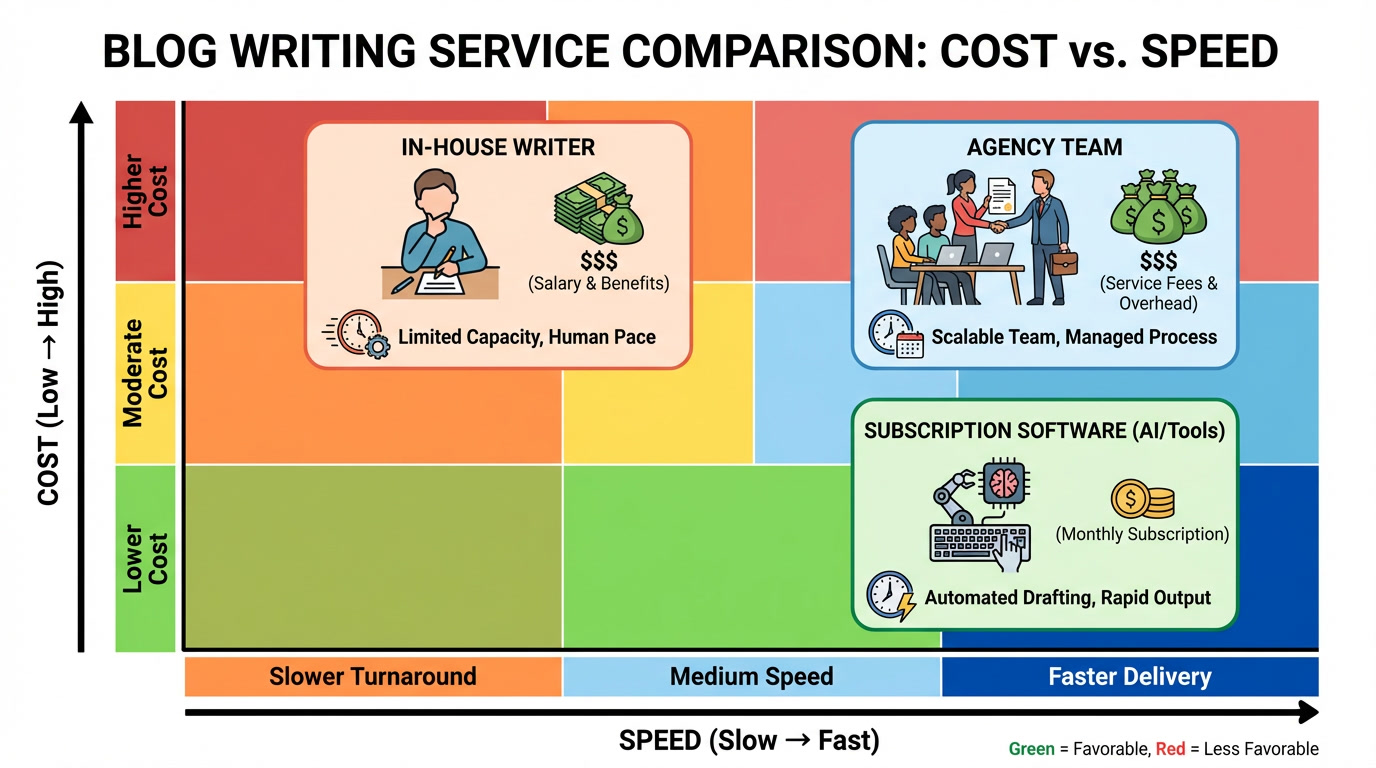
In-house writers are full-time employees dedicated to your content. They learn your brand deeply but require salary, benefits, management, and ongoing training. The best ones contribute to strategy, not just execution.
Agencies provide teams of writers, strategists, and account managers. You pay for their expertise and bandwidth—but also their overhead. Critically, agencies typically bundle content strategy with execution: keyword research, competitive analysis, and editorial calendars often come included.
Blog writing subscriptions offer systematic content delivery (often AI-assisted with human editing) at fixed monthly rates. Think of it as content-as-a-service. Most subscriptions focus on execution—they produce posts based on topics you provide or they suggest from keyword research. They generally don't replace strategic planning the way a full-service agency might.
Each model has legitimate use cases. The question is which one matches your current reality—and where you need the most help.
Speed Comparison: How Fast Can You Actually Publish?
Time kills momentum. Every week without new content is a week competitors are building authority you're not.
In-House Writer Timeline
Hiring a content writer takes 6-12 weeks minimum [1]. You'll spend time writing job descriptions, screening candidates, conducting interviews, negotiating offers, and waiting out notice periods.
Once hired, onboarding adds another 2-4 weeks. Your new writer needs to learn your products, audience, style guide, and internal processes before producing publish-ready work.
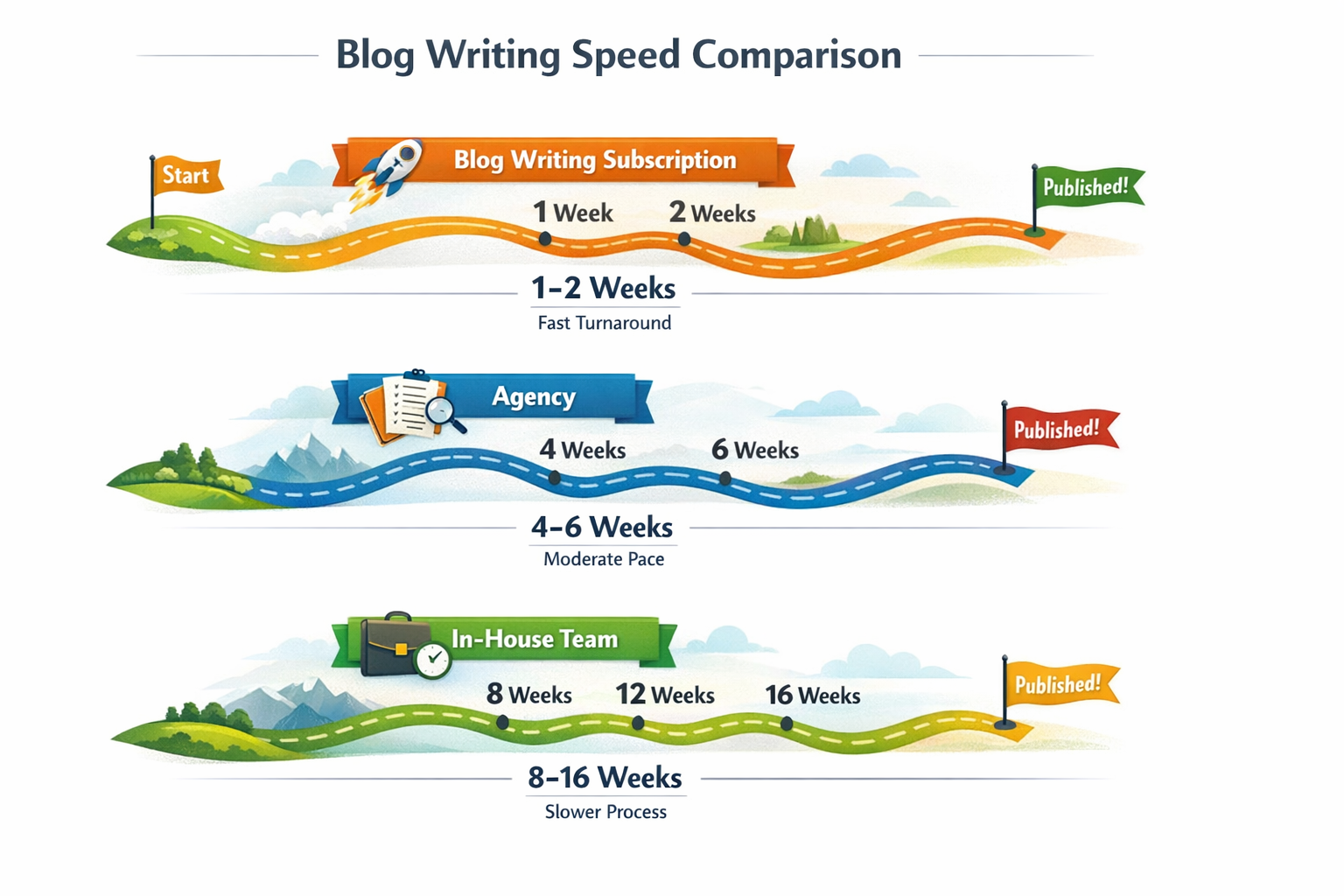
Realistic time-to-first-post: 8-16 weeks
Agency Timeline
Agencies move faster than hiring. Most require a discovery phase (1-2 weeks), followed by strategy development (1-2 weeks), then actual content production (1-2 weeks).
The bottleneck? Feedback loops. Agencies serve multiple clients simultaneously. Your revision requests compete with everyone else's priorities.
Realistic time-to-first-post: 4-6 weeks
Subscription Timeline
Subscription services optimize specifically for speed. Most can deliver initial content within days of signup—some within 48 hours [2].
The trade-off is less upfront strategic customization. You're working within their system rather than building one from scratch. If you need comprehensive content strategy developed before execution begins, subscriptions may require you to handle that work separately.
Realistic time-to-first-post: 1-2 weeks
Speed Assessment
If you need content publishing quickly—say, before a product launch or to capture seasonal demand—subscriptions provide the fastest path. Agencies win when you need strategic groundwork laid first. In-house makes sense when you're building for the long term and can absorb the ramp-up period.
Management Overhead: The Time Tax Nobody Budgets For
Here's where most cost comparisons fail completely. They ignore the hours you spend managing the content operation.
Hidden Costs of In-House Writers
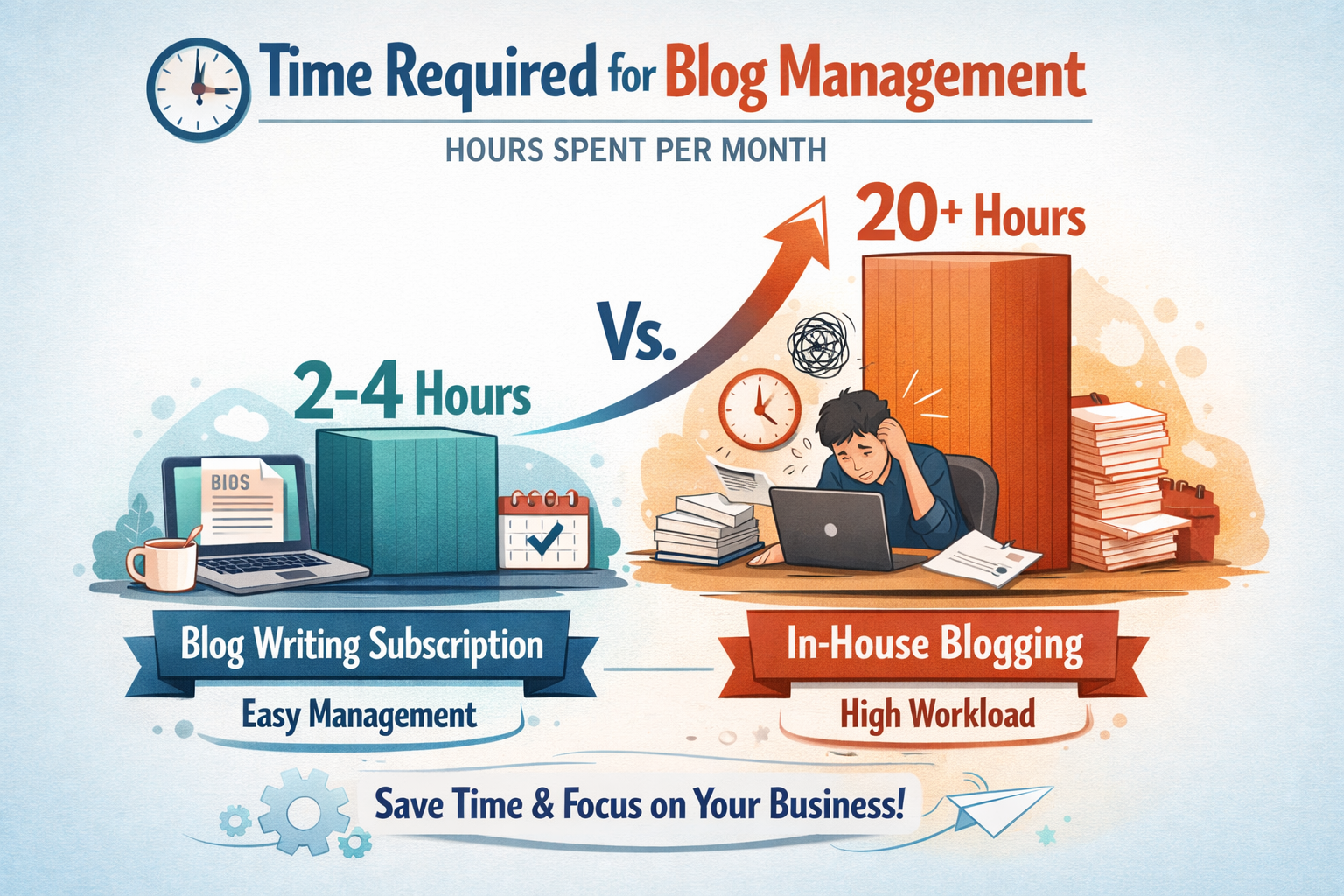
Your writer needs direction. Weekly 1:1s, editorial feedback, performance reviews, career development conversations. Conservative estimate: 3-5 hours per week of management time [3].
Add content strategy work (keyword research, topic prioritization, competitive analysis) if your writer isn't senior enough to handle it independently. That's another 2-4 hours weekly.
If you're paying a marketing manager $80/hour fully loaded, 5 hours weekly equals $1,600/month in hidden management costs.
Hidden Costs of Agencies
Agencies promise to handle everything. Reality differs—but often in a good way.
You'll attend kickoff calls, strategy reviews, and monthly reporting meetings. You'll provide feedback on outlines and drafts. You'll answer questions about product features, customer personas, and brand voice.
Typical client-side time: 4-8 hours per month. Less than in-house, but not zero.
The upside? Good agencies handle strategic burden you'd otherwise own. They bring keyword research, competitive intelligence, and editorial planning. You're paying for that expertise—and for many teams, that trade-off makes sense.
Hidden Costs of Subscriptions
Well-designed subscriptions minimize your involvement to approvals only. You review content, click approve (or request changes), and the system handles the rest.
Typical client-side time: 2-4 hours per month.
The trade-off is that you typically own the strategic layer. Topic selection, keyword strategy, and editorial direction often remain your responsibility—or require a separate solution. Some subscriptions offer topic research and suggestions; others expect you to provide detailed briefs.
Management Assessment
For teams where leadership time is the scarcest resource, subscriptions offer the lowest management burden for execution. Agencies win if you need strategic thinking offloaded too. In-house requires the most ongoing management but offers the most direct control.
Content Strategy: Who Does the Thinking?
This dimension gets overlooked in most comparisons—but it's often the deciding factor.
In-House Strategic Capability
Senior in-house writers can own strategy entirely: keyword research, competitive analysis, content calendars, performance optimization. You get deep domain expertise and strategic alignment.
Junior writers typically execute well but need strategic direction. Someone on your team has to provide that direction—whether it's you or a content lead.
Strategic burden: Low (with senior hire) or High (with junior hire)
Agency Strategic Capability
Agencies typically bundle strategy with execution. Monthly retainers often include:
Keyword and topic research
Competitive content analysis
Editorial calendar development
Performance reporting and optimization recommendations
This is a genuine advantage for teams lacking internal content expertise. You're paying for strategic thinking, not just output.
Strategic burden: Low to Medium
Subscription Strategic Capability
Most subscriptions focus on execution efficiency, not strategic consulting. They may provide:
Topic suggestions based on keyword research
SEO optimization within each post
Basic performance-ready formatting
What they typically don't provide: comprehensive content strategy, competitive positioning, or ongoing strategic refinement.
Some premium subscriptions offer more strategic support, but the core value proposition is reliable execution at scale.
Strategic burden: Medium to High (strategy often remains yours)
Strategy Assessment
If you have strong internal content strategy capabilities and need execution capacity, subscriptions deliver efficiently. If you need strategic guidance alongside production, agencies provide more complete solutions. In-house hires can do both—but only if you hire at the right seniority level.
Consistency Risk: What Happens When Things Go Wrong?
Sporadic publishing torpedoes SEO results. Search engines reward sites that publish consistently over time [4]. A three-month content drought can undo months of progress.
In-House Consistency Risks
Writers get sick. They take vacations. They quit.
Single points of failure are dangerous. When your one content person leaves (average tenure for marketing roles is under 2 years [5]), you're back to square one—hiring, onboarding, ramping up.
Even without turnover, in-house writers face competing priorities. Blog posts get deprioritized when product launches, sales decks, or executive requests demand attention.
Agency Consistency Risks
Agencies spread risk across multiple writers. If one person leaves, others can cover.
But agencies also churn accounts. Your dedicated team might get reassigned to bigger clients. Quality can shift when your primary writer changes—and agencies don't always tell you when this happens.
Payment-related pauses create another risk. Miss an invoice, and your content pipeline stops. Agencies rarely maintain work-in-progress during billing disputes.
Subscription Consistency Risks
Subscription models are built specifically around consistency. Fixed weekly output is the product.
The risk shifts to platform-level issues. If the service shuts down or pivots, you need a backup plan. Choosing established providers with clear track records reduces this risk.
Consistency Assessment
For pure publishing consistency, subscriptions are purpose-built for this outcome. The model exists to eliminate content gaps. Agencies offer reasonable consistency with strategic upside. In-house carries the highest consistency risk due to single-point-of-failure dynamics.
Quality Control Requirements: How Much Editing Will You Actually Do?
Raw content is rarely publish-ready. Every model requires some level of quality control—the question is how much.
In-House Quality Control
In-house writers learn your voice over time. After 6-12 months, strong writers require minimal editing.
The early months are different. Expect heavy editing on initial pieces as you calibrate tone, depth, and accuracy. Budget 1-2 hours of editing time per post for the first quarter.
Long-term, quality control becomes maintenance: occasional style guide updates, periodic feedback sessions, and spot-checking published work.
Agency Quality Control
Agencies employ editors internally, which theoretically reduces your editing burden.
In practice, agency content can read generic without sufficient briefing. You may need to add company-specific examples, product references, and authentic perspective. The quality gap often reflects brief quality—detailed inputs yield better outputs.
Request writing samples before signing. Ask about their revision process. The gap between agency sales pitches and actual deliverables can be substantial.
Subscription Quality Control
Subscription quality varies enormously by provider. Some deliver polished, publish-ready posts. Others produce content requiring significant revision.
The best subscriptions combine AI efficiency with human editorial oversight [6]. AI handles research and initial drafting; humans ensure readability, accuracy, and brand alignment.
Key questions when evaluating:
Is human editing included, or are you paying for raw AI output?
What's their revision process if quality falls short?
Can they adapt to your brand voice, or is the style fixed?
Premium subscriptions with human editorial layers typically cost more than basic AI-generated content—but the quality difference justifies the premium for most B2B applications.
Quality Assessment
High-quality in-house writers eventually produce the most brand-aligned content. But reaching that point requires substantial upfront investment. Agencies offer quality with strategic context when properly briefed. Subscriptions with human editing offer reliable, good-enough quality at efficient price points—but won't match a deeply embedded in-house expert.

12-Month Cost Comparison: The Full Picture
Now for the numbers. We'll use assumptions typical for mid-market SaaS and eCommerce companies, with realistic ranges for each model.
In-House Writer: Full Cost Breakdown
| Cost Component | Annual Amount |
| Base salary (mid-level writer) | $65,000 |
| Benefits (20% of salary) | $13,000 |
| Recruiting costs (15% placement fee) | $9,750 |
| Equipment and software | $2,500 |
| Training and professional development | $2,000 |
| Management time (5 hrs/week × $80/hr × 50 weeks) | $20,000 |
| Total Year One | $112,250 |
Output at 2 posts/week: approximately 100 posts annually.
Cost per post: $1,122
Note: Year two drops significantly (no recruiting costs, reduced management overhead) to approximately $85,000, bringing cost per post to around $850.
Agency: Full Cost Breakdown
| Cost Component | Annual Amount |
| Monthly retainer ($4,000-$6,000/month average for 8 posts + strategy) | $48,000-$72,000 |
| Strategy/kickoff fees | $3,000-$5,000 |
| Revision/rush fees (typical 10% overage) | $4,800-$7,200 |
| Client-side management time (6 hrs/month × $80/hr × 12) | $5,760 |
| Total Year One | $61,560-$89,960 |
Output: approximately 96 posts annually, plus strategic deliverables.
Cost per post: $641-$937 (with strategy effectively included)
Agency costs scale linearly with output. Doubling volume roughly doubles cost—though some agencies offer volume discounts.
Subscription: Full Cost Breakdown
Subscription pricing varies significantly based on quality tier:
Basic AI-Assisted Subscription ($250-$500/month)
| Cost Component | Annual Amount |
| Monthly subscription | $3,000-$6,000 |
| Client-side review time (3 hrs/month × $80/hr × 12) | $2,880 |
| Total Year One | $5,880-$8,880 |
Premium Human-Edited Subscription ($800-$2,000/month)
| Cost Component | Annual Amount |
| Monthly subscription | $9,600-$24,000 |
| Client-side review time (3 hrs/month × $80/hr × 12) | $2,880 |
| Total Year One | $12,480-$26,880 |
Output at 2 posts/week: approximately 100 posts annually.
Cost per post: $59-$269 (depending on quality tier)
Important caveat: If you lack internal content strategy capabilities, factor in either your time to develop strategy or a separate strategy consultant ($2,000-$5,000 for initial strategy development).
Cost Comparison Summary
| Model | Year One Cost | Posts Delivered | Strategic Support | Cost Per Post |
| In-House | $112,250 | ~100 | Variable (depends on seniority) | $1,122 |
| Agency | $61,560-$89,960 | ~96 + strategy | Included | $641-$937 |
| Subscription (Basic) | $5,880-$8,880 | ~100 | Minimal | $59-$89 |
| Subscription (Premium) | $12,480-$26,880 | ~100 | Moderate | $125-$269 |
The cost differential remains substantial. Even premium subscriptions cost significantly less per post than agencies, and considerably less than in-house writers. The question is whether the strategic gap matters for your situation.
When Each Model Makes Sense
Cost alone shouldn't drive your decision. Here's when each approach fits best.
Choose In-House When:
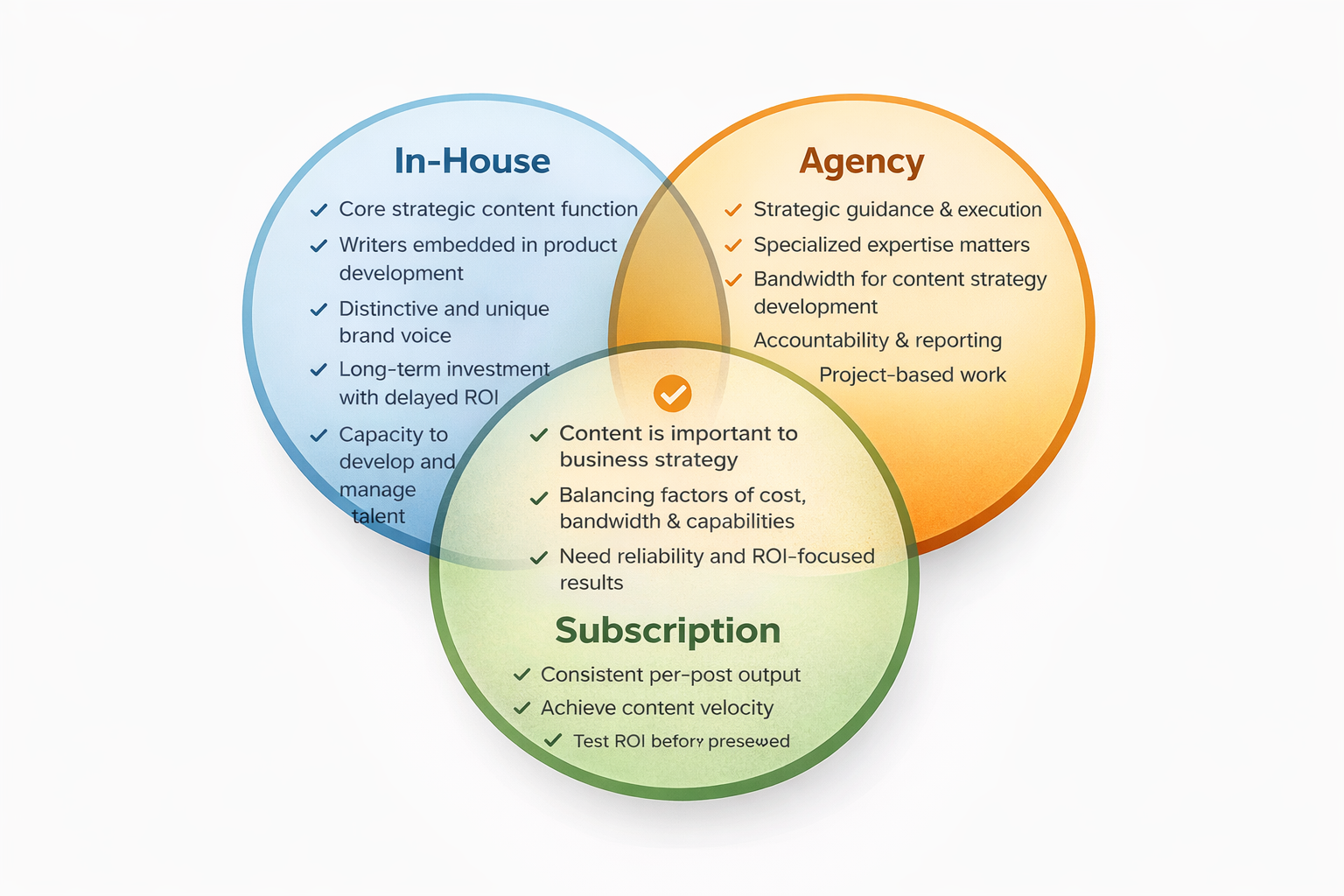
Content is a core strategic function (not just SEO fuel)
You need writers deeply embedded in product development
Brand voice is highly distinctive and difficult to replicate externally
You're building a content team, not just publishing posts
Budget allows for long-term investment with delayed ROI
You have management capacity to develop talent
Choose an Agency When:
You need strategic guidance alongside execution
Specialized expertise matters (technical writing, regulated industries, specific verticals)
Your team lacks bandwidth for content strategy development
You want accountability and reporting without building internal infrastructure
Project-based work makes more sense than always-on production
Choose a Subscription When:
Consistency is your primary concern
You need content velocity you can't achieve internally
You already have solid content strategy capabilities (or a simple strategy works)
Budget constraints require efficient per-post economics
Your team's time is better spent on activities other than content production
You want to test content marketing ROI before larger investments
A Risk-Adjusted Decision Framework
Consider your situation across four dimensions:
Financial risk: In-house requires the largest upfront commitment with uncertain returns. Agencies require meaningful monthly commitments. Subscriptions allow month-to-month evaluation with lower minimums.
Quality risk: In-house offers the highest eventual ceiling but longest ramp time. Agencies provide professional quality with strategic context. Subscriptions trade peak customization for consistent, reliable output.
Strategic risk: In-house can own strategy (if senior enough). Agencies provide strategy as part of the package. Subscriptions typically leave strategy to you.
Continuity risk: All models have failure modes. In-house suffers from turnover. Agencies reassign teams. Subscriptions depend on vendor stability.
Decision Matrix: If You Are... Then Consider...
A founder with limited time and budget → Start with a subscription to establish publishing consistency, then evaluate whether you need strategic support.
A marketing leader with strategic vision but no execution capacity → A subscription handles execution while you direct strategy.
A growing company that needs both strategy and execution offloaded → An agency provides the complete package at higher cost.
A company where content is a core differentiator → Invest in in-house talent who can own both strategy and execution long-term.
Making Your Decision
The best content model is the one you'll actually execute consistently.
An "optimal" in-house strategy that never gets implemented loses to a reliable subscription that publishes twice weekly for twelve months straight.
Start with these questions:
How quickly do you need content flowing?
How much management bandwidth can you realistically allocate?
Do you have content strategy capabilities internally, or do you need them provided?
What's your content budget for the next 12 months?
How important is distinctive brand voice versus consistent SEO visibility?
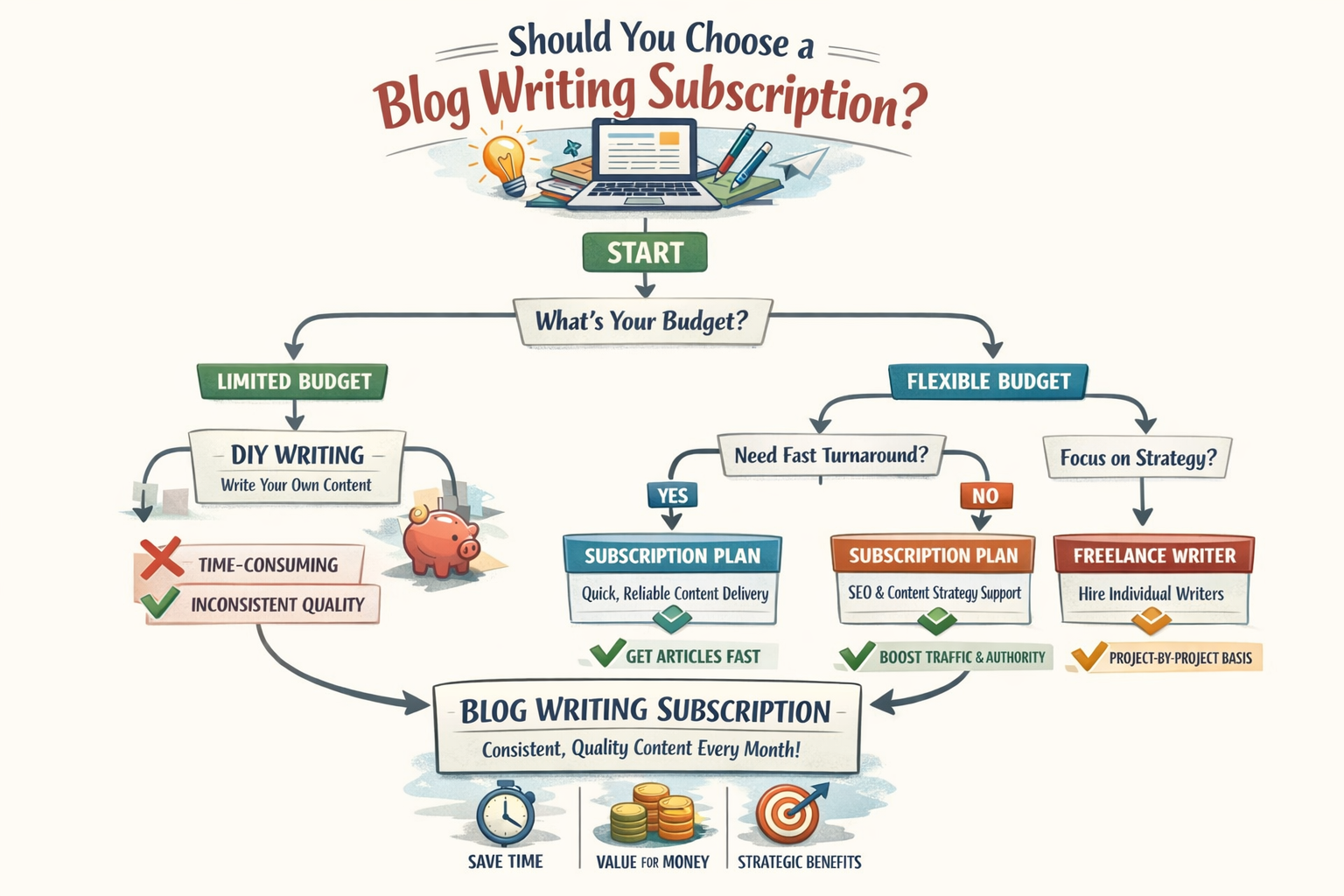
If you answered "fast," "minimal," "we have strategy covered," "limited," and "visibility matters most"—subscriptions deserve serious consideration.
If you answered "we need strategic help" and "we have budget"—agencies offer more complete solutions.
If you answered "content is central to our business" and "we can invest long-term"—build in-house.
Ready to see what consistent content looks like without the management overhead? Try the Mighty Quill Blog Engine free—get 2 custom articles in 48 hours with zero commitment.
Frequently Asked Questions
How many blog posts per week do SaaS companies typically need?
Most successful SaaS content programs publish 2-4 posts weekly to build meaningful organic traffic. Research suggests companies publishing 16+ posts monthly see significantly more traffic than those publishing less frequently [7]. The key is consistency over volume—two quality posts weekly beats sporadic bursts of ten posts followed by silence. Start with a sustainable cadence you can maintain for at least six months.
Can I combine content models—like using a subscription plus in-house?
Absolutely. Many companies start with subscriptions for velocity, then add in-house capacity for strategic or highly specialized content. A hybrid approach might use subscriptions for consistent SEO content while an in-house writer handles product announcements, thought leadership, and customer stories. The key is clear role definition so you're not duplicating effort or creating management complexity.
What quality indicators should I look for in a blog writing subscription?
Look for services that combine AI efficiency with human editorial oversight. Request samples across different topics to assess range and depth. Check whether SEO optimization (meta descriptions, internal linking, schema markup) is included or extra. Ask specifically about their revision process and what happens if you're unsatisfied. The best subscriptions should be transparent about their human involvement level.
How long before blog content starts generating meaningful organic traffic?
Content marketing typically requires 3-6 months before showing measurable traffic results [8]. SEO compounds over time—early posts often perform better as your domain authority grows. This is precisely why consistency matters: companies that stop publishing during the slow early months never reach the compounding phase. Plan for a minimum six-month commitment regardless of which model you choose.
Do agencies provide better quality than subscriptions?
Not necessarily. Quality depends more on the specific provider than the category. Premium subscriptions with strong editorial processes can match mid-tier agency output. Agencies often provide better strategic context and brand customization—but that's a different dimension than writing quality itself. The real question is what level of strategic support you need alongside execution.
Why Trust This Comparison
This analysis draws on practical experience building content systems for growth-stage companies, combined with published research on content marketing economics. We've intentionally included hidden costs (management time, editing overhead, quality control) that most comparisons ignore—because those costs determine whether content programs succeed or fail.
We've also been transparent about trade-offs. Subscriptions aren't right for everyone. If you need comprehensive strategic support bundled with execution, agencies provide real value. If content is a core differentiator for your business, in-house talent may justify the investment.
The numbers presented use market-rate ranges and typical engagement models. Your specific situation may vary based on location, industry complexity, and internal capabilities.
Cited Works
[1] Society for Human Resource Management — "Average Time to Hire." https://www.shrm.org/topics-tools/news/talent-acquisition/average-time-to-fill-increases
[2] The Mighty Quill — "How It Works." https://www.themightyquill.com/
[3] Harvard Business Review — "How Much Time Should You Spend Managing?" https://hbr.org/2018/02/how-much-time-and-energy-do-we-waste-toggling-between-applications
[4] Search Engine Journal — "How Often Should You Blog for SEO?" https://www.searchenginejournal.com/how-often-should-you-blog-for-seo/
[5] LinkedIn — "Workforce Report: Marketing Role Tenure." https://www.linkedin.com/pulse/linkedin-workforce-report/
[6] Content Marketing Institute — "AI in Content Marketing." https://contentmarketinginstitute.com/articles/ai-content-marketing-research/
[7] HubSpot — "How Often Should Companies Blog?" https://blog.hubspot.com/marketing/blogging-frequency-benchmarks
[8] Ahrefs — "How Long Does SEO Take?" https://ahrefs.com/blog/how-long-does-seo-take/