Your blog hasn't been updated in six weeks. The last post sits there like a digital tombstone, timestamped and slightly embarrassing.
It's not that your team doesn't care. They do. It's that the SEO strategist got pulled into a product launch, the freelancer ghosted after two posts, and the "content planning session" keeps getting bumped to next quarter. Meanwhile, your competitors are publishing twice a week, climbing search rankings, and capturing the leads you're leaving on the table.
This is the consistency problem. And it's why a growing number of B2B teams are abandoning the traditional project-based approach to content and switching to something different: a blog content subscription.
What Is a Blog Content Subscription?
A blog content subscription is a recurring service where a provider delivers a set number of blog posts per month (or week) for a fixed fee. Think of it as content as a service—predictable output, predictable cost, no project scoping required.
The typical subscription includes:
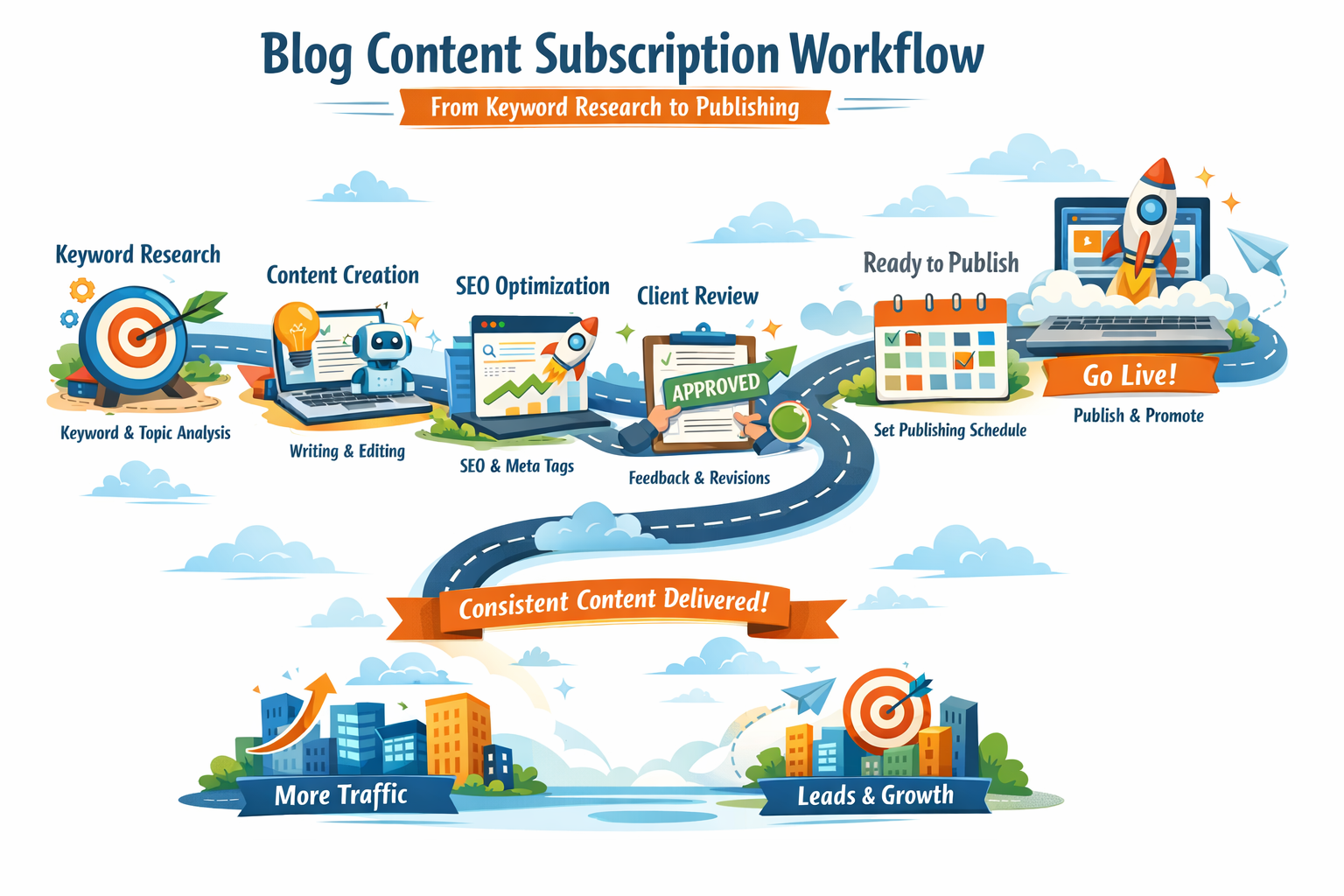
Keyword and topic research aligned to your business goals
Drafting and editing by writers (often AI-assisted with human oversight)
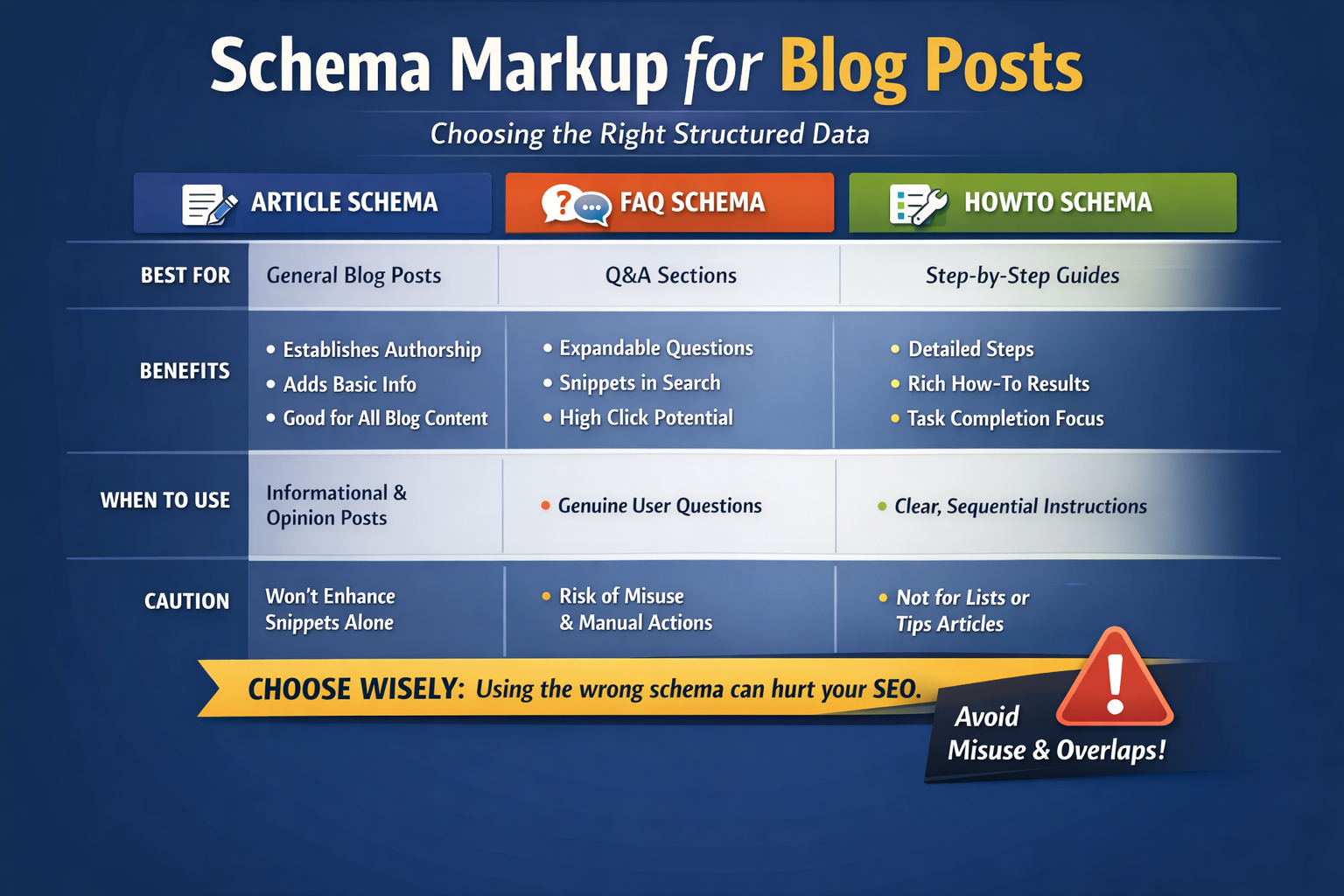
SEO optimization including metadata, internal links, and schema markup
A publishing cadence you can count on
Some providers handle the publishing itself. Others deliver ready-to-post drafts. Either way, the core promise is the same: you stop worrying about where the next blog post is coming from.
This differs from project-based content work, where you request individual pieces, negotiate scope, wait for delivery, and repeat the cycle. A recurring content model eliminates the repetitive procurement loop and replaces it with a system that runs in the background—week after week, month after month.
Why B2B Teams Struggle With Consistent Publishing
Content marketing works when it compounds. A single blog post might generate a trickle of traffic. But a library of well-optimized posts, published consistently over months, creates a foundation that attracts qualified visitors around the clock. This is how you build topical authority—the signal that tells search engines your site is a legitimate resource in your space.
The problem? Most teams never reach that point.
According to the Content Marketing Institute, only 29% of B2B marketers rate their content strategy as effective [1]. That's not a skills problem—it's a consistency problem. Teams know what to do. They just can't do it reliably.
The usual culprits include:
Resource constraints: Writers get pulled into other projects. Editors are stretched thin. Content velocity drops to zero.
Approval delays: Posts sit in review queues while stakeholders juggle priorities. By the time feedback arrives, the topic feels stale.
Freelancer churn: Finding, vetting, and managing external writers takes time. And when a good one leaves, you start over—rebuilding context, explaining your voice, waiting for ramp-up.
No dedicated owner: Without a content lead, editorial calendar management falls through the cracks. Publishing becomes reactive instead of strategic.
The result is a blog that updates sporadically—sometimes three posts in a month, sometimes nothing for eight weeks. Search engines notice the inconsistency. So do readers. And over time, content decay sets in: older posts lose relevance, rankings slip, and the organic traffic you worked to build starts evaporating.
How Subscriptions Solve the Consistency Problem
A blog content subscription removes the operational friction that causes inconsistent publishing.
Here's what changes:
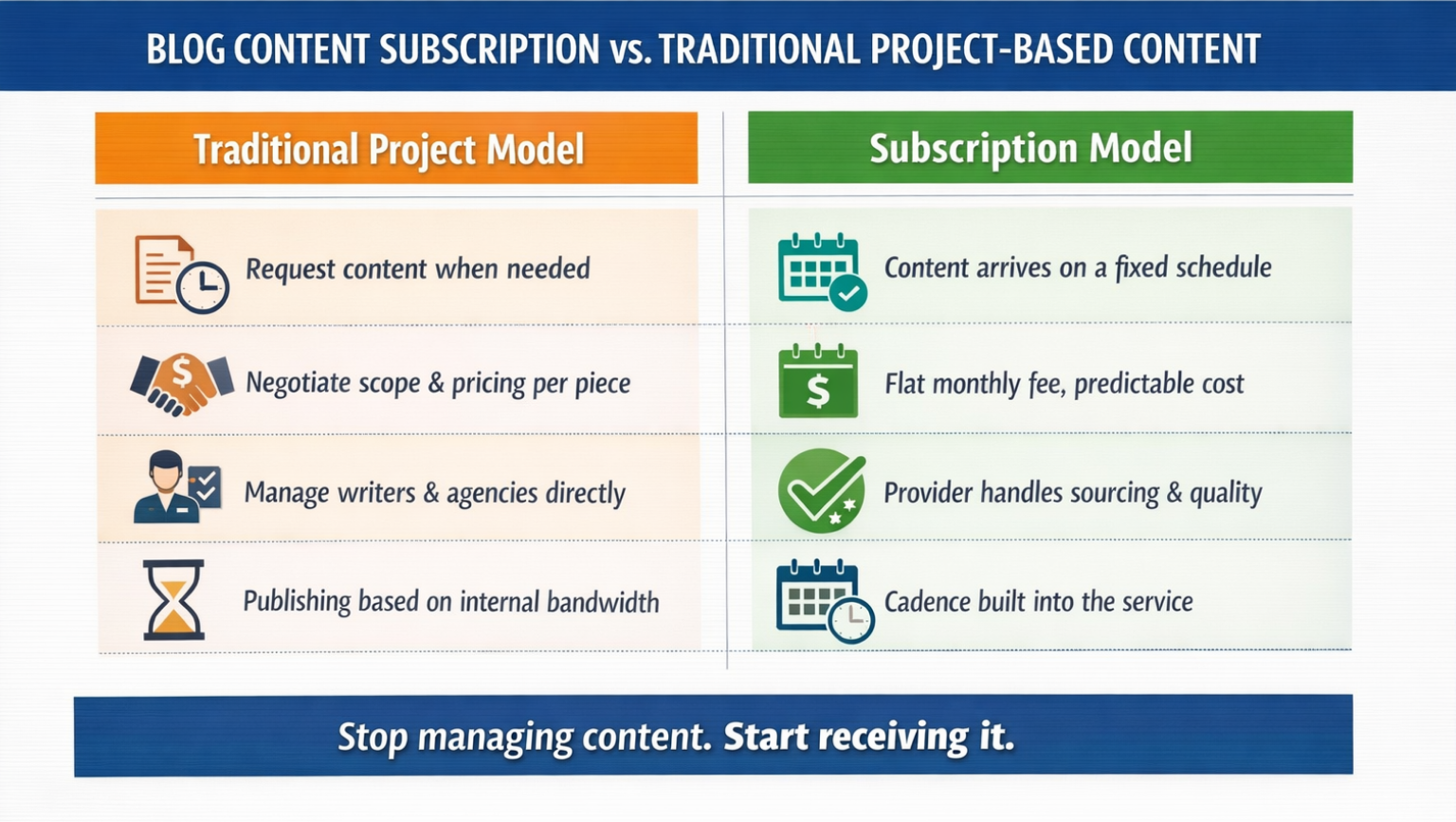
| Traditional Project Model | Subscription Model |
| Request content when needed | Content arrives on a fixed schedule |
| Negotiate scope and pricing per piece | Flat monthly fee, predictable cost |
| Manage writers or agencies directly | Provider handles sourcing and quality |
| Publishing depends on internal bandwidth | Cadence is built into the service |
With a subscription, you're not managing a content operation. You're receiving output from one.
This is especially valuable for lean marketing teams—those without a dedicated content manager or the budget for a full-time writer. Instead of building infrastructure, you plug into a system that already exists.
The shift is similar to what happened with other business functions. Companies don't build their own payroll software. They subscribe to one. B2B blog outsourcing is moving in the same direction.
Understanding the True Cost: Subscription vs. Project-Based Content
At first glance, project-based content can seem cheaper. You pay per piece. No commitment. Full flexibility.
But the true cost includes more than the invoice amount. It includes the time spent:
Writing briefs and communicating expectations
Finding and vetting writers
Reviewing drafts and requesting revisions
Managing contracts, payments, and timelines
Filling gaps when freelancers disappear
When you account for these hidden costs, the math shifts—often dramatically.
Example: Total Cost of Ownership Over 6 Months
Project-Based Approach (8 posts/month)
Average cost per post: $350 (mid-tier freelance rate)
Posts over 6 months: 48
Direct content cost: $16,800
Internal management time: ~10 hours/month at $75/hour = $4,500
Total: $21,300
Subscription Approach (8 posts/month)
Monthly subscription: $800 (done-for-you tier at comparable quality)
6-month cost: $4,800
Internal management time: ~2 hours/month at $75/hour = $900
Total: $5,700
The subscription model delivers lower total cost of ownership—and more importantly, it delivers consistent output. No scrambling. No missed weeks. No rebuilding relationships with new writers every few months.
Important caveat: These figures vary based on your industry, content complexity, and provider. Subscription pricing reflects a systems-based approach that uses AI assistance and standardized workflows to reduce per-article costs without sacrificing quality. When comparing options, ensure you're evaluating similar quality levels—a $50/post content mill won't match a $350/post specialist, regardless of delivery model.
What to Look for in a B2B Blog Outsourcing Partner
Not all content subscriptions are created equal. Some providers churn out generic filler. Others deliver strategic, SEO-optimized posts that actually rank.
When evaluating a recurring content model, consider:
Topic and Keyword Research
Does the provider conduct research, or do they expect you to hand over topics? The best services build a topic bank based on your audience, competitors, and search opportunity. This ensures every post serves a strategic purpose—not just filling a slot on the calendar.
SEO Optimization
Look for providers that handle on-page SEO: title tags, meta descriptions, header structure, internal links, and schema markup. Content that isn't optimized is content that won't compound.
Editorial Quality
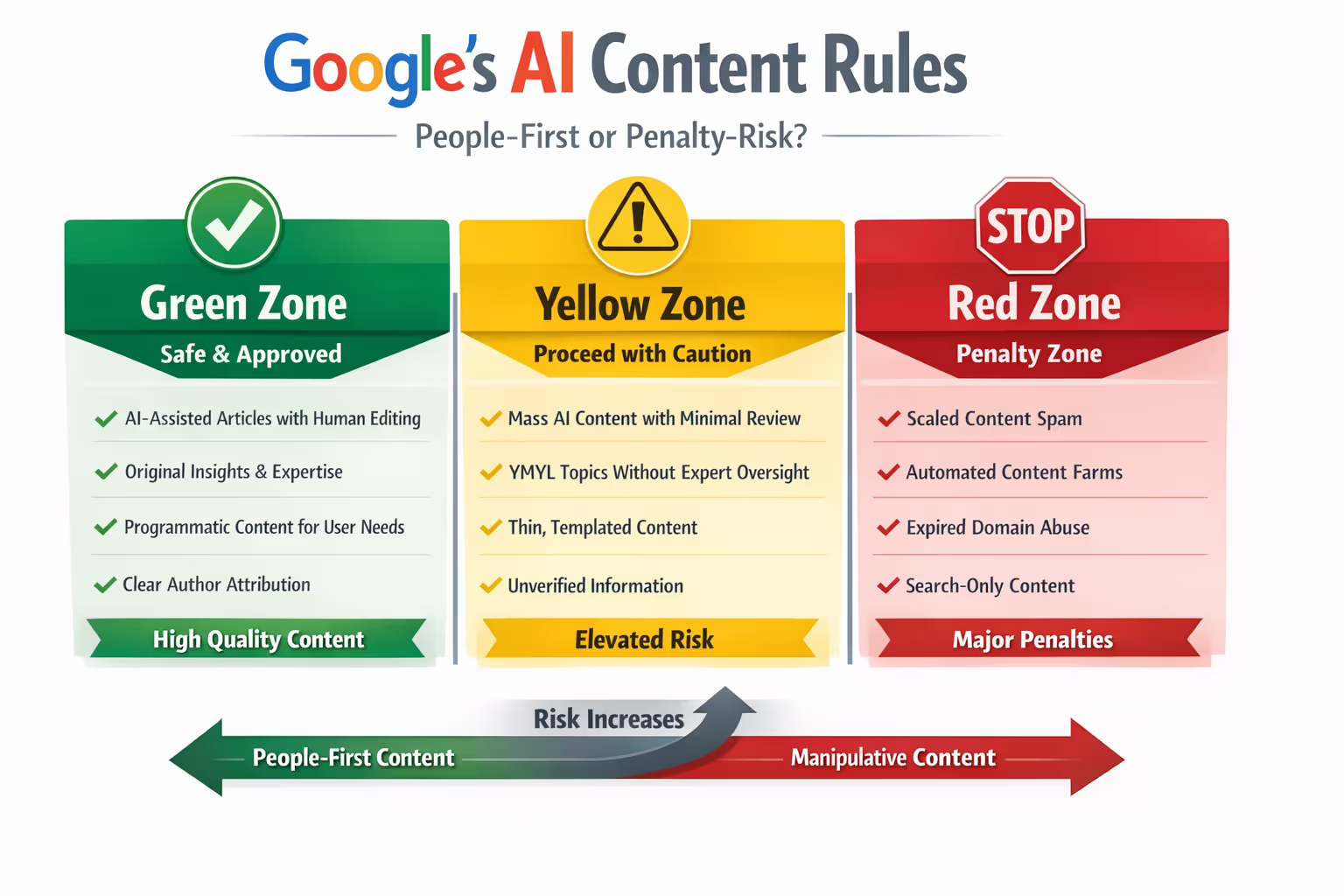
AI-assisted writing has improved dramatically, but human oversight still matters. Ask whether posts are reviewed by editors. Request samples. Content should read like an expert wrote it—not like a chatbot guessed at it.
Brand Voice Alignment
This is where many subscriptions fall short. During onboarding, a good provider will conduct a deep-dive into your audience, tone, and messaging. They'll ask about your differentiators, your customers' pain points, and the language your industry uses. Without this foundation, even well-written content can feel generic.
Ask prospective providers: How do you learn our brand voice? What does your onboarding process look like? If the answer is vague, expect the content to be too.
Publishing Cadence and Flexibility
Clarity here is essential. How many posts per week or month? Is there flexibility to scale up for a product launch or down during a slow period? What happens if you need to pause?
Ownership and Transparency
Confirm that you own the content outright. Some providers retain rights or limit usage. You should be able to repurpose, edit, and publish content wherever you choose—forever.

The Risks of Content Subscriptions (And How to Mitigate Them)
Honesty matters here. Subscriptions aren't a silver bullet, and pretending otherwise would undermine everything this article is trying to build.
Risk: Generic, off-brand content
When providers scale across many clients, there's a temptation to template everything. The result is content that's technically correct but lacks personality—the kind of posts that blend into the background noise of search results.
Mitigation: Choose providers with a robust onboarding process. Review samples before committing. Maintain approval rights on every post, and don't hesitate to send feedback when something misses the mark.
Risk: Misaligned topics
A provider optimizing for volume might chase keywords that drive traffic but attract the wrong audience. Vanity metrics look good in reports but don't convert.
Mitigation: Stay involved in topic selection, at least initially. Review the keyword strategy and ensure it aligns with your buyer's journey—not just search volume.
Risk: Quality inconsistency
Some subscription services rely heavily on AI without adequate human review, leading to posts that read well superficially but contain errors, awkward phrasing, or outdated information.
Mitigation: Ask about the editorial process. Who reviews drafts before delivery? What's the revision policy? A credible provider will be transparent about their workflow.
Risk: Over-reliance on external content
Outsourcing your entire content strategy can leave internal teams disconnected from customer conversations and market insights that often surface through the writing process.
Mitigation: Treat subscription content as a foundation, not a replacement. Supplement with occasional pieces from internal subject matter experts, customer interviews, or original research.
Who Benefits Most From a Blog Content Subscription
This model isn't for everyone. But it's particularly well-suited for:
SaaS companies building organic traffic as a growth channel, especially those without a dedicated content team
E-commerce brands competing for category-level search visibility across hundreds of potential keywords
Agencies that need to deliver content for clients without expanding headcount or burning billable hours
Service businesses establishing thought leadership in competitive markets where trust matters
The common thread: these teams need consistent content but lack the internal capacity to produce it reliably.
If your blog has gone quiet for months at a time—or if your team dreads the "who's writing this week's post?" question—a subscription model is worth considering.
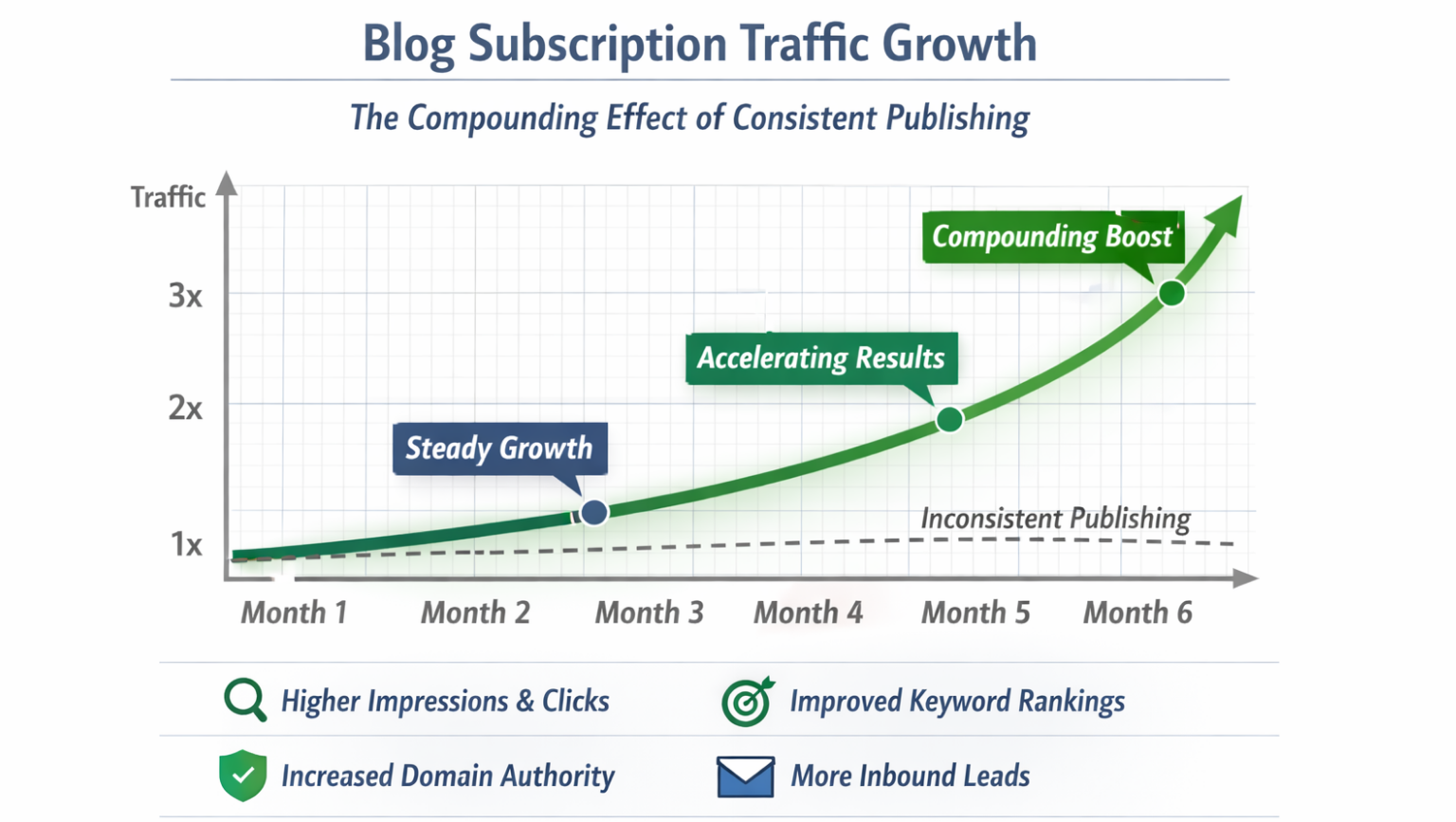
The Compounding Effect of Consistent Publishing
One underappreciated benefit of subscriptions is what happens over time.
SEO rewards consistency. A site that publishes two optimized posts per week builds topical authority faster than one that publishes sporadically. Search engines see steady output as a signal of relevance. Readers see it as a sign of expertise.
Research from HubSpot suggests that companies publishing 16 or more blog posts per month see roughly 3.5 times more traffic than those publishing four or fewer [2]. While exact results vary by industry, the pattern holds: more consistent output leads to faster compounding.
After six months of consistent publishing, most sites see measurable improvements in:
Organic impressions and clicks
Keyword rankings for target terms
Domain authority
Inbound leads from content
This compounding effect is difficult to achieve with project-based content, because the output is inherently irregular. A subscription creates the conditions for compounding to occur—not through heroic effort, but through systems.
Making the Switch: What to Expect
Transitioning to a subscription model typically involves:
Kickoff call: The provider learns about your business, audience, goals, and brand voice. Good providers dig deep here—asking about your customers, your competitors, and the specific language your industry uses.
Topic bank creation: Keywords and topics are researched and organized into a content calendar. You should have visibility into this plan and the ability to adjust priorities.
First drafts delivered: You review, request revisions if needed, and approve. The best providers make this process simple—one-click approvals, clear feedback channels, fast turnaround.
Ongoing cadence: Content arrives on schedule, week after week. Over time, the provider learns your preferences and the need for revisions typically decreases.
The learning curve is short. Most teams are up and running within a week or two.
The key is choosing a provider that treats your content as their responsibility—not as a series of one-off tasks. Look for partners who think in systems, not assignments.
Start Building Your Organic Traffic Engine
If your blog has stalled—or never quite got off the ground—a content subscription can change that.
It won't require you to hire writers, manage freelancers, or build an editorial calendar from scratch. It simply requires you to show up, approve drafts, and let the system run.
The teams winning at content marketing in 2024 aren't necessarily the ones with the biggest budgets. They're the ones who've solved the consistency problem—who've turned content from a periodic project into a reliable engine.
Ready to see what consistent publishing looks like? Try a blog content subscription with two free articles delivered in 48 hours—no commitment required. [Start your free trial today.]
Frequently Asked Questions
What's the difference between a blog content subscription and hiring a freelance writer?
A freelance writer provides individual pieces on request. A subscription provides a complete system: topic research, writing, editing, SEO optimization, and a fixed publishing schedule. You're not managing a vendor—you're receiving output from an ongoing content operation. The subscription model also removes the risk of freelancer churn and the management overhead of coordinating multiple contractors.
How many blog posts should a B2B company publish per month?
Most B2B teams see meaningful results with 8–12 posts per month (2–3 per week). This cadence builds topical authority, gives search engines fresh content to index, and creates enough volume to cover multiple keyword clusters. However, consistency matters more than raw volume—four posts per week, every week, outperforms eight posts one month and zero the next.
Is AI-generated content acceptable for SEO?
Yes, when properly executed. Google evaluates content based on quality, relevance, and usefulness—not authorship method [3]. AI-assisted content that's reviewed by human editors and optimized for search can perform as well as (or better than) manually written posts. The key is ensuring human oversight catches errors, improves readability, and adds genuine expertise.
How long does it take to see results from consistent blogging?
Most companies see measurable improvements within three to six months. SEO compounds over time, so the benefits accelerate as your content library grows and posts begin ranking for target keywords. Early indicators include increased indexation, growing impressions in Search Console, and initial keyword movements before significant traffic gains appear.
Can I cancel a blog content subscription anytime?
Policies vary by provider, but reputable services offer flexible terms. Look for month-to-month options or short commitment periods. You should be able to pause or cancel without penalty. Be wary of providers requiring long-term contracts—the best services earn your business through results, not lock-in.
About Our Editorial Standards
This article was produced by The Mighty Quill, an AI-powered content engine built for B2B marketers who need consistent, SEO-optimized publishing. Our team combines AI drafting with human editorial oversight to deliver content that ranks, reads well, and drives results. With over 15 years of experience in digital marketing and SEO, our founder built this system to help growing companies win organic traffic without the operational headaches of traditional content production.
Cited Works
Content Marketing Institute — "B2B Content Marketing Benchmarks, Budgets, and Trends." https://contentmarketinginstitute.com/research/
HubSpot — "How Often Should Companies Blog?" https://blog.hubspot.com/marketing/blogging-frequency-benchmarks
Google Search Central — "Creating helpful, reliable, people-first content." https://developers.google.com/search/docs/fundamentals/creating-helpful-content