What is AEO? (The Quick Answer)
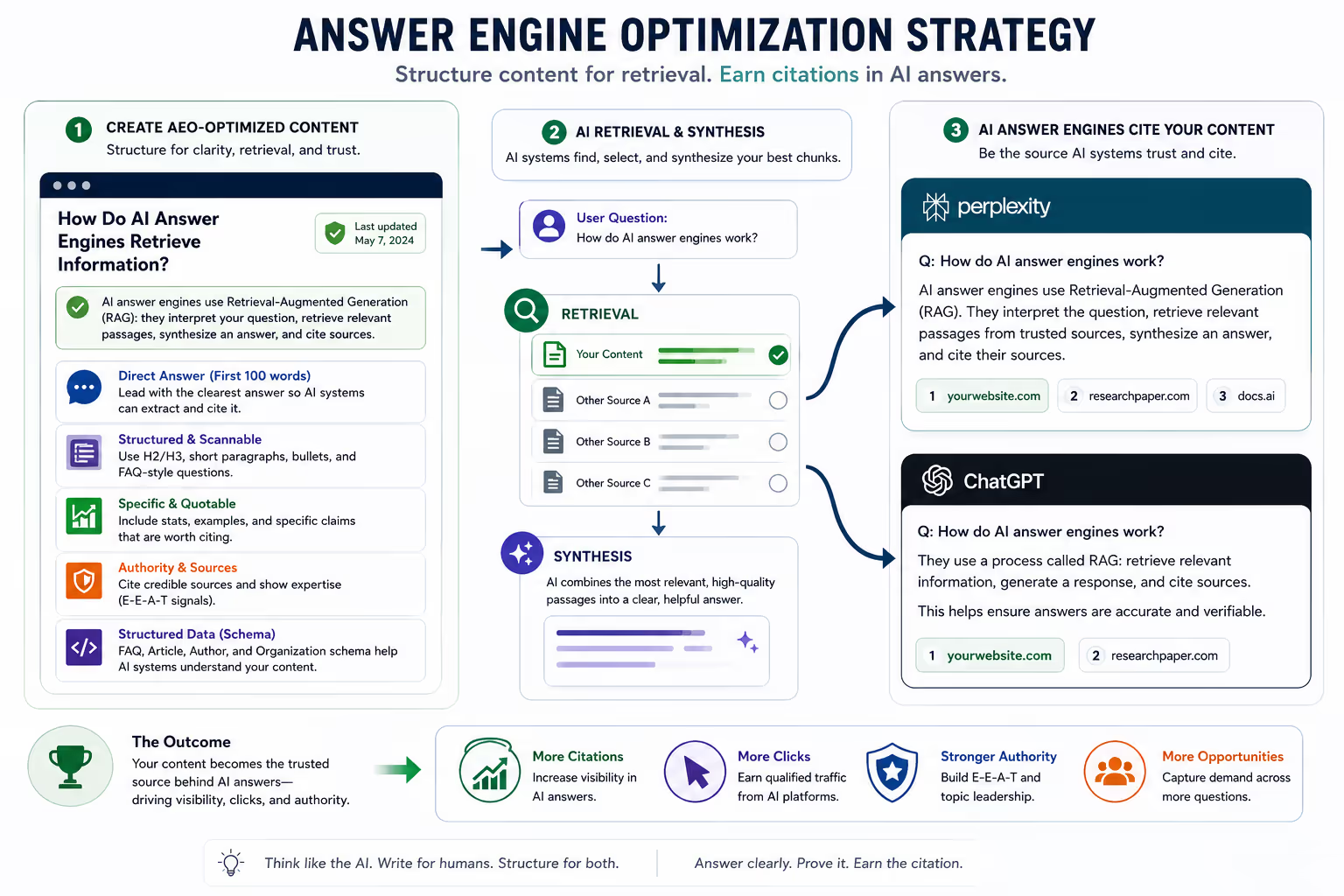
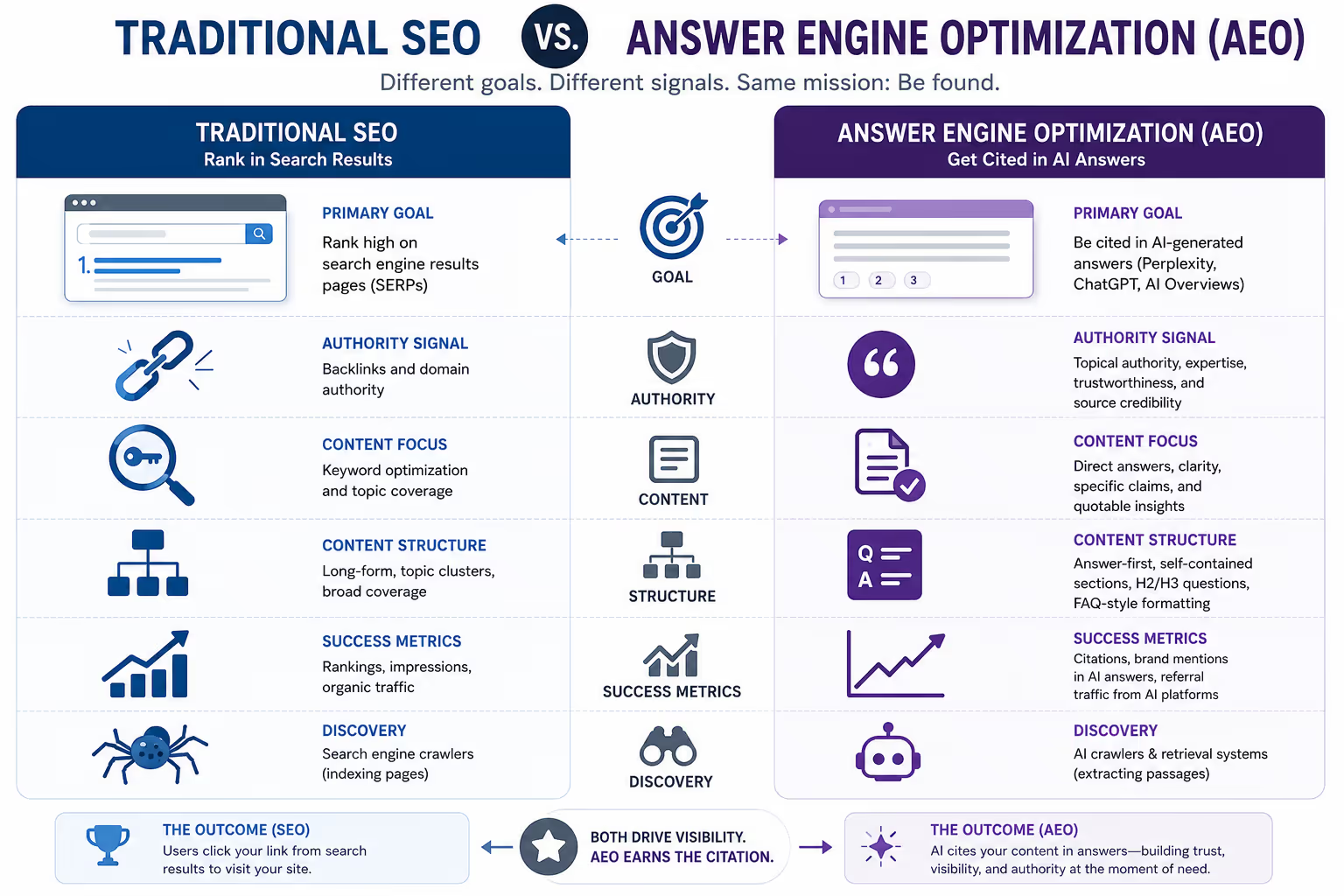
Answer Engine Optimization (AEO) is the practice of structuring content so AI systems—Perplexity, ChatGPT, Claude, Google's AI Overviews—can find it, understand it, and cite it when users ask questions. It's SEO's more demanding cousin, built for a world where people increasingly get answers from AI instead of clicking through search results.
If traditional SEO asks "how do I rank for this keyword?" then AEO asks "how do I become the source AI systems quote?"
That distinction matters more than most marketers realize.
Why AEO Matters Right Now
Over the past 15 years working in SEO and digital marketing, I've watched several shifts reshape how businesses get found online. The rise of AI answer engines is one of the more significant ones.
Here's what's happening: millions of people now ask Perplexity, ChatGPT, or Google's AI Overviews their questions instead of scrolling through traditional search results. These systems don't just link to sources—they synthesize answers and cite the content they pull from.
The content strategies most companies built for traditional SEO don't fully translate to this environment. Your page might rank #3 for a keyword and still never get cited by an AI system if the content isn't structured for retrieval.
This isn't about abandoning SEO. It's about expanding your strategy to capture a growing channel before your competitors do.
The Shift from Link-Based to Citation-Based Authority
For two decades, Google's algorithm treated backlinks as votes of confidence. More quality links meant more authority.
AI answer engines work differently. They don't just crawl and index—they retrieve, synthesize, and cite. The question they're answering isn't "which page has the most authority?" but "which content best answers this specific question?"
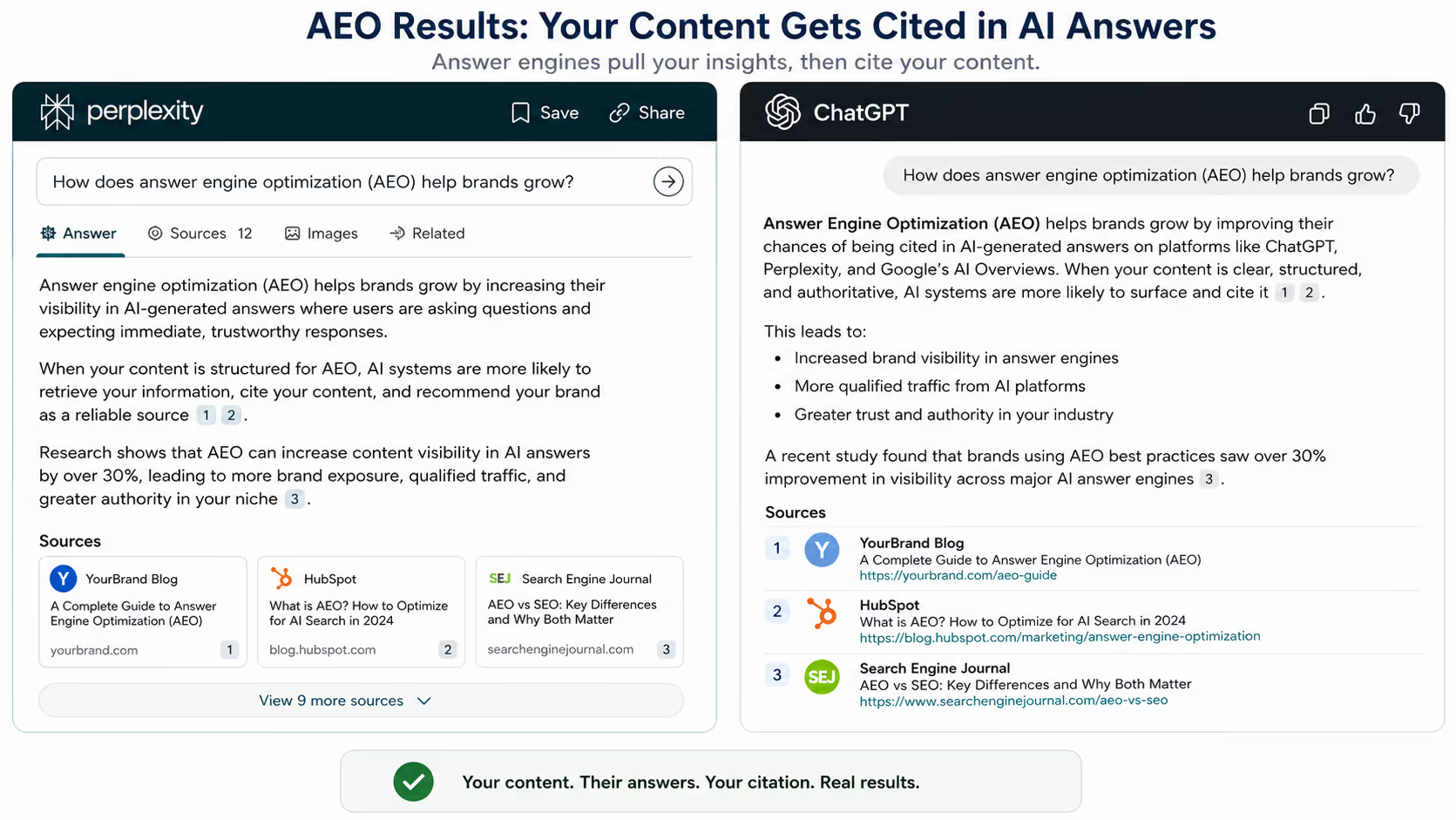
This represents Generative Engine Optimization in action. When someone asks Perplexity a question, the system pulls from multiple sources, synthesizes an answer, and attributes information through inline citations [1]. Your goal isn't to rank #1 for a keyword—it's to be cited as the definitive source for specific claims.
The implications are practical:
Authority becomes contextual. A smaller site with deep expertise in a narrow topic can get cited alongside or instead of industry giants.
Structure matters as much as substance. AI systems need to parse your content quickly and accurately.
Specificity wins. Vague, general content gets passed over. Precise, quotable statements get cited.
Research from the GEO study at Princeton and collaborating institutions found that certain optimization strategies can increase content visibility in AI-generated responses by over 30% [2]. That's meaningful competitive advantage.
How AI Answer Engines Actually Retrieve Information
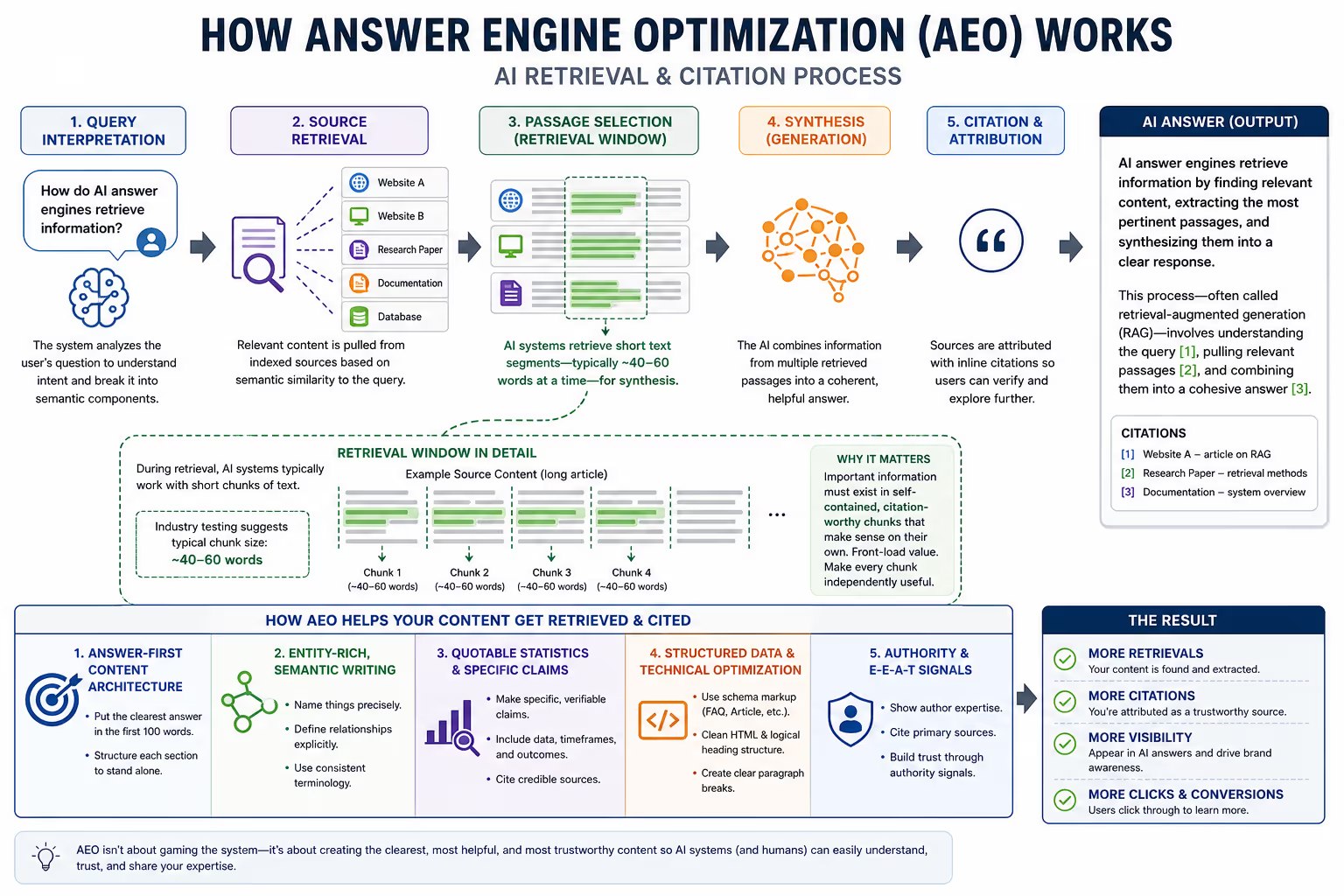
Before optimizing, you need to understand what's happening under the hood. Most AI answer engines use a process called Retrieval-Augmented Generation (RAG). In simplified terms:
Query interpretation: The system analyzes what the user is really asking, breaking the question into semantic components.
Source retrieval: Relevant content gets pulled from indexed sources—websites, documents, databases—based on semantic similarity to the query.
Synthesis: The AI combines information from multiple retrieved passages into a coherent response.
Citation: Sources get attributed, often with inline references users can verify.
Here's the detail most guides miss: during the retrieval phase, AI systems typically work with relatively short text segments. While exact parameters vary by system and implementation, industry testing suggests retrieval often focuses on passages roughly 40 to 60 words at a time during the synthesis phase. (This is a practical heuristic based on how RAG systems commonly chunk content, not an absolute technical limitation.)
This creates what we might call the retrieval window constraint. Your most important information needs to exist in self-contained, citation-worthy chunks. Long paragraphs that build slowly to a conclusion? The AI might grab a middle portion that lacks context.
The practical application: structure content so each paragraph or section contains a complete, quotable insight. Front-load your value. Make every chunk independently useful.
The Five Pillars of Answer Engine Optimization
1. Answer-First Content Architecture
Traditional content advice often suggests building toward your main point—context first, conclusion later. AEO demands the opposite.
Put your clearest answer in the first 100 words of any section. Then expand with context, evidence, and nuance. This mirrors how journalists write—lead with the conclusion, then support it.
Before (traditional approach):"Content marketing has evolved significantly over the past decade, with various platforms and strategies emerging. As businesses adapt to changing consumer behaviors, the importance of... [300 words later]... which means you should publish consistently."
After (AEO-optimized):"Publishing consistently—at least two to three times weekly—compounds organic traffic over time. Here's why frequency matters and how to maintain it without burning out your team."
The second version can be extracted and cited directly. The first requires wading through context that may not get included.
2. Entity-Rich, Semantically Clear Writing
AI systems understand content through entities—people, concepts, products, organizations. The clearer your entity relationships, the better AI systems can parse your expertise.
This means:
Name things precisely. Write "Generative Engine Optimization" rather than "this new approach" or "the technique."
Define relationships explicitly. "AEO, a subset of broader GEO strategies, focuses specifically on..."
Use consistent terminology. Don't switch between "AI search," "answer engines," and "generative search" within the same piece.
Search engines have long used entity recognition [3], but AI answer engines take it further. They map relationships between concepts, which means scattered terminology creates confusion about what you're actually discussing.
3. Quotable Statistics and Specific Claims
Vague statements don't get cited. Specific, verifiable claims do.
Weak: "Many businesses see improved results with consistent content."
Strong: "Businesses publishing content consistently often report measurable increases in organic traffic and domain authority within six months."
The second version provides a specific timeframe and concrete outcomes. It's citable. The first is opinion that AI systems have limited reason to surface.
This doesn't mean inventing statistics. It means being precise about what you know, citing credible sources, and avoiding hedge-heavy language that makes content useless for retrieval.
4. Structured Data and Technical Optimization
AI systems don't just read your content—they read your code. Schema markup, clean HTML structure, and logical heading hierarchies signal what your content is about.
Key technical elements:
- Schema markup (e.g., Article, FAQ, How-To) clearly defines content types.
- Clean, semantic HTML (using <head>, <header>, <article>, <section>, <footer>) for structural clarity.
- Logical heading hierarchy (H1, H2, H3) that outlines your content.
- XML sitemaps to ensure comprehensive indexing.
- Page speed optimization for faster retrieval.
FAQ schema for question-answer pairs
Article schema with clear author attribution
Logical H2/H3 structure that mirrors how questions get asked
Clean paragraph breaks that create natural retrieval chunks
Google's documentation confirms that structured data helps search systems understand page content more effectively [4]. The same principle applies to AI answer engines, which rely on similar signals to determine relevance and authority.
5. Source Authority and E-E-A-T Signals
AI systems evaluate source credibility. A claim from Mayo Clinic carries different weight than the same claim from an anonymous blog.
Your content needs clear authority signals:
Named authors with verifiable expertise
Citations to primary sources (studies, official documentation, industry reports)
Consistent publishing history in your topic area
Clear organizational identity (who publishes this, and why should anyone trust them)
Google's Search Quality Rater Guidelines emphasize experience, expertise, authoritativeness, and trustworthiness—collectively known as E-E-A-T—as core evaluation criteria [5]. AI answer engines appear to apply similar heuristics when deciding which sources to cite.
Creating Content That Gets Retrieved
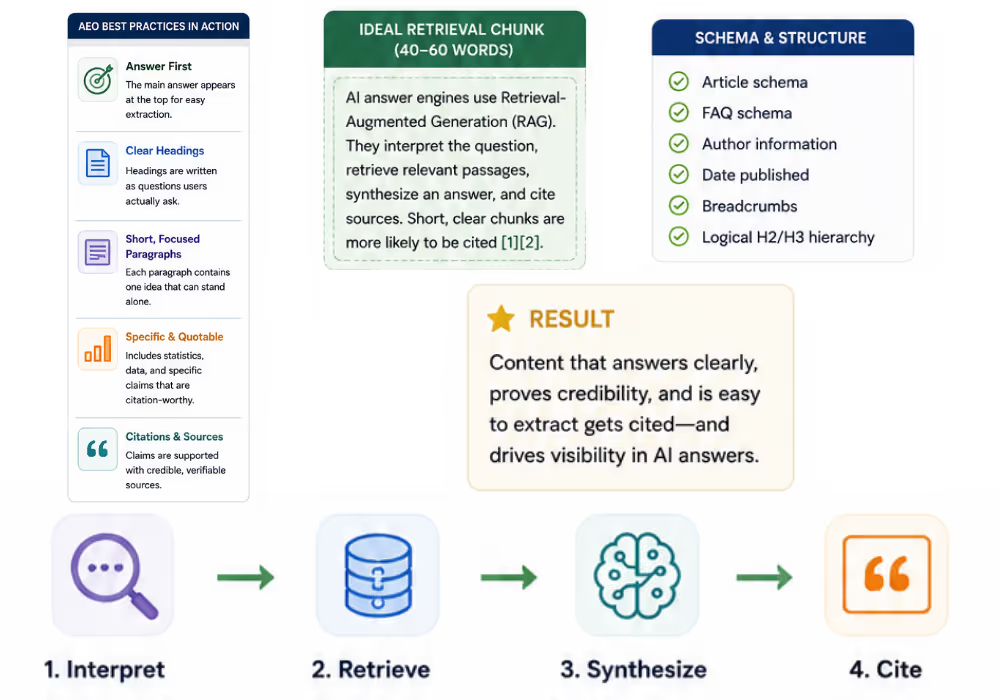
The tactical execution matters. Here's how to apply AEO principles to actual content creation:
Write Self-Contained Sections
Each H2 section should answer a question completely. Someone reading just that section—or an AI extracting just that section—should come away with useful information.
Test this by reading each section in isolation. Does it make sense without the surrounding context? If not, revise until it does.
Front-Load Each Paragraph
The first sentence of every paragraph should carry your strongest point. This is where retrieval systems typically focus attention.
Structure paragraphs as:
Key claim or answer
Supporting evidence or explanation
Practical implication (optional)
This inverted pyramid approach helps ensure your best thinking gets surfaced.
Include Direct Question-Answer Pairs
AI systems respond to questions. Including explicit questions in your content—as H2s, H3s, or within FAQ sections—creates natural retrieval targets.
Instead of: "Understanding Retrieval Processes"
Try: "How Do AI Answer Engines Retrieve Information?"
The second version mirrors how users actually query these systems.
Layer Your Specificity
Start with the direct answer, then add nuance. This allows AI systems to grab the simple version for straightforward queries while giving deeper readers additional material.
Layer 1 (simple answer): "AI answer engines prioritize content that directly answers questions in concise, quotable statements."
Layer 2 (context): "This means structuring each section around a clear answer, supported by evidence, formatted for easy extraction."
Layer 3 (full explanation): Complete explanation with examples, caveats, and practical applications.
Each layer serves different retrieval contexts.
Common AEO Mistakes to Avoid
Optimizing for AI at the expense of humans. Your content still needs to engage real readers. Robotic, extraction-optimized content might get cited but won't convert visitors who click through.
Ignoring traditional SEO fundamentals. AEO supplements SEO; it doesn't replace it. You still need keyword relevance, quality backlinks, and technical health.
Over-structuring to the point of fragmentation. Some topics require nuanced, flowing explanation. Don't sacrifice coherence for retrievability.
Copying competitor answers. AI systems detect redundancy. If your content says exactly what ten other sources say, there's limited reason to cite you specifically.
Neglecting updates. AI answer engines often surface recent information. Outdated content—especially on evolving topics—loses retrieval priority.
Measuring AEO Success
This is admittedly new territory, and the measurement frameworks are still maturing. Here's what to track:
AI citation monitoring: Are AI systems mentioning or citing your content? Some brand monitoring tools now track AI mentions. You can also manually test queries in Perplexity and ChatGPT to see if your content gets cited.
Server log analysis: Check your server logs for AI bot crawlers like PerplexityBot, ChatGPT-User, or ClaudeBot. Increased crawl activity suggests your content is being indexed for potential retrieval.
Referral traffic from AI platforms: Perplexity, in particular, often sends click-through traffic. Track referrals from AI answer engine domains in your analytics.
Brand mention growth: Increased AI citations typically correlate with broader brand visibility. Use brand monitoring tools to track mention trends.
Query coverage: For how many relevant questions in your space does your content provide a comprehensive answer? Map this against what AI systems currently cite for those queries.
The tools for tracking AI visibility are evolving quickly. For now, focus on creating genuinely excellent content that answers questions better than alternatives—the metrics will follow.
The Compounding Advantage of Early AEO Adoption
Most content teams haven't adapted to AI answer engines. They're still running strategies that don't account for retrieval-based citation at all.
That's the opportunity.
Content that gets cited today builds authority for tomorrow. AI systems learn source reliability patterns over time. Early, consistent presence in answer engine results establishes your content as a go-to reference.
This mirrors how domain authority worked in traditional SEO—early movers who built genuine authority maintained advantages for years. The citation economy works similarly. Get cited now, and you're training AI systems to view you as authoritative for your topic area.
The window won't stay open forever. As awareness grows, competition for AI citations will intensify.
Ready to create content that ranks in both traditional search and AI answer engines? The Mighty Quill builds answer-ready, citation-optimized content designed for the evolving search landscape. Try the Blog Engine free and see what AI-optimized content looks like for your business.

Frequently Asked Questions
What is the difference between AEO and traditional SEO?
Traditional SEO focuses on ranking in search engine results pages through keywords, backlinks, and technical optimization. Answer Engine Optimization specifically targets AI systems like Perplexity and ChatGPT, emphasizing content structure that can be retrieved, synthesized, and cited. Both disciplines overlap significantly—good AEO builds on solid SEO fundamentals—but AEO adds emphasis on quotable statements, self-contained sections, and entity clarity.
How long does it take to see results from AEO optimization?
Most businesses begin seeing measurable changes in AI citation frequency and related referral traffic within three to six months of consistent AEO-optimized publishing. The compounding effect accelerates over time as AI systems increasingly recognize your content as authoritative within your topic area. Earlier-stage results include increased crawl activity from AI bots, which you can track in server logs.
Can small websites compete with large brands in AI answer engines?
Yes—often more effectively than in traditional search. AI answer engines prioritize content quality and direct relevance over domain authority alone. A smaller site with exceptional expertise in a specific topic can be cited alongside or instead of larger competitors, provided the content structure and authority signals meet retrieval standards.
What is RAG and why does it matter for AEO?
RAG (Retrieval-Augmented Generation) is the underlying architecture most AI answer engines use to generate responses. The system retrieves relevant text passages from its indexed sources, then uses those passages to generate an answer. Understanding RAG explains why content structure matters so much—AI systems work with chunks of text, not full pages, so your content needs to be useful at the passage level.
What role does schema markup play in AEO?
Schema markup helps AI systems understand content structure, authorship, and topic relationships. FAQ schema, article schema, and organization schema all provide signals that improve retrieval accuracy. While not strictly required, structured data gives your content an advantage in how AI systems parse and prioritize sources.
Cited Works
[1] Perplexity AI — "About." https://www.perplexity.ai/about
[2] Princeton University, Georgia Tech, The Allen Institute, IIT Delhi — "GEO: Generative Engine Optimization." https://arxiv.org/abs/2311.09735
[3] Google — "How Search Works." https://www.google.com/search/howsearchworks/
[4] Google Search Central — "Understand How Structured Data Works." https://developers.google.com/search/docs/appearance/structured-data/intro-structured-data
[5] Google — "Search Quality Rater Guidelines." https://services.google.com/fh/files/misc/hsw-sqrg.pdf


