You watched your organic traffic drop 30% last quarter and immediately wondered: Is it because we started using AI to help write our blog posts?
That fear keeps marketing leaders awake at night. And it's often misplaced.
Google has never penalized content simply because AI helped create it. What Google penalizes—and penalized aggressively in 2024—is low-quality content produced at scale without genuine value for readers [1]. The distinction matters enormously, yet it gets lost in polarized debates where one side claims AI content is perfectly safe and the other warns it's career suicide.
The truth sits in the middle, and it depends entirely on execution.
This checklist gives you a practical framework for evaluating AI content risk in 2026 and beyond. You'll learn which content types carry the highest stakes, how to assess your current workflow, and where AI genuinely helps versus where it creates liability.
No hype. No fearmongering. Just a clear-eyed look at what actually matters.
What Google Actually Says About AI Content (Updated for 2024-2026)
Google's position has remained consistent since early 2023, but their enforcement became substantially more aggressive in 2024.
The core principle: helpfulness determines value, not origin [1].
Google's Search Quality Evaluator Guidelines emphasize E-E-A-T—Experience, Expertise, Authoritativeness, and Trustworthiness [2]. Content demonstrating these qualities ranks well regardless of how it was produced. Content lacking them struggles regardless of who (or what) wrote it.
Here's what Google explicitly states:
Automation has long been used to create helpful content, including sports scores, weather forecasts, and financial data summaries [1]
AI can assist in content creation without violating guidelines
The focus remains on "people-first" content that provides genuine value
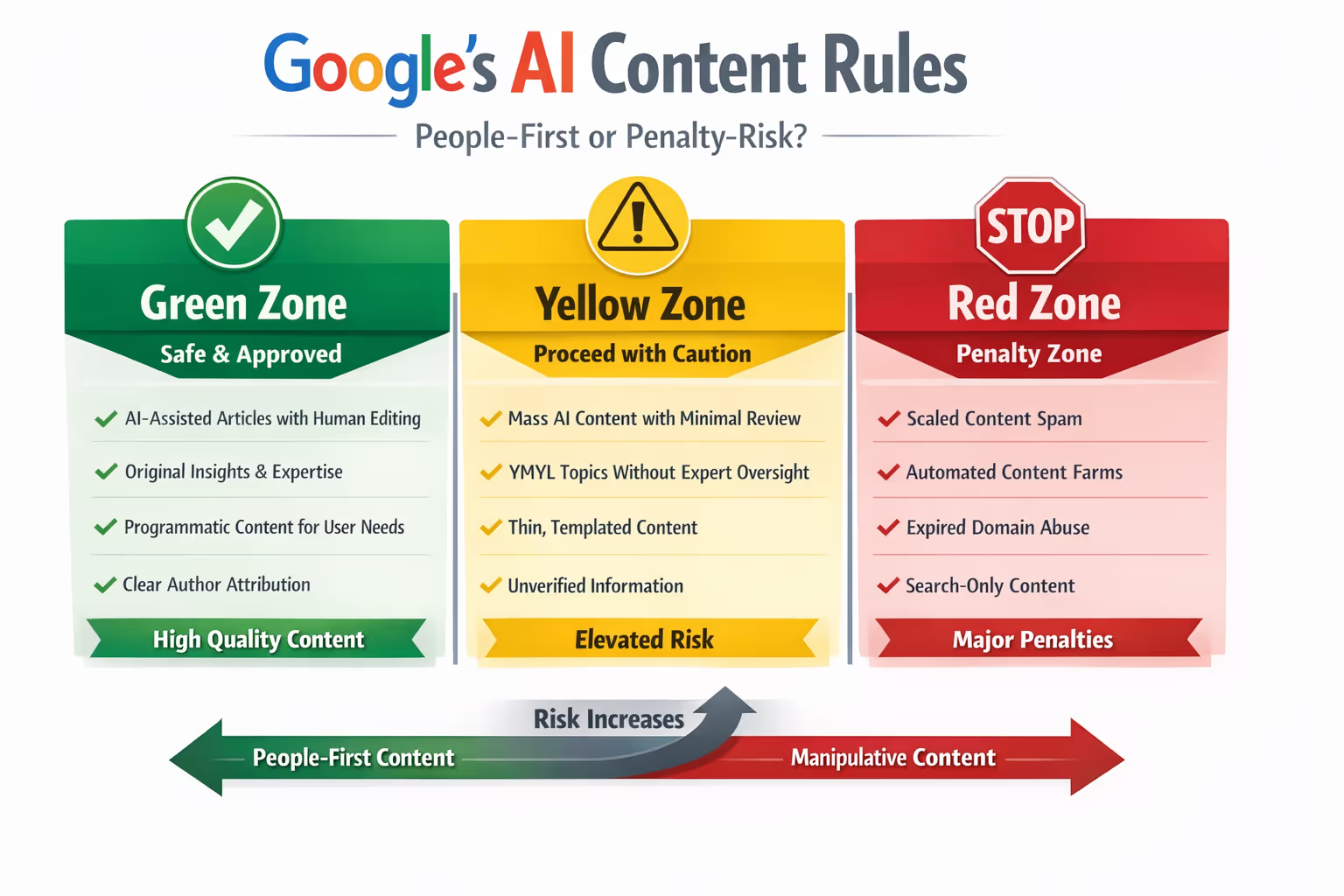
What changed in 2024: Google's March 2024 Core Update specifically targeted "scaled content abuse" with unprecedented force [3]. The update aimed to reduce low-quality, unoriginal content in search results by 40%. Sites that had mass-produced thin AI content without editorial oversight saw dramatic ranking losses—some were deindexed entirely.
This wasn't an anti-AI policy. It was an anti-garbage policy that happened to catch a lot of poorly executed AI content in its net.
The pattern matters for understanding 2026: Google cares progressively less about your production tools and progressively more about whether content demonstrates genuine expertise and unique perspective. AI detection isn't the mechanism—quality signals are.
Why "2026" Matters: The Trajectory Ahead
If you're planning content strategy for the next 12-18 months, understanding Google's direction helps more than fixating on current rules.
The trendline is clear:
Google's tolerance for AI as a tool is increasing. They've repeatedly stated that AI assistance doesn't violate guidelines. Their Search Liaison has clarified that they have no interest in penalizing content simply because AI was involved in creating it.
Google's standards for human value are also increasing. Each core update raises the bar for what "helpful" means. Content that would have ranked adequately in 2022 may not compete in 2026—not because it's AI-generated, but because it doesn't offer unique insight, experience, or expertise.
The "Experience" in E-E-A-T matters more than ever. Google added Experience to their quality framework specifically to reward content demonstrating first-hand knowledge. AI can synthesize existing information, but it cannot replace genuine experience with a product, industry, or situation.
What this means for 2026: The safest approach isn't avoiding AI—it's ensuring your content includes elements AI cannot provide. Original perspective. Tested advice. Real-world constraints. Actual expertise. Companies that use AI to accelerate production while adding genuine human value will thrive. Those using AI to manufacture authority they haven't earned will struggle increasingly.
The Risk Scoring Framework: Low, Medium, and High
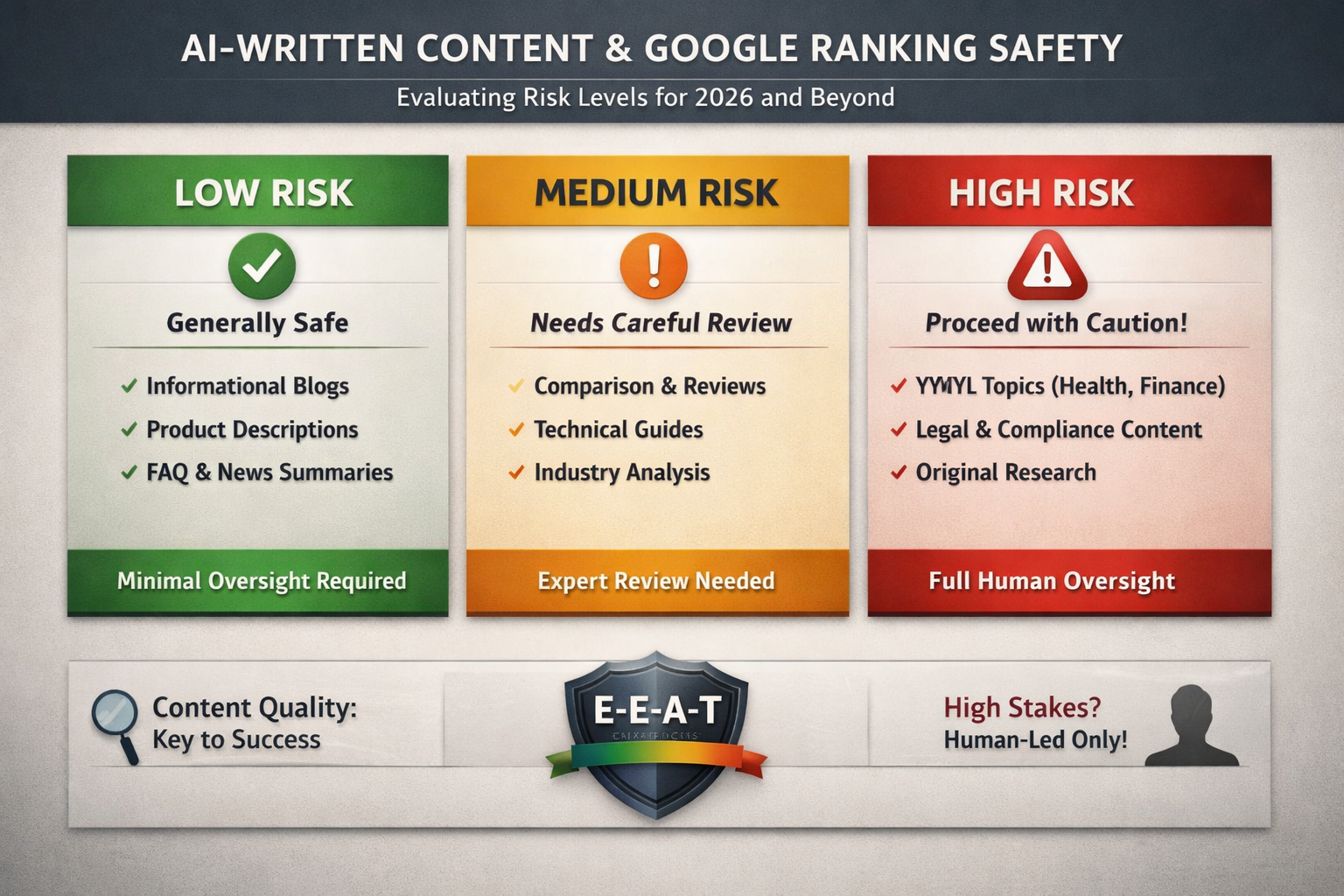
Not all content carries equal risk. A product comparison guide requires different scrutiny than a financial planning article. Understanding where your content falls on the risk spectrum helps you allocate editorial resources appropriately.
Low-Risk Content Types
These content categories typically involve lower stakes and tolerate more AI involvement:
Informational blog posts on general topics (how-to guides, listicles, industry overviews)
Product descriptions for standard e-commerce items
FAQ pages covering common questions
News summaries based on publicly available information
Internal documentation and process guides
Why they're lower risk: Errors are easier to catch, consequences of mistakes are limited, and source material is often widely available for verification.
Recommended workflow: AI drafts with human review for accuracy, tone, and brand alignment. A single knowledgeable editor can process multiple pieces efficiently.
Medium-Risk Content Types
These categories require more careful oversight:
Comparison and review content that influences purchase decisions
Technical tutorials where incorrect steps cause real problems
Industry analysis that positions your brand as a thought leader
Case studies featuring specific results or data
Email sequences that nurture leads toward conversion
Why they carry more risk: Readers make decisions based on this content. Inaccuracies damage trust. Claims require verification. Your reputation compounds with each piece—positively or negatively.
Recommended workflow: AI assists with structure and initial drafts. Human experts verify facts, add nuance from actual experience, and ensure claims are defensible.
High-Risk Content Types (Proceed with Extreme Caution)
These require the most rigorous human involvement:
YMYL content (Your Money or Your Life)—health, finance, legal, safety [2]
Technical documentation where errors cause system failures or security vulnerabilities
Regulatory or compliance content with legal implications
Original research or data analysis
Crisis communications or reputation-sensitive messaging
Why they're high risk: Consequences extend beyond brand perception. Bad health advice harms people. Incorrect financial guidance costs money. Legal inaccuracies create liability. Google applies heightened scrutiny to YMYL topics specifically because the stakes are higher.
Recommended workflow: Human experts lead entirely. AI may assist with research organization or draft refinement, but qualified professionals must verify every substantive claim. Consider whether AI involvement adds enough value to justify the additional verification burden.
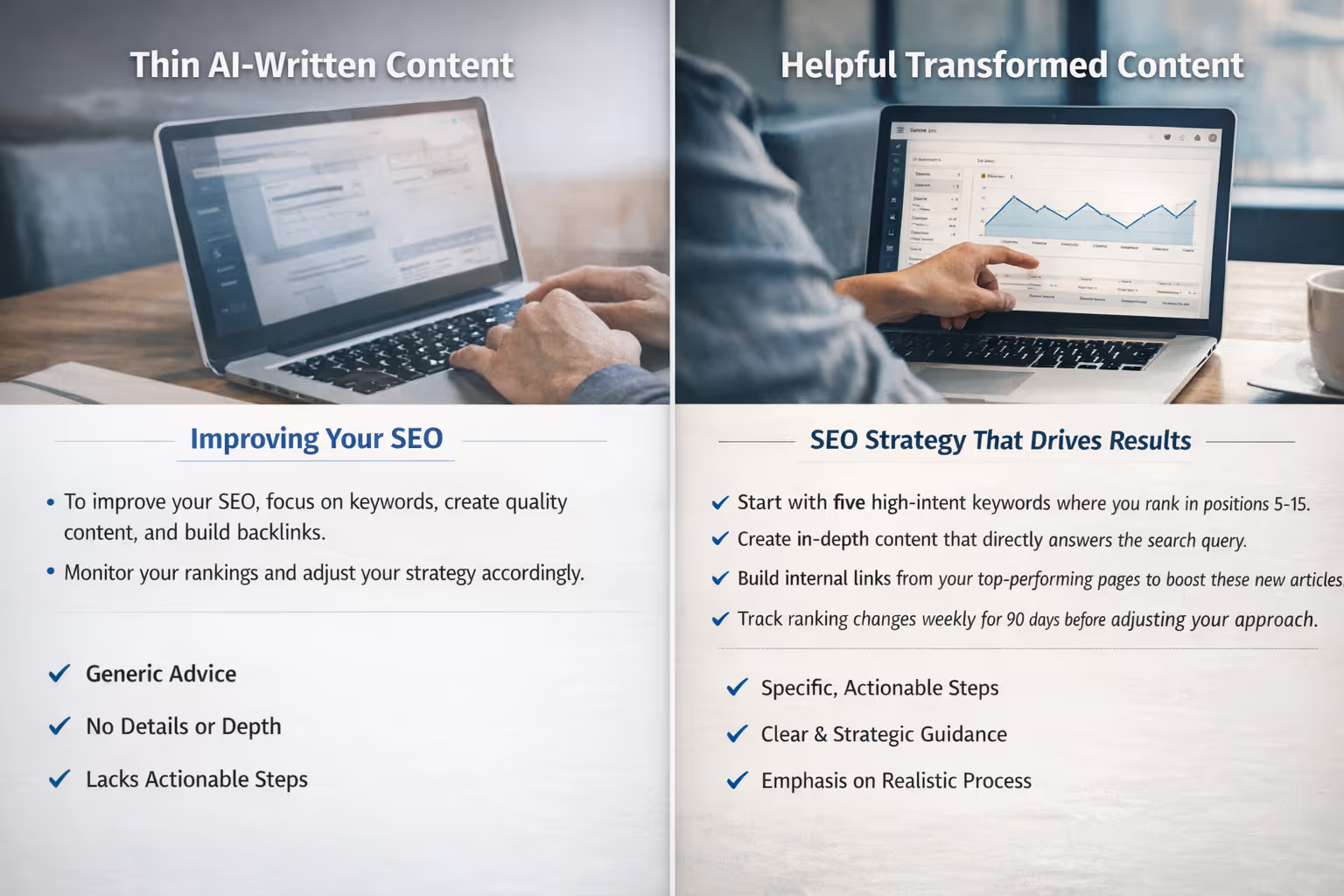
The Thin vs. Helpful Transformation Guide
The difference between content Google rewards and content it ignores often comes down to execution. Here's what separates thin AI output from genuinely helpful content.
Example 1: The Generic Definition Post
Thin version:
"Content marketing is a strategic marketing approach focused on creating and distributing valuable, relevant, and consistent content to attract and retain a clearly defined audience."
This is technically accurate. It's also the first sentence from dozens of existing articles. It adds nothing a reader couldn't find in thirty seconds of searching.
Helpful transformation:
"Content marketing sounds simple until you try it consistently. The concept—creating valuable content to attract your audience—makes intuitive sense. The execution breaks down when publishing schedules slip, topics feel random, and nobody can prove the blog actually generates leads. The gap between theory and practice is where most companies stall."
The second version acknowledges real challenges, speaks to lived experience, and gives readers something they haven't encountered elsewhere.
Example 2: The Feature Dump Product Description
Thin version:
"Our software includes automated reporting, team collaboration tools, and customizable dashboards. It integrates with popular platforms and offers 24/7 customer support."
Every competitor says the same thing. The reader learns nothing useful for making a decision.
Helpful transformation:
"Most reporting tools require you to build dashboards before you know what questions matter. Ours ships with templates based on the metrics B2B SaaS teams actually track—MRR, churn, expansion revenue—so you're analyzing data on day one instead of configuring software for weeks."
The second version identifies a specific pain point, explains how the product addresses it, and helps the reader evaluate fit.
Example 3: The Superficial How-To
Thin version:
"To improve your SEO, focus on keywords, create quality content, and build backlinks. Monitor your rankings and adjust your strategy accordingly."
This is advice anyone could generate in seconds. It provides no actionable guidance a reader could implement.
Helpful transformation:
"Start with five high-intent keywords where you have topical authority but currently rank positions 5-15. Create comprehensive content that directly answers the search query better than current top results. Build internal links from existing high-traffic pages to these new pieces. Track ranking changes weekly for 90 days before evaluating performance—SEO compounds slowly, and premature pivots waste effort."
The second version gives specific, actionable steps with realistic timeframes and reasoning.
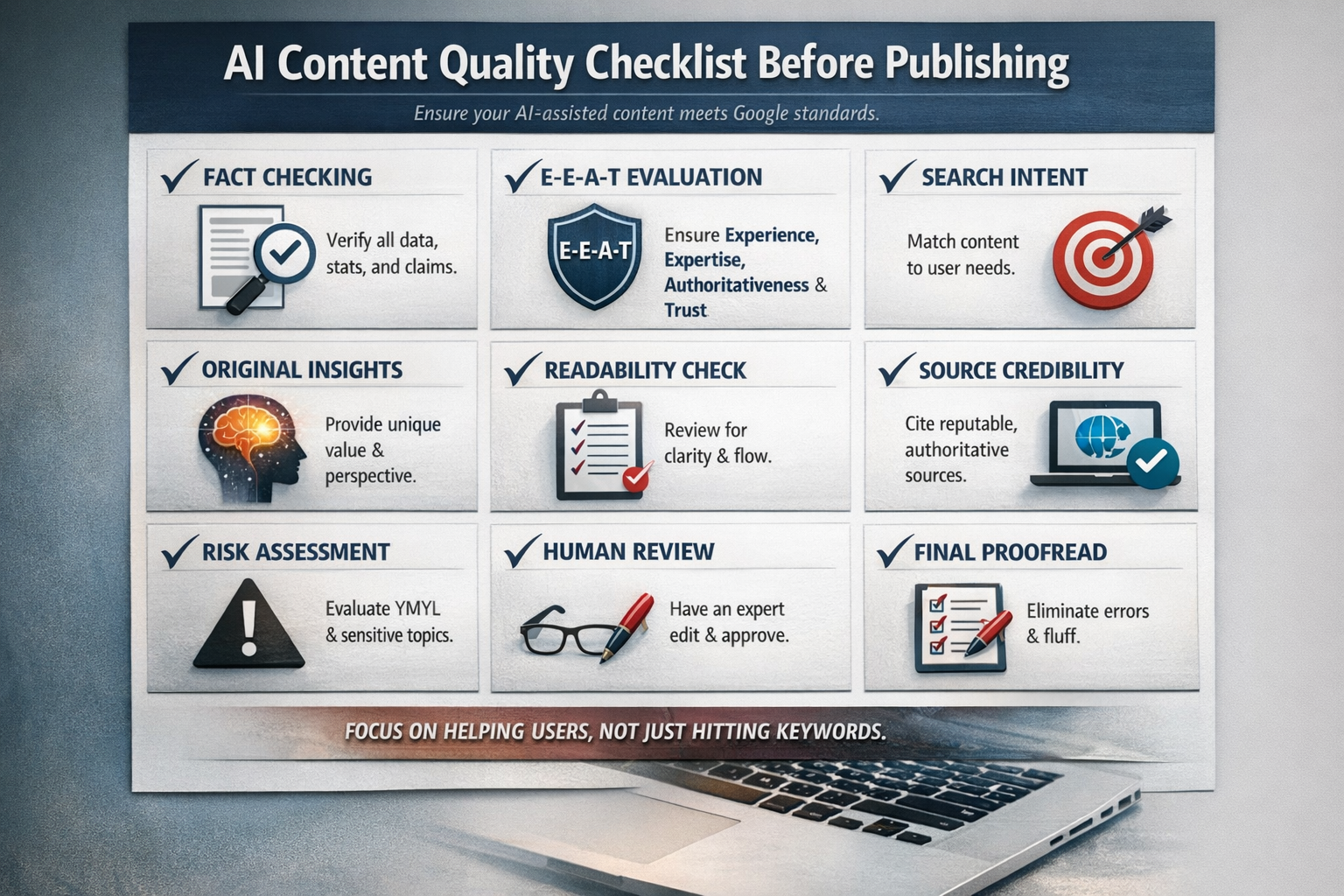
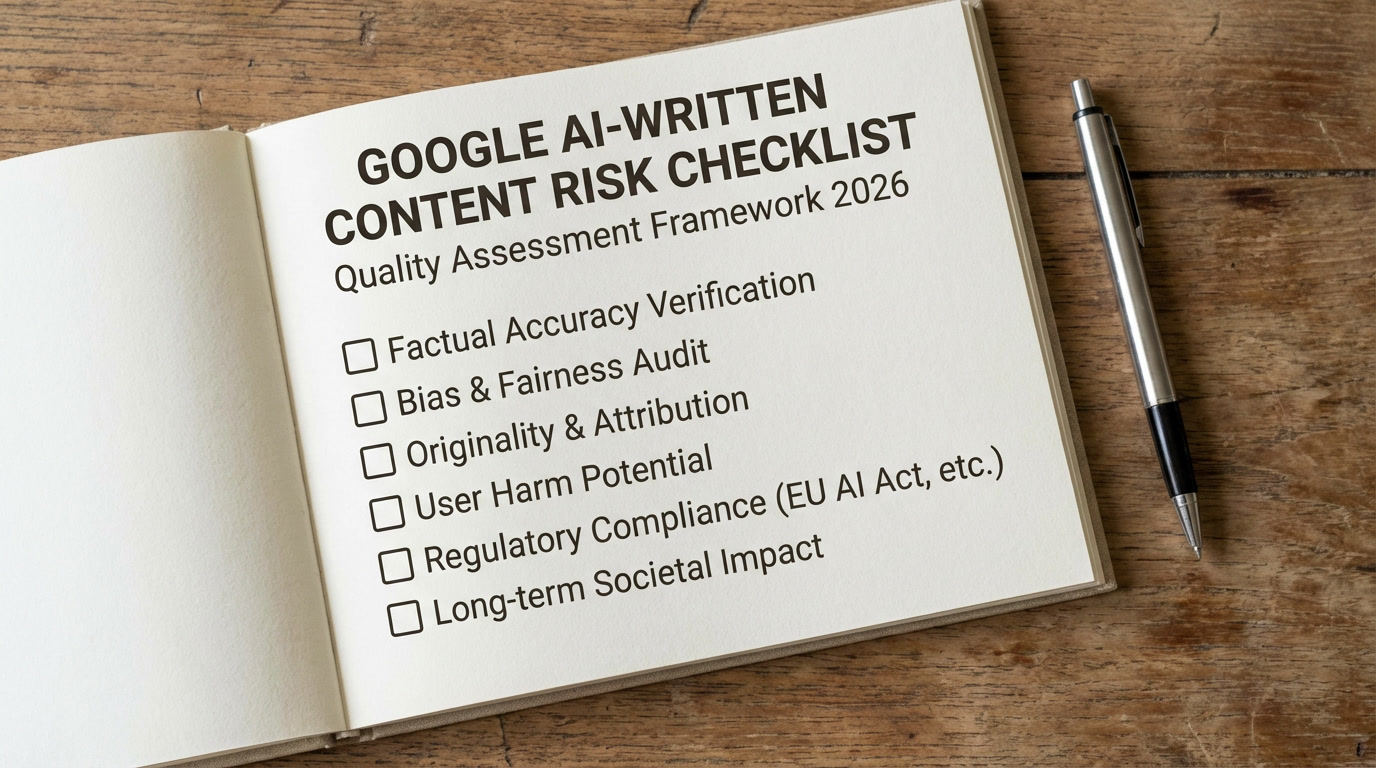
The Practical Risk Checklist
Use this checklist before publishing any AI-assisted content:
Accuracy Verification
[ ] All statistics and data points link to original, credible sources
[ ] Claims are either verifiable or rewritten as general observations
[ ] Technical instructions have been tested by someone qualified
[ ] Named individuals, companies, or products are accurately represented
[ ] Information reflects current reality (not outdated training data)
Helpfulness Assessment
[ ] Content answers the actual search intent, not a related question
[ ] Information adds value beyond what's already ranking
[ ] Readers can take specific action based on what they've learned
[ ] The piece addresses objections or complications real people encounter
[ ] You've included perspective that requires genuine experience
E-E-A-T Signals
[ ] Author has relevant expertise for this topic
[ ] Content reflects first-hand experience where appropriate
[ ] Sources are credible and authoritative
[ ] The piece demonstrates genuine understanding, not surface-level coverage
[ ] Your unique angle or insight is clearly present
Quality Control
[ ] No repetitive or filler sentences that pad word count
[ ] Tone matches brand voice and audience expectations
[ ] Structure supports scanning (clear headers, short paragraphs)
[ ] Internal links connect to relevant, high-value pages
[ ] You would confidently sign your name to this piece
Risk Mitigation
[ ] YMYL content reviewed by qualified professional
[ ] Legal claims vetted appropriately
[ ] No unsupported guarantees or promises
[ ] Medical/financial content includes appropriate disclaimers
[ ] Risk level matches your editorial investment
Common Workflow Mistakes That Create Risk
Even well-intentioned teams make these errors:
Publishing raw AI output without substantive editing. AI models generate plausible-sounding text that may contain factual errors, outdated information, or invented citations. "Light editing" isn't enough—every piece needs verification.
Treating AI as a subject matter expert. AI synthesizes patterns from training data. It doesn't know which practices actually work in your industry, which vendors are reliable, or which approaches your specific audience prefers. It can sound confident while being wrong.
Ignoring topical authority boundaries. Publishing AI-generated content on topics where you have no expertise signals to Google (and readers) that you're manufacturing authority rather than earning it. This triggers exactly the quality concerns that hurt rankings.
Scaling quantity without scaling quality control. The economics of AI make it cheap to produce large content volumes. Without proportional investment in editing and verification, quality degrades quickly—and Google's algorithms are increasingly sophisticated at detecting this pattern.
Skipping the "would I stake my reputation on this?" test. If the content doesn't reflect well on your brand—if you'd be embarrassed to have a prospect read it closely—don't publish it. The time saved isn't worth the trust lost.
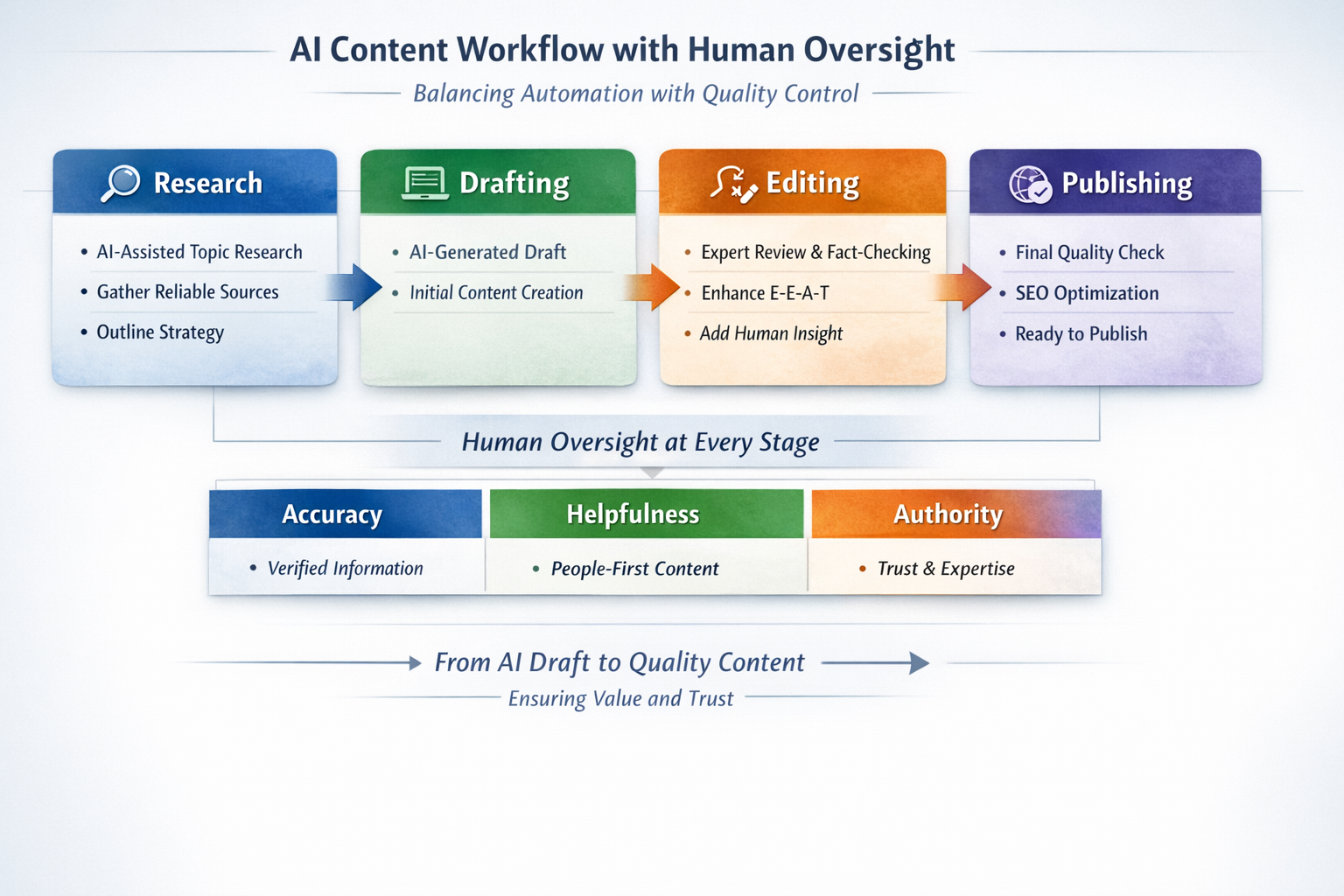
Building a Sustainable AI-Assisted Workflow
The most effective approach treats AI as a capable research assistant and first-draft writer, not a replacement for editorial judgment.
Research phase: AI excels at synthesizing information, identifying subtopics, and suggesting angles. Use it to accelerate research without replacing primary source review. Have it compile what exists—then add what only you know.
Drafting phase: AI produces working drafts faster than most humans. Accept that these drafts require substantial editing. The time savings come from starting with structure rather than a blank page, not from skipping revision.
Editing phase: Human editors add what AI cannot—original insights, brand voice calibration, fact verification, and the judgment to recognize when something sounds good but isn't actually helpful. This is where your content earns the right to rank.
Publishing phase: Final quality checks ensure accuracy, proper attribution, and alignment with your content strategy. No piece goes live without passing the "would I sign my name to this?" test.
This workflow produces better content faster than either pure human writing or unchecked AI generation.
What Actually Gets Penalized
Google's spam policies target specific behaviors, not AI use generally [3]:
Scaled content abuse: Mass-producing low-quality pages across many topics to manipulate rankings
Thin affiliate content: Product reviews that add no original analysis
Auto-generated spam: Pages created solely to rank, with no user value
Scraped content: Copying content from other sources without adding value
Site reputation abuse: Publishing low-quality third-party content to exploit a site's ranking signals
Notice the pattern. The penalty triggers aren't about AI—they're about intent and quality. Content designed to manipulate rankings rather than help users violates guidelines regardless of production method.
Conversely, helpful content ranks well even when AI assists in its creation. The determining factor is whether you're serving users or gaming algorithms.
The Compounding Value of Quality
Search engines increasingly reward consistent quality over time. A site that publishes genuinely helpful content week after week builds topical authority that compounds [4].
This creates a strategic question: Would you rather publish 50 thin articles that collectively generate minimal traffic, or 25 comprehensive pieces that each attract qualified visitors for years?
The math favors quality. Higher-quality content earns backlinks, generates social shares, and satisfies users—all signals that improve rankings. Thin content may index, but it rarely compounds.
AI makes it possible to maintain quality at higher volume. The key is resisting the temptation to trade quality for quantity just because you can produce more. The sites that win in 2026 will be those that used AI to raise their floor without lowering their ceiling.
Take the Guesswork Out of Content Quality
Building a content engine that balances AI efficiency with human quality control isn't simple. It requires clear workflows, consistent standards, and the discipline to prioritize helpfulness over volume.
That's exactly what The Mighty Quill delivers—an AI-powered content system with human editorial oversight built in. Every piece gets research, strategic optimization, and quality review before it reaches your blog. We handle the system so you can focus on the strategy.
See the difference yourself. Try our Blog Engine free and receive two publication-ready articles within 48 hours. No commitment, no credit card—just content you can evaluate against your current process.
Frequently Asked Questions
Does Google penalize all AI-generated content?
No. Google's guidelines focus on content quality and helpfulness, not production method. AI-assisted content that demonstrates expertise, provides genuine value, and serves user intent ranks well. What Google penalizes—especially after the March 2024 Core Update—is low-quality content created at scale to manipulate rankings, regardless of whether humans or AI produced it [1][3].
What makes AI content "thin" versus "helpful"?
Thin content restates obvious information without adding insight, skips verification of facts and claims, and could apply to any brand or situation. Helpful content addresses specific user needs, includes original analysis or experience, verifies accuracy, and gives readers actionable guidance they can apply immediately. The test: would a reader feel their time was well spent?
How much human editing does AI content need?
The editing requirement scales with content risk. Low-risk informational posts may need moderate review for accuracy and tone. High-risk YMYL content requires substantial expert involvement—AI might assist with research or structure, but qualified professionals must verify every claim that could affect reader health, finances, or safety. No AI content should publish without human verification.
Can I use AI for product reviews and comparison content?
Yes, with appropriate human oversight. AI can help structure comparisons and synthesize feature information, but reviews need genuine evaluation of products, honest assessment of strengths and weaknesses, and original perspective that helps readers make informed decisions. Pure AI output typically lacks the hands-on experience that makes reviews trustworthy and useful.
What's the safest approach for businesses new to AI content?
Start with low-risk content types where errors carry limited consequences. Establish clear quality standards and editing workflows before scaling volume. Build internal expertise in recognizing thin versus helpful content. Consider partnering with services that combine AI efficiency with human editorial oversight while you develop internal capabilities.
About This Content
This article was produced by The Mighty Quill's editorial team, combining AI-assisted research and drafting with human expertise in SEO content strategy. Our founder brings over 15 years of digital marketing experience, including deep work in search optimization and content systems. We publish practical guidance for businesses navigating the intersection of AI, content marketing, and organic growth—because we believe clear information helps marketers make better decisions.
Works Cited
[1] Google Search Central — "Google Search's guidance about AI-generated content." https://developers.google.com/search/blog/2023/02/google-search-guidance-ai-generated-content
[2] Google — "Search Quality Evaluator Guidelines." https://static.googleusercontent.com/media/guidelines.raterhub.com/en//searchqualityevaluatorguidelines.pdf
[3] Google Search Central — "Google Search Essentials (formerly Webmaster Guidelines)." https://developers.google.com/search/docs/essentials/spam-policies
[4] Semrush — "How to Build Topical Authority for SEO." https://www.semrush.com/blog/topical-authority/