You need more content. Your blog has been gathering dust, competitors are ranking above you, and organic traffic feels like a distant dream.
So you face the classic decision: hire a junior writer, find a freelancer, or subscribe to an AI content marketing service?
Most comparisons focus on the obvious—word counts, per-article costs, writing quality. But they miss the elephant in the room.
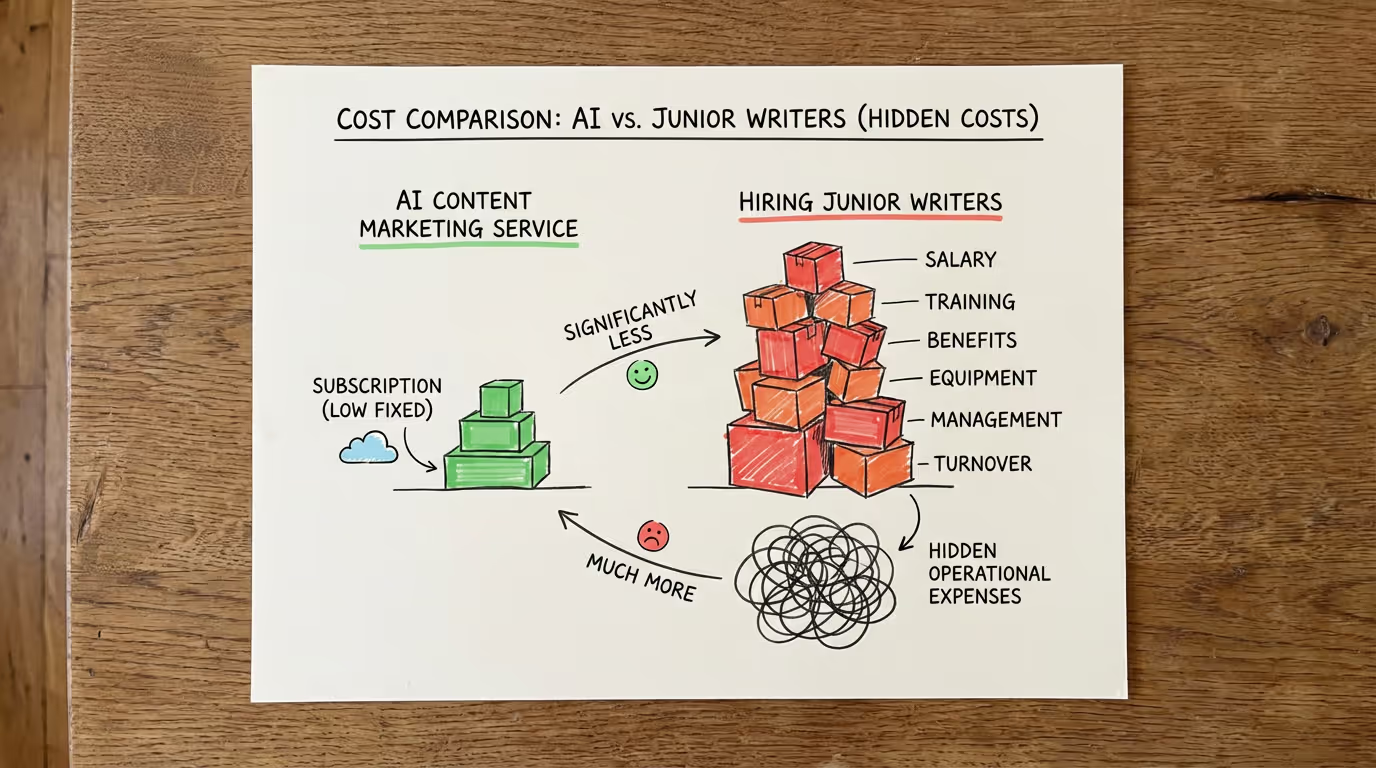
The real cost of content isn't what you pay for words. It's what you pay in time, attention, and operational headaches to manage those words into existence.
Let's break down what these options actually cost you—including the hidden expenses nobody talks about.
The Visible Costs: What Shows Up on the Invoice
Start with the numbers everyone quotes.
A junior content writer in the United States typically earns between $40,000 and $55,000 annually, according to salary data from Glassdoor and Indeed [1]. That translates to roughly $3,300 to $4,600 per month before you factor in benefits, taxes, and overhead.
Freelance writers on platforms like Upwork or Contently charge anywhere from $50 to $500 per article depending on experience, niche expertise, and turnaround time. A mid-tier freelancer producing four articles monthly might cost $400 to $1,200.
A managed AI content marketing service like The Mighty Quill runs $250 to $400 per month for consistent weekly output [2].
On paper, the math looks straightforward. But visible costs tell maybe half the story.
The Hidden Cost Nobody Calculates: Content Operations
Here's where the comparison gets interesting—and where most businesses miscalculate badly.
Content operations encompasses everything required to transform an idea into a published, optimized blog post. This includes topic research, keyword analysis, editorial calendars, draft reviews, revision cycles, SEO optimization, formatting, publishing, and performance tracking.
When you hire a writer—whether full-time or freelance—you become the content operations manager. That role doesn't appear on any invoice, but it consumes real hours every single week.
What Managing a Junior Writer Actually Looks Like
Onboarding and Training
Most junior writers need significant guidance before producing quality work. Expect to spend several hours weekly during the first month explaining your brand voice, industry nuances, and content expectations. Industry research suggests onboarding a new employee costs thousands of dollars in direct expenses—not counting your time [3].
Topic Research and Assignment
Someone needs to determine what topics will drive traffic and align with business goals. That means keyword research, competitor analysis, and strategic planning. Without this foundation, your writer produces content that nobody searches for.
Junior writers rarely arrive with SEO expertise. You'll either train them (more of your time) or handle research yourself (even more of your time).
Draft Reviews and Revision Cycles
Junior content requires editing. Period.
Plan for at least two revision rounds per article. Each round involves reading the draft, providing detailed feedback, waiting for revisions, and reviewing again. For a single 1,500-word article, this easily consumes 60 to 90 minutes of management time.
Multiply that by your target publishing frequency.
SEO Optimization
Does your junior writer understand internal linking strategies? Schema markup? Meta descriptions that drive clicks? Header hierarchy for featured snippets?
If not, someone handles these tasks post-writing. Usually you.
Publishing and Formatting
Uploading to your CMS, adding images, checking mobile formatting, scheduling publication—these tasks seem small individually but accumulate quickly across dozens of monthly posts.
The Freelancer Management Reality
Freelancers eliminate some overhead—no benefits, no onboarding paperwork, no office space. But they introduce different challenges.
Finding and Vetting
Sorting through portfolios, running writing tests, checking references. One marketing manager described freelancer management as "a nightmare" that "takes hours you don't have." The search for a reliable writer can consume weeks before you publish a single post.
Communication and Coordination
Freelancers juggle multiple clients. Your project competes for attention with everyone else's deadlines. Emails go unanswered. Revisions lag. The writer who delivered brilliantly last month may ghost you this month.
Quality Inconsistency
Without daily oversight, output varies wildly. Some articles arrive publication-ready; others need complete rewrites. You won't know which you'll get until it lands in your inbox.
The Hidden Rate
That $150 article becomes $250 when you factor in your time briefing, reviewing, requesting revisions, and optimizing for SEO. The economics shift quickly.
The Management Time Calculation
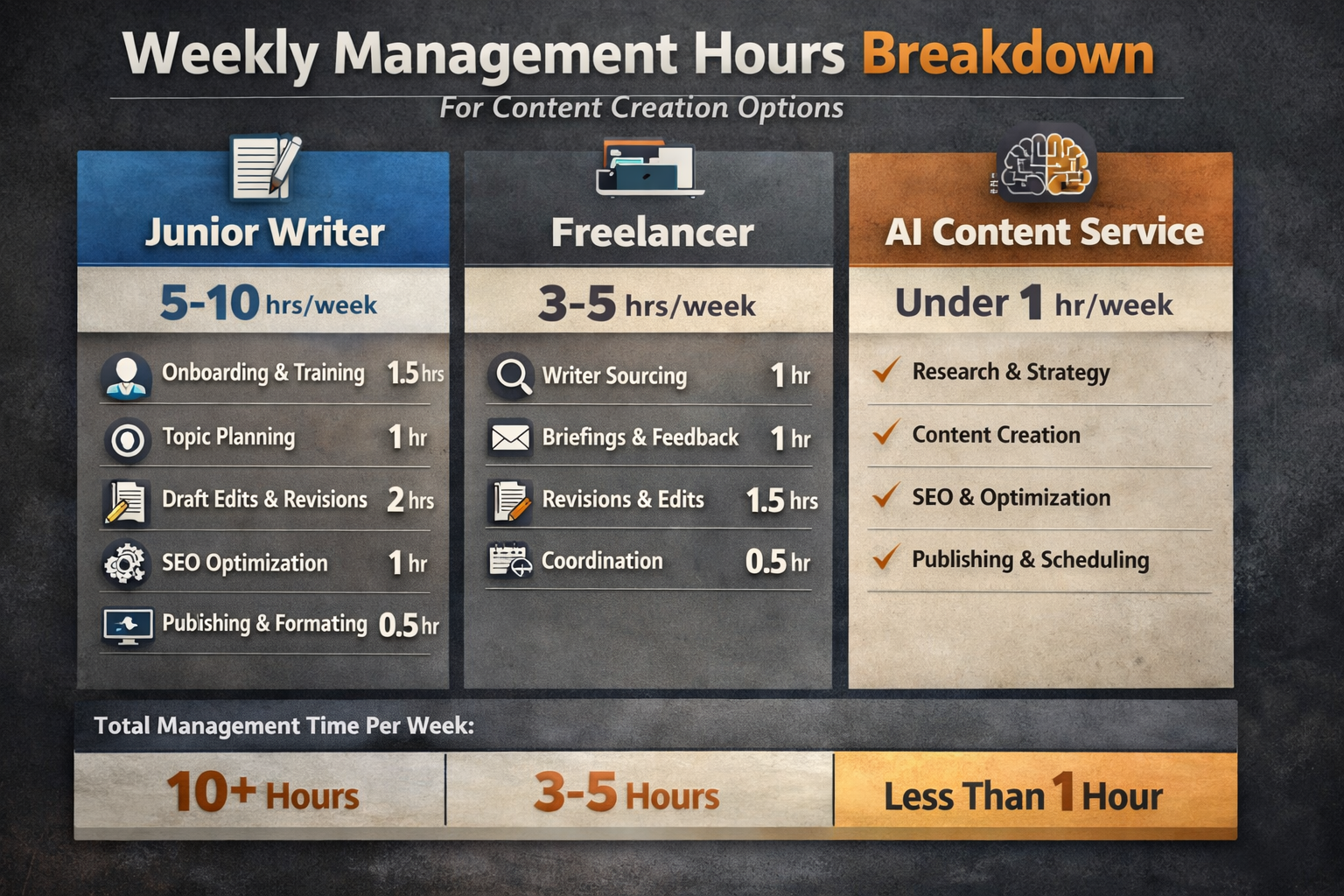
Let's be conservative. Assume your junior writer needs just five hours of management attention weekly once they're trained. At a typical marketing manager's hourly rate of $40 to $60, that's $200 to $300 weekly in hidden management costs—$800 to $1,200 monthly.
Freelancers typically require three to five hours of management weekly across sourcing, briefing, and revision cycles. Similar math applies.
What a Managed AI Content Service Actually Delivers
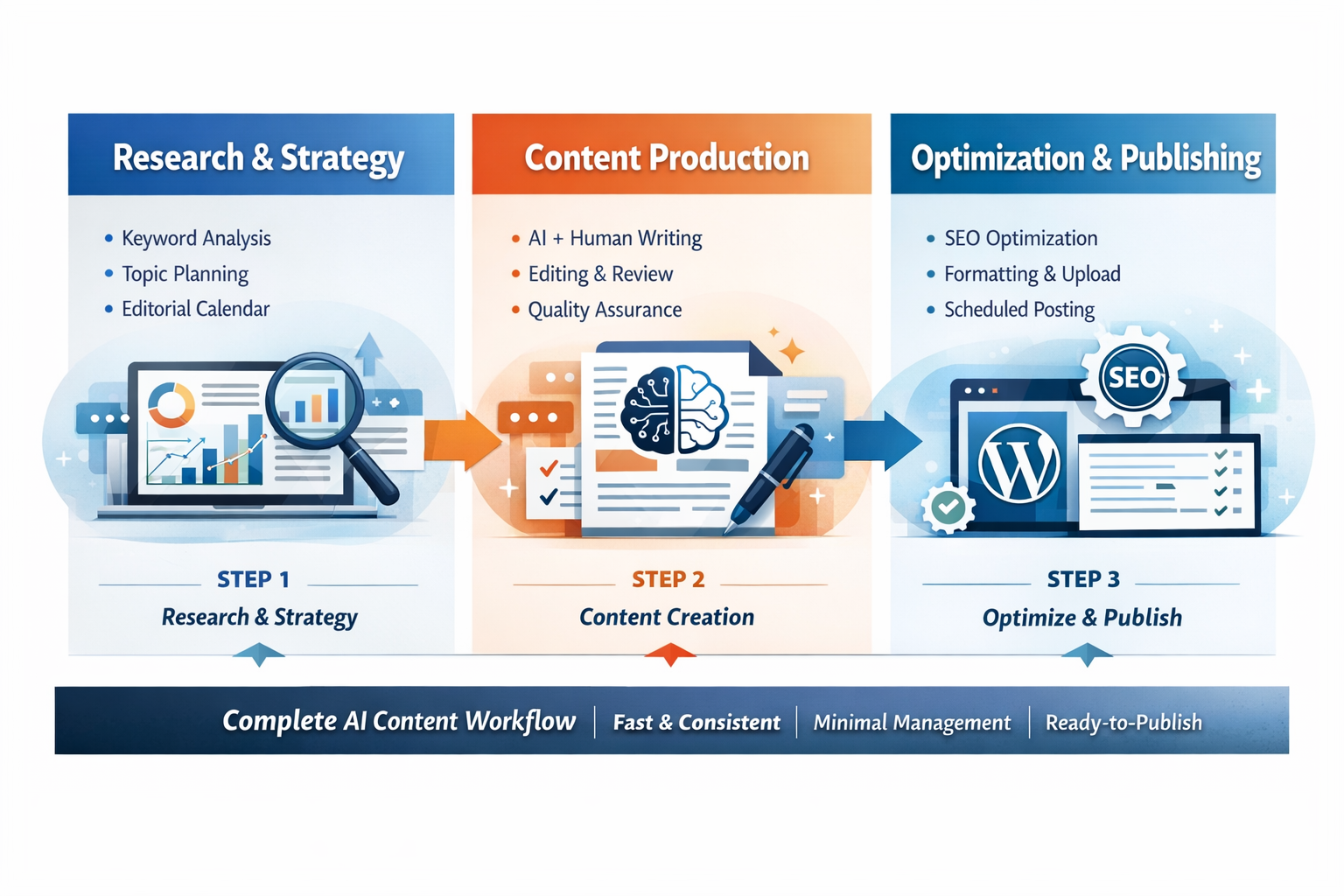
A managed AI content service doesn't just produce words. It handles the entire content operations pipeline.
Research and Strategy
Topic banks built from keyword research. Editorial calendars aligned with your business goals. Strategic content planning that targets actual search demand.
Production
Articles drafted using AI capabilities, then refined through human editing to ensure quality and brand alignment. The result reads like an expert wrote it—not like someone fed a prompt into ChatGPT and copied the output.
This distinction matters. Low-quality AI services exist—plenty of them produce generic content that adds nothing to the conversation. Managed services with human oversight catch errors, inject expertise, and maintain brand voice. The AI handles scale; humans handle judgment.
Optimization
On-page SEO baked in. Internal linking structures. Schema markup. Meta descriptions. Alt text suggestions for images.
Publishing (Done-for-You Plans)
Higher-tier services handle WordPress uploads, formatting, and scheduling. You approve; they execute.
Consistency
Perhaps most critically: automated systems don't call in sick, miss deadlines, or produce inconsistent quality based on mood. You publish every week without managing anything.
The Real Comparison: Total Cost of Ownership
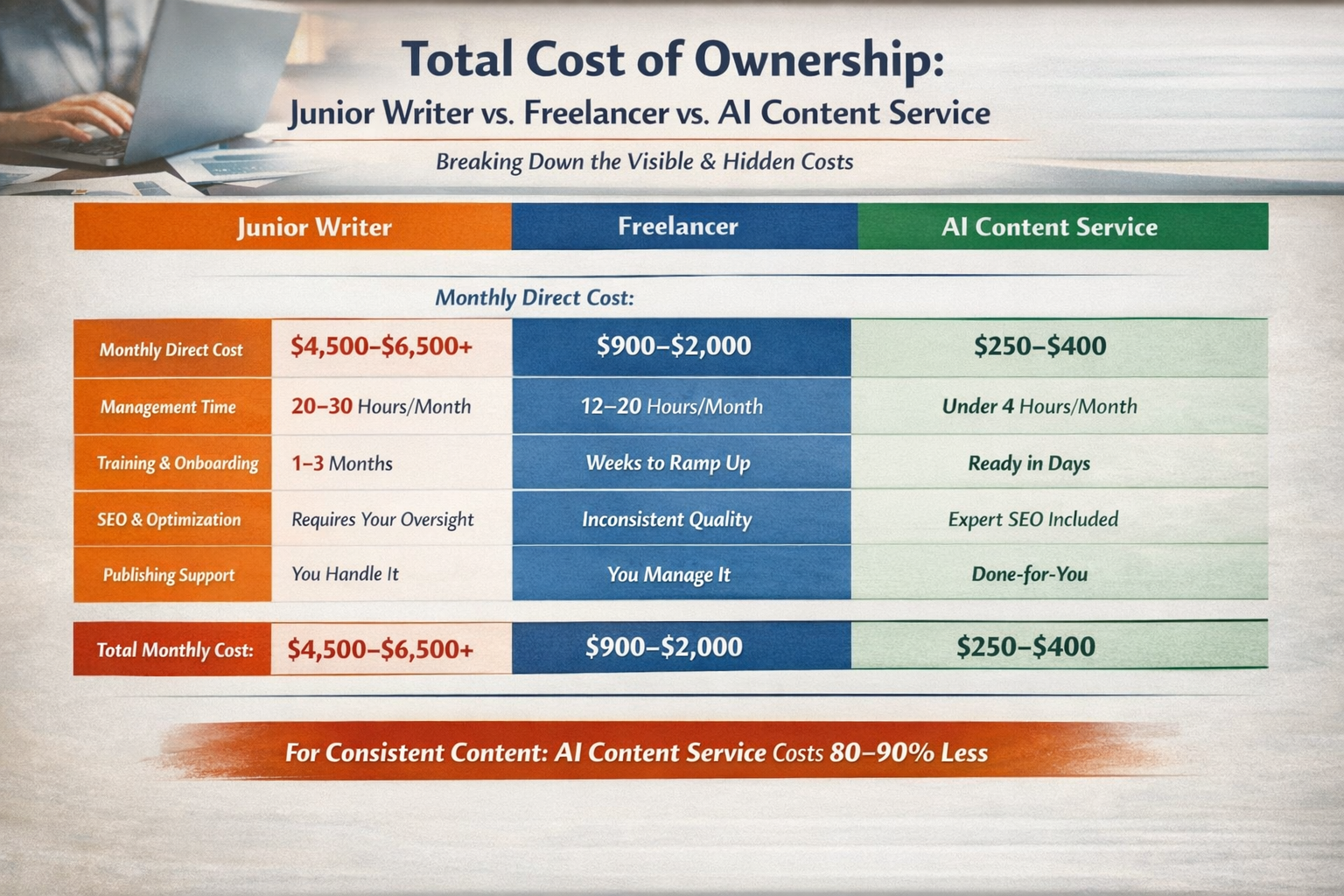
| Factor | Junior Writer | Freelancer | AI Content Service |
| Monthly direct cost | $3,300–$4,600+ | $400–$1,200 | $250–$400 |
| Benefits/taxes overhead | 20–30% additional | $0 | $0 |
| Management time (hours/week) | 5–10 hours | 3–5 hours | Under 1 hour |
| Management time cost (monthly) | $800–$1,200+ | $500–$800 | Minimal |
| Onboarding time to productivity | 1–3 months | 2–4 weeks | Days |
| SEO expertise included | Rarely | Sometimes | Yes |
| Publishing support | You handle | You handle | Available |
| Consistent weekly output | Depends on person | Depends on availability | Guaranteed |
Total realistic monthly cost:
Junior writer: $4,500–$6,500+
Freelancer (4 articles): $900–$2,000 including management time
AI content service: $250–$400
For comparable output volume, managed services cost roughly 6% to 9% of what a junior writer actually costs—and 20% to 40% of what freelancers cost—when you count everything.
When Each Option Makes Sense
To be fair, there are scenarios where hiring delivers superior value.
Hire a Junior Writer When:
You're Building a Content Team
If content is becoming a core function requiring multiple formats—blog posts, video scripts, social content, email sequences, sales collateral—dedicated headcount makes sense. At true enterprise scale, the management overhead becomes worthwhile.
You Need Deep Subject Matter Expertise
If your content requires specialized knowledge that takes years to develop—medical research, legal analysis, advanced technical documentation—a subject matter expert on staff may be necessary. AI systems excel at clear explanations and SEO optimization, but genuine expertise in narrow fields still requires human specialists.
Use Freelancers When:
You Have Irregular Needs
Project-based content—a product launch, a one-time campaign, seasonal coverage—doesn't justify subscription costs. Freelancers flex to match uneven demand.
You Need Original Reporting
Content requiring primary research—customer interviews, industry surveys, investigative pieces—needs human judgment and interpersonal skills that AI cannot replicate.
Choose a Managed AI Service When:
Consistency Matters More Than Customization
For standard blog content designed to drive organic traffic, reliability beats occasional brilliance. Managed services deliver publication-ready content every week without fail.
You Lack Content Operations Expertise
Without someone who understands keyword strategy, search intent, and technical optimization, even well-written content underperforms. Services bundle this expertise into the package.
You Value Your Time
If the hours you'd spend managing writers could generate more value elsewhere—sales calls, product development, client work—delegation makes economic sense.
For most businesses publishing standard blog content to drive organic traffic, the math strongly favors managed services.
The Compounding Factor
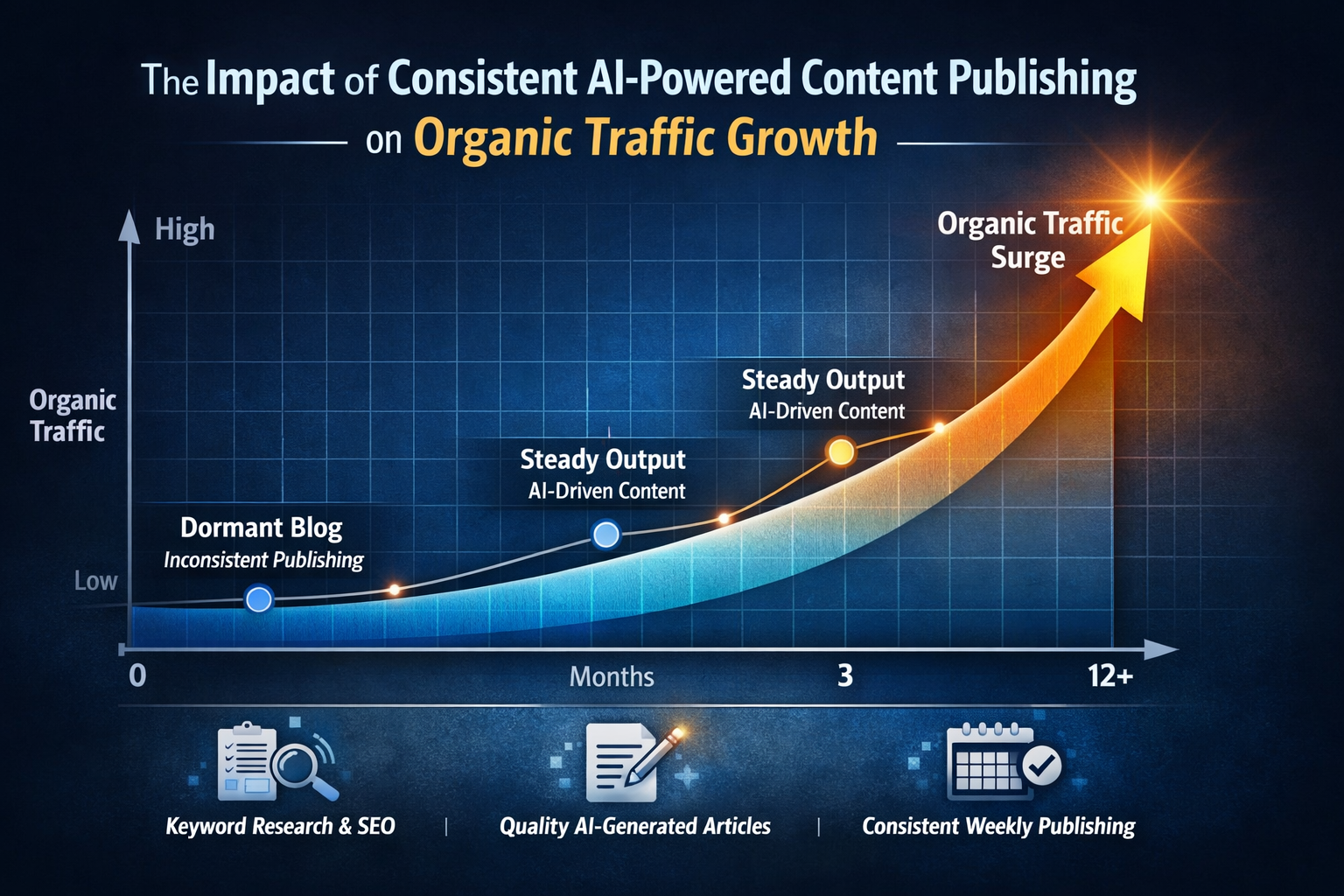
Content marketing works through compounding. Each quality article builds authority, earns backlinks, and creates internal linking opportunities that strengthen your entire site.
But compounding requires consistency. Miss weeks or months, and you reset the clock.
The businesses seeing meaningful organic growth—doubled leads, significant domain authority improvements—maintain relentless publishing schedules. They don't skip weeks because someone's on vacation or because revision cycles dragged too long.
Automation makes consistency automatic. That's the hidden advantage nobody mentions in cost comparisons.
The Operational Reality Nobody Admits
Here's what content marketing veterans know but rarely say publicly: managing writers is exhausting.
The recruiting process alone consumes weeks. Writing tests, portfolio reviews, interview rounds, reference checks. Then onboarding. Then realizing after month two that the fit isn't quite right. Then starting over.
Even good writers require constant feeding—assignments, feedback, direction. Miss a week and your publishing calendar craters.
Imagine you've finally found a solid junior writer. They're producing decent work after three months of training. Then they get a better offer and leave. You're back to square one—recruiting, onboarding, training—while your blog goes silent.
Freelancers introduce different friction: chasing late deliveries, explaining the same brand guidelines repeatedly, handling the awkward conversation when quality drops.
Services exist specifically because this operational burden destroys marketing teams' productivity.
Evaluating Your Actual Needs
Before deciding, answer these questions honestly:
How many hours weekly can you realistically dedicate to content management?
If the answer is "not many," a service removes that bottleneck entirely.
Does your team possess SEO expertise?
Without someone who understands keyword strategy, search intent, and technical optimization, even well-written content underperforms.
How critical is publishing consistency to your growth goals?
Inconsistent publishing torpedoes SEO momentum. Services guarantee cadence; employees get sick, take vacations, and occasionally quit.
What's your timeline to results?
Hiring takes months before producing optimized content. Services can deliver ready-to-publish articles within days.
What volume do you actually need?
If you need one article monthly, freelancers work fine. If you need eight to twelve articles monthly to compete in your space, the management burden of freelancers becomes unsustainable—and a full-time hire becomes expensive.
Making the Decision
For growth-focused businesses needing consistent content-driven traffic without the operational burden of managing writers, AI content marketing services offer compelling economics.
You get the output without the overhead. The pipeline without the personnel management. The consistency without the chaos.
The question isn't whether you can afford $250 to $400 monthly for content.
The question is whether you can afford spending ten times that amount—plus your limited attention—managing someone who might deliver the same results.
Ready to see the managed workflow in action? Start a free trial and receive two custom articles within 48 hours. No management required.
Frequently Asked Questions
How does content quality compare between AI services and junior writers?
Modern managed AI content services combine artificial intelligence with human editing, producing articles that read naturally and demonstrate expertise. Junior writers vary significantly in quality and typically require extensive editing. The key difference is consistency—services deliver predictable quality with every article, while individual writers fluctuate based on experience, workload, and familiarity with your subject matter.
Can an AI content service understand my specific industry?
Quality services begin with detailed onboarding that captures your audience, brand voice, industry terminology, and content goals. This foundation informs every article produced. The result is content tailored to your niche—not generic filler. However, services work best for explanatory and educational content; highly technical or opinion-driven pieces may still require human specialists.
What happens if I need revisions to AI-generated content?
Reputable services include revision processes. You review drafts, request changes, and approve final versions before publication. The difference is that revision cycles happen within the service workflow rather than consuming your personal management time.
How quickly can an AI content service start producing results?
Most services deliver initial content within days rather than the months required to hire, onboard, and train a writer. Some, like The Mighty Quill, provide trial articles within 48 hours. This speed advantage accelerates your path to SEO traction significantly.
Is AI content penalized by search engines?
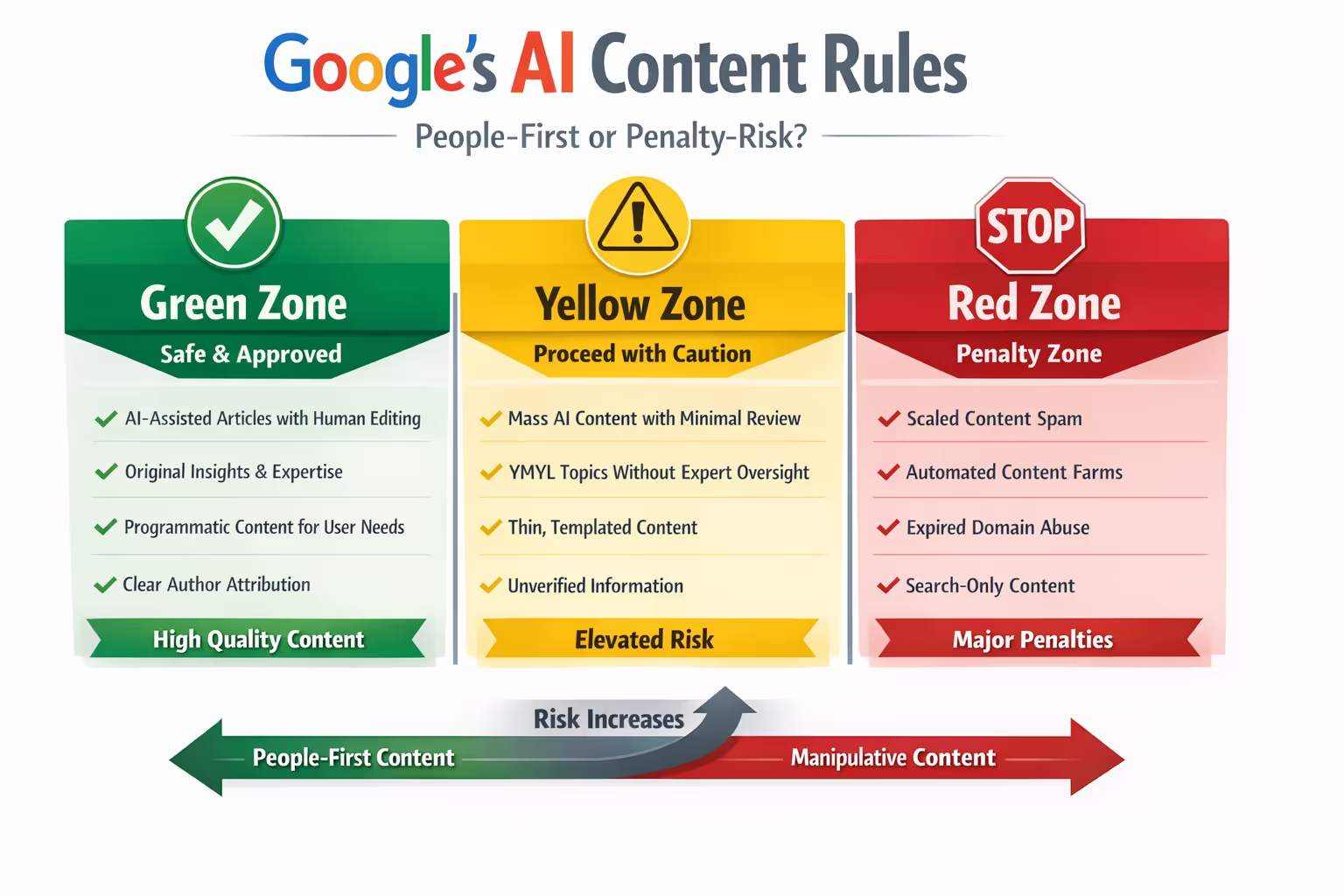
Search engines evaluate content quality, not production method. Google's guidelines focus on whether content helps users, demonstrates expertise, and provides value—regardless of whether humans or AI created it. High-quality AI content optimized for search intent performs well; low-quality content from any source performs poorly. The risk lies in using AI carelessly, not in using it at all.
About This Article
This analysis draws on current market data for writer compensation, industry research on content operations and marketing team productivity, and practical experience building content systems that drive organic growth. The Mighty Quill specializes in AI-powered content marketing services designed to help growth-focused businesses publish consistently without the operational overhead of managing writers. Our team combines digital marketing expertise spanning over fifteen years with modern AI capabilities to deliver SEO-optimized content that earns traffic and builds authority.
Works Cited
[1] Glassdoor — "Content Writer Salaries."
https://www.glassdoor.com/Salaries/content-writer-salary-SRCH_KO0,14.htm
[2] The Mighty Quill — "Pricing."
https://www.themightyquill.com/
[3] Society for Human Resource Management — "The Real Costs of Recruitment." https://www.shrm.org/topics-tools/news/talent-acquisition/real-costs-recruitment