Your marketing team has a content problem. Not a creativity problem or a strategy problem—a math problem.
Every week, blog posts need to go out. Every week, someone has to research keywords, draft content, edit for quality, optimize for SEO, and hit publish. The question isn't whether AI should help. That debate ended years ago. The question is how AI should help—and which approach actually delivers return on investment.
AI blog writing services and AI writing tools both promise to solve your content bottleneck. But they solve it in fundamentally different ways, with radically different cost structures hiding beneath the surface.
One requires your team's time. The other doesn't.
That distinction matters more than most ROI calculators reveal.
The Hidden Math Behind AI Writing Tools
AI writing tools like Jasper, Copy.ai, and ChatGPT have democratized content creation. For roughly $50 to $200 per month, your team gets access to powerful language models that can generate drafts in seconds [1].
The pricing looks attractive. The output feels magical. But the total cost of ownership tells a different story.
Here's what the subscription fee doesn't include:
Research and strategy time. Someone still needs to identify which keywords matter, what topics align with business goals, and how each piece fits your content calendar. For most B2B teams, this takes 2-4 hours per article before a single word gets written.
Prompt engineering and iteration. AI tools don't produce publish-ready content on the first try. Getting quality output requires crafting detailed prompts, reviewing results, regenerating sections, and combining fragments. Teams commonly report spending 30-60 minutes per 1,000 words wrestling with prompts and revisions.
Editing and quality control. Raw AI output needs human oversight for accuracy, brand voice, logical flow, and factual verification. This editing layer often takes as long as the original drafting would have.
SEO optimization. Tools generate words. They don't automatically structure content for featured snippets, add schema markup, build internal links, or optimize meta descriptions. That's additional specialized work.
Publishing and formatting. Someone still uploads to your CMS, adds images, checks mobile formatting, and schedules publication.
When you add these hidden costs, a "$100/month" AI tool often costs $500-$1,500 per article in staff time—before you factor in the opportunity cost of what your team could be doing instead.
The True Time Investment: A Breakdown
Let's get specific about where the hours go.
For a single 1,500-word SEO-optimized blog post using AI writing tools, here's a realistic time breakdown for most B2B marketing teams:
| Task | Time Required |
| Keyword research and topic selection | 45-90 minutes |
| Outline creation and strategic planning | 30-45 minutes |
| Prompt engineering and draft generation | 45-60 minutes |
| Editing, fact-checking, and revision | 60-90 minutes |
| SEO optimization (headers, meta, links) | 30-45 minutes |
| Image sourcing and formatting | 20-30 minutes |
| CMS upload and publishing | 15-20 minutes |
| Total | 4-6 hours |
At a fully loaded cost of $75/hour for a mid-level content marketer (salary plus benefits plus overhead), that single blog post costs $300-$450 in staff time—on top of your tool subscription.
Multiply by 8-12 posts per month for consistent publishing, and you're looking at $2,400-$5,400 in monthly labor costs. Add the tool subscription and you're investing $2,500-$5,600 monthly for DIY AI content.
This isn't speculation. Content marketing research consistently shows that strategy, editing, and optimization consume more time than initial drafting [2].

What AI Blog Writing Services Actually Include
AI blog writing services operate on a different model entirely. Rather than providing tools for your team to use, they deliver finished content.
A managed AI content service typically handles:
Keyword and topic research aligned to your business goals
Content calendar development with strategic sequencing
AI-assisted drafting with human editorial oversight
Quality editing for accuracy, voice, and readability
Full SEO optimization including schema, internal links, and meta data
Publishing directly to your CMS (for full-service tiers)
The output is publish-ready content. Your team's involvement shrinks to approving drafts—often through a simple one-click workflow.
This shifts the cost structure entirely. Instead of paying for a tool plus extensive staff time, you pay a predictable monthly fee for completed deliverables.
Control vs. Convenience: Understanding the Trade-Off
Before diving into cost comparisons, it's worth acknowledging what you're actually choosing between.
AI writing tools offer granular control. You direct every prompt. You shape every sentence. You decide when content is "done." For teams that want hands-on involvement in the creative process, this control feels essential.
Managed services offer predictable output. You approve finished work rather than building it yourself. You trade creative control for guaranteed delivery. For teams drowning in competing priorities, this reliability matters more than sentence-level decisions.
Neither approach is inherently superior. The right choice depends on whether your primary constraint is control or capacity.
If your team enjoys the content creation process and has bandwidth to spare, tools preserve that hands-on experience. If your team is stretched thin and content keeps slipping through the cracks, services remove the execution burden entirely.
Most B2B teams we've observed fall into the second category—they have plenty of ideas but insufficient hours to execute consistently.
Comparing Total Cost of Ownership
When you calculate the complete investment for each approach, the math often surprises teams who've been focused on tool subscription prices.
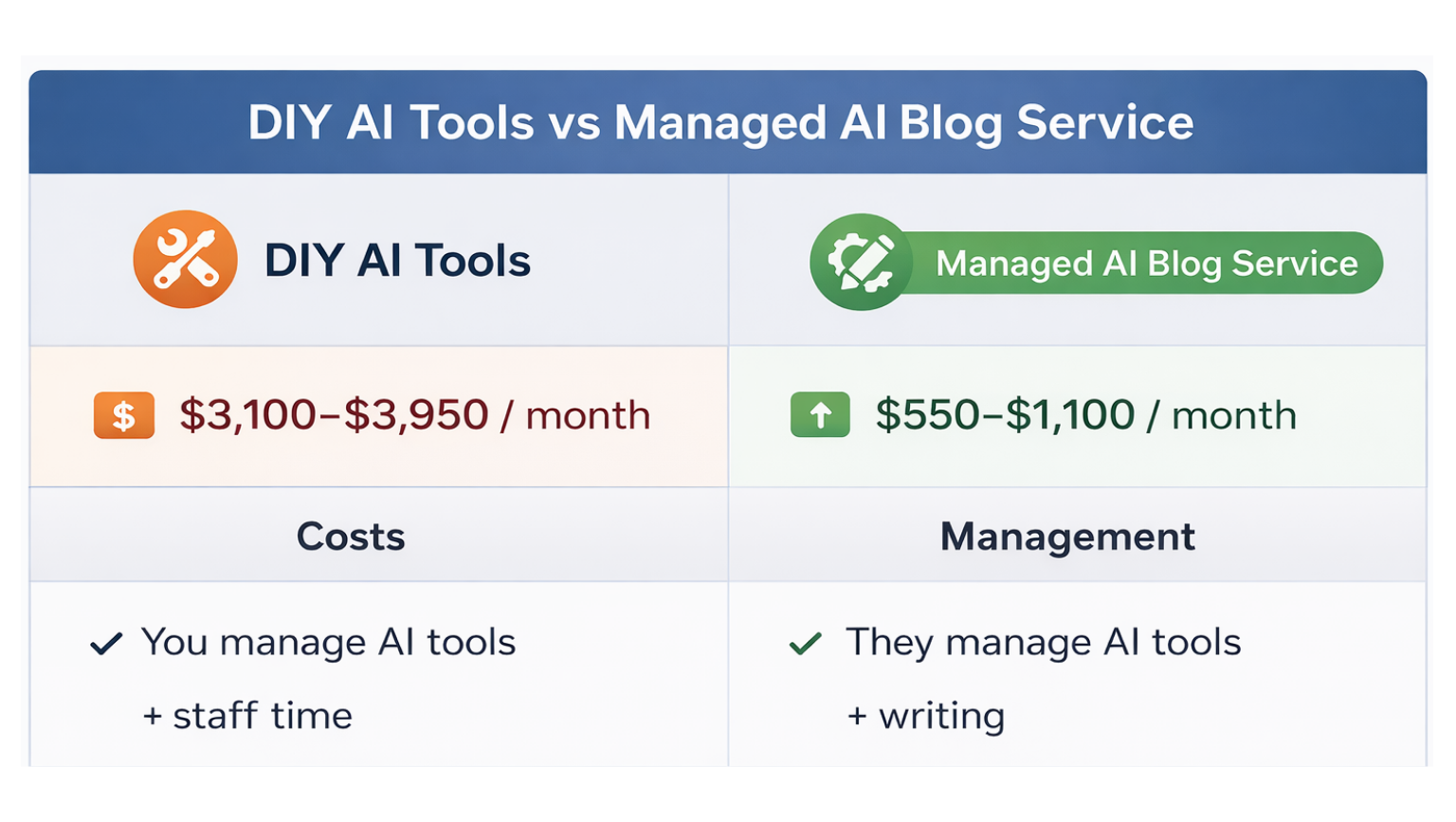
DIY AI Tools (8 posts/month):
Tool subscription: $100-$200/month
Staff time (40-50 hours): $3,000-$3,750/month
Total monthly investment: $3,100-$3,950
Managed AI Blog Service (8 posts/month):
Service subscription: $400-$800/month (varies by service level and quality tier)
Staff time (2-4 hours for review/approval): $150-$300/month
Total monthly investment: $550-$1,100
A note on service pricing: Budget services promising 8+ articles for under $300/month typically deliver content that requires significant editing—negating the time savings. Quality B2B content services with genuine editorial oversight generally start around $400/month for consistent output. The pricing reflects the human expertise involved, not just AI generation.
The differential still favors services when you account for true time investment. Managed services often cost 60-75% less than DIY approaches once you factor in staff hours honestly.
This is why AI content ROI calculations that only compare tool prices miss the point entirely. The tool is the smallest line item. The hidden cost is your team's attention.
Feature Comparison: Tools vs. Services
Beyond cost, consider what each approach actually delivers:
| Capability | AI Writing Tool | Managed Service |
| Keyword/topic strategy | User responsibility | Included |
| Content drafting | User directs AI | Included |
| Editorial review | User responsibility | Included |
| Brand voice consistency | User responsibility | Built into process |
| SEO technical optimization | User responsibility | Included |
| Internal linking | User responsibility | Included (full-service) |
| Schema markup | User responsibility | Included (full-service) |
| CMS publishing | User responsibility | Included (full-service) |
| Plagiarism checking | Varies by tool | Included |
| Guaranteed output | No | Yes |
Tools give you capability. Services give you deliverables.
When DIY Tools Make Sense
AI writing tools aren't inherently inferior. They're optimal for specific situations.
DIY tools work well when:
You have dedicated content staff with capacity to spare
Your team enjoys the hands-on creative process and wants to shape every sentence
Content volume needs are modest (1-2 posts monthly)
You're building internal AI capabilities for strategic reasons
Budget constraints are extreme and time is more available than money
You need content for formats beyond blog posts (social, email, ad copy)
For solo marketers wearing multiple hats or enterprise teams with robust content operations, AI tools can integrate smoothly into existing workflows.
The tools also excel for non-blog content: social posts, email drafts, brainstorming, and ad copy variations where volume matters more than deep optimization.
When Managed Services Deliver Better ROI
AI tool alternatives like managed services make sense when the math favors predictability and efficiency over control.
Managed services work well when:
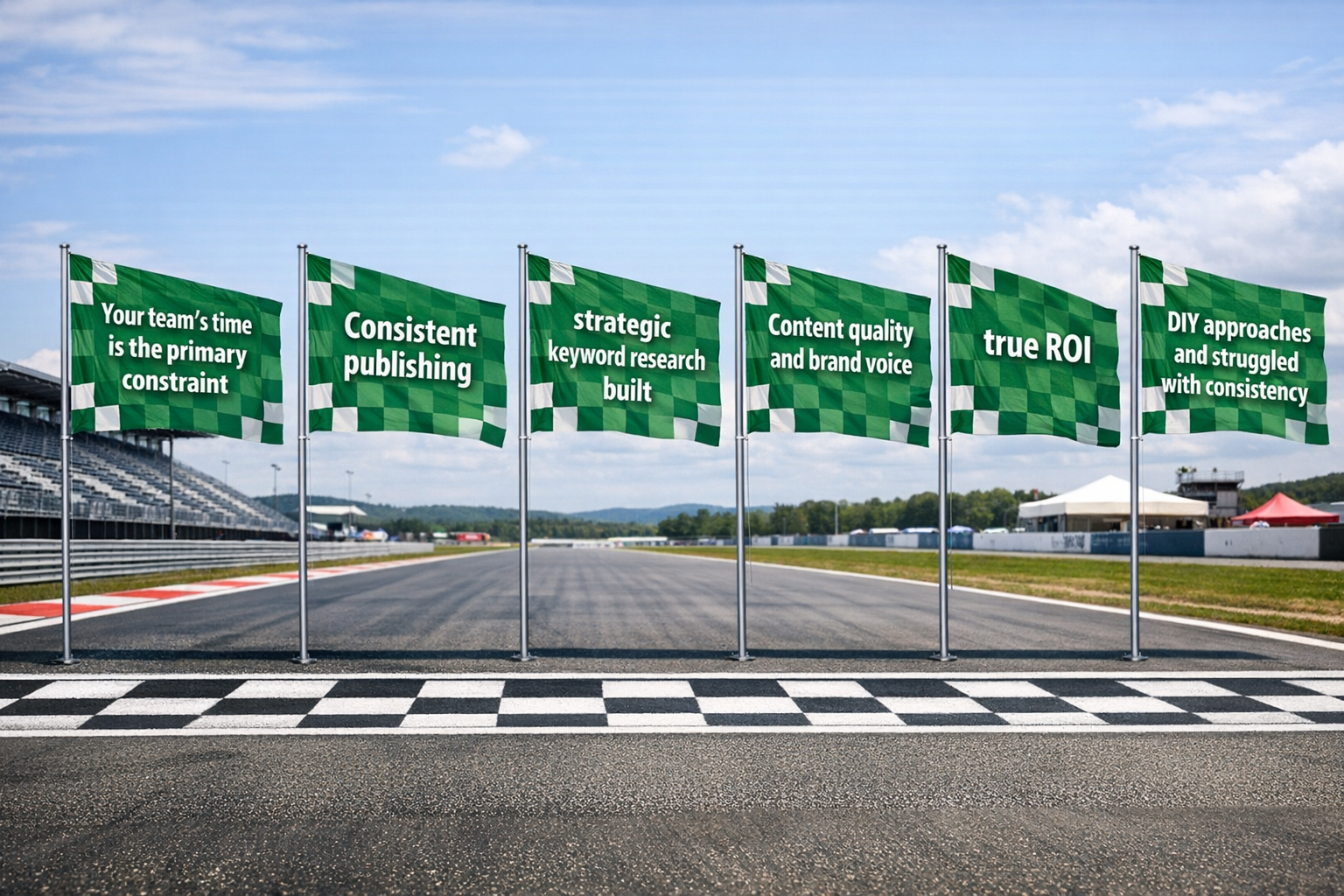
Your team's time is the primary constraint
Consistent publishing cadence matters for SEO momentum
You need strategic keyword research built into the process
Content quality and brand voice can't slip during busy periods
You're calculating true ROI including opportunity costs
You've tried DIY approaches and struggled with consistency
For B2B teams where every hour spent on content is an hour not spent on demand generation, sales enablement, or strategic initiatives, the calculus often favors delegation.
Managed AI writing services essentially convert a variable cost (staff time fluctuating with content needs) into a fixed cost (predictable monthly investment with guaranteed output).
The Opportunity Cost Factor
Here's what most ROI analyses miss entirely: opportunity cost.
When your marketing team spends 40+ hours monthly on content production, those hours don't come from thin air. They come from somewhere.
Usually, they come from:
Campaign optimization and testing
Sales team support and enablement
Customer research and persona development
Strategic planning and competitive analysis
Channel experimentation and new initiatives
The question isn't just "how much does content cost?" It's "what else could your team accomplish with 40 reclaimed hours monthly?"
For growth-stage B2B companies, redirecting content production time toward revenue-generating activities often produces returns that dwarf any savings from cheaper tool subscriptions.
Imagine your content manager, Sarah, currently spends half her week managing AI tools to produce blog content. If a service handled that output instead, she could focus on the sales enablement project that's been stuck in "someday" territory for six months. Which delivers more value to the business?
Measuring Content ROI Accurately
Whichever approach you choose, measuring AI content ROI requires looking beyond simple cost-per-article calculations.
Metrics that matter:
Organic traffic growth from published content over 6-12 months
Keyword rankings for target terms
Lead generation attributed to content assets
Time-to-publish from ideation to live post
Consistency rate (did you actually hit your publishing goals?)
That last metric often differentiates DIY from managed approaches. Tools give you capability. Services give you reliability.
Many B2B teams discover that their theoretical DIY capacity rarely translates to actual published content. Competing priorities, bandwidth fluctuations, and the friction of managing tools conspire against consistent execution.
A service that guarantees 2-3 posts weekly often outperforms a tool that could theoretically produce more—but doesn't.
Making the Decision for Your Team
The right choice depends on your specific constraints.
Choose AI writing tools if:
You have 40+ hours monthly available for content production
Building AI workflows serves strategic capability goals
Total content investment under $500/month is essential
You want hands-on control over every sentence
Your team finds energy in the creative process
Choose managed AI services if:
Time is your scarcest resource
Consistent publishing matters more than control over process
You want predictable costs and guaranteed output
Opportunity costs of staff time factor into your calculations
You've struggled to maintain publishing consistency
Neither option is universally superior. But one is almost always better for your situation when you calculate the complete investment honestly.

Build Your Content Engine the Smart Way
The AI writing landscape will keep evolving. New tools will emerge. Capabilities will expand. But the fundamental math won't change: your team's time costs money, and producing quality content requires more than generating words.
Whether you invest in tools or services, the goal remains the same—consistent, strategic content that drives organic growth without consuming your team's capacity for higher-leverage work.
Ready to see what done-for-you AI content looks like? Try the Mighty Quill blog engine free—get 2 custom articles delivered in 48 hours with zero commitment.
Frequently Asked Questions
What is the average cost of AI blog writing services compared to tools?
AI writing tools typically cost $50-$200 monthly for subscriptions, but require 4-6 hours of staff time per article for research, editing, and optimization. Quality managed AI blog writing services with genuine editorial oversight range from $400-$800 monthly for 8-12 articles delivered publish-ready. When you factor in staff time costs, services often deliver better value for teams with limited bandwidth.
How do I calculate true ROI for AI content investments?
Calculate your fully loaded hourly cost for content team members (salary plus benefits plus overhead). Multiply by hours spent per article across research, drafting, editing, and publishing. Add tool subscription costs. Compare this total to managed service pricing. Also factor opportunity costs—what could your team accomplish if content production hours were freed up for higher-leverage work?
Can AI writing tools produce SEO-optimized content without human help?
AI tools generate text but don't automatically handle strategic SEO elements like keyword targeting, internal linking, schema markup, or meta optimization. These require human judgment and additional work. Managed services typically include SEO optimization as part of the deliverable, reducing the gap between raw output and publish-ready content that actually ranks.
What's the biggest hidden cost of DIY AI content creation?
Staff time investment is the largest hidden cost. Most teams underestimate how much editing, fact-checking, and optimization AI output requires. Prompt engineering alone can consume 30-60 minutes per article. When you add research, strategy, and publishing time, DIY approaches often cost 3-5x more than subscription prices suggest when calculated honestly.
How long before AI blog content shows ROI?
Quality blog content typically takes 3-6 months to gain significant organic traction as search engines index and rank new posts. Consistency matters—teams publishing weekly see compounding returns faster than those publishing sporadically. Both tool-based and service-based approaches require this patience, though services often maintain consistency more reliably over time.
About This Content
This article was produced by The Mighty Quill, an AI-powered blog engine built specifically for B2B companies seeking consistent, SEO-optimized content. Our team combines deep experience in digital marketing, SEO strategy, and content operations—with over 15 years of hands-on work helping companies grow through organic search. We write about content marketing and AI because we've tested these approaches in the real world, not just theorized about them.
Cited Works
Content Marketing Institute — "B2B Content Marketing: Benchmarks, Budgets, and Trends." https://contentmarketinstitute.com/research/b2b-content-marketing-research/
HubSpot — "The State of Marketing Report: Marketing Trends." https://www.hubspot.com/state-of-marketing