Most teams using AI for content creation are winging it. They generate a draft, skim it, hit publish, and hope for the best.
That approach worked in 2023. It doesn't anymore.
Search engines and readers have gotten better at spotting generic AI output. The content that performs now requires something different: a repeatable AI-assisted editorial workflow that combines speed with genuine quality control.
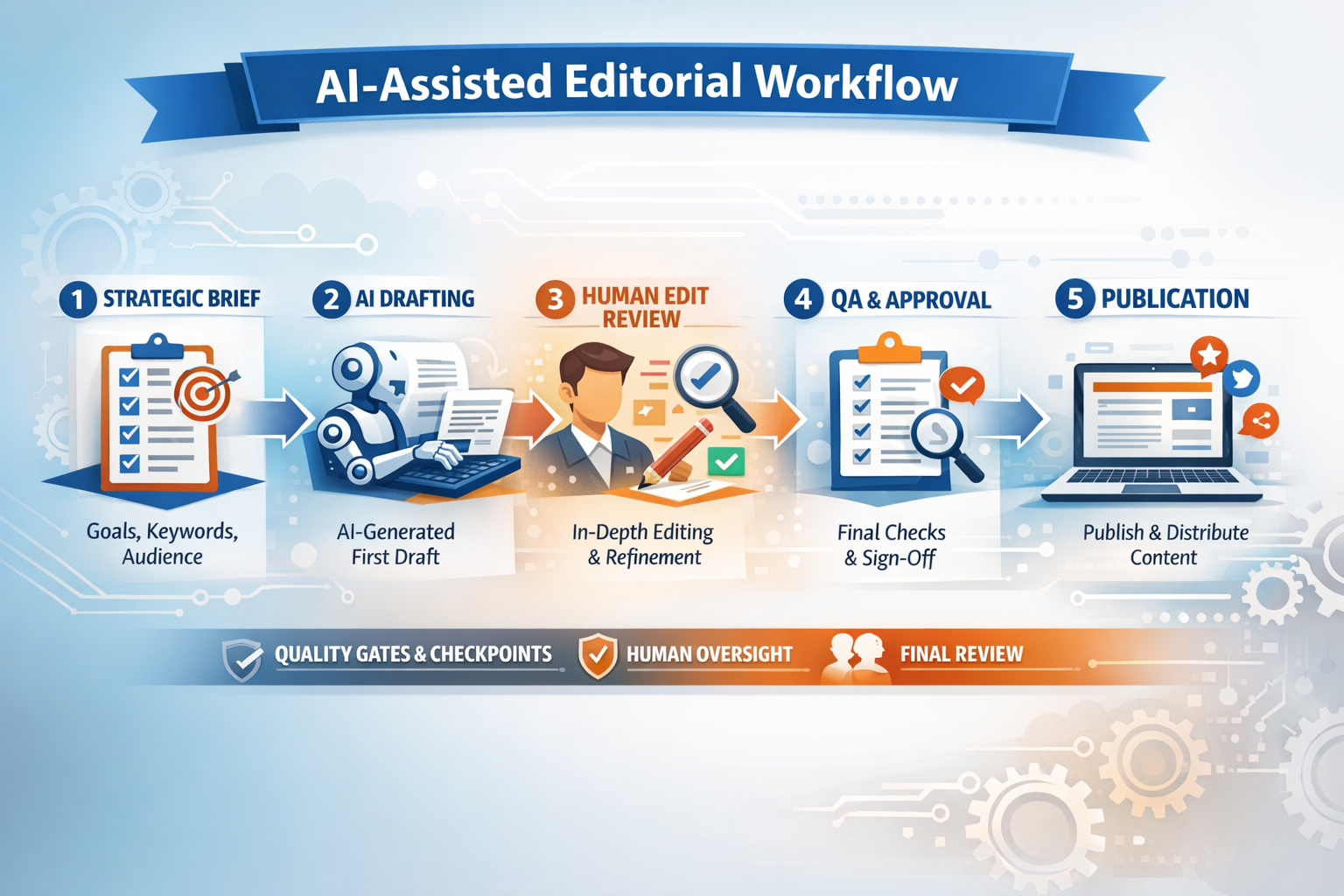
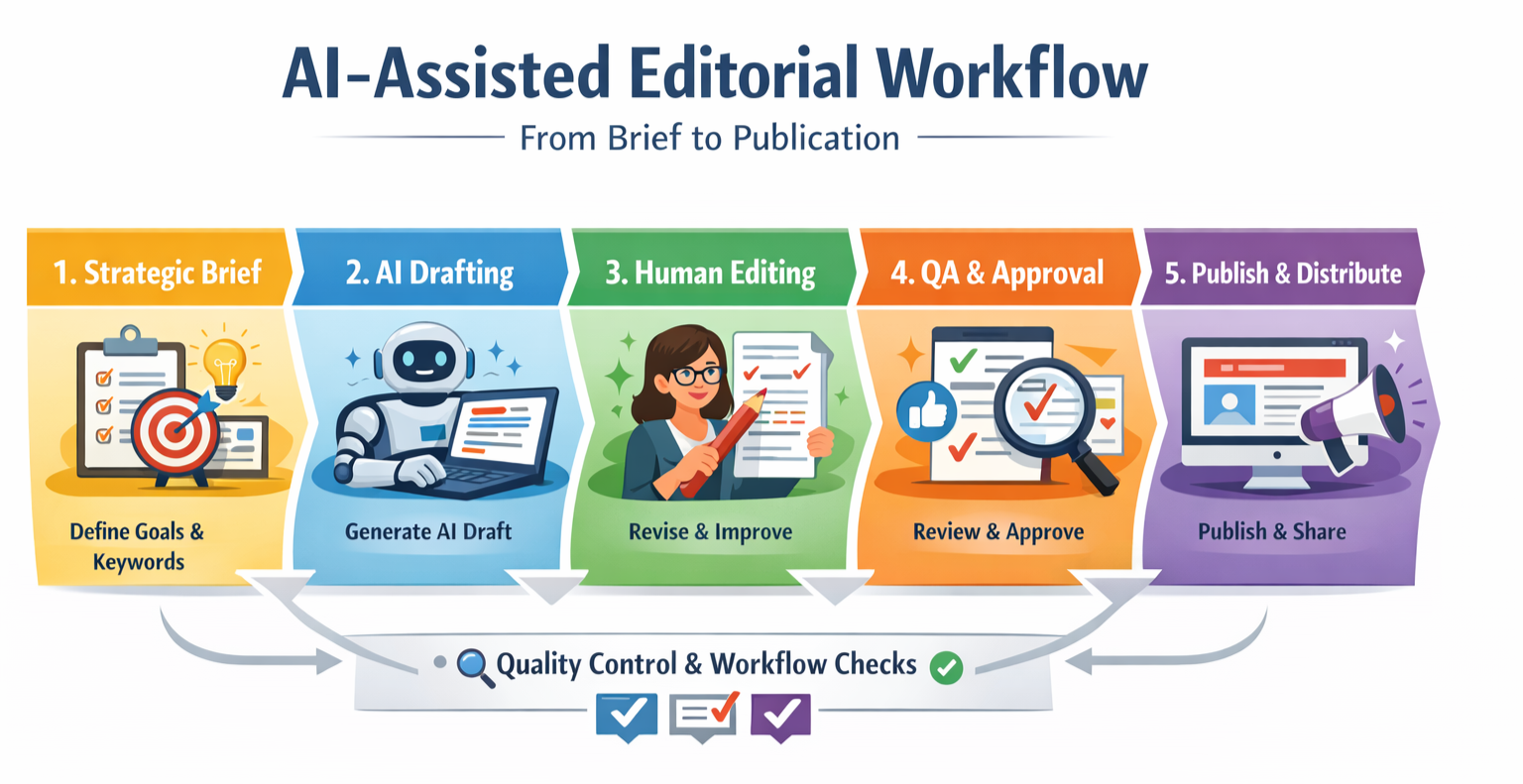
This template gives you exactly that—a five-stage system moving from brief to published post with clear handoffs, quality gates, and human checkpoints that catch the patterns AI consistently gets wrong.
Whether you're building an internal content engine or evaluating whether to outsource, this framework shows you what operational content production actually looks like.
Why Most AI Content Workflows Fail
The problem isn't AI. The problem is treating AI like a vending machine.
Teams skip the brief. They accept first drafts without scrutiny. They publish without checking whether the content actually serves their audience.
The result? A blog full of technically accurate, emotionally flat content that sounds like everything else on the internet. Google's helpful content guidelines explicitly target this pattern—content created primarily for search engines rather than humans [1].
A functional weekly editorial cadence for consistent operations solves this by building quality into the process, not hoping it appears at the end.
Here's what that looks like in practice.
Stage 1: The Strategic Brief
Every piece of content needs a brief. No exceptions.
This isn't bureaucracy—it's insurance against wasted effort. A good brief takes 10-15 minutes to create and prevents hours of revision later.
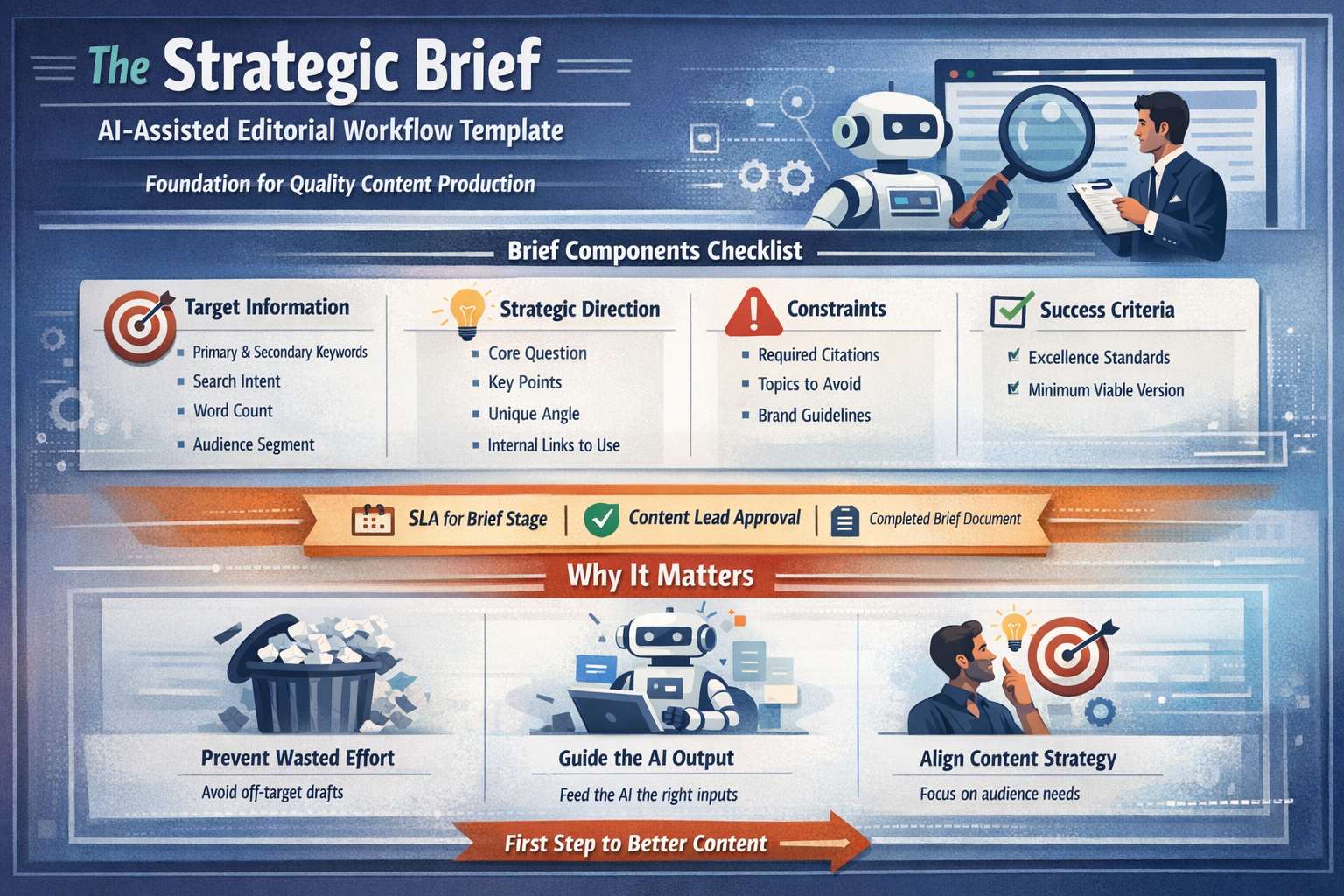
Brief Components Checklist
Target Information:
Primary keyword and search intent (informational, commercial, transactional)
Secondary keywords and semantic variations
Target word count range
Specific audience segment this serves
Strategic Direction:
Core question the piece must answer
2-3 supporting points that must be covered
Angle or perspective that differentiates from competitors
Internal pages to link (mapped to funnel stage)
Constraints:
Claims that require citations
Topics or angles to avoid
Brand voice requirements
Compliance or legal boundaries
Success Criteria:
What would make this piece excellent?
What's the minimum viable version?
SLA for Brief Stage
Turnaround: 1 business day from topic assignment
Approval required: Content lead or strategist
Output: Completed brief document in shared system
The brief is your quality control starting point. Skip it, and every downstream stage suffers.
At scale, the brief stage is also where building a B2B content ops pipeline pays off — when briefs are templated, assigned, and tracked systematically, the entire downstream workflow accelerates without losing strategic alignment.
Stage 2: AI-Assisted Drafting
With a solid brief, AI becomes genuinely useful. Without one, it's just a sophisticated random generator.
Drafting Protocol
Input Preparation:Feed the AI your brief components systematically. Include:
The exact target keyword
The specific angle you want
Any required sections or subtopics
Examples of tone and voice from existing content
Generation Parameters:Request structured output with clear headers, short paragraphs, and placeholder markers for statistics or claims needing verification.
Initial Output Review:Before moving to human editing, verify the draft addresses:
Primary search intent (does it answer what the searcher wants?)
Core sections from the brief
Approximate target length (±20%)
SLA for Draft Stage
Turnaround: Same day as brief approval
Output: Complete first draft with structure matching brief
Quality gate: Draft must address all required sections before advancing
The draft is raw material. The next stage transforms it into something worth publishing.
If your team is looking to compress the full cycle even further, the guide on compressing your content workflow to 48 hours shows how the drafting and approval phases can run in parallel without sacrificing quality.
Stage 3: Human Editorial Review
This is where content becomes good. No AI workflow can skip this step and produce consistent quality. Maintaining brand voice integrity in AI-assisted workflows is one of the most common failure points at this stage — getting it right requires both clear voice documentation and an editor trained to recognize when AI output has drifted from it.
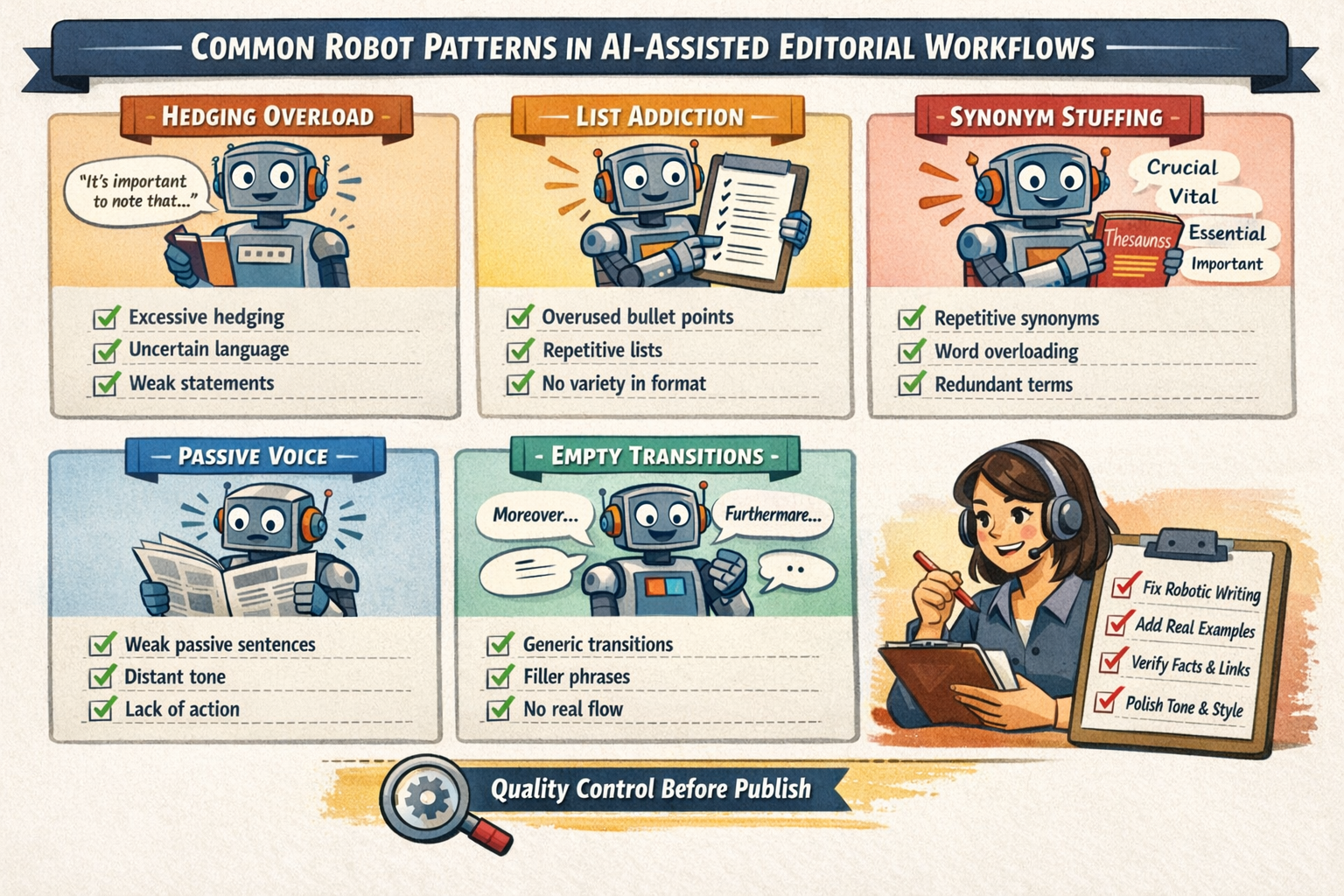
Human editors catch patterns that AI cannot recognize in its own output—because those patterns emerge from how AI generates text, not from errors in logic or grammar [2].
Robot Pattern Detection Checklist
Sentence-Level Patterns to Remove:
| Pattern | Example | Fix |
| Hedging overload | "It's important to note that..." | Delete or state directly |
| False certainty | "This will definitely..." | Qualify appropriately |
| List addiction | Every section becomes bullets | Vary structure |
| Passive clustering | "It is believed that... It was found that..." | Activate the verbs |
| Synonym stuffing | "Crucial, vital, essential, important" in same paragraph | Pick one |
| Empty transitions | "Furthermore, additionally, moreover" stacked | Cut or replace with meaning |
Structural Patterns to Fix:
Introductions that summarize instead of hook
Conclusions that repeat rather than advance
Sections of identical length and structure
Missing concrete examples or specifics
Generic claims where specific evidence should exist
Voice and Tone Checks:
Does this sound like our brand or generic internet?
Are there moments of genuine insight or perspective?
Would a reader feel smarter after reading this?
Is there anything here a competitor couldn't have written?
Human Edit Requirements
The editor's job isn't proofreading. It's transformation.
Must Do:
Read the piece aloud (catches robotic rhythm)
Add at least one specific example, analogy, or data point not in original draft
Remove or rewrite minimum 3 "robot pattern" instances
Verify all factual claims have citations or are general knowledge
Check internal links are relevant and naturally placed
Must Verify:
Focus keyword appears in H1, first 100 words, at least one H2, and conclusion
Headers create logical hierarchy (H2 → H3, never skipping)
Paragraphs stay under 5 sentences
No placeholder text remains
SLA for Human Edit Stage
Turnaround: 1-2 business days depending on piece length
Editor qualification: Someone who understands the subject matter and brand voice
Output: Tracked-changes document showing all modifications
Quality gate: Editor certifies piece passes all checklist items
Stage 4: QA and Approval Gate
Edited content needs a final review before publication. This isn't about catching typos—it's about ensuring the piece meets strategic objectives.
A structured approach to evaluating content quality at the QA gate — using a consistent scoring framework rather than subjective gut-checks — makes this stage faster and more reliable, especially as publishing volume increases.
Pre-Publication QA Checklist
SEO Verification:
[ ] Title tag includes focus keyword naturally
[ ] Meta description is compelling and includes keyword variant
[ ] URL slug is clean and keyword-relevant
[ ] Header hierarchy is correct (one H1, logical H2/H3 flow)
[ ] Image alt text is descriptive and relevant
[ ] Internal links point to correct pages and use natural anchor text
[ ] Schema markup is appropriate for content type
Content Verification:
[ ] All statistics and claims include citations
[ ] No placeholder text or "[TK]" markers remain
[ ] Tone matches brand voice guidelines
[ ] Call to action is clear and appropriate to content type
[ ] FAQ section answers real questions (not just keyword stuffing)
Technical Verification:
[ ] Content displays correctly in CMS preview
[ ] Mobile formatting looks correct
[ ] Links work (no 404s)
[ ] Images load and are appropriately sized
Approval Workflow
For routine content:
Editor completes checklist
Content lead gives final approval
Moves to publish queue
This timeline assumes dedicated resources. Most internal teams struggle to maintain it because content production competes with dozens of other priorities.
Editor completes checklist
Subject matter expert reviews accuracy
Content lead approves
Legal or compliance review if required
Moves to publish queue
SLA for QA and Approval
Turnaround: Same day for routine content, 2 days for sensitive content
Approval authority: Defined by content type and topic sensitivity
Output: Approved content in publish queue with scheduled date
Stage 5: Publication and Distribution
Publishing isn't the end—it's a checkpoint. Good workflows include immediate verification and distribution steps.
Publication Protocol
Immediate Post-Publish:
Verify page loads correctly on live site
Test all internal and external links
Submit URL to Google Search Console for indexing
Confirm schema appears in rich results test
Distribution Checklist:
Share to relevant social channels (if applicable)
Include in next email newsletter roundup (if applicable)
Notify internal teams who might reference the content
Log in content tracking system with publish date and assigned metrics
SLA for Publication
Turnaround: Published within 24 hours of approval
Verification: Publisher confirms live page functions correctly
Tracking: Content logged in performance tracking system
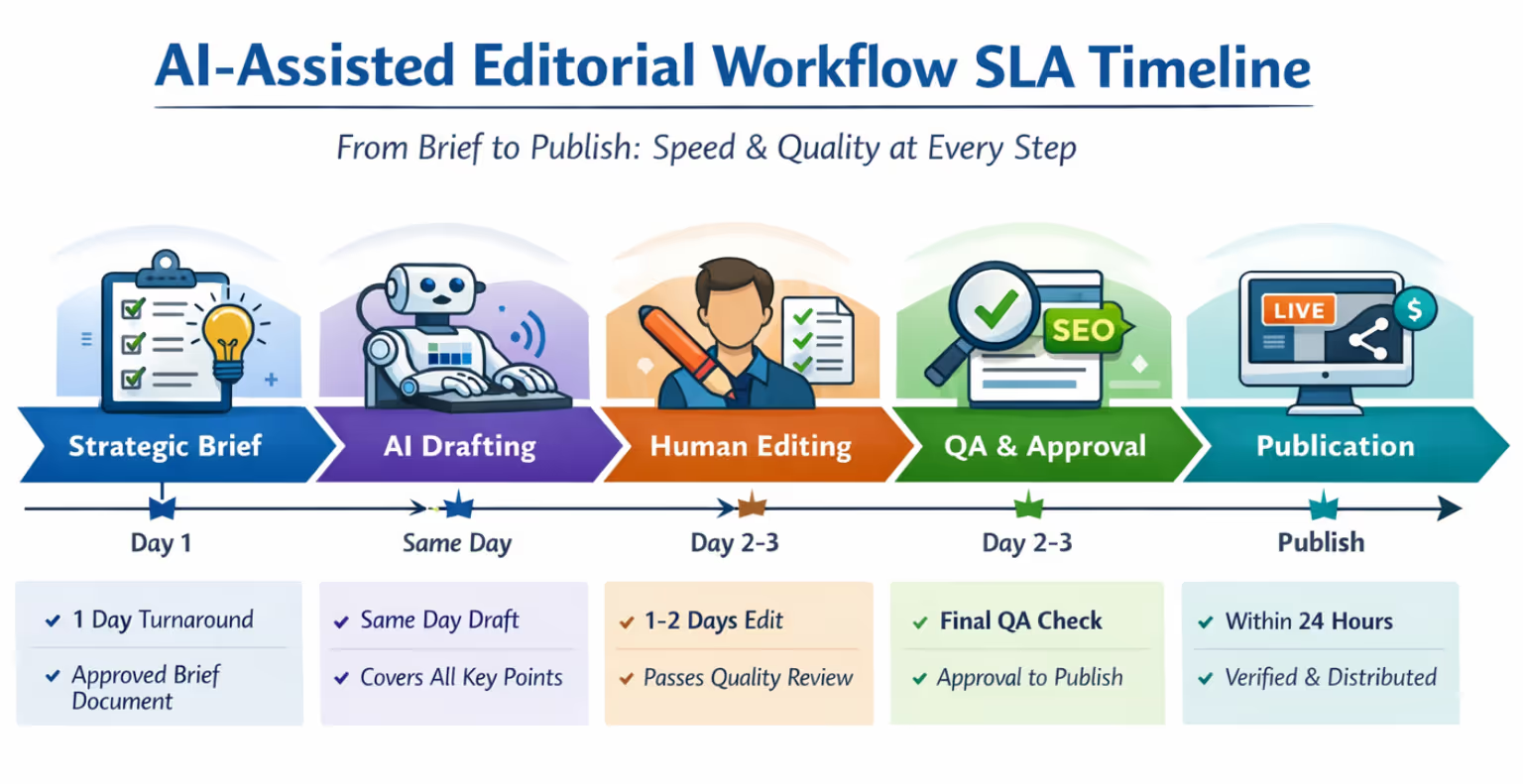
Putting It All Together: Complete Workflow Timeline
| Stage | Owner | SLA | Quality Gate |
| Brief | Strategist | 1 day | Approved by content lead |
| AI Draft | Content system | Same day | Covers all brief sections |
| Human Edit | Editor | 1-2 days | Passes robot pattern checklist |
| QA/Approval | Content lead + stakeholders | Same day to 2 days | All checklist items complete |
| Publish | Publisher | Within 24 hours | Live page verified |
Total timeline for routine content: 3-5 business days from topic assignment to live post.
This timeline assumes dedicated resources. Most internal teams struggle to maintain it because content production competes with dozens of other priorities.
Where This Gets Hard (And Where Teams Get Stuck)
The workflow above is straightforward on paper. Execution is harder.
Common failure points:
Briefs get skipped when things are busy. Then drafts miss the mark, editing takes longer, and the whole timeline collapses.
Human editing becomes rubber-stamping. Editors under time pressure approve drafts that should be revised. Quality erodes gradually.
Approvals create bottlenecks. Content sits in someone's inbox while the publishing calendar falls behind.
Consistency lapses. Teams hit their targets for a few weeks, then a product launch or holiday breaks the rhythm. The blog goes quiet.
These aren't character flaws—they're structural problems. Content production requires dedicated operational capacity that most teams don't have.
Building Your Content Engine
You have two paths forward.
Path 1: Build internally. Staff the workflow with dedicated roles. Create the systems, enforce the SLAs, maintain the cadence. This works if content is a core competency you want to own.
Path 2: Operationalize externally. Work with a partner who handles the operational load while you maintain strategic control.
The Mighty Quill exists specifically for the second path. We run this exact workflow—brief through publish—for clients who need consistent, quality content without building an internal content team.
Each stage maps directly:
Strategic briefs: We build your keyword bank and topic calendar, then create detailed briefs for each piece
AI-assisted drafting: Our systems generate structured drafts optimized for your specific audience and goals
Human editing: Every post goes through editorial review using the robot pattern checklist above
QA and approval: You see the content before it goes live, with one-click approval
Publication: Done-for-you clients get content published directly to their CMS, fully optimized
The result: 2-3 SEO-optimized posts per week, every week, without the operational overhead of managing it yourself.
Ready to see how it works? Get two free articles delivered within 48 hours—no commitment required. Try the Mighty Quill blog engine free.
Frequently Asked Questions
How long should the human editing stage take per article?
Plan for 45-90 minutes per 1,500-word article, depending on draft quality and editor familiarity with the topic. Rushing this stage below 30 minutes typically means robot patterns are slipping through. The editing stage is where content transforms from acceptable to genuinely good.
Can we skip the brief stage for simpler content pieces?
Skipping briefs is the most common workflow failure. Even "simple" posts benefit from 10 minutes of strategic alignment. The brief prevents drift, catches misalignment early, and gives editors clear criteria for what success looks like. Create a shorter brief template for simpler pieces rather than eliminating the stage.
What qualifications should a human editor have for AI content review?
Effective AI content editors need three things: subject matter familiarity (they can spot factual gaps), brand voice internalization (they know what sounds "like us"), and specific training on AI output patterns. Grammar skills matter less than these three capabilities—proofreading can happen separately.
How do we maintain workflow consistency during busy periods?
Build buffer into your publishing calendar. Having 2-3 weeks of approved content in queue means short-term disruptions don't break your publishing cadence. Teams without buffer capacity are always one vacation or product launch away from inconsistency.
What metrics should we track to know if our workflow is working?
Track both process and outcome metrics. Process: brief completion rate, editing turnaround time, approval bottleneck duration. Outcomes: organic traffic growth, keyword ranking improvements, time-on-page, and conversion rates from content. Process metrics diagnose problems before outcome metrics reflect them.
About This Guide
This workflow template draws on established content operations practices and current understanding of AI content capabilities and limitations. The Mighty Quill team has implemented these processes across multiple client engagements, refining the checklist items and SLAs based on what actually works in production environments. Our approach combines AI efficiency with the human oversight necessary to produce content that serves readers and performs in search.
Works Cited
[1] Google Search Central — "Creating helpful, reliable, people-first content." https://developers.google.com/search/docs/fundamentals/creating-helpful-content
[2] Nielsen Norman Group — "AI-Generated Content: Writing Quality and User Experience." https://www.nngroup.com/articles/ai-generated-content/


