Client retention isn't a relationship problem. It's an operations problem.
Most agencies lose clients not because the work was bad, but because the experience felt chaotic. Deliverables arrived late. Approvals dragged. Reports confused more than they clarified. And somewhere around month four, the client started wondering if they were getting value—or just invoices.
Recurring SEO blogging creates a unique retention opportunity. Unlike one-time projects, ongoing content builds compounding visibility over time. But that same recurring nature exposes every operational crack in your agency. Miss a deadline twice, and trust erodes. Fail to explain why rankings haven't moved yet, and clients assume nothing is working.
This playbook covers the operational systems that actually retain clients: approval workflows that reduce friction, reporting narratives that build confidence, and expectation-setting frameworks that prevent the "why isn't this working yet?" conversation before it starts.
Why Most Agency Retention Advice Misses the Point
Search for "agency client retention," and you'll find endless advice about account management. Send more check-in emails. Schedule quarterly business reviews. Build relationships.
That advice isn't wrong. But it treats symptoms while ignoring the disease.
Clients don't leave agencies because their account manager didn't call enough. They leave because the work felt disorganized, the results felt unclear, or the communication felt reactive instead of proactive [1].
Recurring SEO content amplifies this problem. When you're delivering two or three blog posts per week, every operational hiccup multiplies. A missed approval deadline doesn't just delay one project—it creates a backlog that cascades forward. A confusing report doesn't just frustrate once—it trains the client to distrust your updates.
The agencies that retain clients for years don't just do better work. They run better systems.
The Three Pillars of Operational Retention
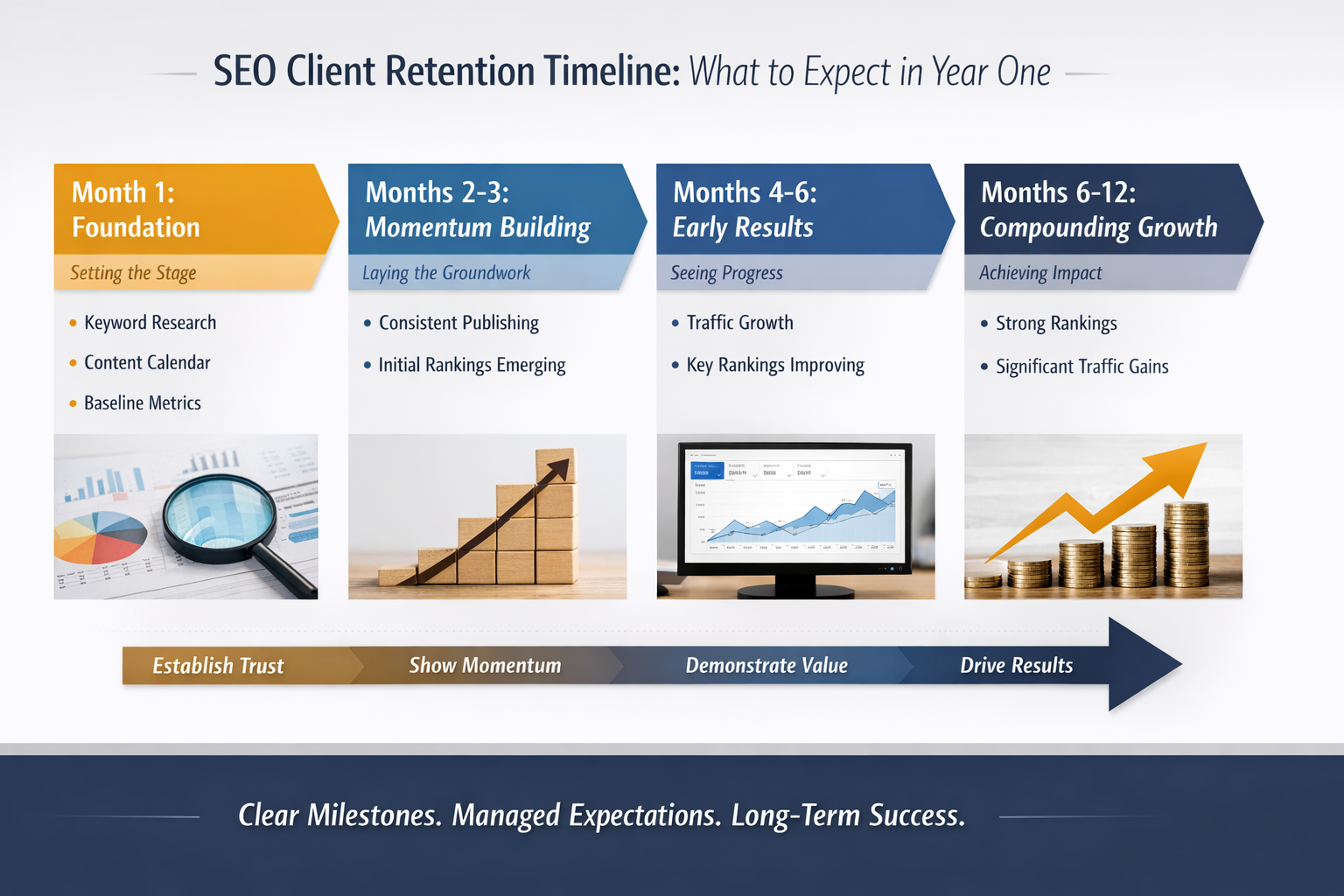
Client retention for recurring SEO blogging depends on three interconnected systems:
Approval workflows that make saying "yes" effortless
SLA structures that set clear expectations and consistently meet them
Reporting narratives that explain what's happening and why it matters
Miss any one pillar, and the others can't compensate. A great report won't save you if approvals are a nightmare. Smooth approvals won't matter if you never explain results. And clear expectations mean nothing if you don't actually meet them.
Building Approval Workflows That Reduce Client Friction
The Hidden Cost of Approval Bottlenecks
Every approval request is a small withdrawal from your client relationship. You're asking them to stop what they're doing, review something, make a decision, and communicate that decision back to you.
Make this process painful, and clients start dreading your emails. Make it effortless, and approvals become a moment of value—a reminder that work is happening, progress is being made, and their input matters.
Design Principles for Frictionless Approvals
One-click decisions whenever possible. The ideal approval email contains everything the client needs to decide, with clear options: Approve, Request Changes, or Reject. No logins required. No digging through attachments. No ambiguity about what they're approving.
Batch strategically, not excessively. Some agencies batch all weekly content into one massive approval request. This feels efficient but actually increases cognitive load. A client facing eight blog posts to review often reviews none of them carefully.
Better approach: send approvals in logical groups (two to three pieces maximum) with clear deadlines. "These posts are scheduled for next week—please approve by Thursday EOD."
Provide context, not just content. Each approval should include:
The target keyword and why it matters
The intended audience for this piece
Any strategic notes (seasonal relevance, product tie-in, etc.)
The proposed publish date
This context transforms approval from a chore into a strategic touchpoint.
Set approval SLAs—for both sides. Your client needs to know: "If we don't hear back within 48 hours, we'll proceed with the current version." This isn't aggressive. It's respectful of everyone's time and prevents indefinite limbo.
What Happens When Approvals Stall
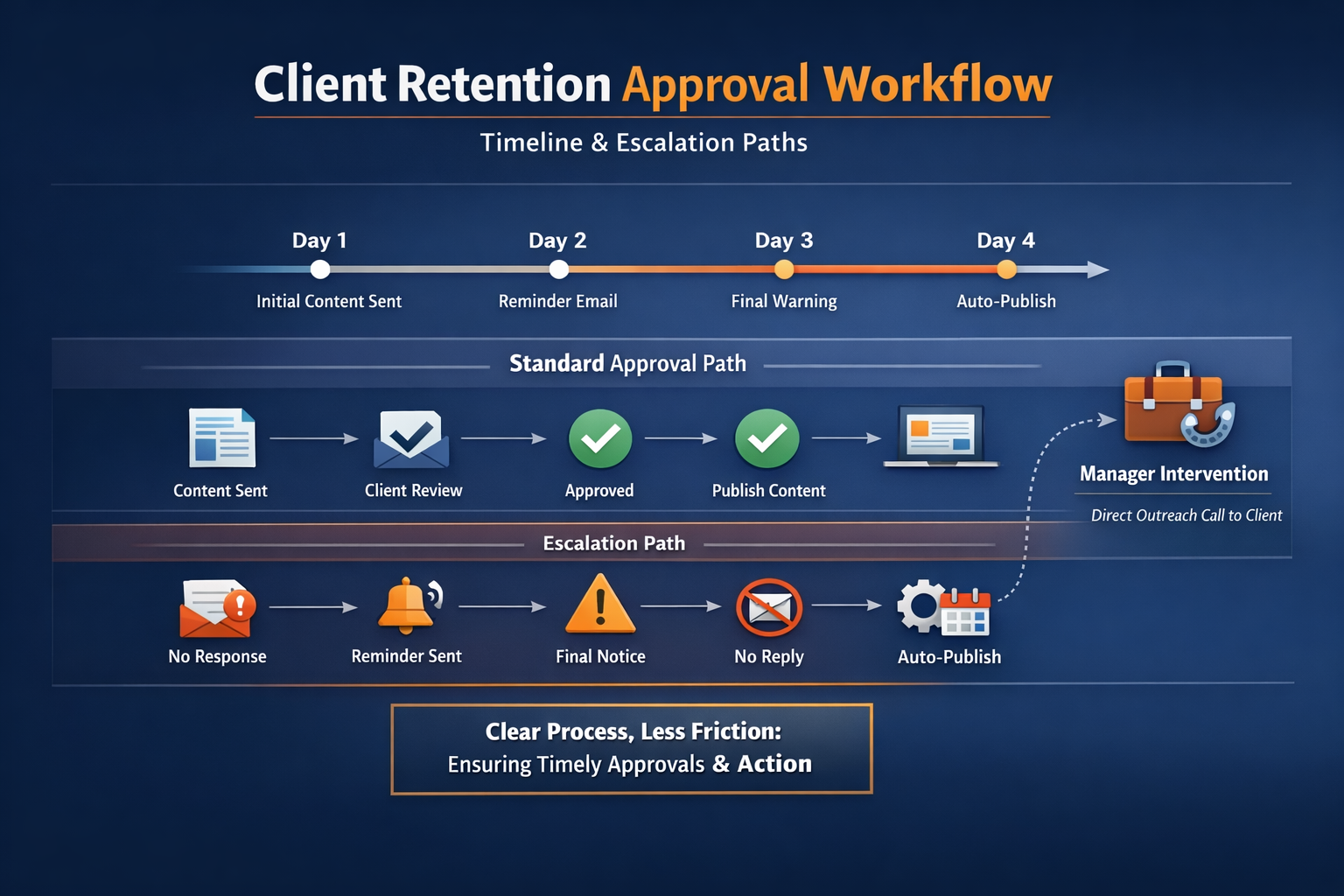
Build explicit escalation paths before you need them:
Day 1: Initial approval request sent
Day 2: Gentle reminder if no response
Day 3: "We'll proceed unless we hear otherwise by EOD"
Day 4: Publish as planned, note any changes requested for future pieces
Document these expectations during onboarding. Clients rarely object to clear processes—they object to surprises.
Setting Expectations: What to Promise and What Not to Promise
The Promises That Destroy Client Relationships
Most agency-client relationships don't end with a dramatic blowup. They end with accumulated disappointment from unmet expectations that were never realistic in the first place.
Never promise specific rankings. You cannot guarantee position one for any keyword. Too many variables exist outside your control: algorithm changes, competitor activity, domain authority gaps, and user behavior signals. Any agency promising specific rankings is either lying or doesn't understand SEO [2].
Never promise specific traffic numbers. "We'll double your organic traffic in six months" sounds impressive. It's also impossible to guarantee. Traffic depends on keyword difficulty, existing authority, content velocity, technical SEO health, and dozens of other factors.
Never promise specific timelines for ranking improvements. "You'll see results in 90 days" creates a ticking clock that often leads to disappointment. Some keywords move in weeks. Others take six months or longer. Promising specific timelines sets you up for a conversation you don't want to have.
What You Can Promise (and Should)
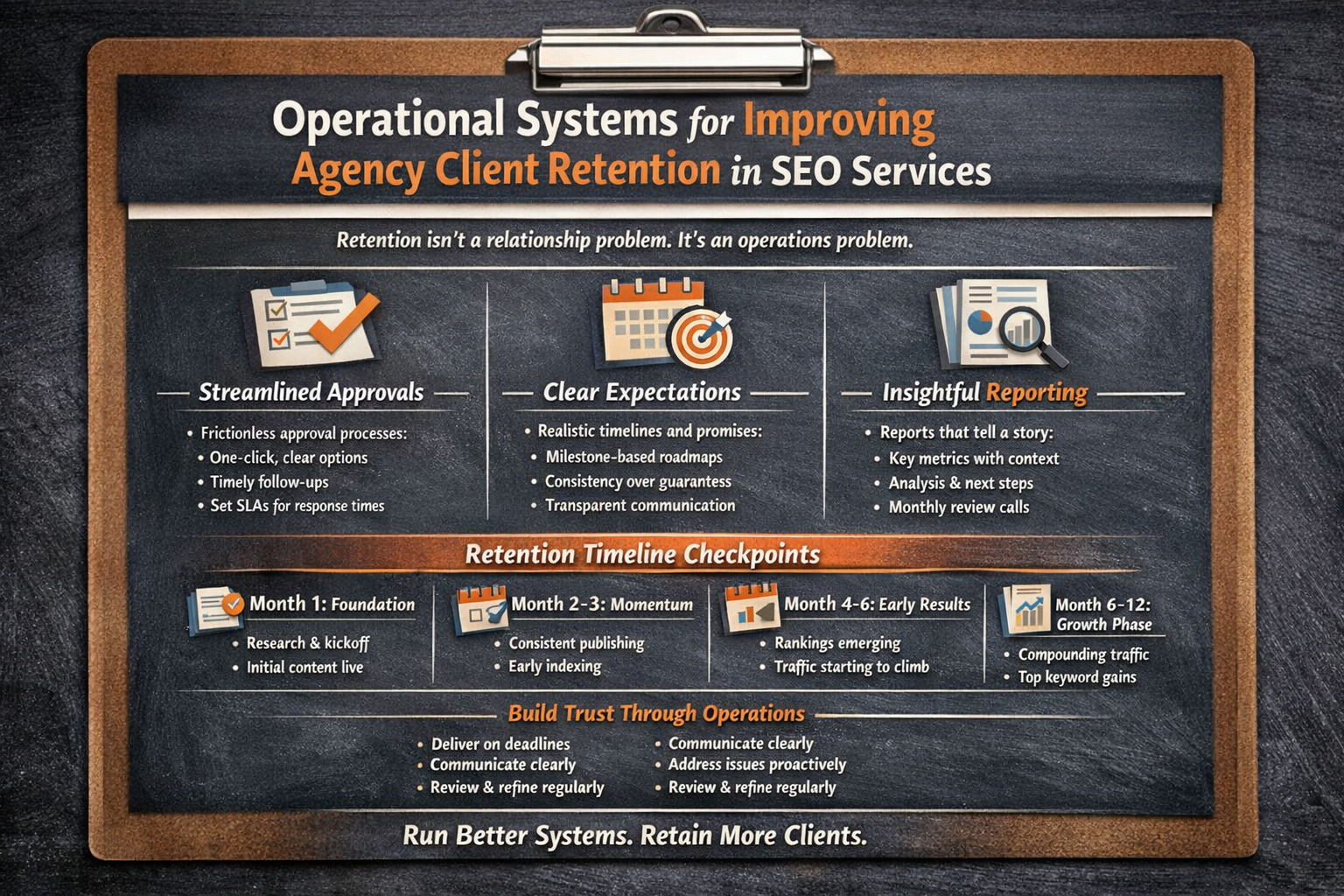
Promise consistency. "We will publish two SEO-optimized articles every week, on schedule, without exception." This is within your control. This is measurable. This builds trust through reliability.
Promise process. "Every piece will be researched, drafted, edited, and optimized according to our documented methodology." Clients can't easily evaluate content quality, but they can evaluate whether you're following a professional process.
Promise communication. "You'll receive a monthly report within the first week of each month, with a 15-minute call to discuss it." Consistency in communication matters as much as consistency in deliverables.
Promise transparency. "If something isn't working, we'll tell you. If we need to adjust strategy, we'll explain why." This promise builds trust precisely because it acknowledges uncertainty.
Expectation-Setting Timeline Checkpoints
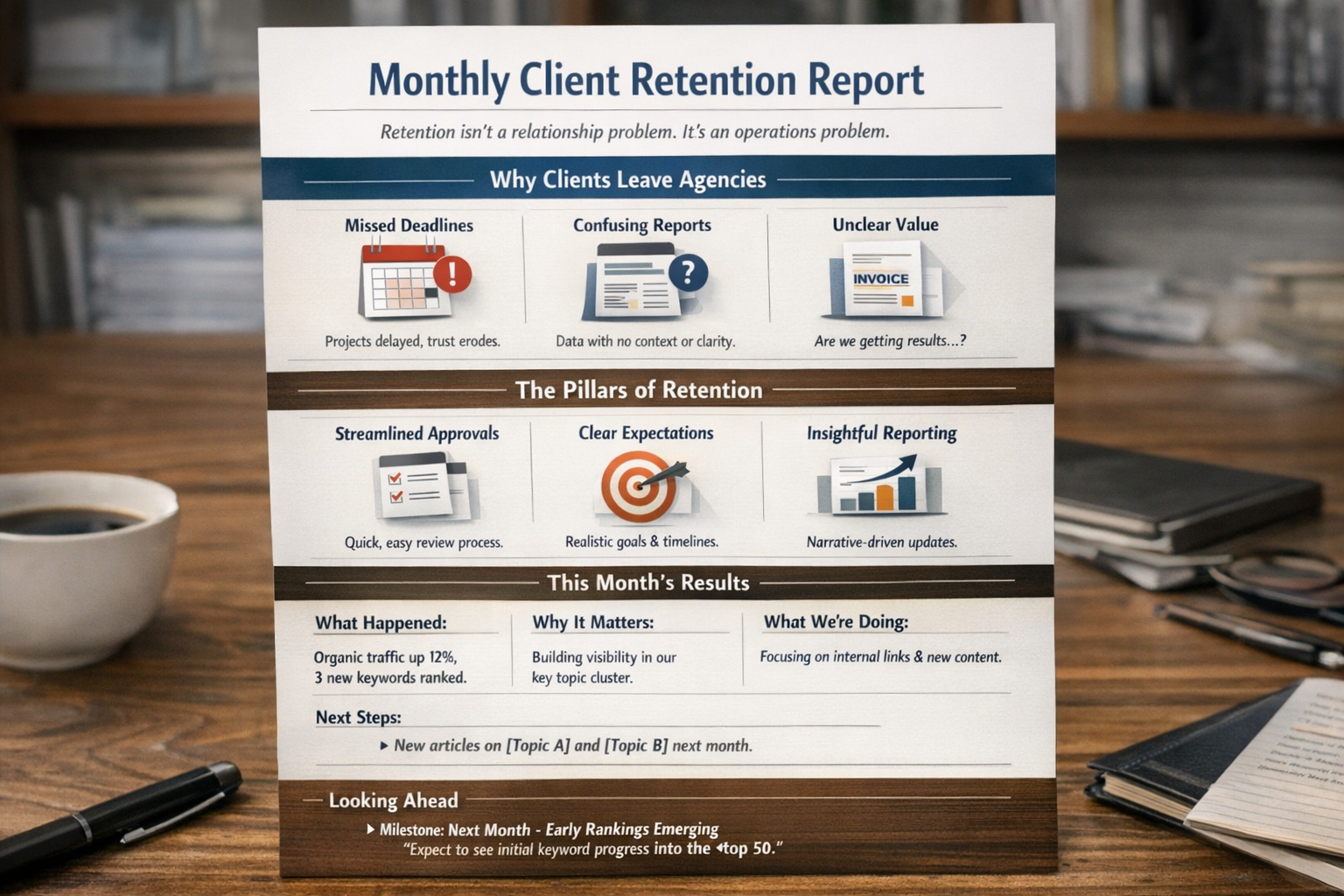
Set clear milestones during onboarding so clients know what to expect and when:
Month 1: Foundation
Keyword research and content calendar completed
Publishing cadence established
Baseline metrics documented
First content pieces live
What to expect: Indexing begins. Early impressions may appear. Rankings unlikely to be visible yet.
Month 2-3: Momentum Building
Consistent publishing rhythm proven
Internal linking structure developing
Topic clusters taking shape
What to expect: Some keywords may begin appearing in positions 50-100. Impressions should show upward trend. Don't expect significant traffic yet.
Month 4-6: Early Results
Content library growing
Topical authority signals strengthening
Some pieces may reach page two or lower page one
What to expect: Traffic begins to compound. Some high-value keywords may break into top 20. Others still developing.
Month 6-12: Compounding Growth
Content moat established
Multiple ranking pieces supporting each other
Organic traffic becomes meaningful channel
What to expect: Clear traffic growth trend. Several pieces in strong positions. Strategy refinements based on performance data.
Document these checkpoints in your onboarding materials. Reference them in monthly reports. When clients understand the timeline, they're far less likely to panic at month three because they haven't hit page one yet.
Reporting That Builds Confidence Instead of Confusion
Why Most SEO Reports Fail
The typical agency SEO report is a data dump: traffic numbers, ranking positions, click-through rates, and a dozen other metrics presented without context or narrative.
Clients receive these reports, glance at the numbers, and have no idea whether things are going well or poorly. They might see traffic up 12% and feel good, or see it down 8% and feel concerned—without understanding that both numbers might be completely normal given the circumstances.
Reports without narrative create anxiety. Anxiety erodes trust. Eroded trust leads to churn.
The Narrative-First Reporting Framework
Every report should answer three questions in plain language:
What happened this month? (Facts)
Why does it matter? (Interpretation)
What are we doing about it? (Action)
Example of data-dump reporting:"Organic sessions: 4,247 (up 8% MoM). Average position: 34.2 (down from 32.1). New keywords ranking: 47."
Example of narrative-first reporting:"This month, organic traffic grew 8% to 4,247 sessions—our fourth consecutive month of growth. Average position dipped slightly from 32.1 to 34.2, which is expected: we published content targeting more competitive keywords that will take time to climb. We added 47 new ranking keywords, including three in our priority topic cluster. Next month, we're focusing on building internal links to accelerate those newer pieces."
Same data. Completely different client experience.
Report Structure That Works
Executive summary (2-3 sentences). What's the headline? Is the program working? Any major developments?
Key metrics with context. Show the numbers, but always explain what they mean. Trending up? Explain why. Trending down? Explain why and what you're doing about it.
Content delivered this month. List every piece published, with links. This proves the work happened and gives clients easy access to review.
Strategic observations. What are you learning? What's working better than expected? What needs adjustment?
Next month preview. What content is planned? Any strategic shifts? This creates anticipation instead of anxiety.
Monthly Check-In Calls: The Retention Multiplier
Reports alone aren't enough. A 15-minute monthly call transforms a document into a conversation.
Use this structure:
5 minutes: Walk through report highlights
5 minutes: Answer client questions
5 minutes: Preview next month and confirm alignment
These calls catch concerns before they become complaints. They surface feedback you'd never get via email. They remind clients that a real human is thinking about their business.
Building the Operational Infrastructure
Document Everything Before You Need It
Create standard operating procedures for:
Content briefing and research
Draft creation and quality control
Approval request formatting and timing
Revision handling and limits
Publishing and optimization
Reporting cadence and format
When these processes exist in writing, they're trainable, scalable, and consistent. When they live only in people's heads, they vary with every client and every team member.
Set SLAs That You Can Actually Meet
An SLA you miss is worse than no SLA at all. Be conservative:
Content delivery: 48 hours before scheduled publish date
Revision turnaround: 24 hours for minor edits, 48 hours for substantial changes
Report delivery: Within 5 business days of month end
Response time: Same business day for urgent items, 24 hours for routine
Then track your performance against these SLAs religiously. Share the results with clients quarterly. "We delivered 98% of content on time this quarter" builds trust through transparency.
Create Feedback Loops That Actually Work
Don't wait for quarterly business reviews to learn what clients think. Build lightweight feedback mechanisms:
After the first month: "How's the onboarding experience been?"
After month three: "Are we communicating the right amount? Too much? Too little?"
After month six: "What would make this engagement even better?"
One question, one email, once per quarter. The answers prevent problems you'd never see coming.
When Things Go Wrong (Because They Will)
Proactive Problem Communication
Every agency makes mistakes. Deadlines slip. Quality dips. Strategies miss.
How you handle problems determines whether clients forgive or leave.
Tell clients about problems before they discover them. "We're running behind on next week's content due to [reason]. Here's our plan to catch up: [specific actions]. We'll be back on schedule by [date]."
This message, delivered proactively, builds trust. The same problem discovered by the client destroys it.
Own mistakes without excessive apology. "We missed the mark on this piece. Here's what happened, what we learned, and how we're preventing it in the future." Then move on. Excessive apologizing makes clients more nervous, not less.
Recovery Frameworks
For minor issues (single missed deadline, quality slip on one piece):
Acknowledge immediately
Provide explanation (not excuse)
Deliver solution with timeline
Move forward
For major issues (pattern of problems, strategic miss):
Schedule a call (not email)
Present honest assessment of what went wrong
Propose specific remediation plan
Offer appropriate accommodation if warranted
Document lessons learned and process changes
The Compounding Effect of Operational Excellence
Here's what happens when you build these systems:
Month 1-3: Clients notice that approvals are easy, deadlines are met, and reports make sense. They relax.
Month 4-6: Trust accumulates. Clients approve content with minimal changes because they've learned your team understands their business.
Month 6-12: The relationship shifts from vendor to partner. Clients ask for your opinion on strategy. They refer colleagues. They stay.
Year 2+: You have clients who never consider leaving because the thought of rebuilding this system with another agency feels exhausting.
Retention isn't about keeping clients who want to leave. It's about never giving them a reason to consider it.
Start Building Your Retention Engine
Client retention in recurring SEO blogging isn't magic. It's methodology.
Build approval workflows that respect client time. Set expectations that you can actually meet. Create reports that tell stories, not just show data. And when problems arise, handle them like a professional.
The agencies that keep clients for years don't have some secret relationship advantage. They simply make the experience of working with them reliably excellent, month after month.
That's the playbook. The rest is execution.
Ready to see how a done-for-you content system handles operations at scale? Request a white-label trial with defined deliverables, clear SLAs, and the reporting framework your clients actually want.
Frequently Asked Questions
How do I set SEO expectations without promising specific results?
Focus on what you can control: publishing consistency, content quality, strategic methodology, and transparent communication. Explain that SEO compounds over time, with meaningful results typically emerging between months four and eight depending on competition and starting authority. Provide timeline checkpoints during onboarding so clients understand the journey before they begin it.
What should I include in monthly SEO reports for maximum client retention?
Lead with a narrative summary explaining what happened and why it matters. Include key metrics with context, not just numbers. List all content delivered with links. Add strategic observations about what's working and what needs adjustment. Close with a preview of next month's plan. The goal is confidence-building clarity, not data overwhelm.
How often should clients approve recurring blog content?
Most agencies find success with two to three pieces per approval batch, sent with 48-hour response windows. Larger batches overwhelm clients and reduce review quality. Establish clear SLAs for both sides: your delivery timeline and their approval deadline. When clients don't respond, have a documented escalation path that keeps content moving.
What causes most agency client churn in SEO services?
Research consistently points to unmet expectations and poor communication rather than actual performance failures [3]. Clients leave when they feel confused about results, surprised by problems, or uncertain whether the investment is working. Operational systems that provide clarity, consistency, and proactive communication address the root causes of churn.
How long should I commit to an SEO client before expecting retention?
The first six months are critical for establishing operational credibility and showing early results. Most clients who churn do so between months three and six—before content has time to compound but after initial enthusiasm fades. Strong onboarding, clear timeline expectations, and consistent delivery through this period dramatically improve long-term retention.
About The Mighty Quill
The Mighty Quill builds content engines for growth-focused businesses, combining strategic keyword research with consistent publishing systems. Founded by a digital marketing veteran with over fifteen years of experience in SEO and content strategy, The Mighty Quill delivers two to three SEO-optimized articles weekly with built-in approval workflows and transparent reporting—exactly the operational infrastructure this playbook describes.
Cited Works
[1] HubSpot — "The Ultimate Guide to Customer Retention." https://blog.hubspot.com/service/customer-retention
[2] Search Engine Journal — "What SEO Guarantees Should You Actually Expect?" https://www.searchenginejournal.com/seo-guarantees/
[3] Agency Analytics — "Client Retention Strategies for Marketing Agencies." https://agencyanalytics.com/blog/client-retention-strategies