Most content marketing initiatives die in onboarding.
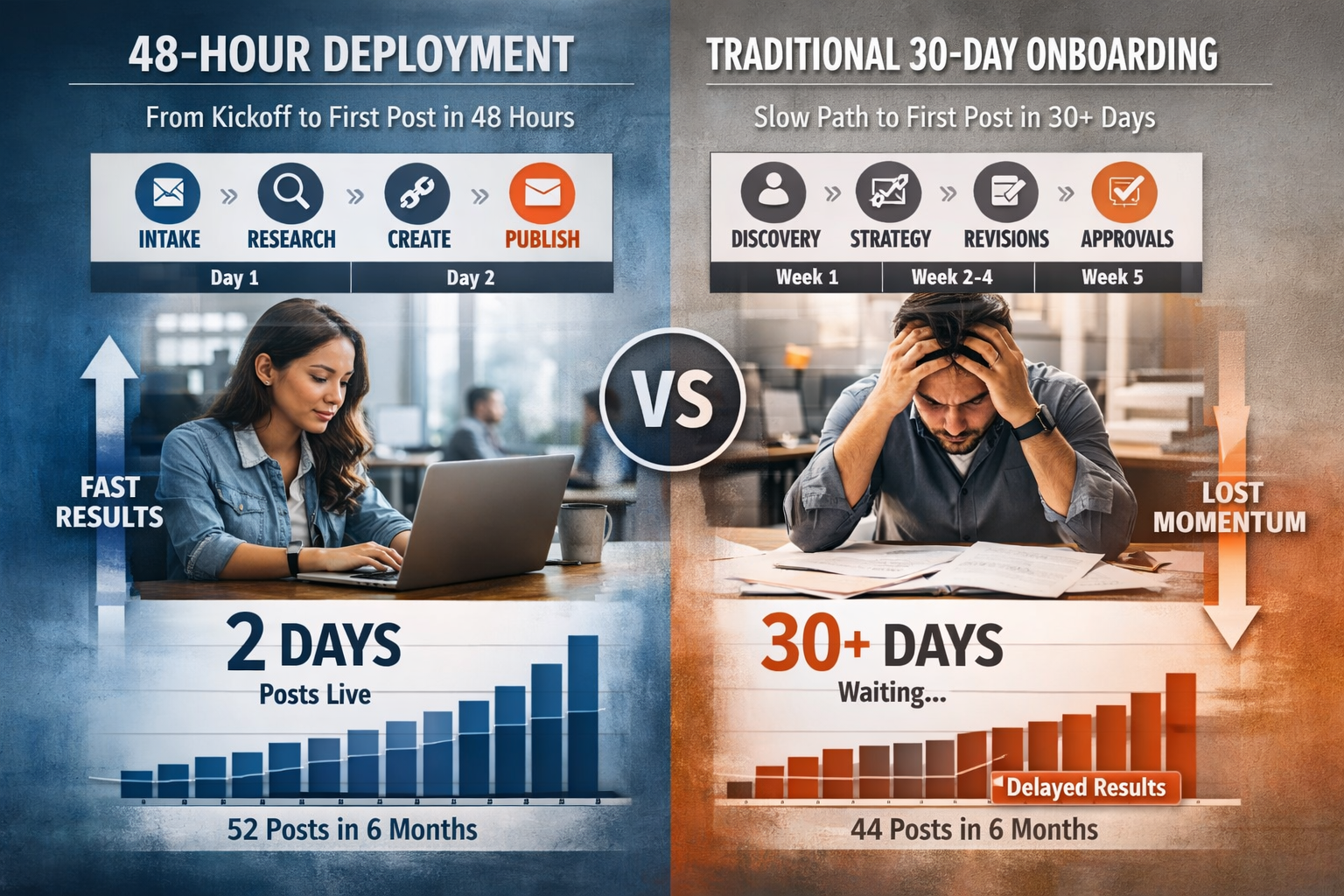
You sign the contract, attend the kickoff call, fill out the brand questionnaire, wait for the strategy deck, review the content calendar, request revisions, and somewhere around day 30—maybe day 45—you finally see your first blog post draft.
By then, momentum is gone. The internal champion who pushed for the project has moved on to other fires. The urgency that sparked the decision has faded into background noise.
This is the hidden cost of traditional content workflows: not just the money, but the time to value. And in a market where organic visibility compounds over time, every week without published content is a week your competitors are building an advantage that becomes harder to overcome.
The good news? It doesn't have to take 30 days. With the right approach, you can go from "we need content" to "first post published" in 48 hours.
This article explains why traditional workflows move slowly, how to identify if you're stuck in what we call "strategic chaos," and the specific methods that compress time to value—whether you build the system yourself or work with a partner like The Mighty Quill.
Why Traditional Content Onboarding Takes 30+ Days
Let's be honest about why most agencies and content teams move slowly. It's not laziness. It's structural.
Traditional workflows involve:
Discovery phases that stretch across multiple stakeholder interviews
Strategy development requiring executive sign-off
Writer recruitment or assignment from limited internal pools
Editorial calendars built for quarterly planning, not weekly execution
Revision cycles that bounce between writers, editors, and clients
Each step makes sense in isolation. Together, they create a bottleneck that pushes first delivery dates weeks—sometimes months—into the future.
Research supports this pattern. According to the Content Marketing Institute, only 29% of B2B marketers rate their organization as "extremely" or "very" successful at content marketing, with workflow inefficiencies frequently cited as a barrier [1]. HubSpot's data suggests that organizations publishing 16+ blog posts per month get approximately 3.5 times more traffic than those publishing 0-4 posts monthly, yet most teams struggle to maintain that velocity due to operational bottlenecks [2].
For agencies billing hourly or by project phase, there's little incentive to compress this timeline. More phases mean more billable milestones.
But for you? Every day without content is a day without compounding organic returns.
The Real Cost of Slow Time to Value
Content marketing works through accumulation. A single blog post might generate modest traffic. Ten posts, strategically interlinked and targeting related keywords, build topical authority. Fifty posts create a moat that competitors struggle to cross.
This compounding effect means early delays have outsized consequences.
Consider a projection of two companies starting their content programs on the same day:
Company A publishes their first post in 48 hours and maintains two posts per week.Company B waits 30 days for onboarding, then publishes at the same cadence.
After six months (modeled scenario):
Company A: Approximately 52 published posts
Company B: Approximately 44 published posts
That 8-post gap represents more than content volume. It represents keyword coverage, internal linking opportunities, domain authority signals, and indexed pages competing for search visibility.
Ahrefs research found that the average page ranking in the top 10 Google results is over two years old, and only 5.7% of newly published pages reach the top 10 within a year [3]. This data underscores why starting earlier matters—the clock on ranking potential begins the moment you publish.
The gap widens over time. And in competitive markets, that early lead often determines who captures the featured snippet, the People Also Ask box, or visibility in AI-generated search responses.
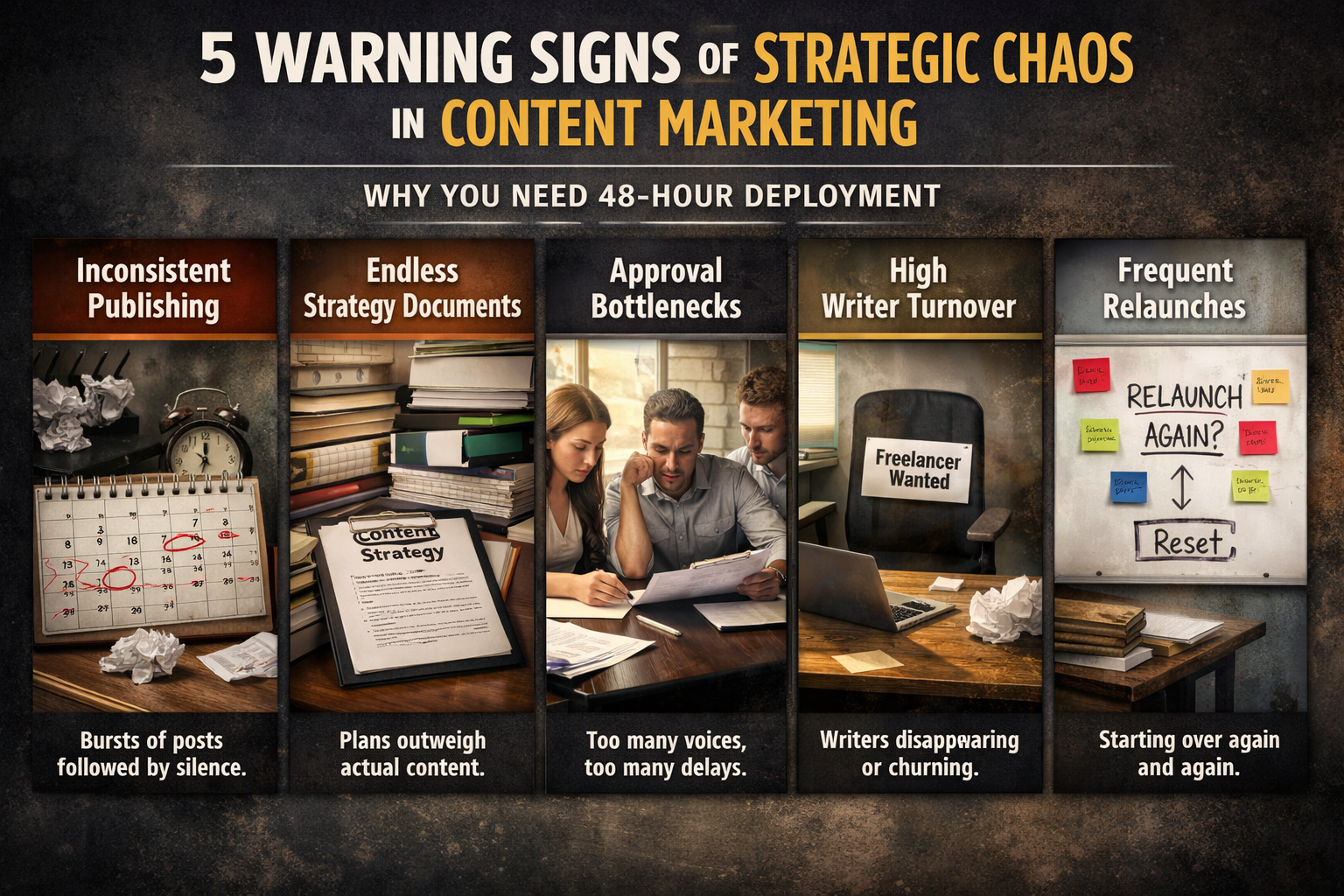
5 Signs You're Stuck in Strategic Chaos
Here's what we hear from nearly every client during intake: "We know we need content. We've tried before. It fell apart."
The symptoms vary—inconsistent publishing, generic content that doesn't rank, endless revision cycles—but the root cause is usually the same.
We call it strategic chaos.
Strategic chaos happens when content efforts lack the systems infrastructure to sustain momentum. The first few posts get attention. By month two, the blog is an afterthought. By month three, someone remembers it exists and suggests another restart.
Here are the warning signs:
Your blog publishes in bursts, then goes silent. Two posts one week, nothing for six weeks, then a flurry before a product launch. No rhythm. No compounding.
You have more "content strategy" documents than published posts. Spreadsheets full of keyword ideas collecting dust. Editorial calendars that exist in theory but not in practice.
Every piece requires a committee. Three stakeholders reviewing drafts, conflicting feedback, revision cycles that stretch longer than the writing itself.
Writers keep churning or disappearing. Freelancers ghost. In-house staff get pulled to "higher priority" projects. Nobody owns the engine.
You've "relaunched" your content efforts more than once. The pattern repeats because the underlying approach—treating content as a project rather than an engine—never changes.
If three or more of these sound familiar, you're not failing at content. You're failing at systems.
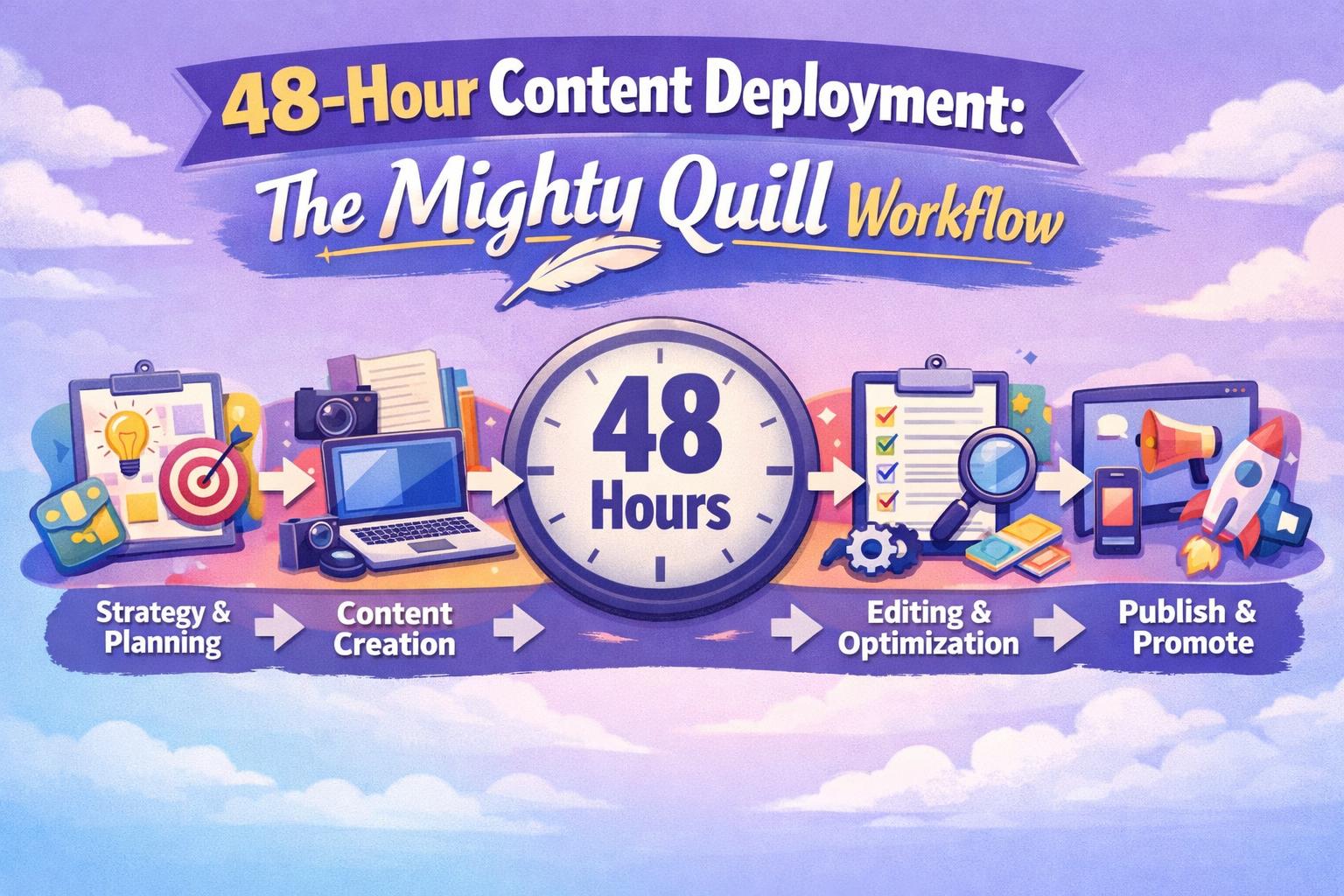
The 48-Hour Deployment Framework
Speed without quality is just noise. The goal is compressing time to value without sacrificing the strategic foundation that makes content effective.
Here's how to structure a rapid deployment workflow—the approach we use at The Mighty Quill, but principles you can apply to any content operation:
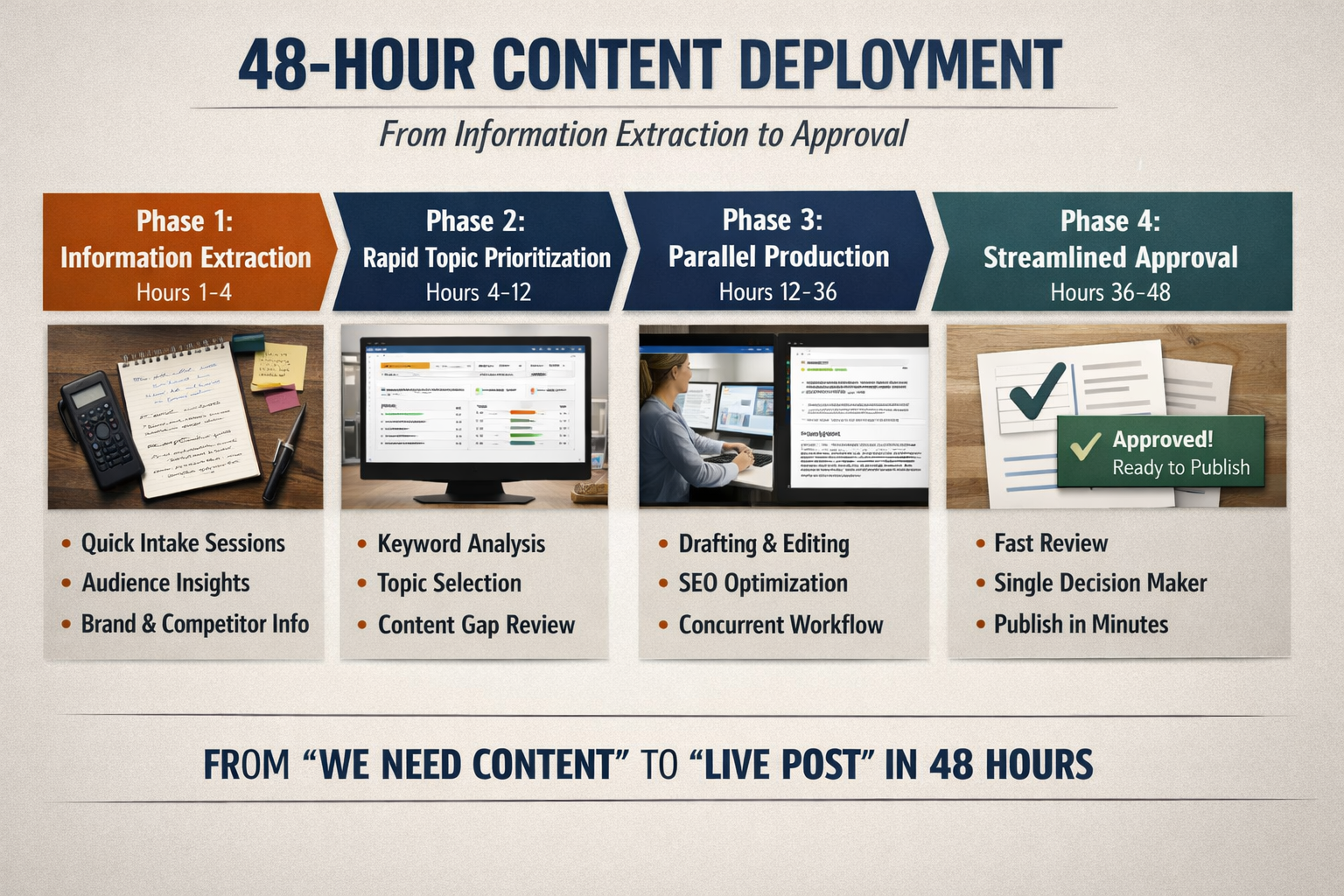
Phase 1: Focused Information Extraction (Hours 1-4)
Instead of a 90-minute discovery call followed by weeks of strategy development, run a structured intake process designed to capture:
Your audience's primary pain points and search behaviors — What questions do they ask before buying? What problems keep them up at night?
Existing content assets worth leveraging or updating — Don't start from zero if you have foundations to build on.
Brand voice parameters and terminology preferences — How formal? What words do you love or hate?
Competitive positioning and differentiation angles — What do you do differently? What should content emphasize?
Priority topics based on business objectives — What matters most in the next 90 days?
This isn't a casual conversation. It's a systematic extraction of the insights that actually matter for content production. Everything else—the nice-to-haves, the future roadmap items, the theoretical positioning exercises—gets parked for later refinement.
Key principle: Gather what's necessary to start, not everything that might eventually be useful.
Phase 2: Rapid Topic Prioritization (Hours 4-12)
While traditional agencies spend weeks on keyword research, a well-built system generates a comprehensive topic bank within hours.
Effective rapid research includes:
Primary keyword targets with search volume and difficulty analysis
Semantic variations and long-tail opportunities
People Also Ask questions for each topic cluster
Content gap analysis against top-ranking competitors
Tools like Ahrefs, Semrush, or even Google's own autocomplete and "People Also Ask" features can accelerate this process dramatically when used systematically rather than exploratorily.
The result should be a living topic bank—not a static spreadsheet that becomes outdated before implementation.
Phase 3: Parallel Production (Hours 12-36)
Traditional workflows move sequentially: research, then strategy, then writing, then editing. A compressed workflow runs these processes in parallel where possible.
What this looks like in practice:
While the topic bank is being built, initial drafts can begin on obvious priority topics.
AI-augmented tools handle the heavy lifting of research synthesis and draft generation, freeing human editors to focus on quality refinement and strategic alignment.
On-page SEO elements (meta descriptions, header hierarchy, internal linking opportunities) are built into the production process, not added as an afterthought.
Google's own guidance emphasizes that helpful content created for people—not primarily for search engines—is what ranks well [4]. Speed doesn't mean sacrificing that principle. It means removing friction that doesn't serve it.
Phase 4: Streamlined Approval (Hours 36-48)
Bureaucratic approval processes kill momentum. The fastest-moving content teams use systems that present finished content for simple approval, allowing posts to move from draft to published in minutes rather than days.
How to shorten approval cycles:
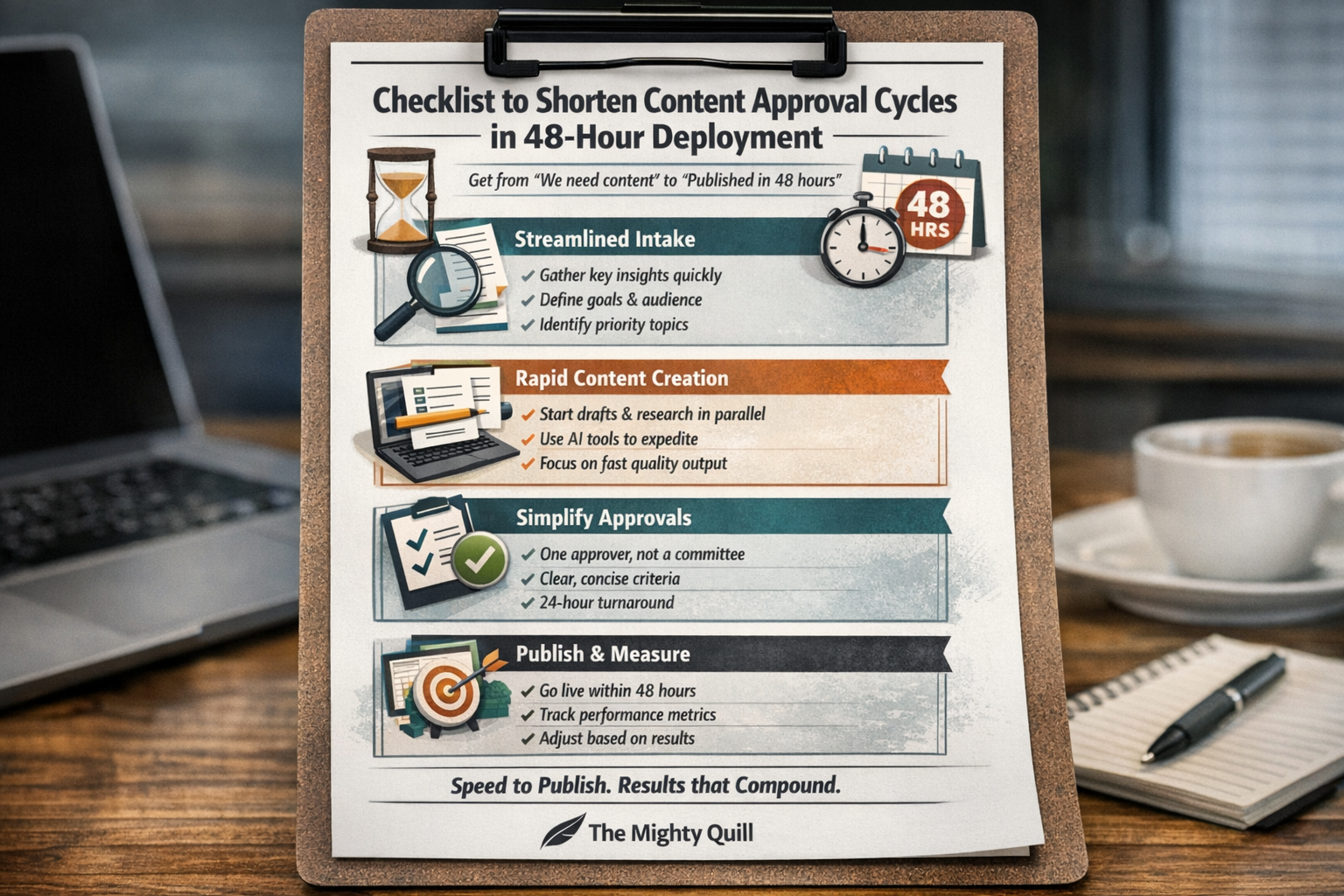
Reduce reviewers. One decision-maker, not a committee.
Use clear approval criteria. Does it match brand voice? Is it factually accurate? Does it serve the target audience? Yes/no on each.
Set time limits. If no response in 24 hours, it ships (or escalates).
Build trust early. The first few posts calibrate expectations; after that, approval becomes routine.
Within 48 hours of starting, you can have content ready to go live.
The Technology Stack That Enables Speed
A 48-hour workflow isn't possible with Google Docs and email chains. You need intentional infrastructure.
The core components:
Research Layer: Keyword and competitor analysis tools (Ahrefs, Semrush, Clearscope, or similar)
Production Layer: AI writing assistance for draft generation, integrated with human editorial review
Workflow Layer: Project management that tracks status and triggers approvals automatically
Publishing Layer: Direct integration with your CMS, or a structured handoff process
At The Mighty Quill, we've built these layers into a unified system—clients see a queue of approved content ready to publish with one click. But even if you're building internally, thinking in terms of these distinct layers helps identify where your current process creates unnecessary delay.
What Happens After the First 48 Hours
Speed matters at launch. Consistency matters forever.
The 48-hour workflow isn't a one-time sprint. It's the beginning of a sustained publishing cadence that compounds over time.
After your initial deployment:
New content enters your queue weekly, maintaining the 2-3 posts per week cadence that builds authority
Topic priorities adjust based on performance data, ensuring resources flow toward what's working
Internal linking strengthens as your content library grows, creating the topical clusters that search engines reward
Your approval workflow stays simple, with streamlined publishing that keeps the engine running smoothly
According to Search Engine Journal, websites that publish content consistently (versus sporadically) see more predictable traffic growth and stronger domain authority signals over time [5].
The goal isn't just fast starts. It's sustainable velocity.
How to Shorten Your Content Approval Cycles
Since approval bottlenecks are one of the most common causes of content delay, here are specific tactics to address them:
Before you start:
Agree on brand voice guidelines in writing. When everyone references the same document, subjective feedback decreases.
Define what "done" means. Does the draft need to be perfect, or publish-ready?
During production:
Share outlines before full drafts. Catching direction problems early prevents major rewrites.
Use inline comments, not rewrite suggestions. "This section needs more specificity" is faster to address than "Here's how I'd rewrite this paragraph."
At approval:
Batch reviews. Approving three posts in one session is faster than three separate review cycles.
Empower a single approver. Multiple reviewers create conflicting feedback and exponential delays.
These aren't revolutionary tactics. They're operational hygiene—but most teams skip them, and the cost shows up in their publishing calendars.
Who Benefits Most from Rapid Deployment
The 48-hour framework works best for companies that:
Value action over planning — They'd rather publish and iterate than perfect in isolation
Understand content compounding — They know early posts create the foundation for later success
Have limited internal content resources — They can't afford to wait while an in-house team ramps up
Compete in crowded markets — They need speed advantages their competitors lack
This includes SaaS companies chasing product-market fit, e-commerce brands building organic channels beyond paid ads, and agencies seeking content solutions they can deploy for clients without expanding headcount.
It's less ideal for organizations that require extensive internal approvals, operate in heavily regulated industries with complex compliance reviews, or prefer theoretical planning over practical execution.
Measuring Time to Value
How do you know if your content workflow is delivering acceptable time to value?
Track these metrics:
Days from decision to first published post — The core measure of deployment speed
Posts published in first 30 days — Early volume indicates sustainable systems
Indexation rate for new content — How quickly search engines recognize your posts (check Google Search Console)
Organic impression growth in first 90 days — Early signals of compounding effect
If your current content approach takes weeks to produce first deliverables, you're paying the hidden tax of slow time to value. Every day of delay is a day without compounding returns.
See the Difference 48 Hours Makes
The Mighty Quill was built specifically to solve the time-to-value problem. While most agencies are still scheduling discovery calls, we can deliver your first two publication-ready articles.
Try the engine for free — We'll deliver two ready-to-publish articles within 48 hours. No commitment. No extended onboarding. Just content that's ready to compound.
Start your free trial and see what strategic chaos looks like when it transforms into a live content engine in two days.
Frequently Asked Questions
How can any workflow produce quality content in just 48 hours?
Speed comes from eliminating unnecessary friction, not cutting corners on quality. The key is separating essential preparation (audience understanding, brand voice, topic priorities) from nice-to-have preparation (exhaustive strategy decks, committee approvals). AI-augmented tools handle research synthesis and draft generation, while human editors ensure quality and brand alignment. When you remove the waiting—between meetings, between approvals, between handoffs—48 hours is more than enough time for thoughtful production.
What's the minimum information needed to start a rapid content workflow?
You need four things to begin: a clear understanding of your target audience's primary pain points, your brand voice parameters (even informal guidelines work), 3-5 priority topics aligned with business objectives, and a single decision-maker empowered to approve content. Everything else—competitive analysis, comprehensive keyword research, detailed editorial calendars—can be developed iteratively as you publish and gather performance data.
Can rapid deployment work for complex or technical industries?
Yes, with adjustments. For highly regulated sectors like healthcare or finance, compliance review timelines extend beyond any workflow's control—build those into your process rather than fighting them. For technically complex topics, the intake process should include subject matter expert coordination to ensure accuracy. The framework adapts to industry requirements while still compressing every controllable delay.
How does this compare to hiring an in-house content writer?
Hiring takes time—job postings, interviews, onboarding, and ramp-up periods often stretch across months before consistent publishing begins. A rapid deployment system delivers production-ready content within days of starting, at a fraction of full-time hiring costs. You get immediate output without recruitment delays or management overhead. In-house hires make sense for long-term capacity building; rapid deployment solves the "we need content now" problem.
What if our brand requires extensive review cycles?
Some organizations genuinely need multi-stakeholder approval—and that's fine. The goal isn't to eliminate necessary review, but to eliminate unnecessary waiting. Map your current process: Where does content sit idle? Who reviews but rarely changes anything? What feedback could be captured earlier (at outline stage) rather than later (at final draft)? Even compliance-heavy organizations can typically cut time-to-publish significantly by identifying and removing non-essential friction points.
About The Mighty Quill
The Mighty Quill was founded by Mario, a digital marketing strategist with over 15 years of experience in SEO, e-commerce, and content systems. After watching too many businesses lose momentum to slow content workflows—endless onboarding, inconsistent publishing, blogs that launch with fanfare and fade to silence—he built a system designed around a different principle: content should compound from day one, not day thirty. The Mighty Quill delivers AI-powered content engines for growing businesses that need consistent organic traffic without the operational burden of managing freelancers or building in-house teams.
Works Cited
[1] Content Marketing Institute — "B2B Content Marketing Research." https://contentmarketinginstitute.com/research/
[2] HubSpot — "How Often Should You Blog? Benchmarks for Blogging Frequency." https://blog.hubspot.com/marketing/blogging-frequency-benchmarks
[3] Ahrefs — "How Long Does It Take to Rank in Google?"
https://ahrefs.com/blog/how-long-does-it-take-to-rank/
[4] Google Search Central — "Creating Helpful, Reliable, People-First Content." https://developers.google.com/search/docs/fundamentals/creating-helpful-content
[5] Search Engine Journal — "Does Posting Frequency Affect SEO?" https://www.searchenginejournal.com/does-posting-frequency-affect-seo/