Most ecommerce blogs fail for the same reason: they exist in isolation.
Posts get published. They sit there. They don't connect to anything that actually matters—like the category pages and product comparison searches that drive real purchasing decisions.
Here's the thing. Your category pages are where buying intent lives. They're the money pages. But Google often struggles to rank them because they look like every other category page on the internet: a title, some filters, and a grid of products.
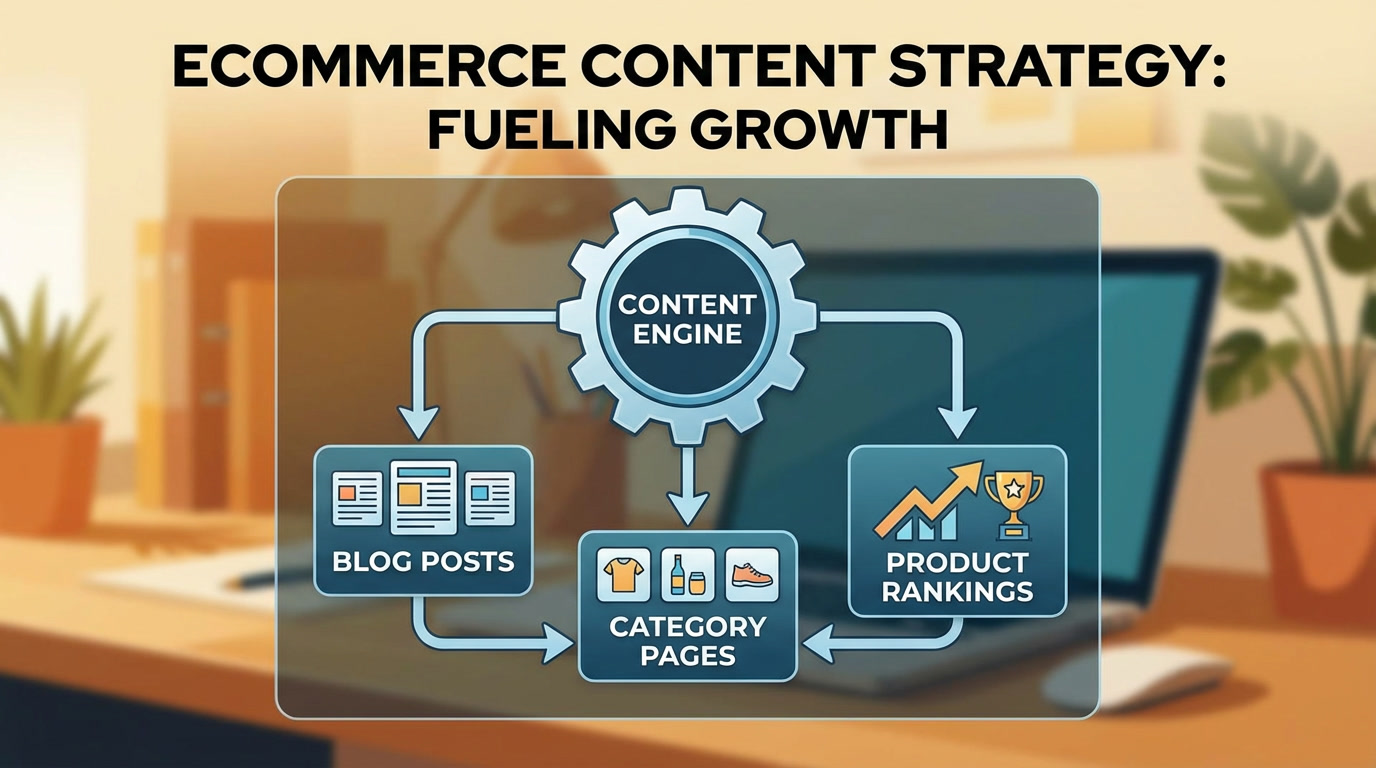
An ecommerce content engine solves this. It's a systematic approach to publishing blog content that directly supports your category and product page rankings while capturing comparison-intent searches that your competitors ignore [1].
This isn't about churning out thin AI content that says nothing. It's about building a content ecosystem where every post has a job—and that job is helping your most valuable pages rank higher.
Why Most Ecommerce Blogs Don't Support Category Page Rankings
The typical ecommerce blog is a graveyard of disconnected posts. "5 Summer Fashion Trends" lives next to "How to Care for Leather" lives next to "Our Founder's Story." None of them link strategically to category pages. None of them target the queries that signal purchase intent.
This matters because category pages need topical support to rank. Google's systems evaluate whether your site demonstrates expertise and depth on a topic [2]. A category page for "running shoes" ranks better when surrounded by content that establishes your authority on running, foot health, shoe technology, and—critically—product comparisons.
The problem compounds when businesses use generic AI tools to fill their blogs. You get surface-level posts that:
Cover topics too broadly to rank for anything specific
Duplicate the same template structures across every post
Lack the internal linking architecture that passes authority to money pages
Miss product comparison intent entirely
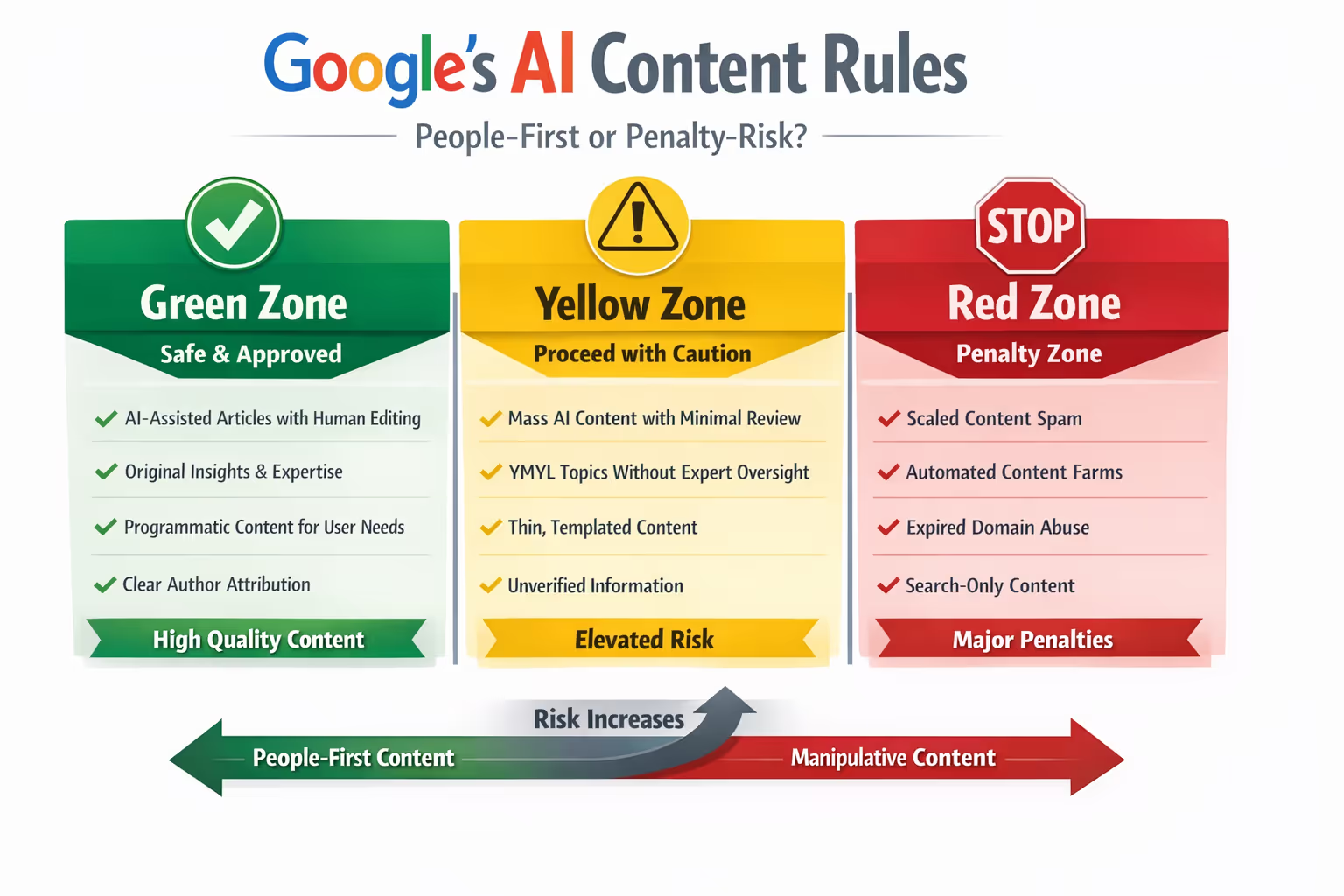
Search engines have become remarkably good at identifying thin content that exists purely for SEO purposes [3]. When every running shoe retailer publishes "How to Choose Running Shoes" with the same 800 words of obvious advice, nobody wins.
Mapping Blog Topics to Category Page Intent
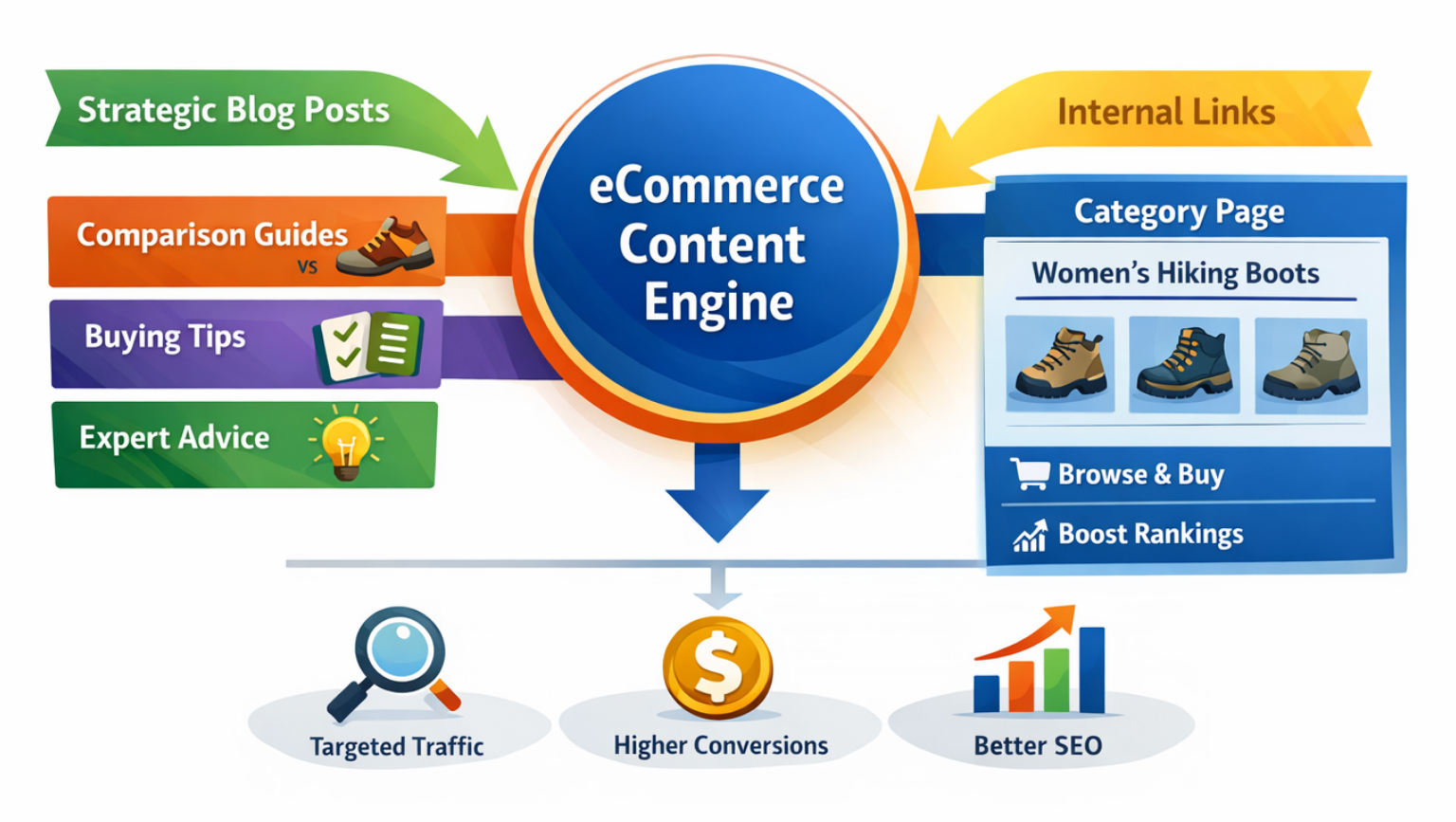
The shift from random blogging to strategic content mapping starts with understanding what your category pages need to rank.
Every category page has an implicit search intent. Someone searching "women's hiking boots" wants to browse options, compare features, and eventually buy. Your content engine should surround that category page with supporting content that:
Targets long-tail variations of the category term
Answers comparison questions that arise during the buying process
Provides educational depth that establishes topical authority
Links naturally to the category page as the logical next step
Here's what this looks like in practice for a "women's hiking boots" category:
| Content Type | Example Topic | Internal Link Target |
| Comparison post | Hiking boots vs trail runners: which is right for your terrain? | Category: Women's Hiking Boots |
| Buying guide | How to choose hiking boots for wide feet | Category + filtered view |
| Problem-solution | Why your hiking boots cause blisters (and how to fix it) | Category: Women's Hiking Boots |
| Use-case specific | Best hiking boots for Pacific Northwest trails | Category + specific products |
Each piece of content serves the category page. The internal links aren't afterthoughts—they're the entire point.
Product Comparison Intent Patterns That Actually Convert
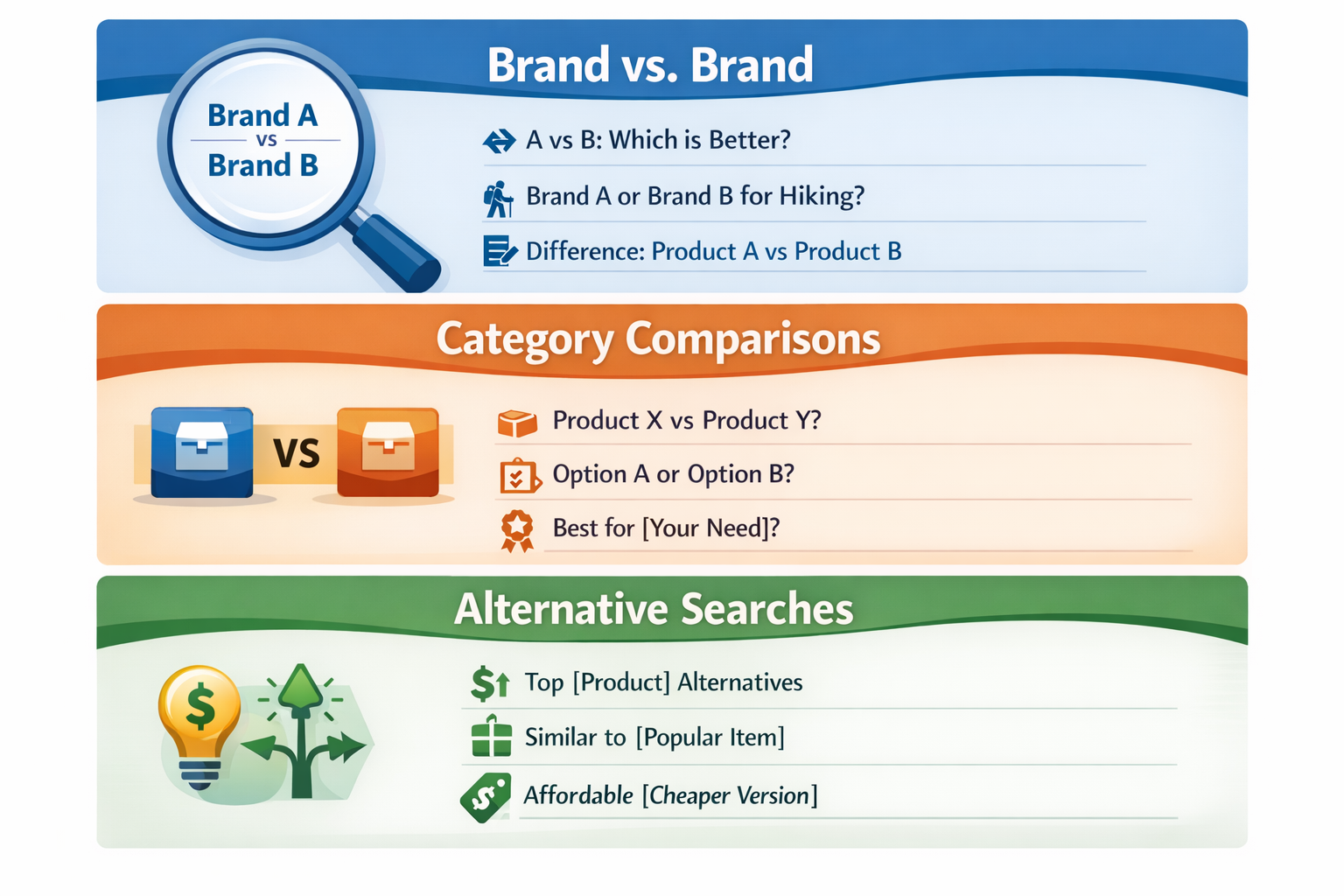
Product comparison searches represent some of the highest-converting traffic in ecommerce. Someone searching "Allbirds vs On Running shoes" has already narrowed their consideration set. They're close to buying.
Yet most ecommerce sites ignore these queries entirely, ceding the ground to affiliate sites and review aggregators.
The patterns worth targeting fall into several categories:
Brand vs Brand Comparisons
"[Your product] vs [competitor]"
"[Brand A] or [Brand B] for [specific use case]"
"Difference between [Product A] and [Product B]"
Category Comparisons
"[Product type A] vs [Product type B]"
"Should I get [option A] or [option B]"
"[Category] compared: which is best for [need]"
Alternative Searches
"[Competitor product] alternatives"
"Products like [popular item]"
"Cheaper version of [premium product]"
The key is writing comparison content that's genuinely useful, not thinly veiled sales pitches. Google's helpful content guidelines explicitly reward content that helps users make decisions rather than content that merely tries to rank [4].
A strong comparison post acknowledges when competitors excel, explains specific use cases where each option makes sense, and includes enough technical detail to satisfy someone deep in the research phase.
Building a Content Structure That Avoids Thin Templates
Thin content isn't just about word count. It's about substance.
A 2,000-word post can be thin if it says nothing your competitors haven't already said. A 900-word post can be substantial if it offers genuine insight and serves a specific purpose.
The templating problem in ecommerce content happens when businesses scale by creating rigid formulas:
Every "best X for Y" post follows identical structures
Introductions all use the same phrasing patterns
Product descriptions get copied and slightly reworded
No original research, testing, or perspective appears anywhere
Search engines recognize these patterns. More importantly, readers recognize them—and bounce.
Avoiding thin templates requires:
Original angles on common topics. If everyone covers "how to choose hiking boots," you cover "what boot features actually matter after 500 miles on the trail." Same general topic. Differentiated approach.
Specific expertise signals. Include details that only come from actual experience: how a product performs in real conditions, what the manufacturer doesn't tell you, common mistakes from customer feedback.
Varied content structures. Some posts should be comprehensive guides. Others should be focused comparisons. Some should address narrow, specific questions in depth. The structure should match the search intent, not a template.
Genuine internal linking logic. Links to your category and product pages should feel like helpful navigation, not forced SEO. If mentioning your category page doesn't flow naturally, the content probably isn't well-targeted.
Creating an Editorial Calendar for Category Support
Sustainable content production requires a system. Publishing sporadically when someone remembers the blog exists doesn't build topical authority—it creates scattered content with no compounding effect.
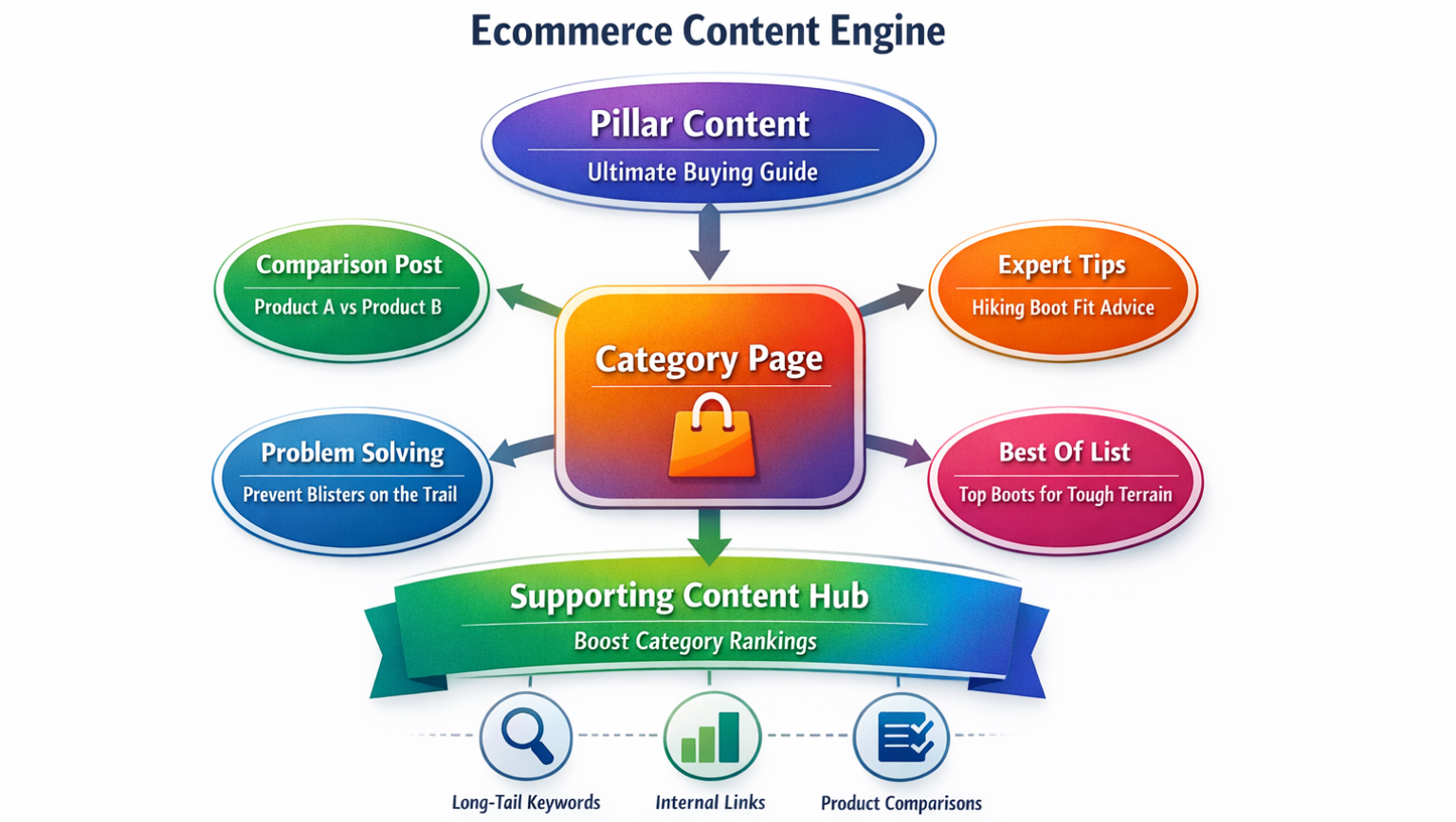
An effective editorial calendar for ecommerce maps directly to your priority categories. Start by identifying:
From there, create content clusters. Each cluster contains:
One comprehensive pillar piece (buying guide or category overview)
Three to five supporting posts (specific use cases, comparisons, problem-solution)
Clear internal linking between all pieces and the target category page
This isn't about volume for volume's sake. Publishing two to three strategically-aligned posts per week typically outperforms publishing ten disconnected posts in a burst.
Research from major SEO platforms consistently shows that topical depth—demonstrated through related content around core themes—correlates with improved rankings for competitive commercial queries [5].
On-Page Optimization for Comparison and Category Content
Writing useful content is necessary but not sufficient. The on-page optimization layer determines whether search engines understand what your content is about and how it relates to your broader site architecture.
For comparison posts:
Include both products or options in the title tag
Use structured comparison elements (tables, clear sections for each option)
Answer the comparison question directly in the opening paragraph
Add schema markup for FAQ elements where appropriate
Link to relevant product and category pages with descriptive anchor text
For category-supporting content:
Target long-tail keywords your category page can't rank for
Include the category-level keyword naturally in the content
Create contextual links that make the category page the obvious next destination
Use consistent terminology that reinforces topical relationships
The internal linking strategy deserves special attention. Your blog content should point up to category pages, which then point to individual products. This creates a logical hierarchy that search engines can follow.
Measuring What Actually Matters
Traffic to blog posts isn't the goal. Traffic that improves category page rankings and drives purchases is the goal.
The metrics that matter for an ecommerce content engine:
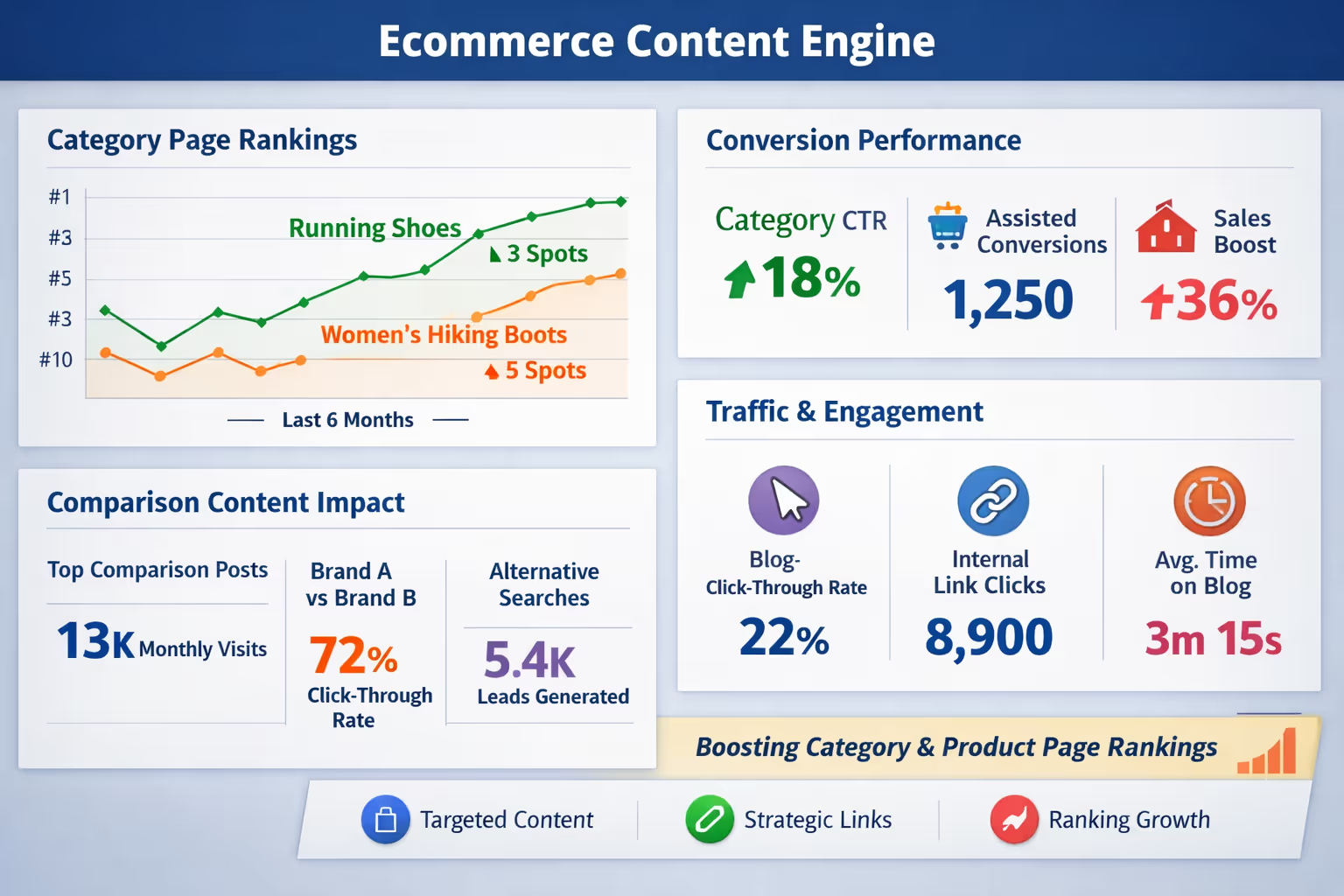
Category page ranking improvements. Are your priority category pages moving up for target keywords after publishing supporting content?
Internal link click-through. What percentage of blog readers continue to category pages?
Assisted conversions. How often does a blog post appear in the conversion path, even if it wasn't the last touchpoint?
Impressions growth for category-adjacent queries. Is your content capturing new search visibility in your product areas?
Standard analytics tools can track these patterns. Google Search Console shows impression and ranking trends for specific pages. Attribution modeling in most analytics platforms reveals how content contributes to conversion paths.
The compounding effect takes time. Most sites see meaningful ranking improvements in priority categories after three to six months of consistent, strategically-aligned content publishing [6].

When to Build Versus When to Outsource
Building an ecommerce content engine internally requires consistent bandwidth that most growing companies don't have. Someone needs to:
Conduct ongoing keyword research and gap analysis
Map content to category and product strategy
Write (or oversee) content that meets quality standards
Handle on-page optimization and internal linking
Publish on a consistent schedule
Monitor performance and adjust strategy
Some businesses have this capacity. Many don't—which is why content engines stall out after an initial burst of enthusiasm.
The alternative is partnering with a service that handles the full workflow: research, writing, optimization, and publishing. The key is finding a partner that understands the strategic layer, not just the content production layer.
Generic blog content won't move the needle. Content that's explicitly mapped to your category page rankings and optimized for comparison intent will.
Ready to build a content engine that actually supports your ecommerce SEO?
The Mighty Quill's Done-For-You plan handles everything—from keyword research and content mapping to publishing and on-page optimization. Get SEO-optimized posts that drive traffic to your category pages, not just your blog.
[Start your free trial and get 2 custom articles in 48 hours →]
Frequently Asked Questions
How many blog posts should support each category page?
Most category pages benefit from three to seven supporting posts targeting different intent angles—buying guides, comparison content, problem-solution posts, and use-case-specific pieces. The right number depends on search volume and competition for your category keywords. Start with your highest-revenue categories and build clusters of at least three posts each before expanding.
Can AI-generated content rank for product comparisons?
AI-generated content can rank when it's properly edited for accuracy, includes genuine product knowledge, and offers specific value. The issue isn't AI as a tool—it's thin content that lacks original insight. Comparison posts need accurate specifications, honest assessments, and real use-case recommendations that generic AI output typically doesn't provide without significant human input.
How long does it take for blog content to improve category page rankings?
Most sites see measurable ranking improvements for priority category pages within three to six months of consistent publishing. The effect compounds as you build topical depth. Initial wins often come from capturing long-tail queries with blog posts, while category page improvements take longer because they face more competition.
Should comparison posts include competitor products I don't sell?
Yes, when it's relevant to the searcher's journey. If someone searches "Nike vs Adidas running shoes" and you sell both, compare honestly. If you only sell one brand, you can still create helpful comparison content—just be transparent about what you carry. Genuine helpfulness builds trust that often converts better than promotional content.
How do I avoid duplicate content when writing about similar products?
Focus each post on a distinct search intent rather than a distinct product. Two posts about hiking boots aren't duplicates if one addresses "hiking boots for narrow feet" and another covers "hiking boots for Pacific Northwest trails." The differentiation comes from the specific problem or use case, not just swapping product names in a template.
About The Mighty Quill
The Mighty Quill builds content engines for growth-focused businesses. With over 15 years of digital marketing experience, our team combines AI-powered efficiency with human editorial oversight to produce SEO-optimized content that supports measurable business outcomes. We specialize in helping ecommerce brands and SaaS companies build sustainable organic traffic through strategic, high-quality publishing.
Cited Works
[1] HubSpot — "The Ultimate Guide to Content Marketing Strategy." https://blog.hubspot.com/marketing/content-marketing
[2] Google Search Central — "Creating helpful, reliable, people-first content." https://developers.google.com/search/docs/fundamentals/creating-helpful-content
[3] Search Engine Journal — "How Google Identifies & Handles Thin Content." https://www.searchenginejournal.com/google-thin-content/
[4] Google Search Central — "Google Search's helpful content system." https://developers.google.com/search/docs/appearance/helpful-content-system
[5] Semrush — "Content Marketing Statistics." https://www.semrush.com/blog/content-marketing-statistics/
[6] Ahrefs — "How Long Does It Take to Rank in Google?" https://ahrefs.com/blog/how-long-does-it-take-to-rank/